THE DIRECT ANSWER
What a commercial HVAC replacement includes
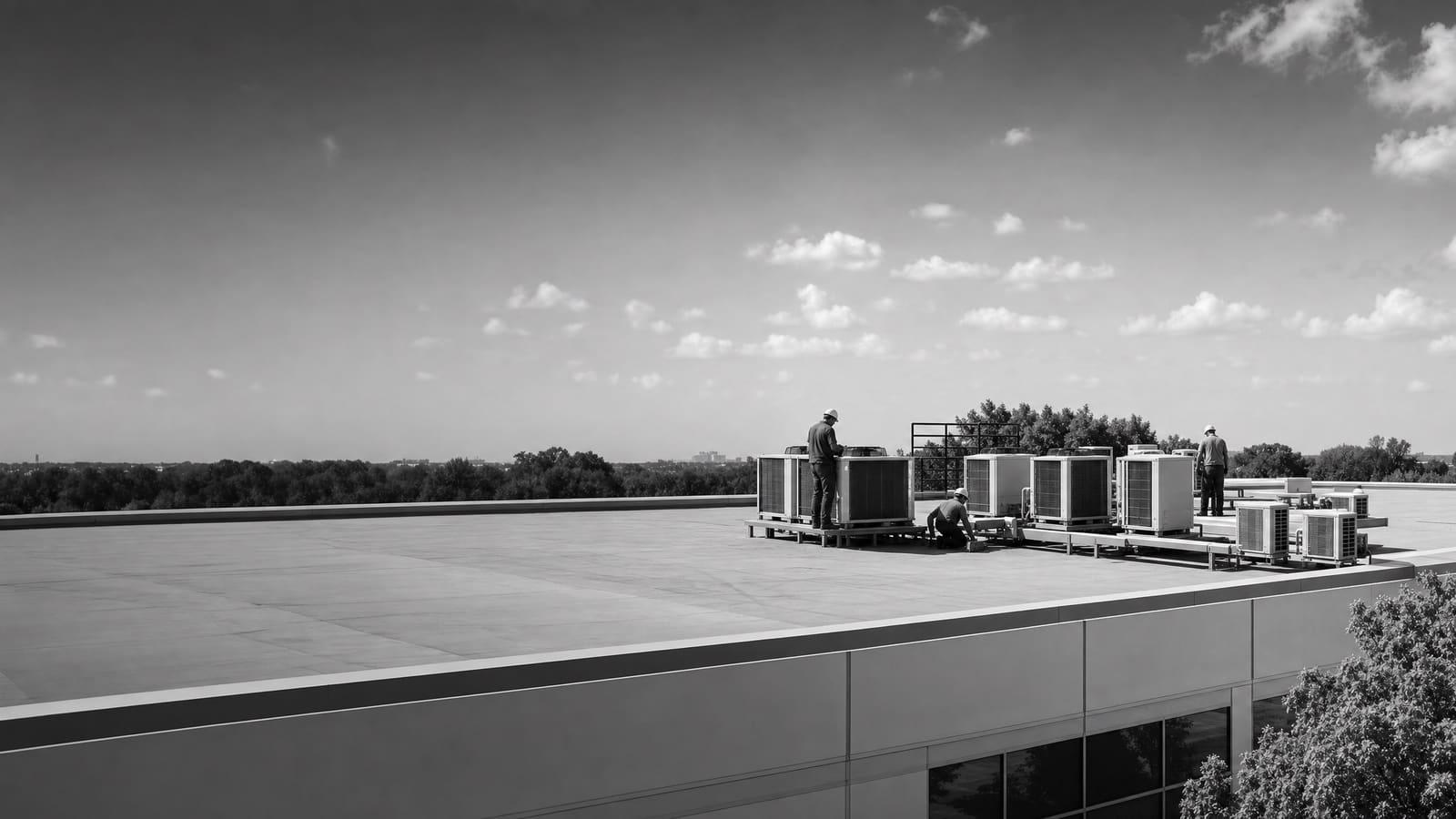
A commercial HVAC replacement covers load verification, equipment selection, rigging and set, gas or electrical connections, controls integration, permits and inspection, and commissioning. Replacement beats one more repair once a unit is past about fifteen years and service calls are stacking up. Rooftop units cool close to half of all U.S. commercial floor space, and old, inefficient ones waste an estimated $900 to $3,700 per unit every year — money that leaves the building whether or not you act.
A site review has to settle what paperwork cannot: curb condition and roof structure, available electrical capacity, crane reach across your lot, and whether today's occupancy still matches the old nameplate tonnage.
THREE WAYS TO GO
Three operating choices for an aging rooftop unit
Most buyers are choosing among three paths, and the right one depends on how much life the rest of the building has left.
Running to failure feels cheapest until the unit dies in season and you take whatever tonnage is on a truck. DOE is blunt about the pattern: facility managers often delay until the unit no longer conditions the space, needs constant service, or quits entirely, and that delay usually costs more than a planned swap would have.
Advanced controls are the middle path. DOE's Advanced RTU Campaign treats both routes as legitimate — replace the unit, or retrofit it with advanced controls — and which one wins is a financial question about that specific unit, not a rule.
Full replacement resets the clock. It is the only path that corrects sizing, brings the unit to current efficiency, and gives you a warranty and a known service life to plan against.
WHERE THE MONEY GOES
The budget lines that actually move
Nobody can quote a rooftop unit from a satellite view. These are the lines that separate a clean same-curb swap from a construction project, and most of them are only settled once someone stands on the roof.
CHOOSING THE EQUIPMENT
Gas-fired, dual fuel, or all-electric heat pump
The biggest equipment decision on a San Mateo roof today is not the brand on the cabinet. It is whether the replacement burns gas at all.
DOE's heat pump rooftop guidance sorts this by climate first. Heat pump efficiency drops as outdoor temperatures fall, so heat pump rooftop units suit mild to moderate winter heating best. For most of the U.S. South and West, DOE says today's heat pump units are an appropriate solution and are capable of addressing most or all of the winter heating demand. A mild coastal site sits squarely inside that description, which is why the all-electric option deserves a real evaluation here rather than a polite dismissal.
Climate is only the first gate. DOE's checklist also weighs local electricity and gas prices, grid emissions, building type, equipment availability, electrical capacity, physical constraints on the roof, existing gas lines, contractor familiarity, and available incentives. Any one of those can send a specific building back toward gas heat, or toward a dual-fuel unit that runs on the heat pump most of the year and lights the burner on the coldest mornings.
The practical move is to price two options on your actual roof instead of picking a technology in the abstract. If the electrical service has headroom, the all-electric case usually holds. If a panel upgrade is required, that cost belongs in the comparison before anyone calls one option cheaper.
HOW HARD IS THIS JOB
Simple swap versus a real project
Two buildings on the same block can get very different numbers for the same tonnage. The difference is almost always access, structure, and what the new unit needs that the old one never did.
LOWER COMPLEXITY
Same curb, clear lot
The replacement matches the old footprint and connections, the roof structure checks out, and there is open pavement for the crane. Occupancy has not changed, so the load confirms close to existing tonnage. The visible work fits in a morning.
HIGHER COMPLEXITY
New footprint or new fuel
Tonnage changed, the curb needs adapting or rebuilding, the unit goes all-electric and the panel needs work, or the crane has to reach over an occupied building. Each of those adds engineering, permit scope, and calendar time.
SCOPING THE WORK
What the site review has to settle
A quote written without a roof visit is a guess with a number attached. The site review exists to turn unknowns into line items before you sign anything.
Start with the load. Twenty years changes occupancy, plug loads, lighting, and often the envelope itself. The old nameplate tells you what someone sized in a different decade, not what the space needs now. Confirming the load either validates a like-for-like swap or finally explains a comfort complaint the building has lived with for years.
Then come the physical constraints DOE names directly: electrical capacity at the panel, room on the roof and around the curb, and where the existing gas lines run. Those three decide whether an all-electric unit is a swap or a small construction project.
Access is the third piece — crane reach, staging, which stalls close, and for how long. Tenants tolerate a planned morning of cones far better than a surprise afternoon of them.
Last is the old unit itself. EPA Section 608 rules govern how refrigerant is recovered and handled when equipment comes down, so recovery and documentation are part of the job rather than an afterthought.
Ask to see the load calculation
If a bidder will not show how they arrived at the tonnage, you are comparing prices built on a number nobody checked. The load calculation is the single document that makes two quotes genuinely comparable.
IN SAN MATEO
Permits, and the roof under the unit
California cities treat mechanical work as permitted work. Local building departments require permits for electrical, plumbing, and mechanical upgrades or repairs, which means a rooftop replacement is an inspected job even when the new unit lands on the existing curb. Budget the review time instead of assuming a same-week set.
Re-roofing is separately permitted, both overlay and tear-off. That matters more than it sounds. If the membrane is within a few years of replacement, setting a new unit on it means paying for a second crane mobilization and a second permit later, plus flashing work around equipment that just went in. Confirm the roof's remaining life during the site review and decide the sequence once — roof first, then units, or both under one coordinated schedule.
Check the roof before the crane is booked
Ask your roofer for remaining membrane life in writing before the equipment order goes in. A two-year gap between the unit set and a tear-off is the most avoidable cost on a project like this.
OWNERSHIP AND OPERATIONS
Two things that outlast the install
The installation takes a week of your attention. The consequences run fifteen years or more, and they show up in two places: the utility bill and the service contract.
DOE built the case on the operating side. Old, inefficient rooftop units waste an estimated $900 to $3,700 per unit each year, and the high-performance specification DOE challenged manufacturers to hit targeted energy use up to fifty percent below the prior standard. Across the Advanced RTU Campaign, more than two hundred organizations upgraded over forty-three thousand units and cut a combined $37 million a year from their energy bills. On a multi-unit roof, that arithmetic is what decides whether you replace one unit now or budget the whole roof across two seasons.
UTILITY COST
The bill is the second price tag
An efficiency tier that costs more up front gets bought back in monthly operating cost. Ask for that comparison against your actual run hours and rate schedule, not against a generic annual estimate.
SERVICE PLANNING
Mixed fleets need a plan
A roof replaced in stages rarely ends up on one refrigerant. EPA Section 608 handling rules apply across all of it, so technician certification, spare parts, and service coverage should be settled before handoff, not after the first call.
PHASING AND PROCUREMENT
Replacing one unit versus planning the roof
Most commercial roofs carry more than one unit, and they rarely fail on a convenient schedule. That leaves a choice: replace reactively, one failure at a time, or set a replacement plan across the whole roof and work through it.
DOE's framing favors the plan. Its guidance describes proactive replacement of inefficient, underperforming units as the smarter business move compared with replacement on failure — and even compared with a like-for-like swap at the end of useful service life. The reason is not sentimentality about planning. A planned project lets you specify the equipment you want, negotiate across more than one unit, schedule the crane once, and pull a single permit package instead of three.
Procurement follows the same logic. Equipment availability sits on DOE's own consideration list for a reason: the unit you specified and the unit that can ship in three weeks are not always the same unit. Get lead times in writing next to the price, and decide which substitutions you would accept before you are under pressure to accept one.
If capital is the constraint, phase by condition rather than by age. The unit with the highest run hours and the worst service history goes first, and the rest follow as budget allows.
COMPARING QUOTES
Five things a comparable quote shows
Two bids on the same roof are only comparable if they answer the same questions. If any of these is missing, ask for it before you compare price.
01
The load calculation
Tonnage with the method behind it, based on how the space is used now rather than on the old nameplate.
02
Equipment and lead time
Make, model, efficiency tier, and the actual availability date — written next to the price, not promised on a call.
03
Curb, roof, and structural scope
Adapter or new curb, what happens if the deck below is compromised, and which party carries that cost.
04
Crane, access, and closure window
Rigging plan, which stalls close, for how long, and whether that window falls inside your operating hours.
05
Permits, inspection, and commissioning
Who pulls the permit, who meets the inspector, and what startup readings get documented at handoff.
Get a defensible number
Price the equipment and the building together.
Send the address, operating target, and target opening date. Flux will identify what must be verified before the project can be priced.
Get a free estimateQuestions
Straight answers.
How long does a rooftop unit replacement take?
The set itself is short — a crane morning for a straightforward same-curb swap. The schedule is driven by two other things: equipment lead time and permit review. DOE lists equipment availability as a core planning consideration, so ask for a written availability date before you commit to a shutdown window.
Should you replace like-for-like or resize?
Confirm the load first, then decide. If occupancy, plug loads, and operating hours are unchanged, like-for-like is often correct and it is the fastest path back to conditioning. If the space was reconfigured or the building has lived with hot and cold spots, the load calculation usually explains why, and right-sizing fixes it permanently.
Is an all-electric heat pump unit realistic here?
For most of the West, DOE says today's heat pump rooftop units are an appropriate solution and can address most or all of the winter heating demand. In a mild coastal setting the gate is rarely climate — it is electrical capacity, roof space, gas line layout, and incentives. Price both options on your roof before ruling either out.
How much does commercial HVAC installation cost?
There is no honest universal price, because tonnage, curb condition, crane access, and electrical work move the number more than the equipment itself does. What is measurable is the cost of waiting: DOE estimates old, inefficient rooftop units waste $900 to $3,700 per unit every year. Get the installed number after a roof visit, and put the annual operating cost beside it.
Do we need a permit for a straight replacement?
Plan on it. California building departments require permits for mechanical upgrades and repairs, and inspection is part of the job even when the new unit reuses the existing curb. The installing contractor should carry permits, inspections, and commissioning inside the installed price — confirm that in writing before you sign.
What happens to the old unit's refrigerant?
It is recovered by certified technicians under EPA Section 608 rules, which govern the handling and recycling of refrigerant in stationary refrigeration, air-conditioning, and heat pump equipment. It is a small line on the quote, but it should be a visible one, along with disposal of the old cabinet.
Sources used for this guide
- [1]betterbuildingssolutioncenter.energy.gov — DOE Advanced Rooftop Unit Replacement Guidance
- [2]betterbuildingssolutioncenter.energy.gov — DOE Commercial Heat Pump Rooftop Unit Replacement Guidance
- [3]betterbuildingssolutioncenter.energy.gov — DOE High-Efficiency Commercial Rooftop Unit Toolkit
- [4]energy.gov — DOE Efficient Commercial Rooftop Air Conditioner Program
- [5]epa.gov — EPA Stationary HVAC Refrigerant Management
- [6]californiacity-ca.gov — HVAC Permits