The direct answer
What commercial HVAC replacement includes
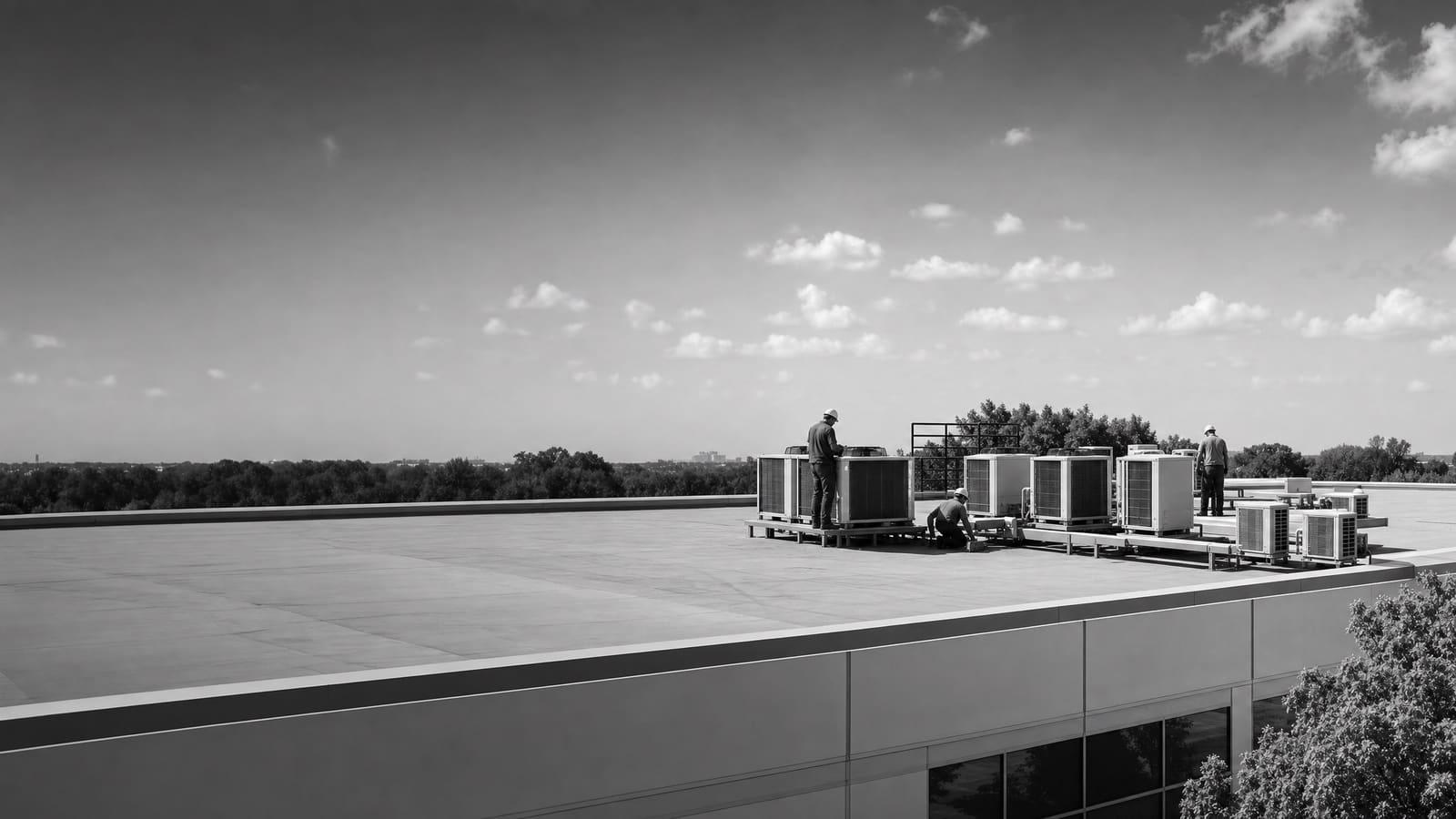
A commercial HVAC replacement should include load review, equipment selection, permits, removal, rigging, connections, controls, startup, testing, and owner handoff. Replacement becomes more useful than another repair when an older unit needs frequent service, cannot hold comfort, or risks failing during critical operations. DOE guidance flags rooftop units over 15 years old for closer replacement review.
A site review must verify actual loads, roof and curb fit, electrical capacity, fuel connections, ventilation, controls, access, and the condition of connected ductwork.
Choose the project path
Three operating choices to make first
Start with the business problem, not a model number. A failed unit may call for the fastest sound replacement. A working but unreliable unit gives you time to compare efficiency, controls, and electrification. A changed space may need new sizing or zoning instead of another copy of the old system.
Do not assume the existing nameplate proves the correct capacity. Occupancy, lighting, process equipment, ventilation needs, and operating hours may have changed. Oversizing can cause short cycles and weak humidity control. Undersizing can leave the building uncomfortable on demanding days. Ask the bidder to state whether the selection is based on a load review, an engineered calculation, or a like-for-like assumption.
Build the budget
What moves the installed price
There is no supported universal installed price for this project. Compare the complete scope because equipment cost is only one part of the budget.
Equipment choices
Compare systems by the work they must do
A packaged rooftop unit combines major heating, cooling, and air-moving parts in one cabinet. It can be a practical replacement when the roof, curb, ducts, utilities, and controls are compatible. A high-efficiency rooftop unit may reduce energy use, but its value depends on operating hours, loads, controls, utility rates, and maintenance.
A commercial heat-pump rooftop unit provides cooling and reverse-cycle heating. DOE guidance says climate, electricity and gas prices, emissions goals, building type, equipment availability, electrical capacity, physical limits, gas lines, contractor knowledge, and incentives all belong in the review. All-electric, dual-fuel, and cold-climate designs solve different problems. An electric option is not complete until the service, panel, feeders, disconnect, and available capacity are checked.
Split systems, variable-refrigerant systems, and central plants can fit buildings that need finer zoning or have limited rooftop options. They also bring more piping, controls, indoor components, and coordination. Ask each bidder to explain why the proposed system fits the building better than the reasonable alternatives. The answer should connect capacity, ventilation, comfort, installation impact, maintenance, and expected service—not just name a preferred brand.
Complexity check
A direct swap and a redesign are different projects
The old and new units may look similar while the installation scope is very different. Put the building conditions in writing before comparing totals.
Lower complexity
Compatible replacement
The selected unit fits the curb, roof loading, ducts, utilities, controls, ventilation plan, and service access with limited modification.
Higher complexity
Modified or electrified system
Capacity, footprint, weight, power, fuel, ventilation, zoning, controls, or operating needs require design and field changes.
Site review
Inspect the system around the equipment
A useful survey starts with equipment identity, age, condition, repair history, refrigerant, capacity, fuel, voltage, controls, and observed comfort problems. It then follows the air and power paths. The reviewer should inspect accessible ductwork, filters, dampers, outdoor-air components, drains, electrical distribution, disconnects, gas service, curbs, roof condition near the equipment, and maintenance clearances.
Operating facts matter too. Record occupied hours, after-hours loads, tenant schedules, process heat, sensitive rooms, ventilation needs, and spaces that are regularly too hot or cold. A replacement sized from the old label alone can carry an old error into a new asset.
The survey should also define the installation path. Confirm how the old equipment leaves, how the new equipment arrives, where lifting equipment can stand, what areas must close, and how weather affects the work. If cooling or heating cannot stop, identify temporary service or phased work before bidding. This turns outage control into part of the scope instead of a last-minute request.
Give every bidder the same starting facts
Provide nameplate photos, service records, plans if available, control requirements, operating hours, known comfort issues, roof rules, and the acceptable outage window.
San Leandro planning
Confirm local approvals before ordering equipment
Permit, plan-review, and inspection requirements are time-sensitive and depend on the actual scope. Before equipment is released, the project team should confirm the current San Leandro requirements with the authority having jurisdiction. Ask whether mechanical, electrical, structural, or other review applies to the proposed work.
This check matters when the replacement changes weight, footprint, curb conditions, power demand, fuel use, ventilation, or roof work. It also protects the schedule. A delivery date is not a workable installation date unless the required documents, inspections, rigging plan, and site access can line up. Put responsibility for permit preparation, fees, corrections, and inspection attendance in the quote.
Treat approval status as a schedule gate
Do not rely on an old permit assumption. Confirm current local requirements for the selected equipment and final scope before purchase and crane scheduling.
Own the result
Plan for operation after startup
A new unit can run without running well. Commissioning checks whether installation and controls match the intended operation. The handoff should record airflow, temperature response, control sequences, alarms, schedules, economizer or outdoor-air operation where applicable, and any open issues.
Refrigerant also belongs in the ownership plan. EPA rules govern refrigerant handling and recycling for stationary air-conditioning and heat-pump equipment. The contractor should identify the old and new refrigerants, recover the old charge properly, and document disposal or recycling. For a mixed equipment fleet, confirm that service vendors, tools, training, and parts support the new unit.
Day one
Commission and document
Verify operation under load, record settings, test controls, and deliver startup and warranty records.
Years ahead
Plan maintenance support
Confirm filters, service access, refrigerant support, parts availability, training, and preventive-maintenance needs.
Procurement and phasing
Buy around risk, not only first cost
A planned replacement gives the owner choices that a failure may remove. Start with the units that have frequent repairs, poor comfort, high operating exposure, or the greatest effect on business continuity. DOE guidance notes that owners often delay rooftop replacement until performance drops, maintenance becomes frequent, or the unit fails. It also says proactive replacement of inefficient, underperforming units can make more business sense than waiting for failure.
For several units, decide whether to replace them together or in phases. A grouped project may simplify design, mobilization, controls standards, training, and future maintenance. Phasing can spread capital needs and reduce disruption. Rank units using condition, service history, operational importance, equipment availability, and the amount of infrastructure work each option needs.
Compare lifetime effects without promising savings before analysis. Review expected energy use, demand, fuel mix, maintenance, controls, warranty, useful support, and outage exposure. Any incentive should be verified for the exact equipment and application before it enters the financial case. Programs, eligibility rules, funding, and deadlines can change. The quote should remain understandable and approvable even if an expected incentive is unavailable.
Comparable bids
Five things every quote should show
Use one written scope for all bidders. Each quote should state inclusions, exclusions, assumptions, and responsibility for work that crosses trades.
01
Selected equipment
Model, capacity, efficiency, heat type, refrigerant, controls, warranty, availability, and approved substitutions.
02
Removal and installation
Shutdown, recovery, demolition, disposal, rigging, curb work, connections, weather sealing, and startup.
03
Building modifications
Duct, electrical, gas, drain, structural, roof, ventilation, controls, and fire-alarm interface work.
04
Approvals and schedule
Permit duties, fees, reviews, inspections, procurement dates, outage windows, phasing, and site closures.
05
Testing and handoff
Airflow checks, balancing, sequence testing, training, manuals, settings, warranties, and closeout records.
Get a defensible number
Price the equipment and the building together.
Send the address, operating target, and target opening date. Flux will identify what must be verified before the project can be priced.
Get a free estimateQuestions
Straight answers.
When should a commercial rooftop unit be replaced instead of repaired?
Review replacement when the unit needs frequent repairs, cannot maintain comfort, has poor efficiency, or creates unacceptable failure risk. DOE guidance says rooftop units over 15 years old can waste substantial energy compared with newer models. Age alone does not decide the project; condition, service history, loads, parts support, and business impact also matter.
How much does commercial HVAC installation cost in San Leandro?
The supplied research does not support one universal installed price. Capacity, system type, efficiency, curb fit, roof access, rigging, electrical capacity, ducts, controls, ventilation, permits, phasing, and temporary conditioning can all change the total. Ask for a site-based quote with allowances and exclusions clearly labeled.
Should the new HVAC unit match the old capacity?
Not automatically. Matching may be reasonable when the building use and loads have not changed and the old system performed well. If occupancy, hours, equipment, ventilation, envelope, or zoning changed, the selection should follow a current load review rather than the old nameplate.
Is a commercial heat pump a good replacement option?
It can be, but the decision needs a building-specific review. Compare climate, heating and cooling loads, utility rates, emissions goals, equipment availability, electrical capacity, physical space, existing gas service, controls, and maintenance support. Evaluate all-electric and dual-fuel options where both are practical.
Who should handle the crane, permits, and inspections?
The contract should assign each duty clearly. One party should coordinate rigging, access, closures, permit documents, corrections, inspection attendance, and schedule updates. Do not assume these items are included because the quote says “installed.”
What should happen during HVAC commissioning?
The team should verify safe startup, airflow, temperature response, control sequences, schedules, alarms, ventilation operation, and other specified functions. The owner should receive settings, test results, manuals, warranty records, and a list showing that open items were resolved.
How should old refrigerant be handled?
Refrigerant should be recovered and managed by qualified personnel under applicable EPA requirements. The closeout record should identify the removed equipment and refrigerant and document recovery, recycling, or disposal as required. Venting refrigerant is not an acceptable removal method.
Sources used for this guide
- [1]betterbuildingssolutioncenter.energy.gov — DOE Advanced Rooftop Unit Replacement Guidance
- [2]betterbuildingssolutioncenter.energy.gov — DOE Commercial Heat Pump Rooftop Unit Replacement Guidance
- [3]betterbuildingssolutioncenter.energy.gov — DOE High-Efficiency Commercial Rooftop Unit Toolkit
- [4]energy.gov — DOE Efficient Commercial Rooftop Air Conditioner Program
- [5]epa.gov — EPA Stationary HVAC Refrigerant Management
- [6]californiacity-ca.gov — HVAC Permits