THE SHORT VERSION
What a commercial HVAC replacement actually includes
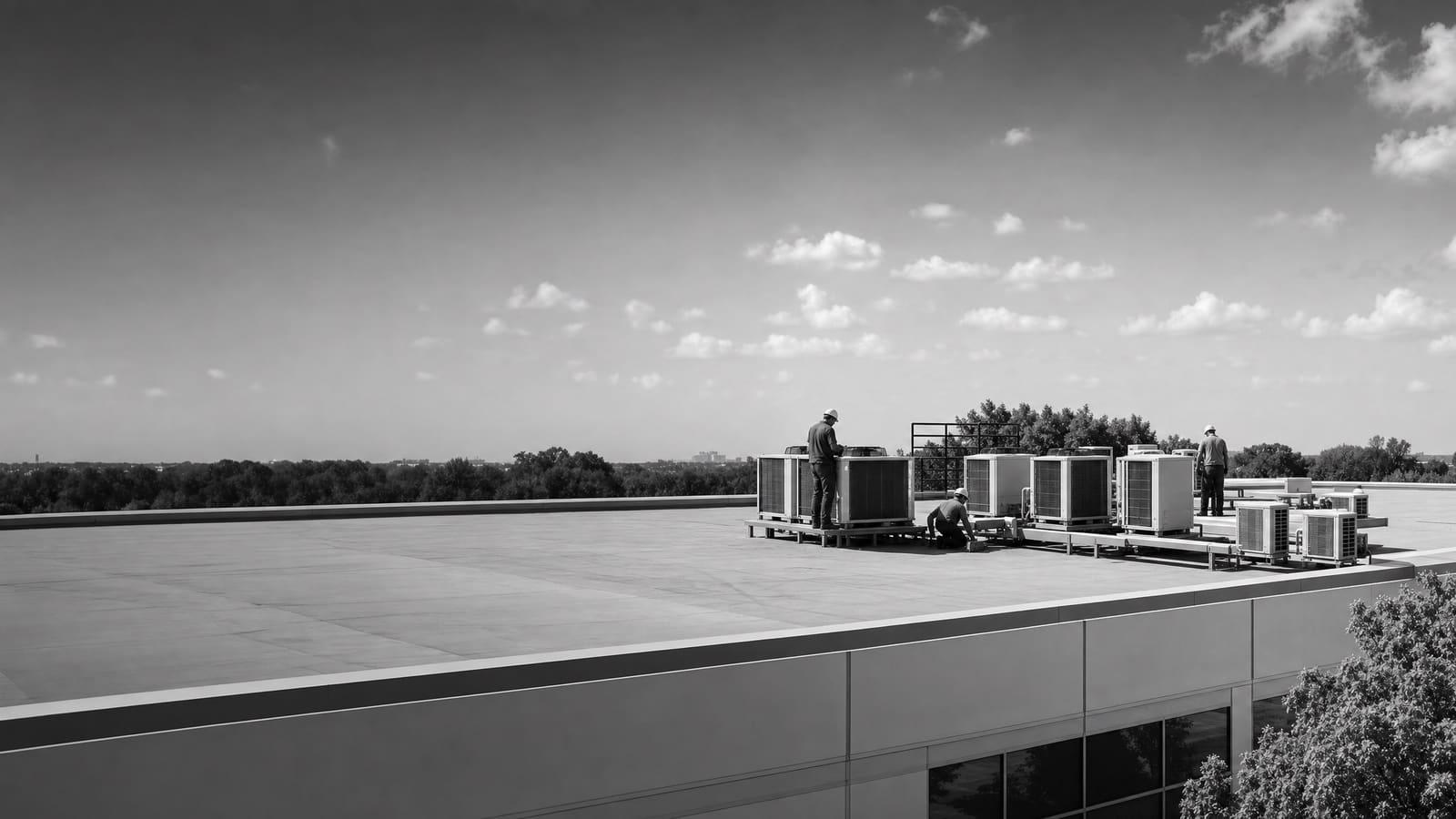
A commercial HVAC replacement is a scoped project, not a swap. It covers a load check against how the building is used today, equipment selected against real lead times, rigging and set, curb work, gas and electric connections, controls, permits, and commissioning. Replacement usually beats another repair once a rooftop unit passes fifteen years, because units that old can waste roughly $900 to $3,700 each per year against current equipment.
A site review still has to confirm curb size and roof structure, crane reach and lot closure, available electrical capacity, gas service, and duct connections before any number is firm.
THE REAL DECISION
Three ways to replace the same rooftop unit
Most commercial replacements come down to what makes heat. Cooling has been standardized for years and the federal minimum efficiency floor moved up, so a new unit of any type will beat a fifteen-year-old one on cooling. The heating choice is where the money and the risk sit. Gas heat is familiar and cheap to connect when the line is already there. A heat pump rooftop unit is the same machine plus reverse-cycle heating, and the Department of Energy treats it as an appropriate solution across most of the West, where winter heating demand is mild. Dual fuel splits the difference. Price the electric option alongside the like-for-like, because the equipment gap is usually smaller than people expect and the electrical work is what really decides it.
WHAT MOVES THE NUMBER
The lines that decide the price
These are the items that actually move a rooftop replacement number. Ask for each one broken out so you can see what is equipment and what is building work. Two bids that look far apart usually differ on one of these, not on the unit.
HOW TO BUY IT
Buying the system the building needs now
The first question is not which brand. It is whether you are buying back the system the building had or the one it needs now. A rooftop unit installed fifteen or twenty years ago was sized for the occupancy, lighting, and plug load of that time. Offices emptied out and then densified. Retail lighting loads dropped hard. A load check against current use often lands on a different tonnage than the nameplate, and following the nameplate carries that error forward for another two decades.
The second question is timing. Facility managers usually wait until a unit stops keeping up, needs constant service, or fails outright. The Department of Energy is direct about this: proactively replacing an underperforming unit tends to beat replacement-on-failure, and often beats a like-for-like swap at end of life. Emergency replacement takes away your leverage on equipment, price, and schedule at the same moment, and it puts the crane on your roof during the week you can least afford to lose the parking.
The third is efficiency tier. Units built to DOE's high-performance specification were designed to cut energy use by as much as half against the older standard, and more than twenty models now exceed it. Whether that premium pays depends on your runtime hours and your rate, which a quote should show rather than assert.
SCOPE CHECK
Simple job or complicated one
Two replacements of the same tonnage can be very different projects. What separates them is almost never the equipment. It is the roof, the lot, and the service.
LOWER COMPLEXITY
A clean changeout
Same tonnage and heating type, existing curb within adapter range, sound roof structure, open lot with crane reach, adequate panel capacity, and controls that carry over. This is a planned day, a permit, and a startup report.
HIGHER COMPLEXITY
Where scope grows
Tonnage or footprint changes, the roof needs framing, the membrane is near end of life, the lot forces a night lift or a street closure, the panel has no capacity for electric heat, or the unit has to join a building automation system.
BEFORE THE QUOTE
What a real site review covers
A quote written from a photo of the nameplate is a starting point, not a price. The visit that turns it into a number is short, but it has to cover specific ground.
On the roof: the existing curb dimensions and condition, the structure under it, the refrigerant in the old unit, the duct drop and its condition, and how much life the membrane has left. On the ground: the crane setup position, the reach over the parapet, the staging area, and how many stalls close and for how many hours. In the electrical room: panel capacity, spare breaker space, and the feeder to the unit, which is the item that decides whether an all-electric option is a swap or a service upgrade. On the gas side: whether the line stays, gets capped, or gets abandoned.
The last piece is operational. Someone has to know when the building can lose conditioning, who tells tenants, and what happens if the weather call moves the lift by a day. A contractor who asks those questions before quoting is the one whose date will hold.
Verify before anyone commits to a number
Curb size and roof structure, crane position and lot closure hours, panel capacity and spare breaker space, gas line disposition, existing refrigerant type, duct condition, and the controls the new unit has to talk to.
WHAT SAN BUENAVENTURA CHANGES
Coastal winters and permitted work
San Buenaventura sits on the Southern California coast, where winter heating demand is mild. DOE's guidance holds that today's heat pump rooftop units are an appropriate solution across most of the West and are capable of covering most or all of the winter heating load. That makes the all-electric option worth pricing here rather than dismissing on habit. The same guidance notes that even mild regions see occasional cold snaps, which is the honest argument for dual fuel when a space cannot tolerate a slow morning recovery.
On paperwork, California building departments treat mechanical work as permit work — mechanical upgrades and repairs are permitted, and re-roofing is permitted separately. That matters for sequencing more than for cost.
One local sequencing call
Check the roof membrane's remaining life before you set new equipment. Re-roofing is its own permit and its own crew. Doing the changeout and the roof in one window usually costs less than cutting a new curb into an old roof and flashing it twice.
OWNERSHIP VIEW
Two questions above the equipment spec
The specification argument gets the attention, but two ownership decisions usually have a bigger effect on what the next ten years cost. One is when you choose to spend. The other is whether you are solving for a single roof or for every roof you hold. Answer both before you compare bids, because they change which bid is actually cheaper.
TIMING
Planned replacement or replace-on-failure
Waiting for failure means paying peak pricing on whatever is in stock, on the worst week of the year. Planning the swap lets you choose the tier, the date, and the lift window while the old unit still runs.
SCALE
One unit or a fleet standard
If you hold several buildings, decide the standard once — heating type, efficiency tier, controls platform — then apply it as units age out. Mixed fleets cost more to stock, service, and train for than the equipment savings return.
OVER THE LIFE OF THE SYSTEM
Phasing, procurement, and what comes after startup
If you have more than one aging unit, replace on age and runtime rather than on failure. Rank the roof by install year and service history, budget a unit or two a year, and the crane day becomes a scheduled expense instead of an emergency. Replacement is also not the only move on the list. DOE's own guidance is that owners can either replace old units or retrofit them with advanced controls, whichever makes better financial sense — a unit with life left and no controls may return more per dollar from controls than from a new box. Across the Advanced RTU Campaign, more than 200 organizations upgraded over 43,000 units and saved a combined $37 million a year, and that figure includes both paths.
Procurement is the part most schedules break on. Equipment availability belongs on the quote next to the price, with a date, not a range. Order the curb adapter when the unit is ordered.
After startup, two things carry cost forward. Commissioning records — charge, airflow, and control settings verified against spec — are what a warranty claim rests on. And refrigerant handling on the old unit falls under EPA rules, so recovery is done by certified technicians and documented.
COMPARE FAIRLY
Five things a comparable quote shows
Two bids only compare when both show the same scope. If one is missing an item below, that is where the difference is hiding — ask before you decide the cheaper one is cheaper.
01
The unit, named
Tonnage, efficiency tier, heating type, and model. Not "equivalent replacement."
02
Availability with a date
Lead time in writing, and what happens to the schedule if it slips.
03
Curb and roof scope
Adapter or new curb, any framing, flashing, and who is responsible for the roof penetration.
04
The crane day
Rigging plan, staging position, stalls closed and for how long, and the weather contingency.
05
Permits through commissioning
Permit and inspection, refrigerant recovery, startup, and the documentation handed over at the end.
Get a defensible number
Price the equipment and the building together.
Send the address, operating target, and target opening date. Flux will identify what must be verified before the project can be priced.
Get a free estimateQuestions
Straight answers.
When is replacement better than one more repair?
Once a unit is past about fifteen years, repairs stop buying much. Equipment that old can waste roughly $900 to $3,700 per unit each year against current models, and that waste continues whether or not the last repair held. Frequent service calls in season are the practical tell.
Should the new unit match the old one's tonnage?
Only if the space and its use have not changed. The nameplate reflects the occupancy, lighting, and equipment of twenty years ago. Confirm the load against how the building runs today; matching a bad number just carries the comfort complaints into the next unit.
Is a heat pump rooftop unit realistic in San Buenaventura?
It is worth pricing. DOE's guidance holds that current heat pump rooftop units suit most of the West and can handle most or all of the winter heating load in mild climates. The deciding factor is usually electrical capacity at the panel, not the weather.
Does a commercial HVAC replacement need a permit?
Yes. California building departments treat mechanical upgrades and repairs as permitted work, and re-roofing is permitted separately. The installing contractor should carry permits and inspections inside the installed price. Confirm that in writing before you sign, not after the lift is scheduled.
What happens to the refrigerant in the old unit?
It has to be recovered, not vented. EPA Section 608 rules govern how refrigerant in stationary air conditioning equipment is handled and recycled, and the work belongs to certified technicians. Expect recovery and documentation to appear as a line on the quote.
Can controls do the job instead of a new unit?
Sometimes. DOE's own campaign lets owners choose between replacing an old unit and retrofitting it with advanced controls, based on which pencils out. If a unit has real service life left and no controls, the controls retrofit can return more per dollar.
Sources used for this guide
- [1]betterbuildingssolutioncenter.energy.gov — DOE Advanced Rooftop Unit Replacement Guidance
- [2]betterbuildingssolutioncenter.energy.gov — DOE Commercial Heat Pump Rooftop Unit Replacement Guidance
- [3]betterbuildingssolutioncenter.energy.gov — DOE High-Efficiency Commercial Rooftop Unit Toolkit
- [4]energy.gov — DOE Efficient Commercial Rooftop Air Conditioner Program
- [5]epa.gov — EPA Stationary HVAC Refrigerant Management
- [6]californiacity-ca.gov — HVAC Permits