THE DIRECT ANSWER
What a commercial HVAC replacement actually includes
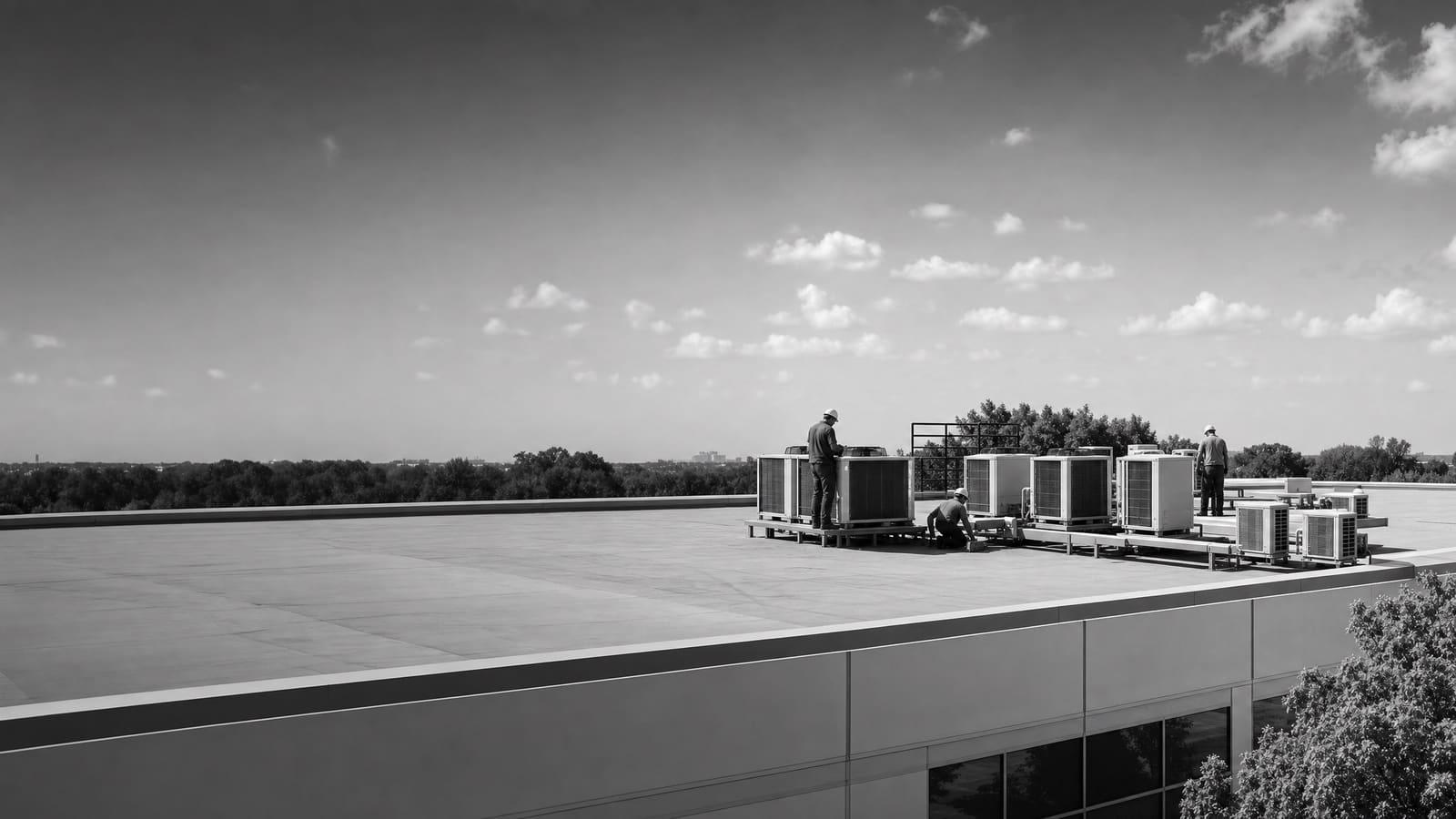
A commercial HVAC replacement means pulling the old packaged rooftop unit, setting a new one on a curb or curb adapter, reconnecting power, gas, and controls, and commissioning it so it holds design conditions instead of just running. Replacement wins over another repair once the unit is old enough that wasted energy and repeat service calls outrun the fix. DOE guidance flags rooftop units past 15 years as heavy energy wasters and treats proactive replacement as the better business move than waiting for a failure.
A site review still has to confirm the measured load, the curb and roof structure, available electrical capacity, crane access, and the gas line before any of that turns into a price.
THREE PATHS
The three replacement choices, and what each one commits you to
Three paths show up on almost every rooftop replacement, and they are not interchangeable. The cheapest one on paper is the like-for-like swap: same fuel, same efficiency class, same footprint. DOE guidance is blunt that this is often the weakest long-term choice, because it locks in another equipment lifetime of the energy profile you already dislike. The second path is a high-efficiency unit of the same type. The federal rooftop unit specification targeted equipment that cuts energy use by up to half against the older standard, and more than twenty models were built to exceed it. The third path is a heat pump rooftop unit, which does the same cooling job and adds reverse-cycle heating. That one changes more than the tag on the equipment. It touches electrical capacity, gas service, and how the building heats on the coldest mornings of the year. Pick the path first, then price it.
WHAT MOVES THE NUMBER
The lines that decide what a replacement costs
Nobody can price a rooftop replacement from a nameplate photo alone. These are the lines that actually move the number, ordered roughly by how much they tend to swing from one building to the next.
HOW TO CHOOSE
Replacing on plan versus replacing on failure
The honest starting question is not which unit to buy. It is whether you are replacing on failure or replacing on plan. DOE guidance describes the common pattern plainly: facility teams put off a new rooftop unit until the old one stops holding the space, needs constant service calls, or quits outright. By then the choice has already been made for you, and it is almost always the like-for-like swap, because that is what can be set fastest.
Replacing on plan opens the other two options. It leaves time to confirm the real load, check what the electrical panel can carry, weigh equipment availability instead of taking whatever is in stock, and look at whether any incentive program applies to the efficiency tier you are considering. Those programs change often, so treat any figure a vendor quotes as something to verify in writing before it goes into a budget.
Rooftop units condition close to half of all commercial floor space in the country, so this is well-traveled ground. What varies is your building. Two identical retail boxes on the same street can land on different answers if one has spare electrical capacity and the other does not. The equipment decision follows the building's constraints, not the other way around.
SIMPLE VERSUS HARD
Why two identical tonnages price differently
Two rooftop replacements can carry the same tonnage and very different numbers. The difference is usually in the conditions below the unit, not the unit itself.
LOWER COMPLEXITY
Matched swap on a clear roof
Same equipment type and size, an existing curb that fits, open lot space for the crane, and a panel with room to spare. Scope is short, the permit path is simple, and the schedule is driven mostly by equipment availability.
HIGHER COMPLEXITY
New equipment type, tight site
Switching to a heat pump, growing tonnage, or lifting over occupied space. Now electrical capacity, curb adaptation, gas line disposition, structural review, and crane staging all have to be settled before the number means anything.
BEFORE YOU PRICE IT
What a real site review has to settle
A quote written from a photo is a guess wearing a number. The site review is where the guess turns into scope. It starts on the roof: what is up there now, what condition the curb is in, whether the deck can carry a heavier unit, and how a crane would reach the spot. Then it moves inside to the electrical room. DOE guidance treats electrical capacity as a gate on any move toward electric heating. If the service or the panel cannot carry the new load, that path either gets a service upgrade line item or comes off the table.
Load comes next. Sizing from the old nameplate copies whatever judgment was made years ago, and buildings change. Occupancy, plug loads, lighting, and envelope work all shift the number. Ventilation and controls belong in the same conversation, because how a unit sequences matters as much as its rated efficiency.
The last piece is the old refrigerant charge. EPA rules under Section 608 govern how refrigerant in stationary air conditioning equipment is handled and recycled, so recovery is a planned step with a cost attached, not something sorted out on the morning of the lift.
Five answers to get in writing
Ask for the measured load, the curb and structural condition, the available electrical capacity, the crane plan with lot closure hours, and the disposition of the gas line. If any one of the five is missing from the proposal, the price will move after you sign it.
OWNING THE DECISION
Two things that outlive the install
The install day ends. The consequences do not. Two ownership questions shape how the next decade feels, and both are far easier to answer before the purchase order than after it.
The first is what happens when the second unit fails. Most commercial buildings carry several rooftop units of similar age, so the one that just died is a preview of the rest. The second is service. A different equipment type means different parts, different diagnostics, and a maintenance agreement that has to cover both what is on the roof now and what is going up next to it. DOE guidance names contractor availability and familiarity as a genuine factor in the equipment decision, not a footnote to it.
PORTFOLIO
The next unit in line
If three units went up the same year, plan the sequence now. Deciding once and phasing the work beats making the same decision under pressure three separate times.
SERVICE
Who maintains it after year one
Mixed fleets need a maintenance plan that covers old and new equipment together. Confirm parts availability and service familiarity for the specific model before it is ordered.
PHASING AND LIFETIME COST
Buying one unit versus planning a fleet
Most commercial buildings do not have one rooftop unit. They have four or seven, installed within a year or two of each other, aging on the same clock. That changes the math. A single emergency replacement is a purchase. A planned sequence is a program, and programs get better scheduling, better coordination with tenants, and far fewer surprise weekends.
The national numbers show how far the logic scales. More than 200 organizations working through the federal rooftop unit campaign upgraded over 43,000 units, and together they cut roughly $37 million a year from their energy bills. No building needs that scale to borrow the idea: the savings come from getting ahead of failure instead of reacting to it.
Lifetime cost is the right frame. Purchase price is one line. The other lines are the energy the unit burns every year it runs, the service calls it generates, and the revenue lost when it stops. Old, inefficient rooftop units have been estimated to waste somewhere between $900 and $3,700 per unit per year in energy alone. Multiply that by the number of aging units on your roof, then by the years you plan to keep them, and the case for a planned sequence usually writes itself.
WHAT TO COMPARE
Five things a comparable quote has to show
Two quotes are only comparable when they scope the same work. Ask every bidder to break out these five lines so the difference between the numbers is real, and not just a measure of what somebody left out.
01
Equipment, spelled out
Manufacturer, model, tonnage, efficiency tier, and heating type. Not just "a new rooftop unit."
02
Curb and structural scope
Whether the existing curb is reused, adapted, or replaced, and whether structural review is included in the price.
03
Rigging and access plan
Crane size, staging location, lot closure hours, and who coordinates the closure with tenants.
04
Electrical and gas work
Any panel, service, or disconnect work included, plus what happens to the existing gas line.
05
Refrigerant handling and commissioning
Recovery of the old charge under federal rules, plus startup, airflow, charge, and controls verification, documented at handoff.
Get a defensible number
Price the equipment and the building together.
Send the address, operating target, and target opening date. Flux will identify what must be verified before the project can be priced.
Get a free estimateQuestions
Straight answers.
When does replacement beat one more repair?
When the unit is old enough that its energy use and service calls cost more than the fix buys you. DOE guidance flags rooftop units past 15 years as heavy energy wasters and describes proactive replacement as usually a smarter move than waiting for a failure, because a failure decides the equipment for you.
Is a heat pump rooftop unit worth considering here?
It is worth pricing. DOE guidance says today's heat pump rooftop units are an appropriate solution across most of the U.S. South and West and can cover most or all of winter heating demand. It also notes Texas has seen sharp winter cold snaps, so backup heat strategy and electrical capacity are the two things to settle before choosing.
How much does a commercial HVAC installation cost?
There is no honest universal number, because tonnage, curb work, crane access, and electrical scope move it more than the equipment tag does. The number that is documented is the cost of waiting: old, inefficient rooftop units have been estimated to waste $900 to $3,700 per unit each year in energy.
What happens to the refrigerant in the old unit?
It gets recovered, not vented. EPA rules under Section 608 of the Clean Air Act cover how refrigerant in stationary air conditioning and heat pump equipment is handled and recycled. Recovery is a scheduled step with a cost, and it should appear on the quote rather than surface on the day of the lift.
Are there incentives for choosing a higher-efficiency unit?
DOE maintains guidance on rooftop unit upgrades and the financial incentives available for them, and incentives are one of the standard considerations in the equipment decision. Programs vary by utility and change on their own schedules, so confirm any specific program is currently open and in writing before it goes into your budget.
Sources used for this guide
- [1]betterbuildingssolutioncenter.energy.gov — DOE Advanced Rooftop Unit Replacement Guidance
- [2]betterbuildingssolutioncenter.energy.gov — DOE Commercial Heat Pump Rooftop Unit Replacement Guidance
- [3]betterbuildingssolutioncenter.energy.gov — DOE High-Efficiency Commercial Rooftop Unit Toolkit
- [4]energy.gov — DOE Efficient Commercial Rooftop Air Conditioner Program
- [5]epa.gov — EPA Stationary HVAC Refrigerant Management