THE DIRECT ANSWER
What a commercial HVAC replacement actually covers
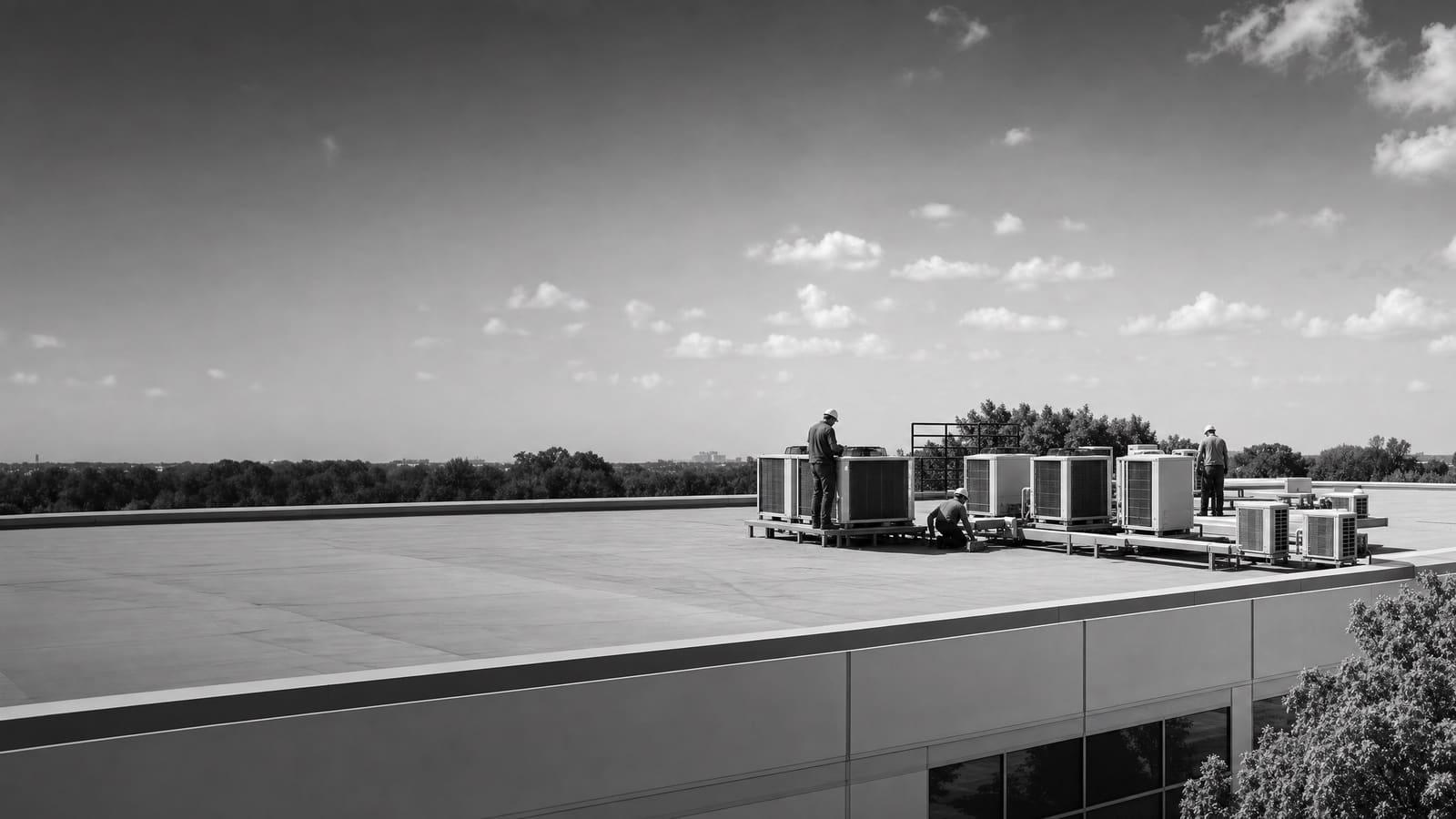
A commercial HVAC replacement covers the load calculation, equipment selection, rigging and set, gas and electrical and refrigerant connections, controls, permits, inspection, and commissioning. Replacement beats another repair once a rooftop unit is past about fifteen years and the failures start repeating. Old, inefficient rooftop units waste roughly $900 to $3,700 each in energy every year. At that point, repair money buys nothing but time.
A site review still has to confirm curb size and condition, roof access for a crane, available electrical capacity, and the real load the space carries today.
THE THREE PATHS
Three ways to replace, and what each one costs you
Most Salinas replacements come down to three choices. You can put back what you had, you can put back the same type at a higher efficiency tier, or you can change the heating fuel. The first is fastest and simplest. The second costs more up front and pays back through the meter, since the federal high-efficiency rooftop specification targets cutting unit energy use by up to half against the older standard. The third is the one worth real thought here. Federal guidance says heat pump rooftop units suit mild-winter regions across the U.S. West, where they can carry most or all of the winter heating load. The catch is never the weather. It is electrical capacity at the panel and what your building pays per kilowatt-hour.
WHAT MOVES THE NUMBER
The lines that decide your price
Nobody can price a roof from a phone call. These are the items that move the number most, and the ones to make every bidder show separately instead of burying inside a lump sum.
HOW TO BUY IT
Buy the replacement instead of just approving it
The strongest thing a buyer can do is separate two questions that usually get merged. First: what does this building need? Second: what is available, and when? Sizing should come from how the space is used now. Twenty years changes occupancy, plug loads, lighting, operating hours, and sometimes the envelope itself. A nameplate is a record of a decision someone made long ago, under conditions that no longer exist.
Once the load is settled, availability becomes the real constraint. Federal guidance on rooftop replacement puts equipment availability and contractor familiarity on the same checklist as climate and cost, and that ordering is honest. A unit you cannot get in season is not an option, no matter how well it models. Ask each bidder to name the model, the tier, and the delivery window in writing.
The last piece is timing. Facility teams often wait until a unit stops holding the space, needs constant service, or fails outright. Federal guidance is blunt that proactive replacement usually beats replacement-on-failure, and often beats a reflexive like-for-like swap at end of life. An emergency removes every choice you would want: efficiency tier, fuel, sizing, and the crane date. Deciding in the shoulder season keeps all four on the table.
SIDE BY SIDE
Simple swap or a real project
Two replacements with the same tonnage can price very differently. What separates them is almost never the box on the roof. It is the curb, the panel, and the parking lot.
LOWER COMPLEXITY
Straight swap conditions
Same fuel and tonnage, an existing curb that takes an adapter, an open lot with clear crane reach, adequate electrical service already at the unit, and controls that carry over unchanged.
HIGHER COMPLEXITY
What adds scope and days
A fuel change, larger or heavier equipment, structural review on the curb, a tight or shared lot, panel and feeder upgrades, occupied tenant space directly below, or automation points that need remapping.
SCOPING IT
What a real site review checks before anyone quotes
A quote written from a photo is a guess with a number on it. The review that makes a price real is short, but it covers specific ground.
Start on the roof. The reviewer confirms the existing curb size and condition, whether an adapter will work or the curb needs replacing, and how the membrane gets patched and warranted after the set. If the roof is near end of life, that conversation belongs here, not six months later.
Then the connections. Federal rooftop guidance groups infrastructure into three checks: electrical capacity, physical constraints, and gas lines. That is the right list. Electrical capacity decides whether a heat pump or a larger unit is practical without service work. Physical constraints decide crane position, reach, and whether the unit can be landed at all. Gas lines decide what happens to the existing fuel path if heating changes.
Last, the inside. The load calculation needs current occupancy, hours, equipment, and any tenant changes since the last unit went in. Controls need a decision: carry over, replace, or integrate. And whoever owns commissioning should be named before award, because that is where charge, airflow, and control settings get verified instead of assumed.
Ask for this in writing
Before signing, get the curb plan, the electrical finding, the crane and lot plan, the delivery window, and the name of whoever performs startup. Five short answers separate a real proposal from a number on a page.
IN SALINAS
Permits, roof work, and mild-winter equipment
Two local realities shape a Salinas replacement more than most owners expect.
The first is permitting. Mechanical work is permitted work in California, and municipal permit schedules in the state commonly list any mechanical, electrical, or plumbing upgrade or repair as requiring a permit — not only brand-new installations. A like-for-like rooftop swap still pulls a permit, and it usually pulls electrical with it. Re-roofing is listed separately on those same schedules, covering both overlay and tear-off. That matters, because a crane set is the cheapest moment in a decade to deal with the roof under the unit. If the membrane is aging, price the roof scope now and file both permits together instead of paying for access twice. Confirm exact scope with the building department serving your address.
The second is climate. Federal heat pump guidance places the mild-winter West among the regions where today's heat pump rooftop units can carry most or all of the winter heating demand. So the heat pump question here is not really about weather. It is about panel capacity and your electric rate.
One decision to make early
Settle the roof and the fuel before the equipment order, not after. Both change permit scope, crane planning, and lead time — and both are far cheaper to resolve on paper than on the morning the crane is already in your lot.
AFTER THE CRANE LEAVES
Two things that outlive the install
The install ends in a morning. The ownership decisions run for the next fifteen years or more. Two of them are worth settling while the project is still on paper, because both are cheap to plan now and awkward to fix later. One is what the new equipment does to your service program. The other is what happens to the rest of the roof once one unit is new and the others are not. Neither shows up in the installed price. Both show up in the operating budget.
REFRIGERANT AND SERVICE
Plan for a mixed fleet
EPA rules govern how refrigerant is handled, recovered, and recycled in commercial equipment. New units ship on newer refrigerants than the ones coming off. Day-one operation is unaffected, but service contracts, technician certification, and spare parts all need to account for a roof running two generations at once.
STARTUP AND WARRANTY
Name who owns commissioning
The warranty depends on documented startup: charge, airflow, and control settings verified against spec. Name the responsible party before award. If commissioning is a line item a bidder can quietly drop to win the job, it gets dropped, and the first comfort complaint shows up in month two.
PHASING AND PROCUREMENT
Replacing a roof full of units without buying them all at once
Few buildings replace every unit in one year, and few should. The useful move is to rank the roof instead of reacting to it. Any unit past fifteen years is a candidate, because that is where energy waste and repeat service calls concentrate. Rank by age, service history, and what each unit serves. The one over a server room, a kitchen, or a tenant with a renewal coming ranks higher than its age alone suggests.
Then buy in groups. A second unit on the same crane day costs far less than a second crane day. The same holds for permits, roof patching, and controls work. Two or three units replaced together usually price better per unit than the same units replaced one per year.
On lifetime cost, keep the comparison honest. Through the federal rooftop campaign, more than 200 organizations upgraded over 43,000 rooftop units and cut a combined $37 million a year from their energy bills. Your building will not match a national average, and it should not try to. But the direction is consistent. Compare the efficiency premium against your own utility spend across the unit's full service life, not against the invoice sitting in front of you.
THE QUOTE CHECKLIST
Five things a comparable quote has to show
Bids only compare when they carry the same lines. Ask every bidder to show these five, on the page, before you compare totals. A lump sum with none of them is not a lower price. It is a smaller amount of information.
01
The equipment, named
Manufacturer, model, tonnage, efficiency tier, heating type, and the delivery window, in writing.
02
Curb and roof scope
Adapter or new curb, any structural work, and how the roof gets patched and warranted after the set.
03
Rigging and access plan
Crane size, staging location, lot closure hours, and who handles tenant notice.
04
Permits and inspections
Which permits are pulled, by whom, and whether inspection time sits inside the quoted schedule.
05
Startup and commissioning
Charge, airflow, and controls verified against spec, documented, and handed over with warranty registration.
Get a defensible number
Price the equipment and the building together.
Send the address, operating target, and target opening date. Flux will identify what must be verified before the project can be priced.
Get a free estimateQuestions
Straight answers.
When does replacement beat one more repair?
Once the unit is past about fifteen years and the same failures keep returning. Old, inefficient rooftop units waste roughly $900 to $3,700 each per year in energy alone. At that point you are paying twice: once for the repair, and again every month on the meter.
Is a heat pump rooftop unit a good fit in Salinas?
Federal guidance puts the mild-winter West among the regions where today's heat pump rooftop units can handle most or all of the winter heating demand. The real question is not the weather. It is whether your electrical panel has capacity and what your building pays per kilowatt-hour.
Does a like-for-like rooftop swap still need a permit?
Plan on yes. California permit schedules commonly list any mechanical, electrical, or plumbing upgrade or repair as permitted work, not just new installations. Re-roofing is permitted separately. Confirm scope with the building department serving your address before the equipment is ordered.
What usually delays a commercial HVAC installation?
Rarely the crane day. Delays come from equipment availability, electrical service work found late, and structural review triggered by a bigger or heavier unit. All three are visible during a site review, which is why the review should happen before you commit to a date.
What happens to the refrigerant in the old unit?
EPA rules govern how refrigerant is handled, recovered, and recycled in commercial equipment, and that work belongs to certified technicians. Recovery should appear on the quote as part of the removal scope, not as a surprise line item after the old unit is already off the roof.
Sources used for this guide
- [1]betterbuildingssolutioncenter.energy.gov — DOE Advanced Rooftop Unit Replacement Guidance
- [2]betterbuildingssolutioncenter.energy.gov — DOE Commercial Heat Pump Rooftop Unit Replacement Guidance
- [3]betterbuildingssolutioncenter.energy.gov — DOE High-Efficiency Commercial Rooftop Unit Toolkit
- [4]energy.gov — DOE Efficient Commercial Rooftop Air Conditioner Program
- [5]epa.gov — EPA Stationary HVAC Refrigerant Management
- [6]californiacity-ca.gov — HVAC Permits