THE SHORT VERSION
What a commercial HVAC replacement actually covers
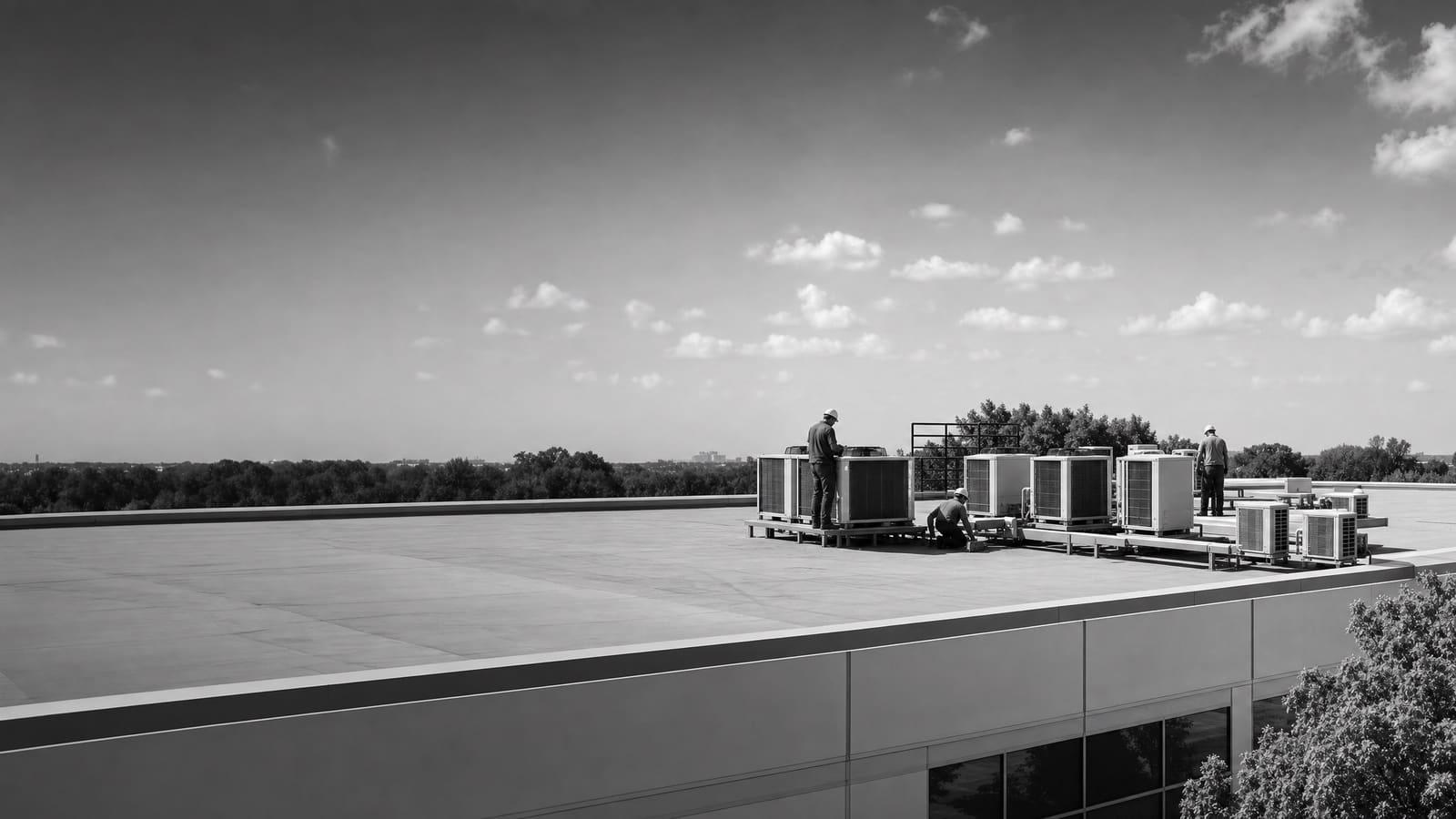
A commercial HVAC replacement covers load confirmation, equipment selection against real lead times, curb and rigging work, gas or electrical changes, controls, and commissioning. Replacement beats one more repair when the unit is past fifteen years and the failures are stacking up. Old, inefficient rooftop units waste an estimated $900 to $3,700 per unit every year, so a planned swap usually returns more than a like-for-like unit installed on the day the old one dies.
A site review still has to verify tonnage against how the space is used now, roof structure and curb fit, available electrical capacity, and whether the gas service stays or goes.
THE REAL CHOICE
Three ways buildings actually replace a rooftop unit
Most facility teams delay a new rooftop unit until the old one stops holding the space, needs constant service calls, or fails outright. That delay quietly picks the option for you. Rooftop units condition close to half of all commercial floor area in the country, which makes this the most common capital decision in the building and often the least planned one.
The three paths below are not equal. Replacement on failure gets the space cold again and carries every sizing and efficiency problem forward. A like-for-like swap at end of life is cleaner but keeps the same performance floor for another fifteen years. A planned high-efficiency replacement is the one that changes operating cost, because you choose the unit, the schedule, and the crane day instead of letting the weather choose them.
Decide which path you are on before you ask for a quote. It changes what you should be asking for.
WHAT MOVES THE NUMBER
What actually drives the installed price
Nobody can price a rooftop replacement from a capacity number alone. These are the lines that separate two honest bids on the same building, and the ones worth asking a contractor to price separately so you can see them.
EQUIPMENT CHOICE
Like-for-like unit or heat pump rooftop unit
The biggest fork in a commercial replacement today is whether the new unit heats with gas or with a reverse-cycle heat pump. Heat pump rooftop units are technologically close cousins of standard cooling rooftop units, so the equipment itself is not exotic. What changes is where the heat comes from on a cold morning.
Heat pump efficiency falls as outdoor temperature drops, and at the coldest hours it trends toward the same efficiency as electric resistance heat. That makes heat pump rooftop units the strongest fit for buildings with mild to moderate winter heating, which describes most of the West. It also means the decision is driven by your building's real heating load and by local electricity and gas prices, not by the brochure.
There are three shapes to choose from. Dual fuel keeps a gas burner for the coldest hours and runs the heat pump the rest of the year. All-electric drops gas entirely and backs up with electric resistance heat. Cold climate models push the efficient heating range further down the thermometer at a higher first cost. Building type matters here too: a warehouse with long heating hours and a small office suite land in different places on the same street.
SCOPE CHECK
Simple swap or engineered project
The gap between a one-morning replacement and a multi-week project is decided long before anyone touches the roof. These are the conditions that push a job from one column to the other.
LOWER COMPLEXITY
Same size, same spot, same fuel
The new unit matches the old one within about ten percent on capacity and dimensions, lands in the existing location, and burns the same fuel. Existing gas and electrical serve it as-is.
HIGHER COMPLEXITY
Bigger, moved, or re-fueled
Capacity or footprint grows, the unit shifts to a new spot on the roof, or gas gives way to electric heat. Each of those adds plan review, and a fuel change can add service work.
BEFORE YOU BUY
What a real site review has to confirm
A rooftop replacement fails on infrastructure far more often than on equipment. Before any number means much, someone needs to be on your roof and in your electrical room.
Electrical capacity comes first on any project that adds electric heat. The question is not whether the unit fits the curb; it is whether the panel, the service, and the feeder can carry the new load without an upgrade. Physical constraints come next: curb dimensions, structural capacity, clearances, and whether a crane can actually reach the spot. Gas lines matter in both directions. Keeping gas means confirming the line and venting still suit the new unit. Dropping gas means deciding what happens to the service.
Two softer items belong in the same review. Equipment availability shapes your schedule more than anything else on the quote, so availability should be written next to the price. And contractor familiarity with the specific equipment type is a real variable, especially on heat pump and controls-heavy installs. Ask who has commissioned this equipment before, not just who can lift it.
The question that saves the most money
Ask for the electrical load calculation on any all-electric option before you compare prices. A service upgrade discovered after the award can cost more than the unit itself, and it is the easiest surprise to rule out early.
SALEM SPECIFICS
The Oregon plan review triggers to check first
Oregon's Building Codes Division generally requires a mechanical plan review for a commercial mechanical permit, and its own checklist spells out which replacements cannot skip it. Four of those triggers are ordinary rooftop swap conditions.
Plan review applies when the replacement appliance's Btu rating differs by more than ten percent from the existing appliance. It applies when the replacement uses a different fuel type. It applies when a rooftop unit's size or shape falls outside ten percent of the original. And it applies when the new unit is not installed in the same location as the one it replaces. Equipment dimensions get their own test, measured against whichever is smaller: six inches, or ten percent of the existing equipment.
That list has a practical consequence for Salem buildings. Converting a gas rooftop unit to all-electric heat is a fuel-type change, so it lands in plan review by definition.
Plan the review into the schedule
If you are upsizing, relocating the unit, or switching fuel, treat mechanical plan review as part of the timeline rather than a surprise at permit time. Get the weight and dimensions of the new equipment, including curb adapters and economizers, early, because both are part of what gets reviewed.
OWNERSHIP
Two things that outlive the install
The installation is a week. The consequences run fifteen years or more. Two of them deserve a decision now rather than a discovery later.
The first is refrigerant. Every commercial replacement involves recovering refrigerant from the old unit, and federal Clean Air Act rules govern how that refrigerant is handled and recycled rather than released. That is the installer's obligation, but it becomes your problem across a mixed fleet, where units on the same roof can hold different refrigerants with different service realities.
The second is what this replacement does to your operating baseline. A unit chosen in a panic on the worst day of the year sets the utility bill for its entire service life, and no maintenance program later recovers what a rushed selection gives away.
REFRIGERANT
Recovery is not optional
Refrigerant from the old unit has to be recovered and handled under federal rules, not vented. Ask how that is documented, and track which refrigerant each unit on the roof holds.
FLEET STRATEGY
One roof, one plan
If you own several units of similar age, sequencing them deliberately beats replacing each on failure. You get better pricing, fewer mobilizations, and a fleet that ages on a schedule you control.
PHASING AND PROCUREMENT
Sequencing replacements without breaking the year
Few buildings replace every unit at once, and few should. The useful pattern is to rank units by age, service history, and consequence of failure, then move the top of that list on a planned schedule while the rest stay on maintenance.
Age is the cheapest filter. Units past fifteen years are the ones quietly costing money whether or not they have failed yet, and that annual waste, which can reach several thousand dollars per unit, is part of what funds the replacement. Service history is the second filter. A unit with repeat compressor or control failures is telling you exactly where next season's emergency will be.
Procurement follows the same logic. Bundling two or three units into one purchase and one crane day usually beats three separate emergencies, and it gives you leverage on lead time. Incentives belong in the conversation early rather than after the equipment is ordered, since available offers vary by location and by equipment type and are easier to line up while the specification is still open.
COMPARE APPLES TO APPLES
Five things a comparable quote shows
Two bids on the same roof can differ widely and both be honest, because they scoped different work. These five lines make them comparable.
01
Unit type, capacity, and efficiency
The exact model, its capacity, how it heats, and its efficiency tier, not just a tonnage number.
02
Equipment availability
A real lead time written next to the price, because availability sets the schedule more than labor does.
03
Curb, structural, and rigging scope
Adapter or new curb, any structural work, crane reach, and how long the lot is closed.
04
Electrical and gas scope
What the existing service supports, and which panel, feeder, or gas work is included or excluded.
05
Permits, plan review, and commissioning
Who files, which reviews the scope triggers, and what startup verification is documented at handoff.
Get a defensible number
Price the equipment and the building together.
Send the address, operating target, and target opening date. Flux will identify what must be verified before the project can be priced.
Get a free estimateQuestions
Straight answers.
When is replacing a rooftop unit better than repairing it again?
Once a unit is past fifteen years and needs regular service, the math usually turns. Old, inefficient rooftop units waste an estimated $900 to $3,700 per unit each year, and that waste continues no matter how well the last repair went. Replacing proactively also lets you pick the equipment and the schedule instead of taking whatever is available the week it dies.
Does a rooftop replacement in Salem need a mechanical plan review?
Often, yes. Oregon generally requires plan review for a commercial mechanical permit, and its checklist specifically calls out replacements where the Btu rating changes by more than ten percent, the fuel type changes, the unit's size or shape falls outside ten percent of the original, or the unit is not set in the same location. A straight like-for-like swap has the best chance of a simpler path.
Should the new unit be a heat pump or stay on gas?
It depends on your heating load, local electricity and gas prices, and whether your electrical service can carry electric heat. Heat pump rooftop units fit best where winter heating is mild to moderate. Dual fuel is the middle path: the heat pump runs most of the year and a gas burner covers the coldest hours.
How does a heat pump rooftop unit behave in cold weather?
Heating efficiency drops as the outdoor temperature falls, and at the low end it trends toward the same efficiency as electric resistance heat. That is why dual fuel and cold climate models exist. The right choice comes from your building's actual heating hours, not from a rating at one temperature.
What happens to the refrigerant in the old unit?
It has to be recovered and handled under federal Clean Air Act rules that govern refrigerant handling and recycling in stationary air conditioning and heat pump equipment. Venting it is not an option. Ask your installer how recovery is documented, and keep a record of which refrigerant each unit on the roof holds.
Sources used for this guide
- [1]betterbuildingssolutioncenter.energy.gov — DOE Advanced Rooftop Unit Replacement Guidance
- [2]betterbuildingssolutioncenter.energy.gov — DOE Commercial Heat Pump Rooftop Unit Replacement Guidance
- [3]betterbuildingssolutioncenter.energy.gov — DOE High-Efficiency Commercial Rooftop Unit Toolkit
- [4]energy.gov — DOE Efficient Commercial Rooftop Air Conditioner Program
- [5]epa.gov — EPA Stationary HVAC Refrigerant Management
- [6]oregon.gov — Inspector Training Program Registration