Direct answer
A replacement is a load check, an equipment decision, and a rigging day
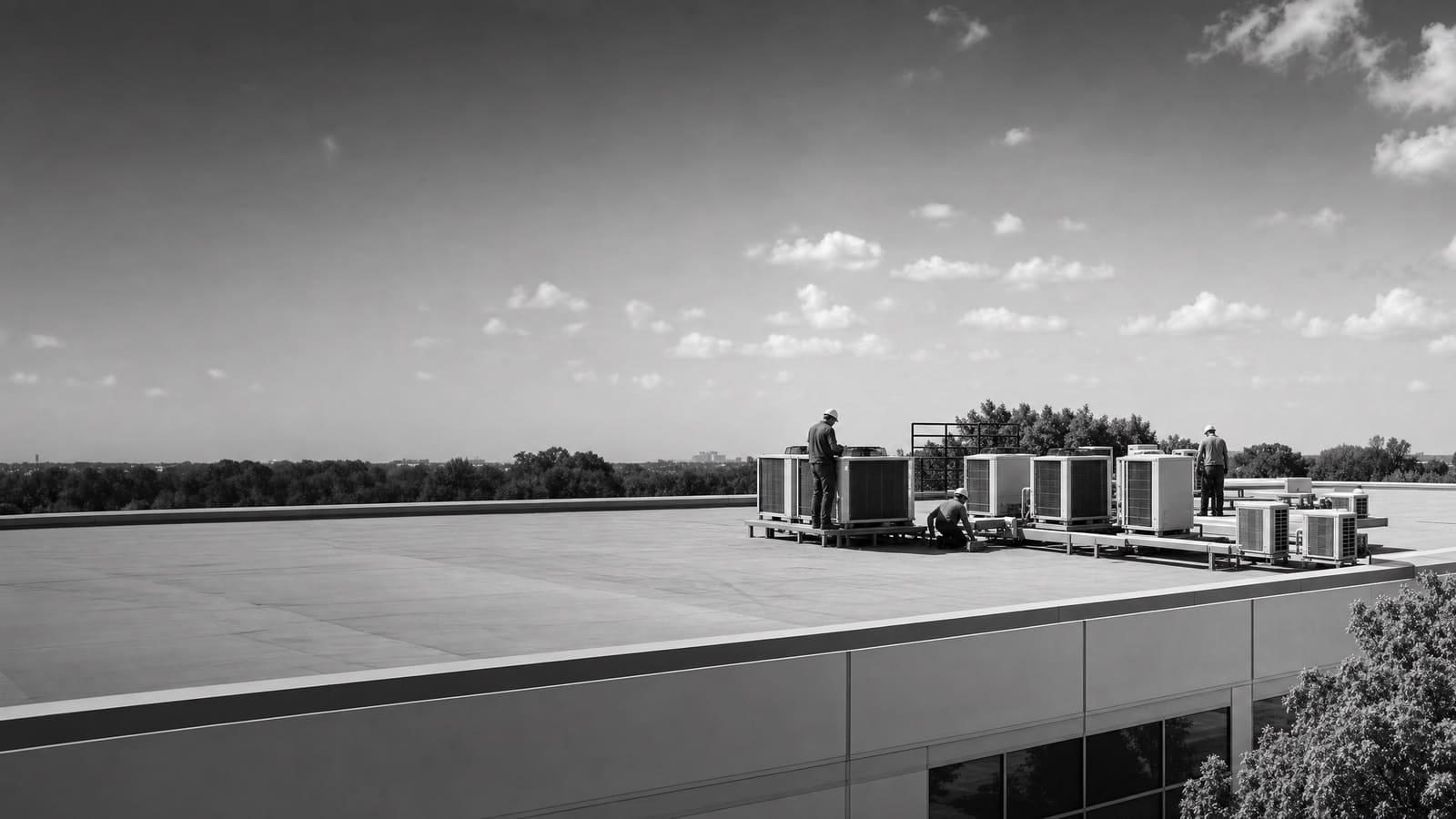
A commercial replacement covers confirming the load the building actually carries today, selecting equipment against real lead times, setting the unit and reconnecting power, gas, and controls, then commissioning it. Replacement beats another repair once a rooftop unit is past about fifteen years and the failures repeat. Federal research puts the waste from an old, inefficient rooftop unit at roughly $900 to $3,700 a year.
A site review still has to verify the curb and roof structure, the actual load from how the space is used now, electrical capacity at the unit, and access for a crane.
Three real options
Three ways to replace a rooftop unit, and when each one is right
The simplest decision is replacement in kind: same tonnage, same fuel, same curb. It is the right call when the space and its use have not changed and the unit failed on age rather than on load.
The second option is the same equipment type at a higher efficiency tier. The Department of Energy's high-performance rooftop specification asked manufacturers for units that cut energy use by up to half against the standard in place at the time, and more than twenty models now exceed that spec. Federal guidance also notes that replacing an inefficient, underperforming unit on purpose usually beats replacement-on-failure, and often beats a like-for-like swap at the end of service life.
The third is a heat pump rooftop unit. It is technically close to a conventional air-conditioning unit but adds reverse-cycle heating. Federal guidance treats today's heat pump rooftop units as an appropriate solution across most of the U.S. South and West, capable of covering most or all of the winter heating demand. Dual-fuel, all-electric, and cold-climate versions exist for different levels of heating risk. The decision turns on electrical capacity, gas service, what you pay for power, and equipment availability.
Build the whole number
What belongs in a commercial HVAC installation budget
Equipment is one line on a replacement quote. The rest of the number comes from what the roof, the power, and the schedule require. Ask for these split out so a low equipment price cannot hide expensive work behind it.
Timing the decision
Replacing before failure is a purchase; replacing after failure is a rescue
Most facility teams delay a rooftop replacement until the unit no longer holds the space, needs constant service, or fails outright. Federal guidance is direct about the cost of that habit: replacing an inefficient, underperforming unit proactively is usually the smarter business move than waiting for it to quit, and often better than a like-for-like swap at the end of its useful life. The difference is leverage. A planned replacement lets you compare equipment, accept a lead time you can live with, and pick a lift day that misses your busiest week. A failure in August gives you whatever is available and whatever crew is free.
The waste is measurable while you wait. An old, inefficient rooftop unit can burn roughly $900 to $3,700 more per year than a newer model. On a roof carrying six of them, that is a real line in the operating budget and a real argument for moving a replacement up a season.
Rooftop equipment deserves this attention because of how much work it does. Packaged rooftop systems condition close to half of all U.S. commercial floor area, which means most commercial buildings run on a handful of units nobody thinks about until one of them stops.
The expensive path
Two roofs, two very different numbers
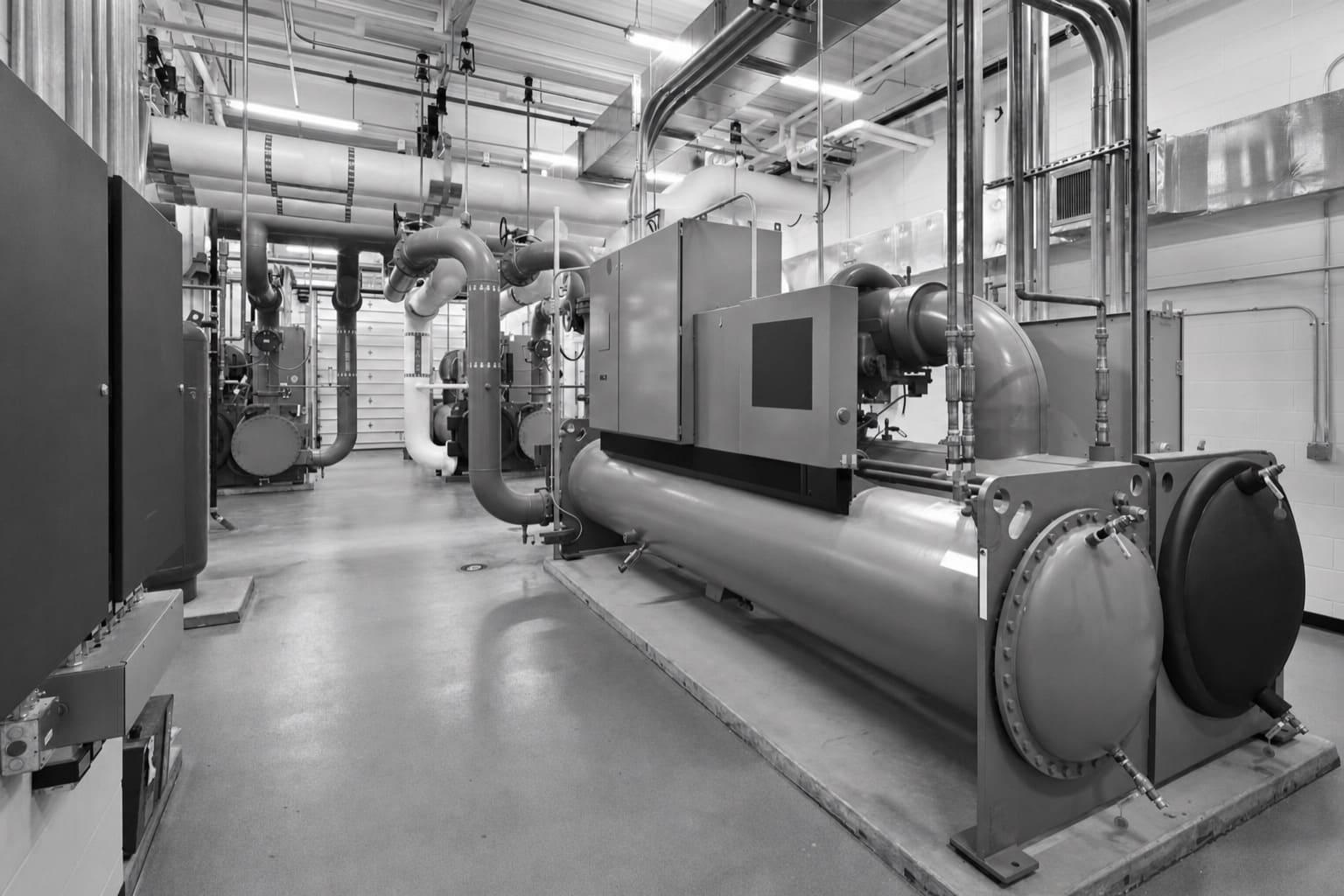
Set a new unit on an existing curb next to a clear lot and the work is a morning. Move the same tonnage onto a roof that needs framing, a longer power run, and a crane parked where trucks normally back in, and identical equipment carries a much larger installed price.
Lower complexity
Fewer building changes
• Same tonnage and footprint on the existing curb
• Adequate electrical capacity already at the unit
• Open lot with room for a standard crane pick
• Controls that map to what is already installed
Higher complexity
More work around the unit
• Larger footprint that triggers structural review
• New electrical capacity or a gas-line change
• Tight access, a night lift, or a lane closure
• A fuel switch that brings new controls with it
Before design starts
What a real site review has to answer
The site review is where the guessing stops. Start on the roof: nameplate data for every unit being replaced, age, curb dimensions, the condition of the roof around the curb, condensate routing, and the duct connection underneath. A curb adapter measured wrong is the single mistake that turns a one-morning job into a return trip.
Then follow the power. Federal heat pump guidance lists electrical capacity, physical constraints, and gas lines as the core infrastructure questions, and they matter just as much on a conventional replacement. Confirm the breaker, conductor size, and disconnect at the unit, then confirm what the panel can carry if the new equipment draws more. If anyone is considering all-electric heating, this is the question that decides the project, not the equipment brochure.
Last, walk the lift. Where does the crane set up, what does it swing over, which stalls close, which tenant loses their entrance for the morning, and who makes the weather call. That same federal guidance also flags equipment availability and contractor availability as genuine constraints. A unit you cannot get and a crew that cannot lift it produce the same delay.
The one number to verify early
Available electrical capacity at the unit. It decides whether a higher-efficiency or heat pump option is even on the table, and finding out after the equipment is ordered is the most expensive way to learn it.
After the lift
Two ownership questions the installed price does not answer
The quote ends at commissioning. Ownership does not. Two questions decide what the unit actually costs you across its life.
The first is utility bill impact. Federal guidance on heat pump rooftop units treats local electricity and gas prices, the building's heating load, and grid emissions as the inputs that determine whether an electric option saves money or simply moves the cost to a different bill. It also points out that even southern climates can see periods of sharp winter heating demand, citing the February 2021 Texas freeze, which is exactly why dual-fuel and cold-climate versions exist.
The second is service. Confirm which refrigerant the new equipment uses and how it fits the parts and service plan for the rest of your units. EPA rules under Section 608 of the Clean Air Act govern how refrigerant is handled and recycled in this equipment, so recovery at removal and correct handling at every service visit are part of the job, not an extra.
Model before you buy
Energy and demand
Compare the electric and gas prices you actually pay, the heating hours the building really needs, and any incentive the equipment tier may qualify for.
Plan for year two
Parts and service
Refrigerant type, filter and belt access, the control platform, warranty terms, and whether crews nearby already service the model you are buying.
Buying more than one
Across a roof, the replacement order matters more than any single quote
If you own several rooftop units, the useful plan is a replacement order rather than a single purchase. Rank them by age, service history, and the hours each one runs. Units past fifteen years with repeat failures move to the front. Younger units serving lightly used zones can usually wait a season without costing much.
Federal work treats this as a portfolio decision, not a one-unit decision. The Advanced Rooftop Unit Campaign has more than two hundred public and private organizations that have upgraded over 43,000 units, together saving about $37 million a year on energy. It also holds out two paths for each unit: replace it with a more efficient one, or retrofit the existing unit with advanced controls, whichever makes better financial sense. That second path matters when budget is tight. A newer unit with a sound cabinet and coil may be a controls project. An older unit with a failing compressor is not.
Grouping units also changes procurement. Several replacements ordered together can share one crane mobilization, one permit cycle, and one commissioning visit. Ask for the multi-unit alternate next to the single replacement so you can see what phasing costs and what it saves.
Comparing bids
Five things a comparable quote shows
Bids only mean something when they cover the same scope. Ask each bidder to price the same tonnage, the same efficiency tier, the same curb and structural work, and the same lift plan. Otherwise you are comparing two different projects.
01
Tonnage, heating type, and efficiency tier of the exact unit being installed
02
The load basis: how the space is used today, not the old nameplate
03
Curb adapter, structural work, and roof repair around the opening
04
Rigging plan, access closure, permits, and inspections, all priced in
05
Startup, commissioning, controls integration, and refrigerant recovery on the old unit
Get a defensible number
Price the equipment and the building together.
Send the address, operating target, and target opening date. Flux will identify what must be verified before the project can be priced.
Get a free estimateQuestions
Straight answers.
When is replacement better than one more repair?
Once a unit is past about fifteen years and the same failures keep returning, replacement usually wins. Federal guidance is direct that proactively replacing an inefficient, underperforming unit is often the better business move than waiting for it to fail, and an old unit can waste roughly $900 to $3,700 a year on its own.
Should we replace like-for-like or resize the unit?
Confirm the load either way. If the space and how it is used have not changed, replacement in kind is often correct and keeps the curb, connections, and schedule simple. If occupancy, equipment, or the envelope changed, sizing to today's use fixes comfort problems the old unit could never solve.
Is a heat pump rooftop unit a realistic option?
Federal guidance treats today's heat pump rooftop units as an appropriate solution across most of the U.S. South and West, capable of handling most or all winter heating demand. Whether it fits your building comes down to electrical capacity, gas service, what you pay for energy, and equipment availability. Dual-fuel versions exist for sites that want heating backup.
What happens to the refrigerant in the old unit?
EPA regulations under Section 608 of the Clean Air Act govern how refrigerant is handled and recycled in stationary air conditioning and heat pump equipment. Recovery before the old unit leaves the roof belongs to the installing contractor, and it should appear in the scope on the quote rather than as a surprise line later.
Can we upgrade controls instead of replacing the unit?
Sometimes. The Advanced Rooftop Unit Campaign points owners toward either replacing an old unit with a more efficient one or retrofitting it with advanced controls, depending on which makes better financial sense. Controls can be the right answer on a newer unit with a sound cabinet and coil, and the wrong answer on one with a failing compressor.
Sources used for this guide
- [1]betterbuildingssolutioncenter.energy.gov — DOE Advanced Rooftop Unit Replacement Guidance
- [2]betterbuildingssolutioncenter.energy.gov — DOE Commercial Heat Pump Rooftop Unit Replacement Guidance
- [3]betterbuildingssolutioncenter.energy.gov — DOE High-Efficiency Commercial Rooftop Unit Toolkit
- [4]energy.gov — DOE Efficient Commercial Rooftop Air Conditioner Program
- [5]epa.gov — EPA Stationary HVAC Refrigerant Management