THE SHORT ANSWER
What commercial HVAC replacement and installation includes
A commercial replacement covers load verification, equipment selection against real lead times, permitted removal and certified recovery of the old refrigerant charge, the crane set and curb adapter, gas, electrical, and control connections, and commissioning. Replacement beats another repair once the unit is old enough to waste money every month it runs. DOE puts the annual waste from old, inefficient rooftop units at $900 to $3,700 each, and flags units past fifteen years as the ones worth planning around.
A site review still has to confirm the actual load, the roof structure under the curb, the electrical capacity at the panel, and whether the unit is reachable by crane. Those four answers move the price more than tonnage does.
THREE WAYS TO GO
Three replacement paths worth pricing side by side
Commercial buildings like yours are usually cooled by packaged rooftop units, the equipment type that conditions nearly half of all U.S. commercial floor space. That means the replacement decision normally comes down to three paths, and they should be priced next to each other rather than assumed.
The cheapest quote is not automatically the cheapest decision. A unit you keep for two decades spends far more on power than it cost to install, which is why a high-efficiency specification exists at all. Ask for each path with its installed price, its confirmed lead time, and what it changes on the utility bill.
There is a fourth answer that is sometimes correct. If the unit is young and mechanically sound, advanced controls can be retrofitted instead of replacing the box, which is a legitimate alternative when it makes better financial sense.
WHAT MOVES THE NUMBER
The lines that decide your installed price
Nobody can quote a commercial rooftop replacement from a tonnage number alone. These are the lines that separate a clean swap from a project, and each one should appear on the quote as its own price rather than buried in a lump sum.
IN PRACTICE
Buying the unit you will still like in year twelve
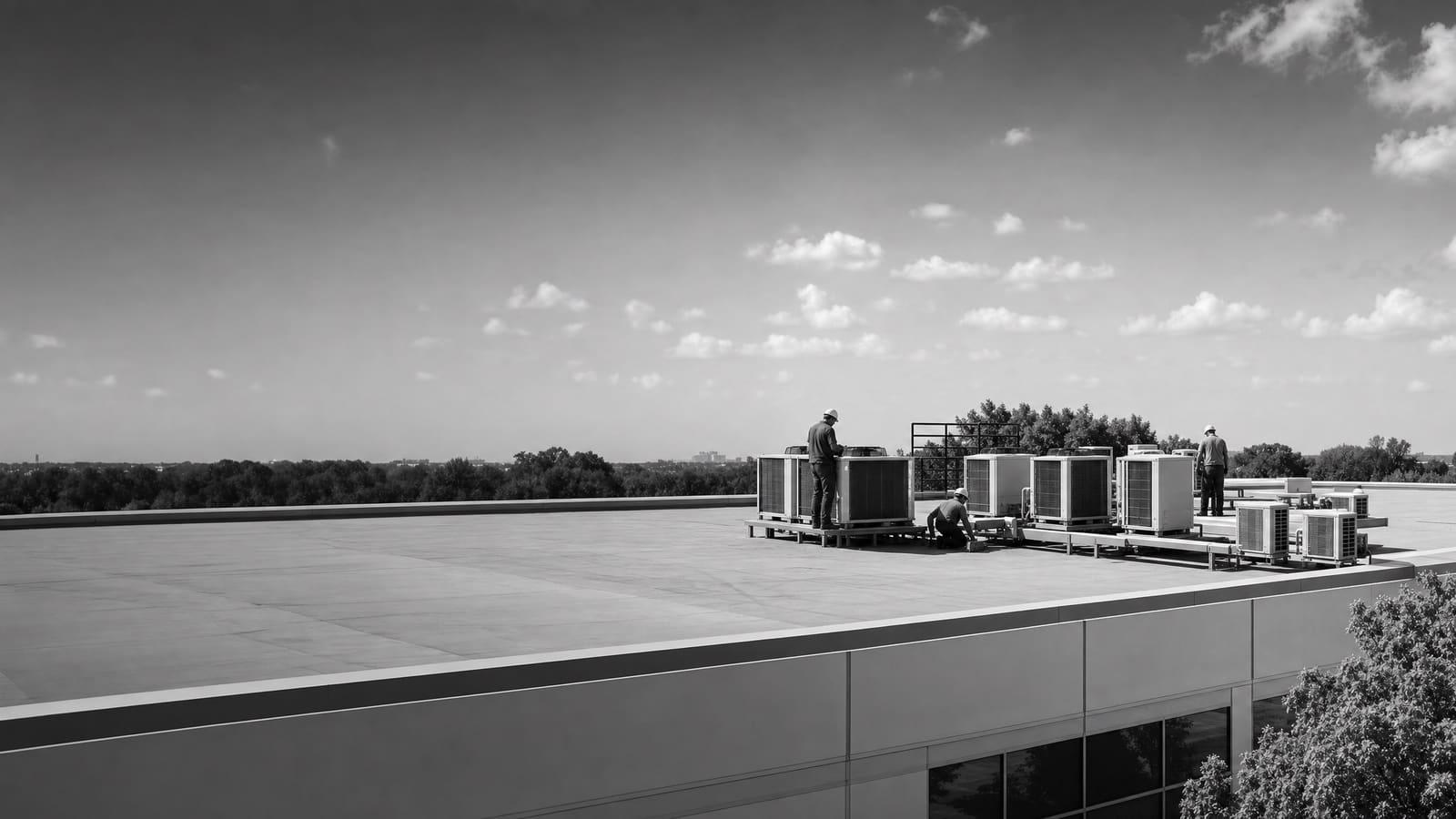
The visible part of the job is one morning. The crane arrives, stalls are coned, the old unit comes off, and the new one lands on a curb adapter measured weeks earlier. Everything that makes that morning uneventful happened before it: the rigging plan, the structural check, the gas and electrical confirmation, and the weather call the day before.
The part that decides whether you are happy in year twelve happens even earlier, at sizing. Two decades change occupancy, plug loads, lighting, and sometimes the envelope itself. Replacing off the old nameplate carries forward whatever the last sizing got wrong, and an oversized unit short-cycles its way through comfort complaints that no amount of service will fix. Ask for the load calculation, not the nameplate.
Waiting for failure is its own decision. Facility teams often delay until the unit no longer conditions the space, needs constant service, or dies outright. Replacing proactively usually beats replacement-on-failure, and often beats a like-for-like swap at the end of a unit's service life. On failure you take whatever is in stock, at whatever lead time, in whatever season. Planned, you pick the equipment, the efficiency tier, and the week.
SCOPE CHECK
Clean swap or real project?
Two rooftop replacements at the same tonnage can land far apart on price, and the reason is almost never the equipment. It is what the building makes you do around it. Here is how to tell which one you have before the quotes arrive.
LOWER COMPLEXITY
Straight swap conditions
Same tonnage and same fuel, an existing curb that is reusable or takes a standard adapter, an open lot with clear crane reach, a service panel with headroom, and controls that already speak to the building system.
HIGHER COMPLEXITY
Project conditions
Tonnage or footprint grows, the roof needs structural review, electric heat needs new panel capacity or a service change, gas piping gets capped, crane reach is blocked by the building, or the work has to happen after hours.
BEFORE YOU BUY
What a real site review answers
A quote written from a photo of the nameplate is a guess with a number attached. A useful one starts on the roof and works down. DOE's checklist for rooftop replacement decisions runs through the same list a good contractor walks: climate and heating load, utility bill impact, building type and how it is used, equipment availability, electrical capacity, physical constraints, and existing gas lines.
Electrical capacity is the item that surprises owners most. A gas-heat rooftop unit draws power for the fan and compressor. An all-electric replacement adds heating to that same panel, and the backup electric resistance element sizes the worst case. If the panel or the service cannot carry it, the honest answer is that the electrical upgrade is part of the project cost, not a change order in week three.
Physical constraints matter almost as much. Curb dimensions, roof access, refrigerant line routing, and whether gas piping stays or gets capped all change the labor. So does contractor familiarity with the equipment you choose, which is its own listed consideration, because unfamiliar equipment gets commissioned badly more often than it gets commissioned well.
Ask for these in writing
Before you sign, get the measured load, the panel and service capacity finding, the curb and structural answer, the crane and lot plan, and the confirmed equipment availability date. Any one of those left blank is the line most likely to move after the contract is signed.
IN ROSWELL
Permit the swap, including the emergency one
Commercial mechanical replacement is permitted work in Georgia, and the permit language is blunt: a contractor who alters, repairs, replaces, or removes a mechanical system must obtain a permit before the work starts. The exemptions are narrow, covering portable equipment and replacement of a minor part that does not change the equipment's approval or make it unsafe. A rooftop unit is neither.
Two details matter for scheduling. Emergency replacements can proceed, but the permit application is due to the building official the next working business day, so the paperwork follows the crane rather than replacing it. And a permit application goes stale: it is treated as abandoned if the work has not commenced within six months of filing. Confirm the submittal path and the inspection sequence with the Roswell building department before the crane date is locked.
The decision this actually changes
Do not file the permit until the equipment is ordered and the lead time is confirmed. Six months of shelf life sounds generous until a special-order unit slips, and a lapsed application means re-filing in the middle of a scheduled outage.
OWNERSHIP MATH
Two things that outlive the install
The install is a few weeks of attention. The consequences run for as long as the unit stays on the roof, and two of them are worth deciding on purpose rather than by default.
The first is what the unit costs to run. Old, inefficient rooftop units waste between $900 and $3,700 per unit each year, which turns the efficiency tier into arithmetic instead of opinion. Across organizations tracked through DOE's rooftop campaign, more than 43,000 upgraded units returned a combined $37 million a year in energy savings.
The second is refrigerant. EPA rules under Section 608 govern how refrigerant is handled, recovered, and recycled in stationary cooling equipment, and new units ship on newer low-GWP refrigerants. That changes nothing about day one and quite a lot about how you stock parts and write service contracts for a mixed fleet.
RUN COST
The efficiency tier is a bill decision
Every year the unit runs, the efficiency tier either pays you back or quietly bills you. Price the high-efficiency option next to the base unit and compare annual operating cost, not just the installed number.
FLEET PLANNING
One roof, two refrigerants
Replace units one at a time and you will run mixed refrigerants for years. Decide now who holds the certification, which parts you stock, and whether the service contract covers both, before the first hot Saturday.
PHASING AND PROCUREMENT
Replacing several units without replacing your budget
Buildings rarely have one aging unit. They have five, installed the same year, aging at the same rate. Replacing all of them in one season is clean but capital-heavy. Replacing them one failure at a time is cheap per event and expensive over a decade, because every emergency swap buys whatever is available instead of what you chose.
The middle path is a ranked plan. Rank by age, service history, and how much waste the unit is producing. The ones past fifteen years with recurring service tickets are usually both the worst performers and the most likely to quit on the hottest day. Replace the top of that list on a planned schedule and let the rest run on maintenance and controls until their number comes up.
Procurement follows the same logic. Ordering two or three units together often improves both pricing and crane economics, since a single mobilization can set more than one unit. Lead time governs everything else: a unit ordered in spring for a summer outage is a plan, and the same unit ordered in summer is a hope.
Write the multi-year sequence down, even loosely. It turns a series of emergencies into a line in the capital budget, which is where this belongs.
QUOTE CHECKLIST
Five things a comparable quote shows
Two quotes are only comparable when they price the same scope. If one includes the curb adapter and the other does not, the lower number is not actually lower. Ask every bidder to break these out as separate lines.
01
Equipment, tier, and lead time
Model, tonnage, efficiency tier, refrigerant, and a confirmed availability date rather than a general range.
02
Curb, structure, and roof work
Adapter or new curb, any structural review, and how the roof opening gets closed and flashed.
03
Crane, rigging, and lot plan
Mobilization, stall closures, reach, and who coordinates with tenants for the morning.
04
Permits and inspections
Which permits get pulled, by whom, and which inspections stand between the set and the handoff.
05
Startup and commissioning
Charge, airflow, controls integration, and the documentation that keeps the warranty intact.
Get a defensible number
Price the equipment and the building together.
Send the address, operating target, and target opening date. Flux will identify what must be verified before the project can be priced.
Get a free estimateQuestions
Straight answers.
How fast can a dead rooftop unit be replaced?
The crane set is usually a single morning once the unit is on site. Equipment lead time is the real variable, so ask for a confirmed availability date next to the price rather than a general range.
Should you replace like-for-like or resize the unit?
Confirm the load either way. If the space and how it is used have not changed, like-for-like is often right. If occupancy, equipment, or operating hours changed, a fresh load calculation fixes complaints the old unit could never solve.
Is a heat pump rooftop unit a real option in Roswell?
Yes. DOE describes today's heat pump rooftop units as appropriate across most of the U.S. South and capable of most or all winter heating demand. The gating item is usually electrical capacity, not climate, so check the panel before you pick the equipment.
Do you need a permit to replace a commercial rooftop unit?
Yes. A permit is required before commercial mechanical replacement work starts, and even an emergency replacement requires the application to reach the building official the next working business day. Confirm the submittal path with the Roswell building department.
Will a new unit need a different refrigerant?
New commercial equipment ships on newer low-GWP refrigerants, and EPA Section 608 rules govern how the old charge is recovered and handled when the unit comes off the roof. Day-one operation is unchanged. Parts stocking and service contracts for a mixed fleet are what need planning.
Is replacing early better than waiting for failure?
Usually. Proactively replacing an inefficient unit often beats replacement-on-failure, and can beat a like-for-like swap at the end of service life, because a failure hands the equipment choice, the lead time, and the season to somebody else.
Sources used for this guide
- [1]betterbuildingssolutioncenter.energy.gov — DOE Advanced Rooftop Unit Replacement Guidance
- [2]betterbuildingssolutioncenter.energy.gov — DOE Commercial Heat Pump Rooftop Unit Replacement Guidance
- [3]betterbuildingssolutioncenter.energy.gov — DOE High-Efficiency Commercial Rooftop Unit Toolkit
- [4]energy.gov — DOE Efficient Commercial Rooftop Air Conditioner Program
- [5]epa.gov — EPA Stationary HVAC Refrigerant Management
- [6]augustaga.gov — FAQs - CivicPlus.CMS.FAQ