THE SHORT VERSION
What a commercial HVAC replacement actually covers
A commercial HVAC replacement covers more than the unit. It covers a load check against how the space is used now, equipment selected against real availability, a rigging and roof plan, permits, electrical and gas connections, and commissioning that proves performance. Replacement beats another repair once a unit is past fifteen years, needs frequent service, or no longer holds the space. DOE puts the annual energy waste from an old, inefficient rooftop unit at $900 to $3,700.
A site review has to confirm the real load, curb and structural condition, crane reach, and whether the electrical service can carry the unit you are actually buying.
THE DECISION
Three ways to handle a unit at end of life
Most buildings face the same three choices when a rooftop unit is done. The cheapest one on paper is not always the cheapest one to run, and the difference shows up every month on the utility bill rather than once on the invoice.
DOE's rooftop unit work points to a fourth option worth knowing about: on some equipment, retrofitting advanced controls makes better financial sense than replacing the box. That only applies to units with life left in them. Once a unit is past fifteen years and failing regularly, controls do not fix the problem.
The choice also depends on what the building can physically support. Electrical capacity, gas lines, roof structure, and the space around the curb set limits before efficiency ratings or refrigerant type enter the conversation. Confirm those first, then compare operating cost.
WHAT MOVES THE NUMBER
What actually drives the installed price
There is no universal installed price for a commercial unit, and any quote that gives you one before seeing the roof is guessing. These are the lines that move the number most, and the ones worth pinning down before you compare bids.
IN PRACTICE
How a replacement actually runs
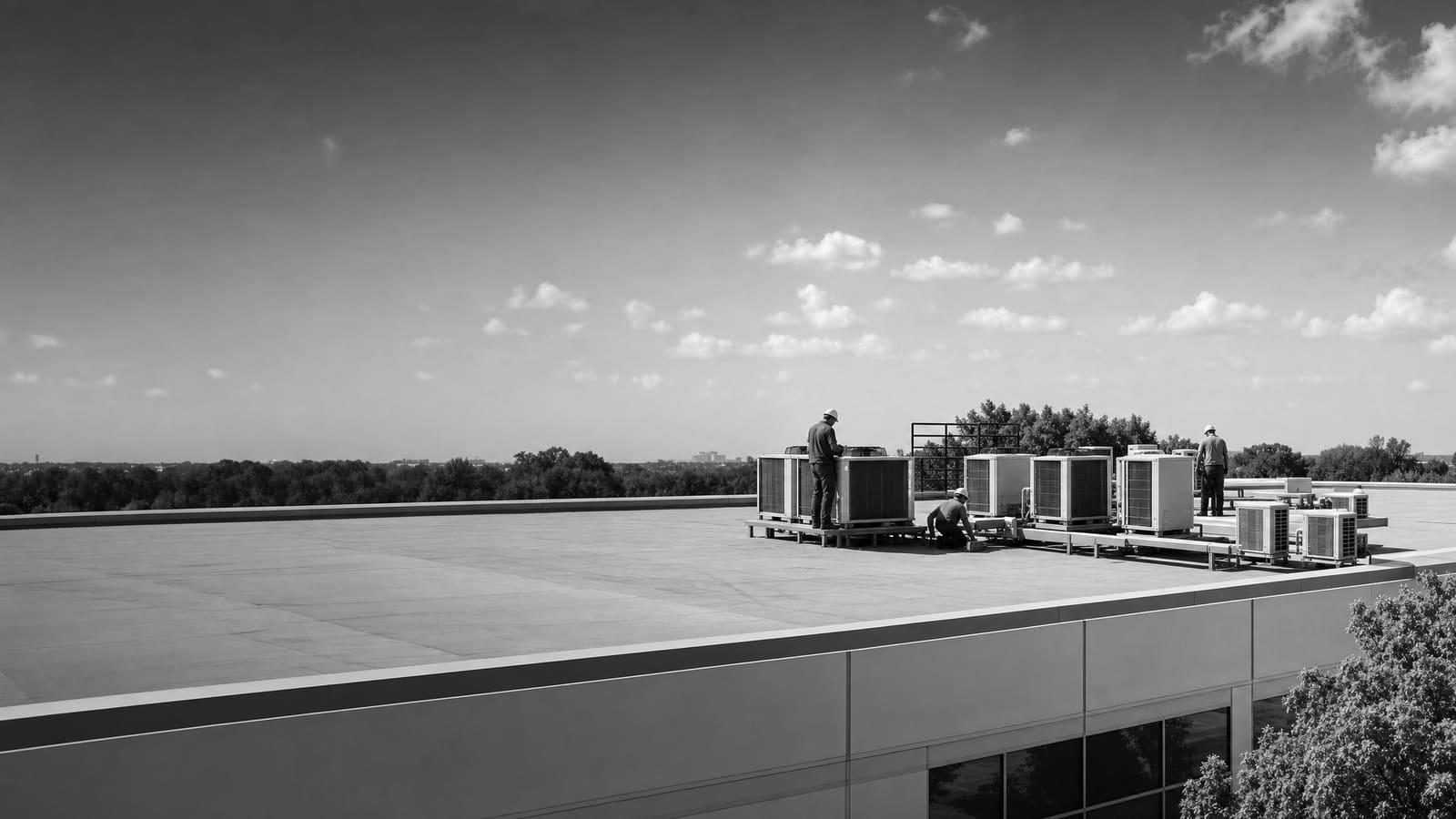
The visible part of a commercial HVAC replacement is short. A crane arrives, stalls get coned off, the old unit comes off the curb, and the new one lands. Tenants notice the cones more than the outage.
Everything that makes that morning uneventful happens weeks earlier. The load gets confirmed against how the space is used today, because twenty years changes occupancy, plug loads, lighting, and sometimes the envelope. The old nameplate records a decision someone made under different conditions, and carrying it forward carries the mistake forward with it. Equipment gets selected against real availability, not a catalog, so the schedule is honest from the first conversation. The curb is measured and the adapter ordered. Structure, electrical, and gas are confirmed on the roof rather than assumed from drawings.
Then the part most owners never see: commissioning. Refrigerant charge, airflow, economizer operation, and control settings get verified against the design and documented. This is where the comfort complaints of month two get prevented, and it is what keeps the manufacturer warranty intact. A unit that turns on is not the same as a unit that performs.
COMPLEXITY
What makes one replacement simple and another hard
Two buildings can buy the same tonnage and land in very different price and schedule ranges. The split usually comes down to whether the new unit fits what is already there, or whether the building has to change to accept it.
LOWER COMPLEXITY
The unit fits what exists
Same tonnage on the existing curb, adequate electrical service, gas already at the roof, and open lot space for the crane. Permits stay mechanical and electrical, and the schedule is driven mostly by equipment availability.
HIGHER COMPLEXITY
The building has to change
Corrected tonnage, a new footprint, structural review, or an all-electric conversion that needs added service capacity. Add an occupied site with limited crane reach and the project becomes a phasing exercise before it becomes a purchase.
BEFORE YOU BUY
The site review that decides the scope
DOE publishes a checklist for owners weighing a rooftop unit decision, and it is a good outline for any commercial replacement, not only an electrification project. It asks about climate and geography, utility bill impact, building type, equipment availability, infrastructure, contractor knowledge, and incentives. Infrastructure breaks into three parts worth walking the roof for: electrical capacity, physical constraints, and gas lines.
Electrical capacity is the one that quietly kills schedules. An all-electric unit can need more service than the panel and feeder were built to deliver, and utility work runs on its own calendar. Physical constraints are the curb dimensions, the structural condition under it, the clearances around the unit, and whether a crane can actually reach the position. Gas lines matter in both directions, because keeping gas heat and abandoning it are both scope.
Equipment availability belongs in the same conversation. A unit that is right on paper but months out is a different decision than one on the shelf, especially mid-season. Get that answer in writing before the specification is locked.
Walk the roof before the specification is locked
Confirm curb size and structural condition, clearances, crane reach and staging, panel and feeder capacity, and gas line status. Each one either confirms the plan or changes the scope, and finding out during the crane day is the expensive version.
IN ROSEVILLE
Permits, and the roof work that comes with them
California building departments handle commercial HVAC work through the local permit counter, and published municipal HVAC permit requirements typically cover any mechanical, electrical, or plumbing upgrade or repair. That is broader than owners expect. A rooftop replacement is rarely one trade, so it is rarely one permit line.
The item most often missed is roofing. The same permit lists that cover mechanical work also treat re-roofing, overlay and tear-off alike, as permitted work in its own right. A unit swap that disturbs the membrane around the curb, or that pairs with a roof section replacement while the crane is already scheduled, can pull that scope in.
Confirm the exact submittal and inspection sequence with the City of Roseville building division before the crane date is set, not after.
One decision this changes
Ask your contractor to price the roof work around the curb as a named line, and to confirm with the city whether it is permitted separately. Bundling roofing into the same crane window is cheaper than paying for a second mobilization later.
OWNING THE OUTCOME
Two things that outlive the install
The install ends. The obligations do not. Two of them shape cost for years afterward, and both are easier to handle if they are settled before the purchase order rather than after the first service call.
The first is refrigerant. EPA regulates the handling and recycling of refrigerant in stationary air conditioning and heat pump equipment under Section 608 of the Clean Air Act, and those rules follow the equipment through its whole service life. The second is fleet strategy. DOE's guidance is direct about the trap: owners tend to wait until a unit fails completely, and replacement-on-failure is usually the most expensive way to buy the same equipment.
REFRIGERANT
Section 608 follows the unit
Handling, recycling, and servicing obligations attach to stationary AC and heat pump equipment. On a mixed fleet, service contracts and spare parts planning have to account for more than one refrigerant at once.
TIMING
Planned beats replacement-on-failure
DOE notes that owners often delay until a unit fails outright. Failure then sets the schedule, the price, and the equipment choice for you, and it always does it in the middle of the season.
THE LONGER MATH
Buying on a calendar you control
Rooftop units condition close to half of all commercial floor area in the country, which is why this replacement decision has been studied so heavily. It is also why the operating side of the math deserves as much attention as the invoice. DOE's estimate for an old, inefficient unit is $900 to $3,700 in wasted energy per unit per year. Across a fleet, that compounds into a number that makes a planned replacement program look very different from a run of emergencies.
The scale case is not theoretical. More than 200 organizations working through DOE's Advanced RTU Campaign upgraded over 43,000 units and reported a combined $37 million in annual energy savings. What made that work was sequencing, not heroics: units ranked by age, condition, and run hours, then replaced on a calendar the owner controlled.
If incentives are part of your case, confirm they are still open and still funded before you count them. Utility and program offerings change, and one that closed last year is history, not a line in your payback. The same goes for lead times. Both are worth re-verifying at the moment you commit, not at the moment you started planning.
COMPARING BIDS
Five things a comparable quote shows
Two quotes are only comparable if they scope the same work. These five lines are where bids diverge most, and where a low number usually turns out to be an incomplete one.
01
Equipment, in full
Make, model, tonnage, efficiency tier, refrigerant, and a stated lead time you can hold them to.
02
Curb and roof scope
Adapter, structural work, and the membrane repair around the opening, priced as named lines.
03
Rigging and access
Crane size, staging plan, lot closure hours, and who coordinates with tenants.
04
Electrical and gas
Panel and feeder work, any utility coordination, and what happens to the existing gas line.
05
Permits and commissioning
Who pulls permits, who meets inspectors, and what startup readings get documented at handoff.
Get a defensible number
Price the equipment and the building together.
Send the address, operating target, and target opening date. Flux will identify what must be verified before the project can be priced.
Get a free estimateQuestions
Straight answers.
When does replacement beat another repair?
DOE's guidance points at units past fifteen years, units that need frequent service, and units that no longer hold the space. Any one of those is a signal. All three together means you are already paying for the replacement in energy and service calls, just on a worse schedule.
Should you replace like-for-like or resize?
Confirm the load either way. If occupancy, equipment, and operating hours have not changed, like-for-like is often right and it is the fastest path back to conditioning. If any of them changed, the old nameplate is carrying forward a decision made for a different building.
Is a heat pump rooftop unit a real option here?
DOE's guidance puts most of the West in the range where heat pump rooftop units can handle most or all of the winter heating demand. The gating question is usually not climate, it is electrical capacity at your building, so check the panel and feeder before you check the model number.
What does a commercial HVAC installation cost?
There is no honest universal number, and anyone quoting one sight unseen is guessing. Tonnage, curb and roof work, crane access, electrical scope, and controls set the price. What is well documented is the other side of the ledger: DOE puts the annual energy waste of an old, inefficient unit at $900 to $3,700 per unit.
Does a rooftop replacement need a permit?
Plan on it. Published California municipal HVAC permit requirements typically cover any mechanical, electrical, or plumbing upgrade or repair, and re-roofing is treated as its own permitted work. Confirm the submittal and inspection sequence with the City of Roseville building division before scheduling the crane.
Will a new unit change refrigerant service?
New commercial equipment ships on current refrigerants, which can differ from what your older units run. EPA Section 608 governs handling and recycling either way. On a mixed fleet, make sure the service contract and spare parts plan cover both.
Sources used for this guide
- [1]betterbuildingssolutioncenter.energy.gov — DOE Advanced Rooftop Unit Replacement Guidance
- [2]betterbuildingssolutioncenter.energy.gov — DOE Commercial Heat Pump Rooftop Unit Replacement Guidance
- [3]betterbuildingssolutioncenter.energy.gov — DOE High-Efficiency Commercial Rooftop Unit Toolkit
- [4]energy.gov — DOE Efficient Commercial Rooftop Air Conditioner Program
- [5]epa.gov — EPA Stationary HVAC Refrigerant Management
- [6]californiacity-ca.gov — HVAC Permits