THE DIRECT ANSWER
What a commercial HVAC replacement actually includes
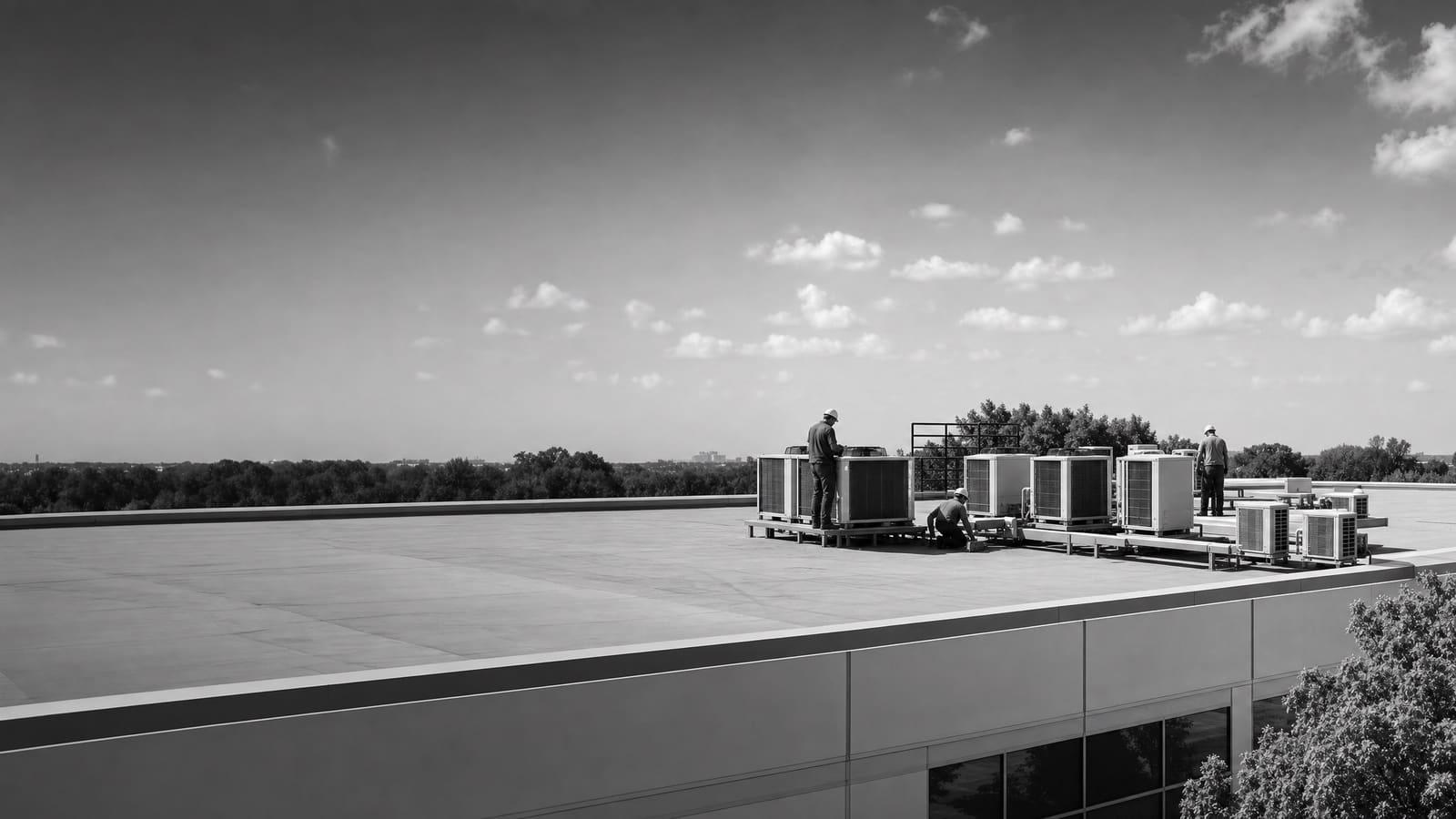
A commercial HVAC replacement covers the load calculation, the unit, the curb adapter, crane rigging, gas and electrical connections, controls, permits, and commissioning. Replacement usually beats another repair once a unit is past fifteen years old. Old, inefficient rooftop equipment has been measured wasting roughly $900 to $3,700 per unit every year in energy, which is often more than the repair you were about to authorize.
A site review still has to confirm roof structure, curb footprint, electrical capacity, and the gas line before a tonnage or fuel choice is real.
YOUR OPTIONS
Three ways to spend the money
End of life gives you three real options, and they are not priced alike.
Advanced controls come first, because replacement is not always the answer. A unit that is mechanically sound but running a constant fan with no staging can be retrofitted with better controls and gain efficiency without a crane day. That is the right call when the compressor still has years in it.
Replacement with a higher-efficiency air-conditioning unit is the default once the equipment is genuinely finished. Minimum efficiency standards for commercial rooftop units were raised years ago, so even a like-for-like tonnage swap lands a better machine than the one coming off.
A heat pump rooftop unit is the third path. It adds reverse-cycle heating and changes your fuel mix, which makes it an electrical and gas-price decision more than a comfort one.
WHAT MOVES THE PRICE
The lines that decide your number
Nobody can price your roof from a search result. What a quote can do is name every line that moves, so two bids can be read side by side. These are the ones that move most.
IN PRACTICE
When replacement is the better buy
Most commercial rooftop replacements happen the worst possible way. The unit fails in season and the building buys whatever is available. Rooftop units cool nearly half of all commercial floor space in the country, so this is the most common capital decision a facility owner makes, and it is usually made under pressure.
The way out is knowing your fleet's age before the failure. A unit past fifteen years is already spending money you cannot see, and the high-efficiency specification that drove the current generation of equipment was written to cut energy use by up to half against the older standard.
Planned replacement also buys the two things emergency replacement cannot: choice of equipment and a real load calculation. Sizing from the old nameplate carries forward whatever mistake was made twenty years ago, plus every change in occupancy, lighting, plug load, and envelope since. Rockford's mechanical permit application has a line for load calculations for exactly that reason. Confirm the load, then choose the unit.
SIDE BY SIDE
What makes this job simple, and what makes it hard
Two replacements at the same tonnage can differ by weeks of schedule and by a large multiple in price. The difference is almost never the unit itself. It is what the building makes you touch on the way in.
LOWER COMPLEXITY
Matched swap, open access
Same tonnage, same fuel, the existing curb fits, electrical service is already sized, and the crane can reach the unit from a lot you can close for a morning. Permits stay routine and inspection is straightforward.
HIGHER COMPLEXITY
New footprint or new fuel
Larger tonnage, an all-electric conversion, or more than half the ductwork replaced. Now you are looking at structural review, panel capacity, a separate gas permit if the gas line changes, and a schedule phased around occupancy.
BEFORE THE QUOTE
What a site review has to answer
A real number comes from a roof visit, not a phone call, and the visit is working through a short list.
Electrical capacity is first. A heat pump or a larger unit can exceed what the existing panel and feeders will carry, and finding that out after the order is placed is what turns a clean project into a change order. The permit application asks for amperage on rooftop units, so the answer has to exist on paper anyway.
Physical constraints are second. Curb dimensions, roof structure, clearances, and crane reach decide whether the new unit lands on the existing curb or on an adapter, and whether structural review gets triggered.
Gas lines are third. If the replacement changes gas input, the piping is its own scope with its own permit and its own inspection.
Then the load. Occupancy, hours, plug load, and envelope have all moved since the last unit went in. The nameplate tells you what was installed, not what the space needs now.
Equipment availability closes the list. The best selection on paper is the wrong one if it lands after your season.
Ask for these before you sign
Amp draw and BTU input for the exact unit, curb condition with photos, panel capacity confirmed, gas scope named on its own line, and a lead time with a date on it rather than a range.
IN ROCKFORD
What the city's process changes
Rockford runs mechanical work through a licensed-contractor system. Mechanical contractors have to hold a City of Rockford mechanical license, which means passing an examination approved by the Mechanical Board. Registrations run the calendar year and have to be renewed annually, so ask for the current-year license before the crane is scheduled, not after.
The permit application also shows how the city reads the job. A rooftop unit is listed with replace-or-new-build, amperage, and BTUs. Ductwork is a separate declaration with a threshold at fifty percent, so replacing more than half of it is a different scope than patching into what exists. And the form states plainly that gas piping and HVAC are separate permits, which makes a gas-fired replacement two applications rather than one.
Two permits, not one
If your replacement touches the gas line, budget for a gas piping permit alongside the mechanical permit, and confirm whether the run is high pressure at one psi or above. A quote showing a single permit line has not been scoped.
OWNERSHIP
Two questions ownership has to settle
Two things decide more about a rooftop replacement than the equipment does, and both are ownership questions rather than engineering ones.
The first is who pays and who benefits. In a leased building, the landlord usually writes the check while the tenant's meter shows the savings. That split is why efficiency upgrades stall, and it is why lease language matters before the bid does.
The second is what you do with the rest of the roof. If you own four units of similar age, replacing them one failure at a time leaves you with four mismatched machines, four service manuals, and a parts strategy nobody can plan. Deciding the fleet approach once is cheaper than deciding it four separate times.
LEASE STRUCTURE
Who books the savings
Confirm before bidding whether the tenant or the owner captures the utility reduction. If they are different parties, the efficiency tier becomes a negotiation rather than a spec decision.
FLEET
One roof, several units
Similar-age units fail on a similar timeline. Standardizing the replacement gives you one parts strategy and one service contract instead of a mixed fleet nobody can stock for.
PLANNING AHEAD
Phasing, procurement, and the number that matters
If more than one unit on your roof is near end of life, phase the work deliberately. Replacing on failure means paying emergency premiums, taking whatever tonnage sits in the warehouse, and losing any chance to standardize. Replacing on a schedule means you order in the shoulder season, you pick the equipment, and you close the lot on a day that suits the building instead of the weather.
Procurement follows the same logic. Lead time belongs on the quote next to price, because a unit that arrives six weeks late was never the cheaper option. If an incentive is part of your math, confirm the program is currently open and that your equipment qualifies before the order goes in. Terms change, and an expired program is worth nothing.
The number that matters is not the installed price on its own. It is that price plus the energy the unit will spend across the fifteen or more years it sits on your roof. That is why the efficiency tier is worth arguing about and the brand usually is not. Across more than forty-three thousand rooftop units upgraded nationally, participating organizations reported a combined thirty-seven million dollars in annual energy savings.
THE QUOTE
Five things a comparable quote has to show
Two bids are only comparable when they name the same scope. If one of these is missing, you are not comparing price. You are comparing assumptions.
01
The exact unit
Model, tonnage, efficiency tier, BTU input, and amp draw, which are the same values the permit application asks for.
02
Curb and roof scope
Whether the unit lands on the existing curb or an adapter, and whether structural review is triggered.
03
The crane day
Rigging plan, lot closure hours, reach, and who makes the call if weather turns.
04
Permits, listed separately
The mechanical permit, plus a gas piping permit on its own line if the gas scope changes.
05
Startup and closeout
Charge, airflow, and controls verified against spec, plus documented recovery of the old refrigerant.
Get a defensible number
Price the equipment and the building together.
Send the address, operating target, and target opening date. Flux will identify what must be verified before the project can be priced.
Get a free estimateQuestions
Straight answers.
When is replacing a rooftop unit better than repairing it again?
Once a unit is past fifteen years, the math usually flips. Old, inefficient rooftop equipment has been measured wasting roughly $900 to $3,700 per unit per year in energy, and that runs whether or not you authorize the repair. Frequent service calls and inadequate conditioning are the other two signals.
Does a commercial HVAC replacement in Rockford need more than one permit?
Often, yes. The city's mechanical permit application states that gas piping and HVAC are separate permits, so a gas-fired replacement that touches the piping needs both. The contractor also has to hold a current City of Rockford mechanical license, which is renewed every calendar year.
Should a Rockford building switch to a heat pump rooftop unit?
It depends on climate and infrastructure, not preference. Heat pump efficiency drops as outdoor temperatures fall and trends toward electric resistance performance, which is why dual-fuel and cold-climate versions exist. Confirm electrical capacity, the winter heating plan, and your gas and electric prices before choosing.
Can we upgrade the controls instead of replacing the unit?
If the unit is mechanically sound but running without staging or economizer logic, an advanced controls retrofit is a legitimate alternative and avoids a crane day entirely. It is the wrong call when the compressor is near the end of its life, because you are improving a machine that is about to leave.
What happens to the refrigerant in the old unit?
Federal Clean Air Act rules govern how refrigerant in stationary air-conditioning equipment is handled and recycled. The old charge must be recovered by a certified technician rather than vented, and that recovery should appear in your closeout documents. Ask which refrigerant the new unit uses so your service contract matches.
Sources used for this guide
- [1]betterbuildingssolutioncenter.energy.gov — DOE Advanced Rooftop Unit Replacement Guidance
- [2]betterbuildingssolutioncenter.energy.gov — DOE Commercial Heat Pump Rooftop Unit Replacement Guidance
- [3]betterbuildingssolutioncenter.energy.gov — DOE High-Efficiency Commercial Rooftop Unit Toolkit
- [4]energy.gov — DOE Efficient Commercial Rooftop Air Conditioner Program
- [5]epa.gov — EPA Stationary HVAC Refrigerant Management
- [6]rockfordil.gov — rockfordil.gov