THE SHORT ANSWER
What a commercial HVAC replacement includes
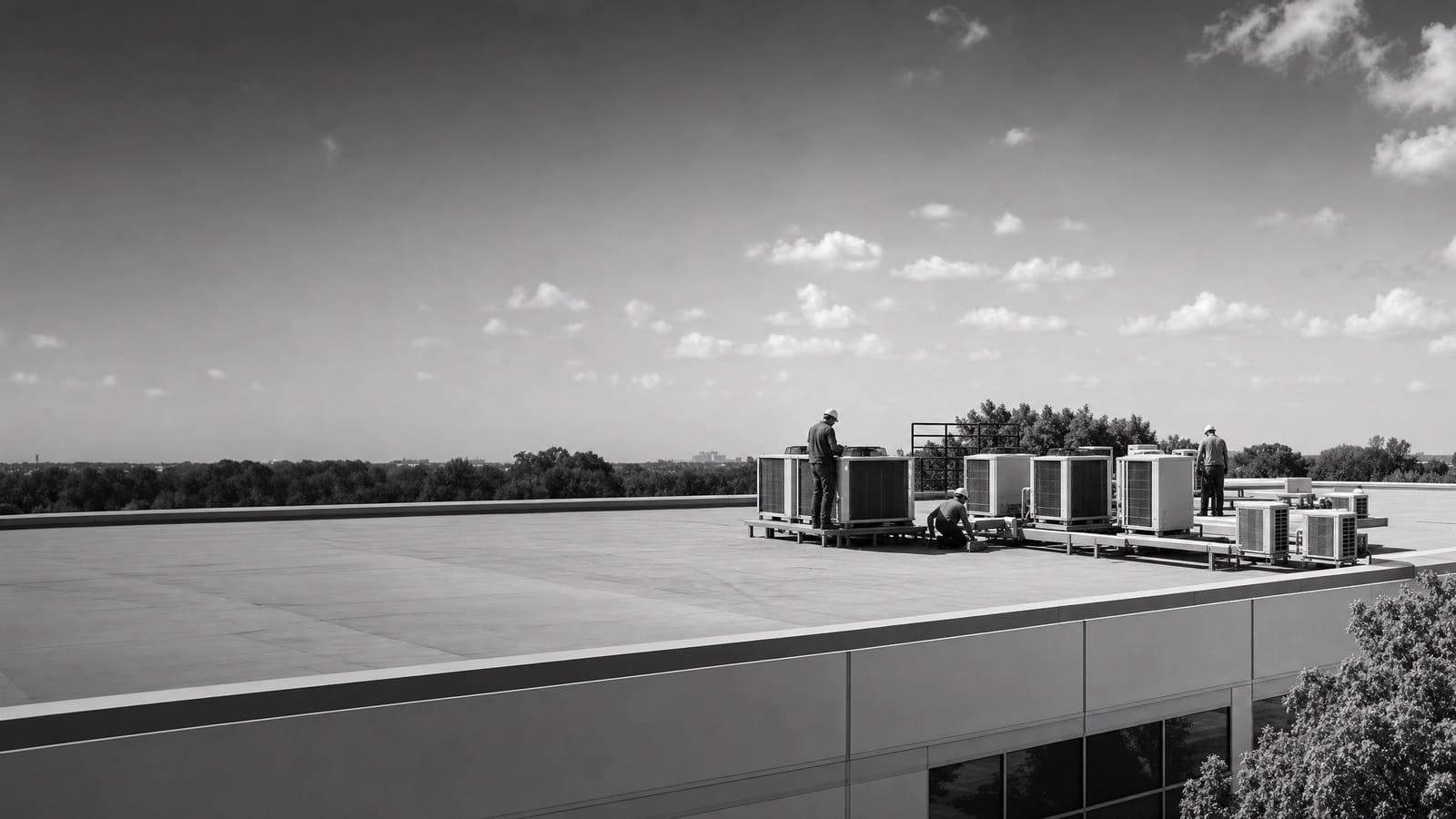
A commercial HVAC replacement covers the load calculation, equipment selection, rigging and set, a new roof curb, gas, electrical and refrigerant connections, controls integration, permits, and commissioning. Replacement beats another repair once a rooftop unit passes about fifteen years. Units that old waste substantial energy — federal figures put it at roughly $900 to $3,700 per unit each year — and repair spending buys none of that back.
A site review still has to confirm tonnage against current occupancy, roof structure at the curb, available electrical capacity, and whether the existing gas service stays in the design.
THREE PATHS
Three ways to replace a rooftop unit here
Rochester winters are the whole conversation. Heat pump heating efficiency falls as outdoor temperature drops, and at the bottom of the range it trends toward the cost of electric resistance heat. Federal guidance treats today's standard heat pump rooftop units as a comfortable fit for mild-to-moderate winter heating, which is not what a Minnesota January is. That does not rule electric out. It means the choice is between three product families rather than a yes-or-no on heat pumps, and each one carries different infrastructure work. Before picking, settle three things the guidance flags: electrical capacity at the panel, physical room on the roof and in the chase, and whether the gas line stays or gets abandoned. Those answers usually decide the path faster than the efficiency spec does.
WHAT MOVES THE NUMBER
Where a replacement budget actually goes
There is no honest per-ton price that survives a real roof. These are the lines that separate two quotes on the same building, ordered roughly by how often they surprise an owner after the paperwork is signed.
BUYING GUIDANCE
Replace on your schedule, not the equipment's
Rooftop units condition close to half of all commercial floor space in the country, so the way most owners handle them is also the way most buildings quietly waste money. The common pattern is to wait: patch the unit until it can no longer hold the space, then buy whatever can be craned in this week. Federal guidance is blunt about that pattern. Replacing an inefficient unit on purpose usually beats both replacement-on-failure and a like-for-like swap at the end of service life, because a failure in July removes every option except the one sitting on a distributor's floor.
There is a middle path worth pricing. Where a unit is structurally sound but poorly controlled, retrofitting advanced controls instead of replacing the box can be the better financial answer, and the national campaign built around this work treats replace-or-retrofit as a real fork rather than a formality. Ask for both numbers. More than two hundred organizations upgraded over 43,000 units through that campaign and cut a combined $37 million a year from their energy bills — the scale of difference that efficiency tiers and controls make when they are chosen deliberately instead of under pressure.
COMPLEXITY CHECK
What makes a replacement simple or hard
Two buildings can run the same tonnage and land in very different projects. The split is rarely the equipment itself. It is the roof, the panel, and how much of the old installation the new unit is allowed to inherit.
LOWER COMPLEXITY
Straight swap, same fuel
Same tonnage, same heating fuel, a roof with structural capacity for a taller curb, clear crane access, and electrical service that already covers the new draw. Permits stay mechanical and electrical, and the schedule is driven mostly by lead time.
HIGHER COMPLEXITY
Resizing or going electric
Tonnage changes, the footprint grows, or the unit switches to electric heat. Now you may be adding curb height, proving the roof can carry it, upsizing a feeder, and coordinating a service change before anything gets craned.
SCOPING THE JOB
What a site review has to settle before pricing
A quote written from a nameplate photo is a starting number, not a price. The nameplate tells you what somebody sized years ago for a building that has since changed its occupancy, its lighting, its plug load, and often its walls. A real review starts by confirming the load against how the space is used now, then works down through the things that cost money to discover late.
On the roof, that means the structure under the curb, the condition and height of the existing curb, and whether the crane can reach the set point without closing more of the lot than tenants can absorb. Inside, it means panel capacity and spare breaker space, the fate of the gas line, and where the controls wiring lands. Federal guidance also flags two practical items owners skip: whether the equipment you want is actually available in your timeframe, and whether the contractors near you have installed that equipment type before. Both belong in the conversation before you commit to a technology, not after the purchase order.
Refrigerant is not a line you can skip
EPA rules under Section 608 of the Clean Air Act govern how refrigerant is handled and recovered from stationary cooling and heat pump equipment. Recovery from the old unit is regulated work, so it belongs in the written scope with the technician certification behind it.
MINNESOTA CODE
The roof curb rule that changes Rochester replacements
Minnesota amended its energy code in a way that lands directly on rooftop replacements. Under the state provisions, new and replacement rooftop HVACR equipment must be set on new insulated curbs unless that is technically infeasible, and mechanical curbs must be insulated to the level required for roofs. The state set the performance standard at R-10 curb insulation, plus a curb height tall enough for a future roof covering replacement to carry code-compliant insulation depth with enough freeboard to keep positive drainage. The reasoning is sequencing: more insulation will be required the next time the roof is replaced, so the cheapest moment to raise the curb is while the equipment is already coming off. Reusing an old curb or a thin adapter is not the default here.
Ask who certifies the roof
If the existing roof structure cannot carry the required curb height, the state's opinion is that technical infeasibility must be demonstrated and certified by a licensed structural engineer for that portion of the roof. Confirm in advance who pays for that review.
OWNERSHIP VIEW
Two things that outlive the install
The install is a short, scheduled event. The decision runs for the entire service life of the unit — operating cost, service contracts, and parts availability. Two questions shape how well that stretch goes, and neither shows up on a side-by-side price comparison. The first is what the building's fleet looks like after this unit lands: one odd machine nobody stocks parts for, or the first piece of a deliberate standard. The second is who owns the building versus who pays the utility bill, because that split decides whether a higher efficiency tier is worth buying at all.
FLEET STANDARD
One unit or the start of a plan
If the roof carries several units of similar age, replacing them one emergency at a time produces a mixed fleet with mixed refrigerants and mixed controls. Setting a standard now makes every later replacement cheaper to spec and easier to service.
WHO BENEFITS
Lease structure and efficiency
Where the tenant pays the energy bill, the owner who buys a higher efficiency tier collects none of the savings directly. Sort that out before comparing quotes, because it changes which quote is actually the better one.
PHASING AND PROCUREMENT
Sequencing replacements across a roof
Most buildings do not replace one unit. They replace one unit now and several more over the following years, usually in the order the units fail. That order is expensive. A better sequence starts with a condition survey of everything on the roof, ranks units by age and run hours, and pairs the replacement schedule against the roof covering's remaining life. If the membrane has a few years left, the curb height you set today is the one you will live with when the roofer arrives, and it costs far less to get curbs right across a planned sequence than to discover the problem one unit at a time.
Procurement follows the same logic. Lead time, not labor, is usually what decides when a project can happen, so equipment availability belongs on the quote next to the price rather than in a phone call after the deposit. If electric heat is on the table for any unit, run the electrical capacity study once for the whole roof instead of unit by unit, because service capacity is a building question. And where a heat pump makes sense on one unit but not another, splitting the fleet on purpose is a legitimate answer — as long as whoever holds the service contract knows about it.
QUOTE CHECKLIST
Five things a comparable quote has to show
Two quotes are only comparable when both spell out the same scope. If one is missing any of these, you are not looking at a cheaper price. You are looking at a smaller job that will grow.
01
The load basis
Whether the tonnage came from a calculation of how the space is used now, or was copied off the old nameplate.
02
Curb scope
The new insulated curb, its height, and any adapter — stated explicitly rather than assumed.
03
Structural and electrical
Who verifies roof capacity and panel capacity, and what happens to the price if either one falls short.
04
Crane day and access
Rigging plan, lot closure hours, and which party coordinates tenants, permits, and inspections.
05
Commissioning and records
Startup readings, refrigerant charge, airflow, controls setup, and the documentation that keeps the warranty intact.
Get a defensible number
Price the equipment and the building together.
Send the address, operating target, and target opening date. Flux will identify what must be verified before the project can be priced.
Get a free estimateQuestions
Straight answers.
When is replacement better than one more repair?
Once a rooftop unit is past about fifteen years, it can waste a substantial amount of energy compared with a current model — federal figures put the range near $900 to $3,700 per unit annually. Repair spending recovers none of that, and waiting until failure removes your ability to choose the equipment.
Do heat pump rooftop units work for commercial buildings in Rochester?
They can, but the cold matters. Heat pump heating efficiency falls as outdoor temperature drops and eventually trends toward electric resistance cost, so the practical options here are dual-fuel or cold-climate units rather than a standard heat pump. Confirm electrical capacity before committing to either.
Does a rooftop replacement need a new roof curb in Minnesota?
Generally yes. State code provisions call for new insulated curbs on new and replacement rooftop equipment unless it is technically infeasible, with an R-10 insulation standard and a curb height that supports a future code-compliant roof assembly and positive drainage. Infeasibility requires certification by a licensed structural engineer.
How long does a rooftop unit replacement take?
The lift and connection is a short, scheduled event once everything is staged. Equipment lead time is what usually governs the calendar, which is why availability belongs on the quote next to the price rather than being discovered after the order goes in.
What does a commercial HVAC installation cost?
There is no honest universal number, because tonnage, heating type, curb and structural work, electrical capacity, and crane access all move it. Ask for those as separate lines. That is the only way two quotes on the same roof can be compared fairly.
Sources used for this guide
- [1]betterbuildingssolutioncenter.energy.gov — DOE Advanced Rooftop Unit Replacement Guidance
- [2]betterbuildingssolutioncenter.energy.gov — DOE Commercial Heat Pump Rooftop Unit Replacement Guidance
- [3]betterbuildingssolutioncenter.energy.gov — DOE High-Efficiency Commercial Rooftop Unit Toolkit
- [4]energy.gov — DOE Efficient Commercial Rooftop Air Conditioner Program
- [5]epa.gov — EPA Stationary HVAC Refrigerant Management
- [6]dli.mn.gov — Division opinion: Insulation and curb heights at replacement rooftop HVACR