THE DIRECT ANSWER
Commercial HVAC replacement and installation in Rochester Hills.
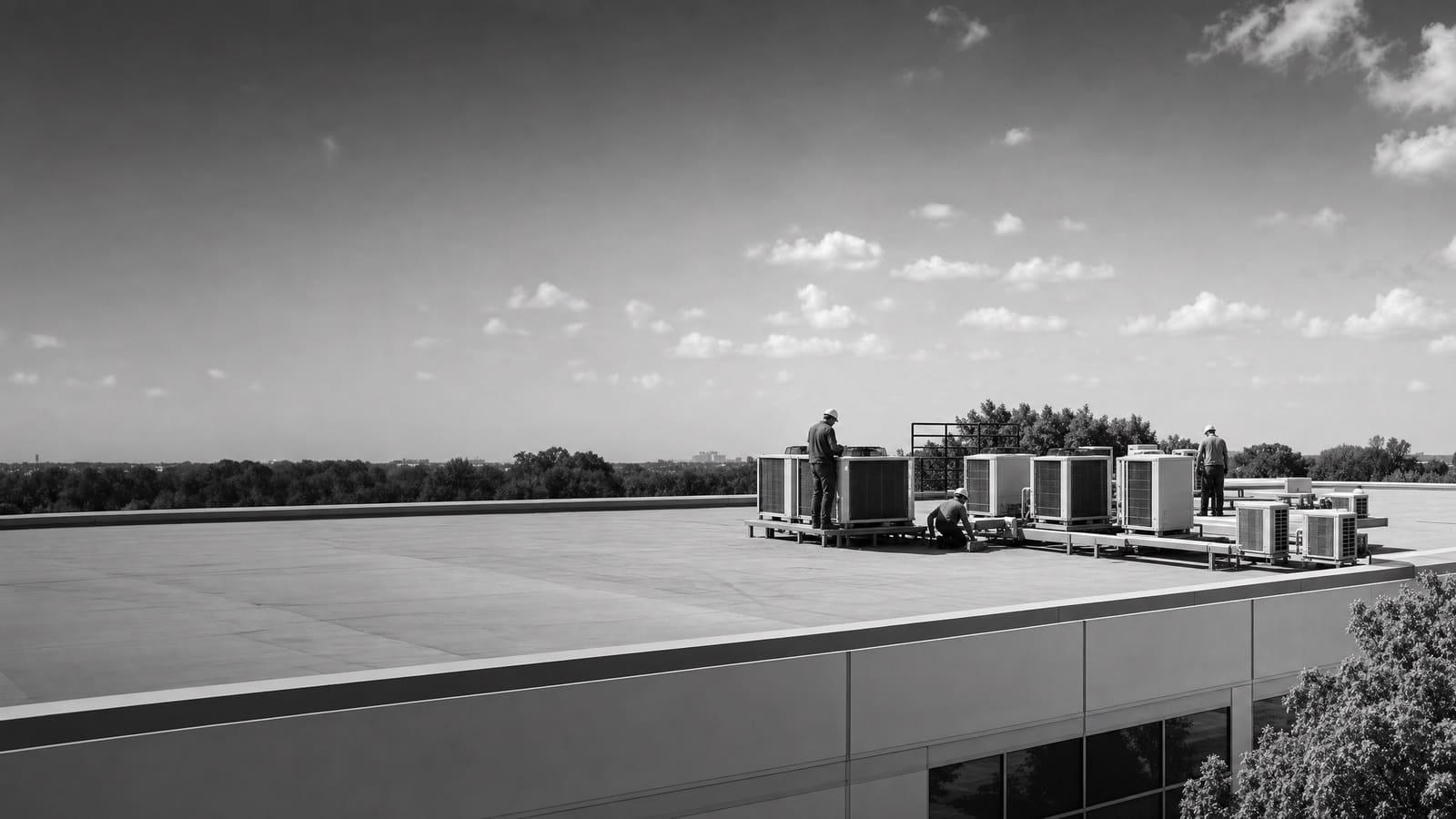
A complete commercial HVAC replacement covers sizing, equipment selection, removal, rigging, connections, controls, startup, and commissioning. Replacement becomes more useful than another repair when an aging unit no longer conditions the space well, needs frequent service, or puts operations at risk. The goal is not just new equipment. It is reliable performance under the building’s real load.
A site review should verify the load, equipment condition, roof and curb, utility connections, electrical capacity, controls, access, and shutdown limits.
THREE OPERATING CHOICES
Choose the replacement path before choosing a model
Start with the business problem. A failed unit may call for a fast replacement, but speed should not hide a sizing error or connection change. A planned end-of-life project gives the owner more time to compare efficiency, heating type, controls, and electrical needs. A heat pump rooftop unit adds another decision: all-electric, dual-fuel, or another arrangement suited to the site.
DOE guidance says rooftop units more than 15 years old may waste substantial energy compared with newer equipment. It also notes that owners often wait until comfort falls, repairs become frequent, or the unit fails. A proactive project can reduce emergency pressure and create time for a better technical review. Age alone does not settle the decision. Service history, refrigerant condition, operating risk, and present building use matter too.
BUDGET DRIVERS
What belongs behind the installed price
There is no sound universal installed price for a commercial HVAC project. The quote should expose the work that can change the total before construction begins.
EQUIPMENT FIT
Match the system to the building, not the old nameplate
A packaged rooftop unit combines major heating and cooling functions in one outdoor cabinet. It can be a practical replacement when the building already has compatible ductwork, roof support, service access, and utility connections. A split system separates indoor and outdoor components. It may fit spaces where roof conditions, zoning, or existing distribution make a packaged unit less useful. Larger or more complex buildings may need an engineered central system instead of a simple equipment swap.
Do not select capacity from the old nameplate alone. The original unit may have been oversized, undersized, or selected for a use that no longer exists. Review occupied hours, people, lighting, process equipment, ventilation, envelope conditions, and problem zones. Also ask whether one large comfort zone should become several controlled zones.
Efficiency matters, but the best catalog rating does not guarantee the lowest operating cost. Controls, fan operation, heating fuel, local utility rates, maintenance, and actual load all shape performance. Ask bidders to state the design assumptions and explain why the proposed system fits. That makes a technical choice easier to compare and less likely to become a comfort problem after installation.
PROJECT COMPLEXITY
A box swap and a building change are different projects
Two units with similar capacity can require very different labor and planning. Separate the equipment purchase from the conditions required to make it work safely and correctly.
LOWER COMPLEXITY
Compatible replacement conditions
The load remains suitable, the curb and duct openings align, utilities have enough capacity, controls are simple, and the work area is easy to reach. The quote can focus on removal, setting, connections, startup, and closeout.
HIGHER COMPLEXITY
Changed building conditions
Capacity, weight, dimensions, fuel, power, ventilation, zoning, or control needs have changed. Engineering, structural review, adapters, distribution work, electrical upgrades, temporary conditioning, or staged shutdowns may be needed.
SITE REVIEW
Find scope gaps before the old equipment leaves
Begin with records and field evidence. Gather nameplate data, service history, control information, drawings if available, operating schedules, utility bills, and a list of comfort complaints. Then inspect the equipment and trace every connection. A roof visit should look beyond cabinet dimensions. The survey should address curb condition, duct transitions, drainage, access paths, service clearances, nearby obstructions, and how the old unit can be removed.
For heat pump rooftop units, DOE guidance identifies climate, electricity and gas prices, building type, equipment availability, electrical capacity, physical constraints, gas lines, contractor knowledge, and incentives as decision factors. That list is useful even when the final choice is not a heat pump. It forces the buyer to test the building around the proposed equipment.
The review should also define what happens during the outage. Identify spaces that cannot lose conditioning, acceptable work hours, roof and parking restrictions, tenant notices, security needs, and temporary measures. A clear shutdown plan lets bidders price the same operating conditions instead of hiding assumptions in exclusions.
Ask for a written basis of design
It should state the load assumptions, selected capacity, heating approach, ventilation, filtration, controls, utility needs, and known site constraints. This gives the owner a record of why the system was chosen.
OWNERSHIP VIEW
Balance first cost with operating exposure
A low bid can be reasonable when it covers the same equipment, field work, controls, testing, and closeout as the other bids. It is not comparable when it omits access work, adapters, utility changes, controls integration, or commissioning. Review exclusions with the same care as the total.
Also look past the first day. Filters, belts, sensors, refrigerant service, control access, parts availability, and staff familiarity shape ownership. EPA refrigerant rules govern the handling and recycling of refrigerants in stationary air-conditioning and heat-pump equipment. The scope should identify lawful recovery and the disposition of refrigerant and removed equipment.
CAPITAL DECISION
Protect the project budget
Set allowances only where a condition cannot be verified. Define who owns engineering, rigging, roof work, utility changes, controls, testing, and corrective work.
OPERATING DECISION
Protect the years after startup
Compare energy use, maintenance access, service support, controls, warranties, refrigerant strategy, and the cost of losing conditioning in critical areas.
DELIVERY PLAN
Phase the work around operations and equipment risk
Planned replacement gives an owner leverage that emergency replacement does not. Survey units before they become urgent. Group equipment by condition, service history, operational importance, and technical similarity. Replace the highest-risk units first while keeping enough flexibility for an unexpected failure elsewhere.
For several rooftop units, decide whether one mobilization or several smaller phases is safer. A combined project may simplify procurement, rigging, controls standards, and staff training. Smaller phases can limit shutdown exposure and spread capital needs. The right answer depends on which spaces each unit serves and whether the facility can operate during the work.
Procurement should follow the approved technical scope. Confirm the exact model, options, dimensions, weight, connection locations, electrical data, controls interface, warranty terms, and expected availability before release. Substitutions should receive the same review as the original selection. Before the lift or shutdown, hold a readiness check covering delivered materials, adapters, utility work, access, weather limits, safety controls, temporary service, and responsible contacts. Good phasing turns installation day into the execution of a tested plan instead of a chain of field decisions.
COMPARABLE QUOTES
Five things every commercial HVAC quote should show
Require each bidder to respond to the same scope. These five items reveal major differences without forcing the owner to decode a pile of product sheets.
01
Exact equipment and design basis
List model, capacity, efficiency, heating type, options, ventilation, filtration, and the assumptions used to select it.
02
Complete installation scope
Define removal, recovery, rigging, curb, duct, roof, drain, gas, electrical, controls, protection, and disposal work.
03
Schedule and outage plan
Show procurement assumptions, work sequence, shutdown needs, occupied-area controls, temporary measures, and responsibilities.
04
Startup and proof of performance
Include airflow, temperatures, refrigerant checks, heating and cooling operation, controls tests, alarms, and recorded results.
05
Exclusions and closeout
State exclusions, allowances, change-order rules, warranties, training, manuals, test records, and final equipment information.
Get a defensible number
Price the equipment and the building together.
Send the address, operating target, and target opening date. Flux will identify what must be verified before the project can be priced.
Get a free estimateQuestions
Straight answers.
When should a commercial rooftop unit be replaced instead of repaired?
Replacement deserves serious review when an older unit cannot hold comfort, needs frequent service, suffers a major failure, or creates too much operational risk. DOE guidance notes that rooftop units more than 15 years old can waste substantial energy compared with newer models. Age is one input, not an automatic cutoff. Compare the repair, recent service history, parts outlook, energy performance, refrigerant condition, and cost of another unplanned outage.
Should the new commercial HVAC unit match the old capacity?
Only after the present load is checked. A matching nameplate can be useful when the building use and load remain stable, but it can also repeat an old sizing error. Review occupancy, operating hours, ventilation, internal equipment, envelope changes, and comfort history. The proposal should explain the sizing basis rather than simply state that the replacement matches the old unit.
Is a commercial heat pump rooftop unit a good replacement option?
It may be, but the site has to support it. Compare all-electric, dual-fuel, and other available configurations against heating demand, electricity and gas costs, electrical capacity, backup heat, physical constraints, equipment availability, maintenance support, and emissions goals. Ask for modeled operating assumptions. Do not treat the equipment label alone as proof of savings.
What should happen during HVAC commissioning?
Commissioning should prove that the installed system operates as intended. The team should verify airflow, temperature response, heating and cooling stages, fan operation, refrigerant conditions, sensors, ventilation, schedules, setpoints, safeties, alarms, and controls integration as applicable. The owner should receive recorded results, corrected deficiencies, operating information, warranty documents, and training before final acceptance.
How can owners compare commercial HVAC installation bids?
Give bidders one written scope and require the exact equipment, options, field work, controls, rigging, startup, commissioning, schedule, warranties, exclusions, and allowances to be shown. Normalize differences before comparing totals. A bid that excludes roof work, electrical changes, controls integration, or testing is not directly comparable with one that includes those items.
What refrigerant work belongs in a replacement scope?
The scope should identify recovery of refrigerant from removed equipment, qualified handling, documentation, disposal or recycling responsibilities, and the refrigerant used by the new system. EPA rules address handling and recycling for stationary air-conditioning and heat-pump equipment. Owners of mixed equipment fleets should also record refrigerant types so future service planning is clear.
Sources used for this guide
- [1]betterbuildingssolutioncenter.energy.gov — DOE Advanced Rooftop Unit Replacement Guidance
- [2]betterbuildingssolutioncenter.energy.gov — DOE Commercial Heat Pump Rooftop Unit Replacement Guidance
- [3]betterbuildingssolutioncenter.energy.gov — DOE High-Efficiency Commercial Rooftop Unit Toolkit
- [4]energy.gov — DOE Efficient Commercial Rooftop Air Conditioner Program
- [5]epa.gov — EPA Stationary HVAC Refrigerant Management