THE SHORT VERSION
What a commercial HVAC replacement actually includes
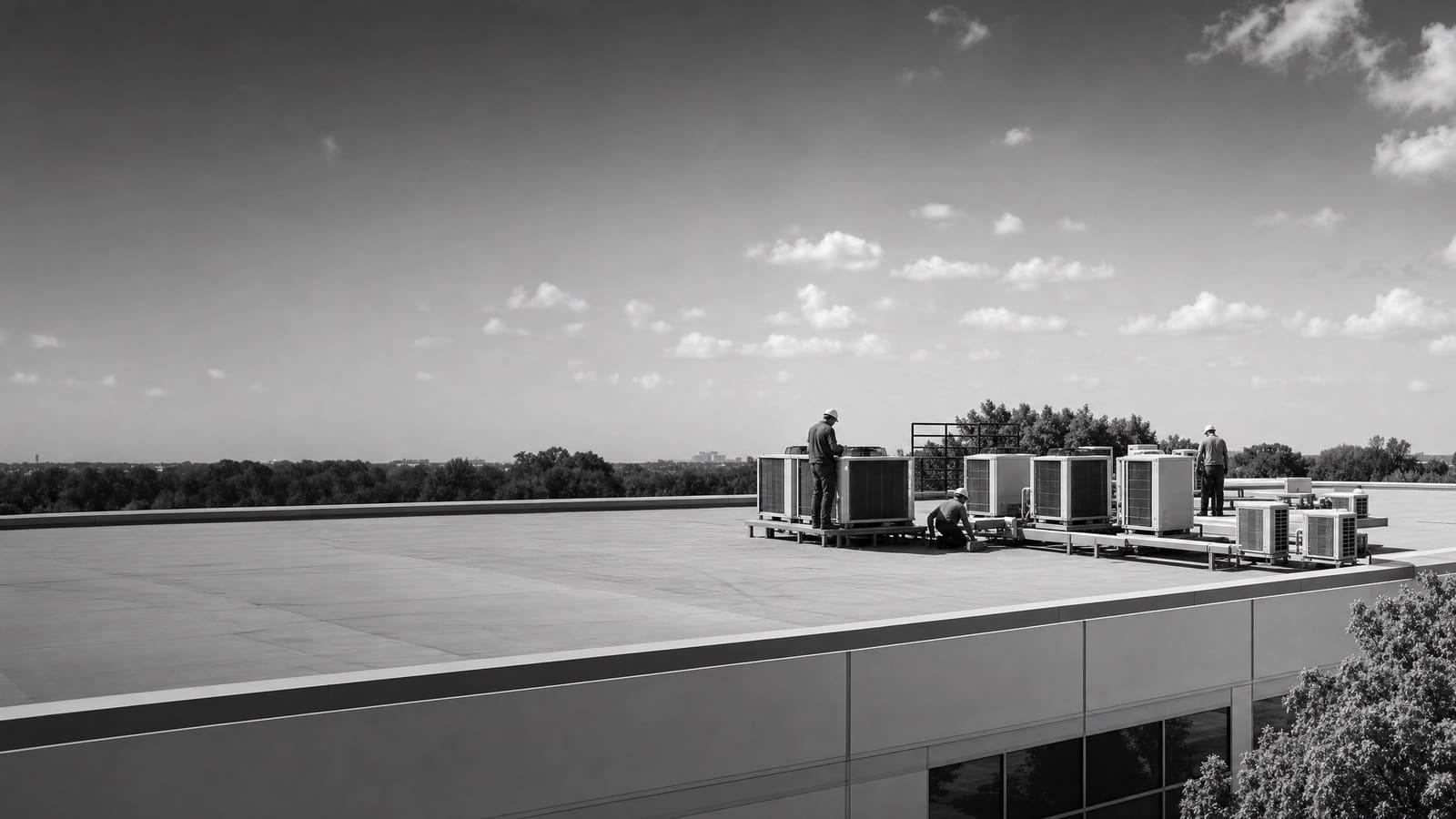
A commercial HVAC replacement confirms the load for how the building is used today, selects equipment that is actually available, sets the unit with a crane, reconnects power, gas, and controls, then commissions it against spec. Replacement beats one more repair when the unit itself has become the recurring cost. Old, inefficient rooftop units waste roughly $900 to $3,700 each every year, and units past fifteen years are usually the ones doing it. That yearly waste often outruns the repair bill you are trying to avoid.
A site review still has to verify curb size and roof structure, available electrical capacity, existing gas service, economizer and controls condition, and whether a crane can actually reach the unit.
THREE WAYS TO GO
Three replacement paths worth pricing
Rooftop units condition nearly half of all commercial floor space in the country, so most replacement decisions come down to what kind of unit goes back on the curb. The cheapest bid is almost always a like-for-like swap, and on a building whose use has not changed, that can be the right call.
The equipment market has moved, though. High-efficiency rooftop units built to the federal performance specification were designed to cut energy use by as much as half compared with the older standard, and more than twenty models now exceed that specification. Heat pump rooftop units are the same basic machine with reverse-cycle heating added, and they come in dual-fuel, all-electric, and cold-climate versions.
Price all three rather than assuming. The difference is not only first cost. It is what the unit spends every year for the rest of its service life, and whether your electrical service, your gas service, and your winter heating load can support the option that looks best on paper.
WHAT MOVES THE NUMBER
The lines that decide your installed price
Nobody can quote a commercial replacement from tonnage alone. These are the lines that separate a clean swap from a project. Ask about each one before you compare two bids that look identical on the cover page, because this is usually where the difference between them lives.
IN PRACTICE
Buy the replacement, not just the unit
The most expensive habit in commercial HVAC is waiting. Most facility teams delay a replacement until the unit no longer holds the space, needs constant service, or fails outright, and then they buy whatever can be delivered fastest. Replacing proactively, with time to compare equipment, generally beats both replacement-on-failure and a reflexive like-for-like swap at the end of a unit's service life.
The second habit is buying against the old nameplate. That number describes the building as it was when the unit went in. Occupancy, plug loads, lighting, and the envelope have all changed since. Ask for the load calculation, not the tonnage that happens to match the curb you already have.
The third is treating the quote as a price for a box. You are buying the box, the rigging, the curb work, the connections, the controls integration, and the commissioning that proves the machine performs the way the submittal says it will. A bid that leaves one of those out is not cheaper, it is less complete. Give every bidder the same scope in writing so the numbers actually mean the same thing when they come back.
SCOPE CHECK
Simple swap or real project?
Two replacements with the same tonnage can be very different jobs. Before you set a budget, work out which side of this line your building sits on. The answer comes from the roof, the electrical room, and how the space is used, not from the unit itself.
LOWER COMPLEXITY
A clean like-for-like set
Same tonnage, same fuel, and the existing curb either fits or takes a standard adapter. Power and gas are already sized for it. The lot gives the crane reach, and there is a window when the building is empty. This is a one-morning job with a short permit path.
HIGHER COMPLEXITY
Anything that changes the building
Larger tonnage, a switch to electric heating, a roof that needs structural review, or a unit tucked where the crane cannot reach. Add controls integration and phased work around occupied hours, and the schedule starts mattering more than the equipment price.
BEFORE YOU BUY
What a real site review has to answer
A site review is not a walk-around. It is a short list of questions that decide the scope, and each one has a wrong answer that shows up later as a change order.
Start with the load. How the space is used now, the hours it runs, and what the equipment inside the building contributes to the heat it has to remove. Then infrastructure. Is there electrical capacity at the panel and the service for the unit being proposed, especially if heating moves to electric? Is the gas line staying, being capped, or coming out? Will the curb take the new footprint, and does the roof structure carry the weight?
Then access and timing. Where the crane sets up, how much of the lot closes, how long the building can go without conditioning, and whether the work has to happen outside business hours. Finally, availability. A unit you cannot get for months is not really an option, and an honest quote says so up front instead of letting you find out after the deposit clears.
Ask every bidder the same five questions
What load calculation is this sized from? What does the curb and roof need? What electrical, gas, and refrigerant recovery work is included? What is the real availability date for this exact model? What does commissioning cover, and what document do I get at the end?
OWNERSHIP
Two things that outlive the install
The install ends. The ownership does not. Two decisions made during a replacement follow the building for the rest of the unit's life: what refrigerant your equipment runs on, and who stays responsible for keeping the new unit performing the way it did the week it was commissioned.
Neither one shows up in a bid comparison, and both show up in the operating budget. If you run more than one unit, think about them across the whole roof rather than one machine at a time. That is the real point of a staged replacement plan. Each unit you touch moves the building toward one service story instead of five different ones.
REFRIGERANT
Your equipment becomes mixed
New units ship on newer refrigerants, so a partial replacement leaves you running two generations side by side. Recovery, servicing, and technician certification are federally regulated either way. Plan parts and service coverage around that mix instead of being surprised by it in a heat wave.
PERFORMANCE
Efficiency is a setting, not a sticker
A high-efficiency unit only delivers if charge, airflow, economizer operation, and control setpoints stay where commissioning put them. Write the verification into the handoff, and put the unit on a maintenance schedule the day it starts, not the first summer it starts struggling.
PLANNING AHEAD
Phasing, procurement, and lifetime cost
If you own several units, the useful question is not which one to replace this year but what order to replace them in. Rank by age, run hours, and service history and the list tends to sort itself. The units past fifteen years old with the thickest repair files are usually the same ones quietly spending the most every month, so replacing them first helps fund the ones behind them.
This is not theory. More than two hundred organizations working through coordinated rooftop upgrade campaigns have replaced or retrofitted over 43,000 units, cutting a combined $37 million a year from their energy bills. The mechanism is unglamorous. They stopped replacing on failure and started replacing on a schedule.
Procurement follows the same logic. Order early enough that availability is not making the decision for you. Standardize on fewer models so parts, controls, and technician training stay simple. And look at incentives while you are still choosing equipment, not after the unit is set. Utility and federal programs commonly attach to efficiency tiers and to heat pump equipment, and the requirements usually turn on exactly which model you specify, so confirm them before the order goes in.
THE QUOTE
Five things a comparable quote shows
Bids only mean something when they cover the same scope. Ask for these five in writing and two quotes become genuinely comparable, or the gap between them turns out to be an exclusion rather than a discount.
01
The equipment, spelled out
Manufacturer, model, tonnage, efficiency tier, heating type, and refrigerant, not just "new rooftop unit."
02
Curb, roof, and rigging
Adapter or new curb, any structural work, crane size, lot closure time, and who pulls the permits.
03
Connections included
Electrical work, gas line changes, and refrigerant recovery from the old unit, priced rather than assumed.
04
A real availability date
Quoted lead time for that exact model, and what changes on your schedule if it slips.
05
Commissioning and documentation
Startup readings, airflow, charge, control setpoints, warranty registration, and the report you keep.
Get a defensible number
Price the equipment and the building together.
Send the address, operating target, and target opening date. Flux will identify what must be verified before the project can be priced.
Get a free estimateQuestions
Straight answers.
When does replacement beat another repair?
When the unit itself has become the cost. Rooftop units past fifteen years old can waste substantial energy compared with newer models, and an old, inefficient unit commonly burns $900 to $3,700 a year more than it should. Put that next to the repair history rather than only against the price of the current fix.
Should we put in a heat pump rooftop unit?
It depends on the building, not the trend. Heat pump rooftop units come in dual-fuel, all-electric, and cold-climate versions, and heating efficiency drops as outdoor temperatures fall, trending toward electric resistance in the coldest hours. The decision turns on your winter heating load, electrical capacity at the service and panel, what happens to the existing gas line, and what incentives apply.
How should the new unit be sized?
From how the space is used today. The old nameplate reflects the building as it was when that unit was installed, and occupancy, equipment, lighting, and the envelope have usually changed since. Ask to see the load calculation the selection came from.
Does the refrigerant change matter for us?
It matters for service planning more than for day one. New equipment ships on newer refrigerants, so a partial replacement leaves you running more than one generation at once. Handling, recovery, and technician certification are regulated under federal rules either way, so make sure your service coverage accounts for the mix.
Two bids are far apart. What now?
Compare scope before price. Most large gaps come from curb and structural work, electrical or gas changes, crane and lot closure time, controls integration, or commissioning being excluded from one bid. Ask both contractors to price the same written scope and the gap usually shrinks or explains itself.
Sources used for this guide
- [1]betterbuildingssolutioncenter.energy.gov — DOE Advanced Rooftop Unit Replacement Guidance
- [2]betterbuildingssolutioncenter.energy.gov — DOE Commercial Heat Pump Rooftop Unit Replacement Guidance
- [3]betterbuildingssolutioncenter.energy.gov — DOE High-Efficiency Commercial Rooftop Unit Toolkit
- [4]energy.gov — DOE Efficient Commercial Rooftop Air Conditioner Program
- [5]epa.gov — EPA Stationary HVAC Refrigerant Management