THE SHORT VERSION
What a commercial HVAC replacement actually includes
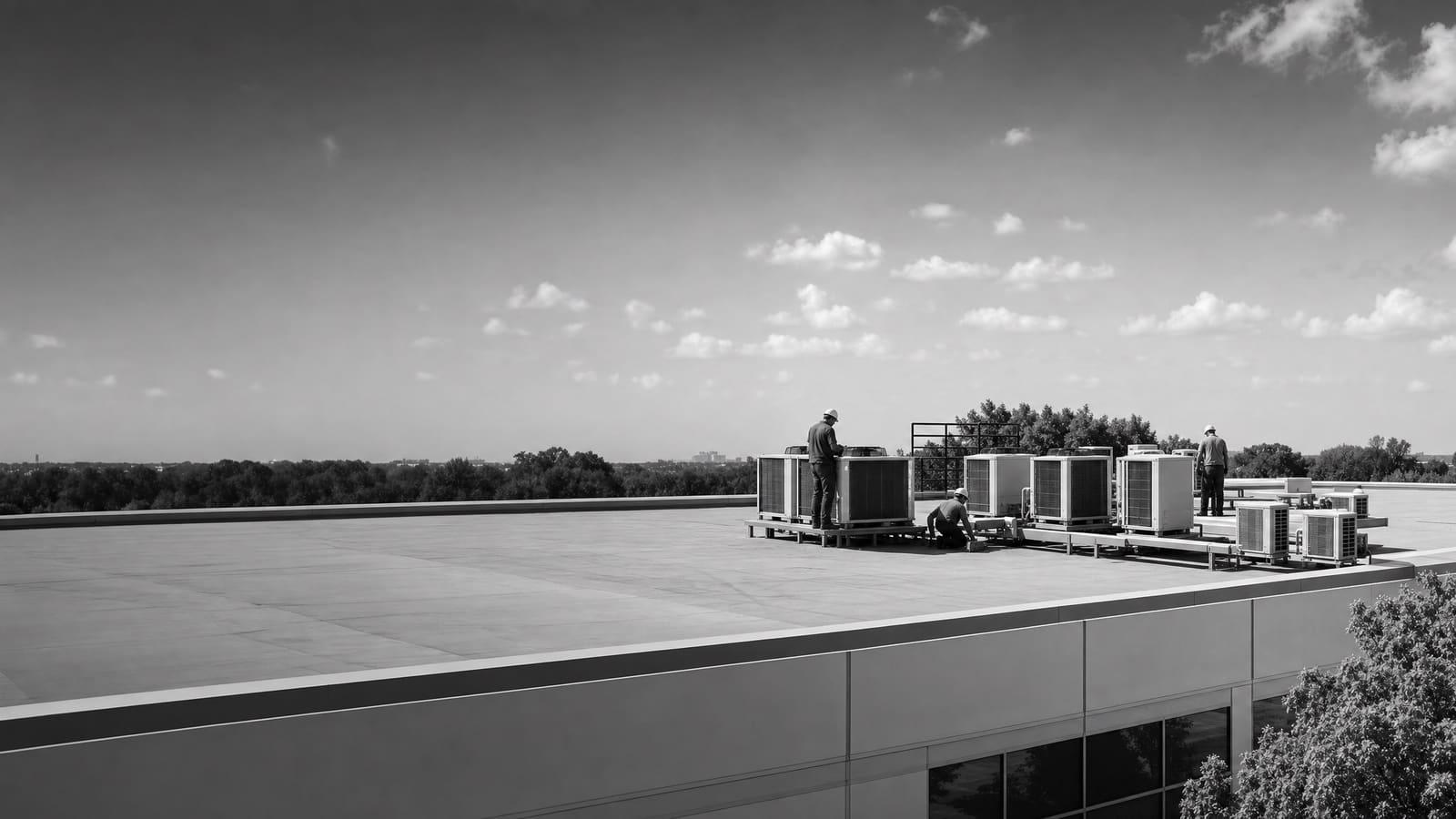
A commercial HVAC replacement is a load check, an equipment selection, a rigging and shutdown plan, and a commissioned startup — not just a new box on the same curb. Replacement beats another repair once failures start clustering and efficiency has slipped. Federal work on rooftop units found that old, inefficient units waste roughly $900 to $3,700 each per year, and that units more than 15 years old are the ones wasting the most.
A site review has to verify the curb and roof structure, the electrical service and gas line at the unit, crane access and reach, and whether today's occupancy still matches the old nameplate.
THREE PATHS
Three ways a commercial HVAC project can go
Most owners think the choice is repair or replace. In practice there are three, and federal guidance is blunt that the worst of them is waiting for a failure and then buying whatever can ship this week.
The first question is whether the existing unit still has service life. If it does, advanced controls can be worth more than new metal. If it does not, the real choice is between matching what is already there and stepping up to a higher-efficiency or heat pump unit — a decision that turns on electricity and gas prices, electrical capacity at the roof, winter heating load, and whatever incentives are open when you buy. Deciding that on a planned schedule gives you the whole menu. Deciding it during a July failure usually gives you one option.
WHAT MOVES THE NUMBER
The lines that move a commercial HVAC installation price
There is no universal installed price for a commercial unit, because the same tonnage lands very differently on two roofs. These are the lines that actually separate one quote from another, and the ones worth asking every bidder to price separately.
IN PRACTICE
Choosing the equipment before the failure chooses for you
The strongest argument for planning a replacement is that it protects the decision. Facility teams often hold a rooftop unit until it can no longer keep the space conditioned, needs constant service, or fails outright. By then the specification is written by whatever a distributor can ship this week. DOE's position is that proactively replacing an inefficient, underperforming unit is frequently the better business move than replacement-on-failure — or even than a like-for-like swap at the end of a unit's service life.
Efficiency is the reason. A federal challenge pushed manufacturers to build rooftop units that cut energy use by as much as half against the prevailing standard, and more than twenty models now exceed that specification. Across the campaign that followed, more than two hundred organizations upgraded over 43,000 units and cut a combined $37 million a year from their energy bills.
Heat pump versions of the same equipment add reverse-cycle heating and come in dual-fuel, all-electric, and cold-climate configurations. Whether one fits your building depends on heating load, electricity and gas prices, electrical capacity at the roof, and installer familiarity. Heat pump heating efficiency falls as outdoor temperatures drop, so the winter design condition matters more than the brochure.
SCOPE CHECK
What makes one roof simple and the next one complicated
Two buildings can order the same tonnage and get quotes that are nowhere near each other. The gap is almost never the equipment. It is what the building makes the crew do to get that equipment in place and running.
LOWER COMPLEXITY
Straight swap conditions
Same tonnage on an existing curb, an unchanged use for the space, adequate electrical service already at the unit, and open lot area for the crane. Permitting is usually mechanical and electrical, and the on-roof work stays short.
HIGHER COMPLEXITY
Where the scope grows
Changed occupancy that makes the old nameplate wrong, a footprint change needing a curb adapter and structural review, a fuel switch leaning on panel capacity, tight or occupied access, or controls that must talk to an existing automation system.
BEFORE YOU BID
What a real site review has to settle
A quote is only comparable if every bidder walked the same building and priced the same scope. That is why the site review comes before the number, not after it.
The review starts on the roof. It confirms the existing curb and how a new unit lands on it, the condition of the structure under that load, the state of the ductwork and its transitions, and whether the electrical service at the unit can carry what you are considering. Federal guidance on rooftop heat pumps lists those same infrastructure checks in order: electrical capacity, physical constraints, and gas lines. Any one of them can move a project from simple to engineered.
Then it comes inside. What is the space actually used for now, how many people are in it, what equipment runs in it, and when is the building occupied? A unit sized twenty years ago was sized for a different building, even if the walls have not moved. The review should also settle access — where the crane sets up, how much of the lot closes, and how long the space goes without conditioning.
Ask for it in writing
Get the site review findings as a written scope: tonnage basis, curb and structural notes, electrical and gas findings, rigging plan, and controls scope. Bidders working from the same written scope produce quotes you can actually line up against each other.
AFTER THE CRANE LEAVES
Two things that outlive the install
The install is a week or two of your attention. The consequences run for the next decade and a half, and they show up in two places: what the unit costs you to run, and what it costs you to service.
Both are worth pricing at the decision rather than discovering later. An old, inefficient unit can quietly waste $900 to $3,700 a year, which is real money set against the premium for a better one. On the service side, a roof that now spans two equipment generations changes how you stock parts and how you write a maintenance contract. Neither is a reason to hesitate. They are reasons to have the conversation while you still have leverage with the bidder.
OPERATING COST
The bill after the install
Efficiency tier is a fifteen-year decision made in one afternoon. Model the utility impact against your actual rates and heating load before choosing, because the same unit pencils differently where electricity is cheap than where gas is.
SERVICE PLANNING
A mixed rooftop fleet
Refrigerant handling is federally regulated — EPA Section 608 governs recovery and recycling every time a unit is opened or removed. Replace units one at a time and you will run a mixed fleet for years, so write the parts plan and service contract for that.
PHASING AND PROCUREMENT
Replacing several units without replacing your whole budget
Most buildings do not have one rooftop unit. They have four, or eleven, and they were all installed in the same year, which means they will all reach the end of their useful life inside the same window. Phasing exists to keep that from becoming one very bad capital year.
The practical approach is to rank the units, not the roof. Age, service history, and the criticality of the space under each unit put them in order. The oldest unit over the most important tenant goes first. Units with genuine life left may be better candidates for a controls retrofit while they wait their turn. That mix — replace some, retrofit others — is exactly the choice DOE puts in front of owners, decided by whichever option makes better financial sense for that unit.
Phasing also helps procurement. Committing to several units across a couple of budget cycles gives a supplier a reason to hold pricing and gives you room to schedule crane days in shoulder seasons instead of the first hot week. It also lets you check incentive programs before you buy rather than after, since eligibility rules are usually written around equipment you have not purchased yet.
QUOTE CHECKLIST
Five things a comparable quote shows
If two bids differ by a wide margin, one of these five is usually missing from the cheaper one. Ask for each in writing before you compare totals.
01
The sizing basis
Tonnage tied to a current load calculation rather than the old nameplate, with the assumptions written down.
02
Equipment tier and lead time
Model, efficiency tier, heating type, and a real availability date — not just a price.
03
Curb, structural, and rigging scope
Curb adapter, any structural work, the crane plan, and how much of the lot closes and for how long.
04
Infrastructure changes
Electrical, gas, and refrigerant line work priced as line items, including anything the new unit's capacity requires.
05
Commissioning and closeout
Startup, charge, airflow, and controls verified against spec, plus permits, inspections, and warranty registration.
Get a defensible number
Price the equipment and the building together.
Send the address, operating target, and target opening date. Flux will identify what must be verified before the project can be priced.
Get a free estimateQuestions
Straight answers.
When does replacement beat another repair?
When failures start clustering and efficiency has slipped. Federal guidance notes that units over fifteen years old can waste substantial energy and money, and that proactively replacing an underperforming unit often beats waiting for it to die — because a failure narrows your options to whatever ships fastest.
Is a heat pump rooftop unit worth considering?
It depends on heating load, electricity and gas prices, electrical capacity at the roof, and installer familiarity. Heat pump heating efficiency drops as outdoor temperatures fall, so the winter design condition drives the answer. Dual-fuel, all-electric, and cold-climate configurations all exist.
How much does commercial HVAC installation cost?
There is no honest universal number for an installed commercial unit. Price follows tonnage, efficiency tier, curb and structural work, crane access, and infrastructure changes. Ask each bidder to price those as separate lines so the totals are actually comparable.
Can advanced controls take the place of a new unit?
Sometimes. DOE treats retrofitting advanced controls as a legitimate alternative for units that still have service life. The right call is whichever option makes better financial sense for that specific unit, judged one unit at a time.
What happens to the refrigerant in the old unit?
It is recovered under EPA Section 608 rules, which govern the handling and recycling of refrigerants in stationary air-conditioning and heat pump equipment. Recovery, documentation, and disposal should appear in the installed price rather than as a later add-on.
Sources used for this guide
- [1]betterbuildingssolutioncenter.energy.gov — DOE Advanced Rooftop Unit Replacement Guidance
- [2]betterbuildingssolutioncenter.energy.gov — DOE Commercial Heat Pump Rooftop Unit Replacement Guidance
- [3]betterbuildingssolutioncenter.energy.gov — DOE High-Efficiency Commercial Rooftop Unit Toolkit
- [4]energy.gov — DOE Efficient Commercial Rooftop Air Conditioner Program
- [5]epa.gov — EPA Stationary HVAC Refrigerant Management