THE DIRECT ANSWER
What a commercial HVAC replacement actually includes
A commercial HVAC replacement covers load verification, equipment selection, rigging and set, mechanical and electrical connection, refrigerant handling by certified technicians, controls integration, and documented commissioning. Replacement beats another repair once the unit is past roughly fifteen years and the failures are stacking up. DOE puts the annual energy waste of an old, inefficient rooftop unit at $900 to $3,700, which often outruns the repair invoice you were trying to avoid.
A site review still has to confirm the real load against today's occupancy, the curb and roof structure, available electrical capacity, crane access, and whether the existing controls and gas service carry forward.
THREE WAYS TO GO
Three replacement paths for a rooftop unit
The equipment decision comes down to three paths, and the right one depends on how much the building has changed and how long you plan to hold it.
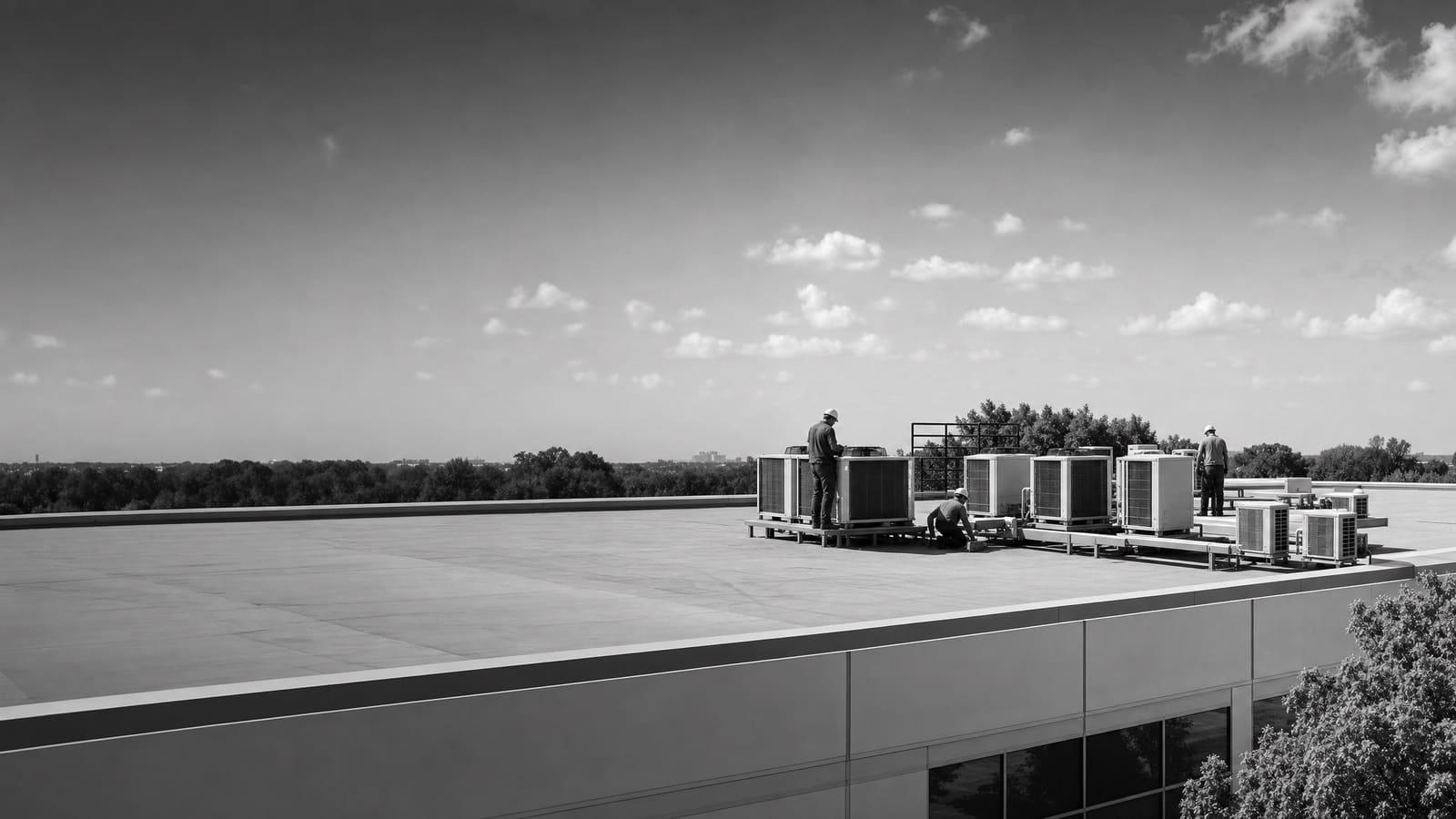
Rooftop units cool nearly half of all U.S. commercial floor space, so most of these projects are packaged-unit projects, and all three options sit on the same basic platform. A like-for-like swap is the fastest and simplest. A high-efficiency unit costs more up front and earns it back through runtime — DOE's High-Performance Rooftop Unit Challenge asked manufacturers for units that cut energy use by up to half against the standard of the time, and more than twenty models now exceed that specification. A heat pump rooftop unit is the same machine with reverse-cycle heating added, which pulls the gas line and the electrical panel into the decision.
DOE's framing is worth holding onto: proactively replacing an inefficient, underperforming unit with a more efficient one is often the better business move than replacing on failure, or than matching the old unit at end of life. That comparison only helps you if you make it early enough to still have a choice.
WHAT MOVES THE NUMBER
Where a replacement budget actually goes
No one can price a rooftop replacement from a tonnage number alone. These are the lines that move most between two buildings carrying the same unit on the roof. Ask for each one priced separately, so you can see what is equipment and what is your building.
IN PRACTICE
Choose the next unit before the old one chooses for you
DOE names the pattern directly: facility managers usually delay a rooftop replacement until the unit stops holding the space, starts eating service calls, or fails outright. That delay is the expensive part. Once a unit is down in season, the decision collapses to whatever sits on a distributor's floor, and the efficiency tier, the heat pump question, and the controls scope all get decided by availability instead of by you.
The fix is unglamorous. Build a roof inventory: nameplate, tonnage, install year, refrigerant, and how hard each unit actually runs. Anything past fifteen years moves onto a watch list. For those units, price the replacement now, while there is still time to compare a like-for-like swap against a high-efficiency or heat pump unit, and to find out whether the panel can carry an electric option at all.
None of this is an argument for replacing everything early. It is an argument for knowing which unit is next on your roof, and having a real number for it before the call comes in on a July afternoon.
COMPLEXITY CHECK
What makes a replacement simple or hard
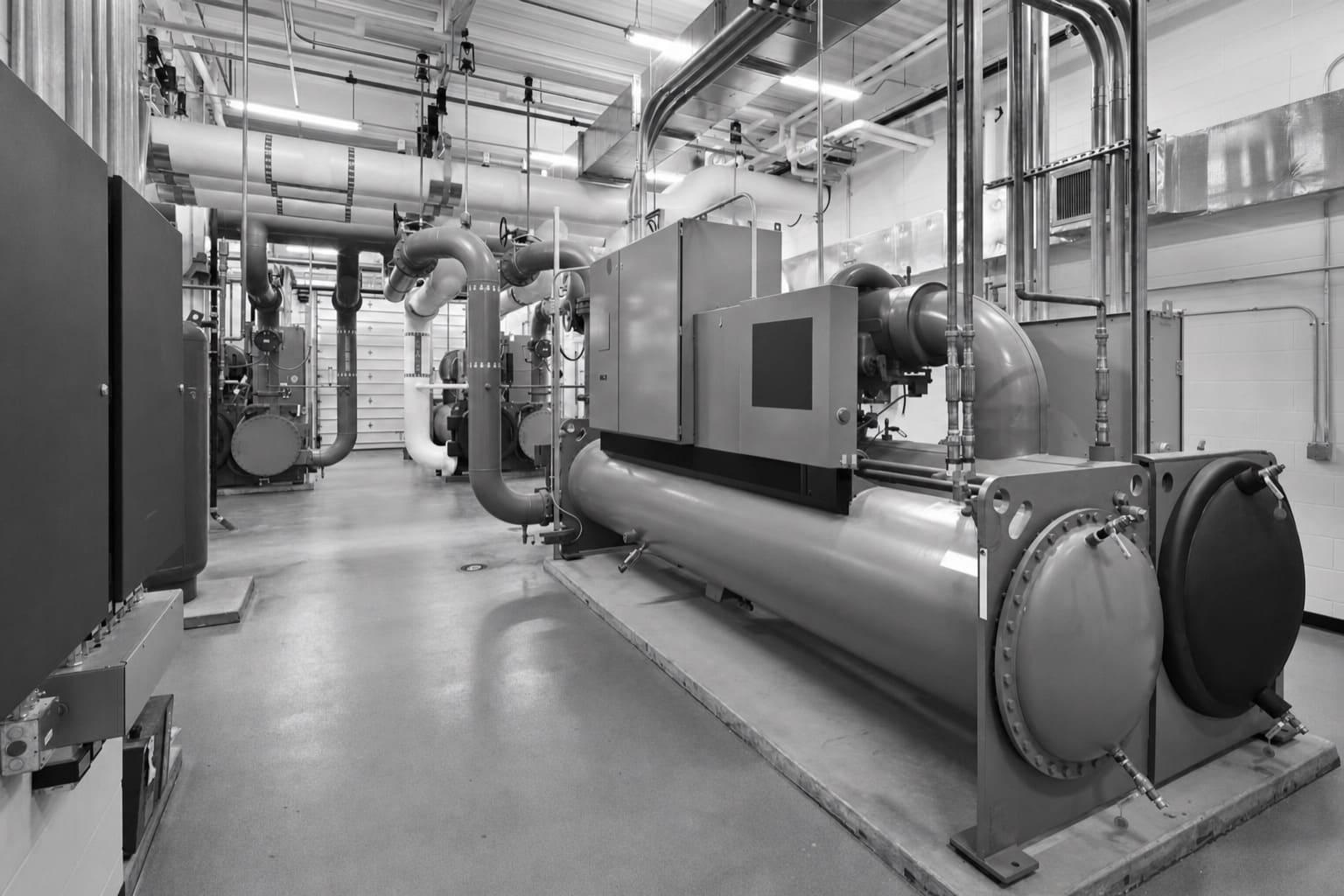
Two buildings can carry the same tonnage and still land in very different places on price and schedule. The difference is usually access, electrical capacity, and how much of the building the new unit touches on its way in.
STRAIGHTFORWARD
Lower-complexity replacement
Same tonnage and same fuel, a curb that adapts cleanly, a panel that already carries the load, an open lot with room for the crane, and controls the new unit speaks to natively. Set in a morning, running the same day.
PLAN FOR IT
Higher-complexity replacement
Tonnage or footprint grows and triggers structural review, a gas-to-electric switch runs into the panel capacity DOE flags as a gating item, crane reach is blocked by a tight lot, or the building's hours push the set to a weekend.
SCOPING THE JOB
What a site review has to settle
A site review is where the price stops being a guess. DOE's heat pump rooftop guidance publishes a usable checklist, and most of it applies whether or not you end up electrifying: heating load and climate, cost and utility bill impact, building type, equipment availability, infrastructure, contractor familiarity with the equipment, and incentives.
Infrastructure is the item that surprises people. DOE breaks it into three parts — electrical capacity, physical constraints, and gas lines — and any one of them can redirect the project. Electrical capacity decides whether an all-electric unit is even on the table without a service upgrade. Physical constraints cover the curb, the roof structure, clearances, and how a crane reaches the spot. The gas line has to be reused, capped, or removed, and that call carries a cost either way.
The load itself deserves a fresh look. A twenty-year-old nameplate reflects the occupancy, plug loads, lighting, and envelope of two decades ago. Copying that number forward is the quiet way to carry an old sizing mistake into the next twenty years of utility bills.
Ask for the infrastructure answers in writing
Panel capacity and spare breaker space, the gas line disposition, the curb and structural check, crane position and lot closure window, and equipment availability with a date attached. If any of those is missing, what you are holding is an estimate, not a quote.
OWNING THE DECISION
Two things owners weigh past the install price
Two questions outlive the installation, and both are cheaper to answer before the purchase order than after the unit is sitting on the curb. The first is what the new equipment does to your service program for the rest of the roof. The second is what it does to the utility bill — which DOE treats as a local calculation rather than a national rule, since the outcome depends on the electricity and gas prices you actually pay and on how much heating the building really needs. Model it against your rates and your schedule before assuming an efficiency upgrade pays back on a fixed timeline. And if an incentive is part of the case, confirm it is live and funded on the day you order, not on the day you read about it.
SERVICE
Refrigerant and mixed fleets
New equipment ships on newer refrigerants, so a roof mid-transition runs two chemistries at once. EPA Section 608 governs recovery and handling across all of it, so the crew doing the work needs current certification and paperwork that matches.
OPERATING COST
Bill impact is local math
DOE ties the utility outcome for heat pump rooftop units to local electricity and gas prices and to the building's heating load. Ask for that comparison run on your rate and your hours, not on a generic payback table.
PHASING AND PROCUREMENT
Sequencing a roof with more than one unit
A roof with six units is not six independent projects. Sequence them and the whole program gets cheaper: one mobilization can cover more than one set, curb adapters get ordered together, and the controls work happens once instead of six times.
Order the sequence by evidence, not by which unit complained last. Age and runtime do most of the sorting. A unit serving a kitchen or a server room accumulates far more operating hours than one over a storage bay, so it reaches the end of its service life sooner even if both were installed the same week. Replace worst-first, and standardize on one platform where you reasonably can, so filters, boards, and service knowledge carry across the roof.
Equipment availability belongs in the plan, not in the apology afterward. DOE lists it as a live constraint on heat pump conversions, and it applies to conventional units too. Ordering ahead of the season is the cheapest schedule insurance on the table.
The scale of this is well documented. Through DOE's Advanced RTU Campaign, more than 200 organizations upgraded over 43,000 rooftop units and saved a combined $37 million a year in energy costs. That came from ordinary buildings running an ordinary sequence, one roof at a time.
ON THE QUOTE
Five things a comparable quote shows
A quote you can actually compare shows its work. When two bids land far apart, it is almost always because one of these five lines is missing from the cheaper one.
01
The equipment, spelled out
Manufacturer, model, tonnage, efficiency tier, refrigerant, and heating type. A tonnage number by itself is not a specification.
02
Availability with a date
The quoted lead time for that specific unit, and what changes if it slips. Availability belongs right next to price.
03
Curb, structure, and roof work
The adapter curb, any structural review triggered by size or weight, and how the roof gets patched and warranted after the set.
04
Crane day and lot plan
Rigging plan, closure window, and who coordinates tenants. Named as included or excluded, never left to assumption.
05
Commissioning and documentation
Verified charge, airflow, and control settings at startup, handed over as a report that supports the equipment warranty.
Get a defensible number
Price the equipment and the building together.
Send the address, operating target, and target opening date. Flux will identify what must be verified before the project can be priced.
Get a free estimateQuestions
Straight answers.
When does replacement beat one more repair?
DOE notes that rooftop units over fifteen years old can waste substantial energy and money compared with newer models, and puts the annual waste of an old, inefficient unit at $900 to $3,700. Once a unit is past that age and the service calls are stacking up, the waste alone often exceeds the repair you were trying to avoid — before you count the downtime.
How much does commercial HVAC installation cost in Richardson?
There is no honest universal installed price, and anyone quoting one from a tonnage number is guessing. The number is set by equipment and efficiency tier, curb and structural work, crane access and lot closure, electrical or gas changes, and controls integration. Ask for those priced as separate lines. That is the only way to tell whether a lower bid is cheaper or just less complete.
Should the replacement be a heat pump instead of a gas unit?
Heat pump rooftop units are technologically similar to air-conditioning units and add reverse-cycle heating, and DOE considers them appropriate for most of the U.S. South and West. The gating items are electrical capacity, what happens to the gas line, and your actual rates. Heat pump efficiency drops as outdoor temperatures fall, and southern climates do see sharp cold snaps — the February 2021 Texas freeze being the reference case — so the heating side has to be designed for the bad week, not the average one. Dual-fuel units exist for exactly that reason.
What does EPA Section 608 mean for my replacement?
Section 608 of the Clean Air Act governs how refrigerant is handled and recycled in stationary air-conditioning, refrigeration, and heat pump equipment. In practice it means the refrigerant in the old unit has to be recovered properly by certified technicians rather than vented, and the work has to be documented. It is not a line you can value-engineer out of a bid.
Can we phase a multi-unit roof instead of replacing everything at once?
Yes, and phasing is usually the better financial plan. Sort by install year and real runtime, replace worst-first, and standardize on one platform so parts and service knowledge carry across the roof. The one thing phasing does not excuse is late ordering — DOE lists equipment availability as a genuine constraint, so units in this year's phase should be ordered before the season that will need them.
Sources used for this guide
- [1]betterbuildingssolutioncenter.energy.gov — DOE Advanced Rooftop Unit Replacement Guidance
- [2]betterbuildingssolutioncenter.energy.gov — DOE Commercial Heat Pump Rooftop Unit Replacement Guidance
- [3]betterbuildingssolutioncenter.energy.gov — DOE High-Efficiency Commercial Rooftop Unit Toolkit
- [4]energy.gov — DOE Efficient Commercial Rooftop Air Conditioner Program
- [5]epa.gov — EPA Stationary HVAC Refrigerant Management