THE SHORT ANSWER
What commercial HVAC replacement in Rialto actually covers
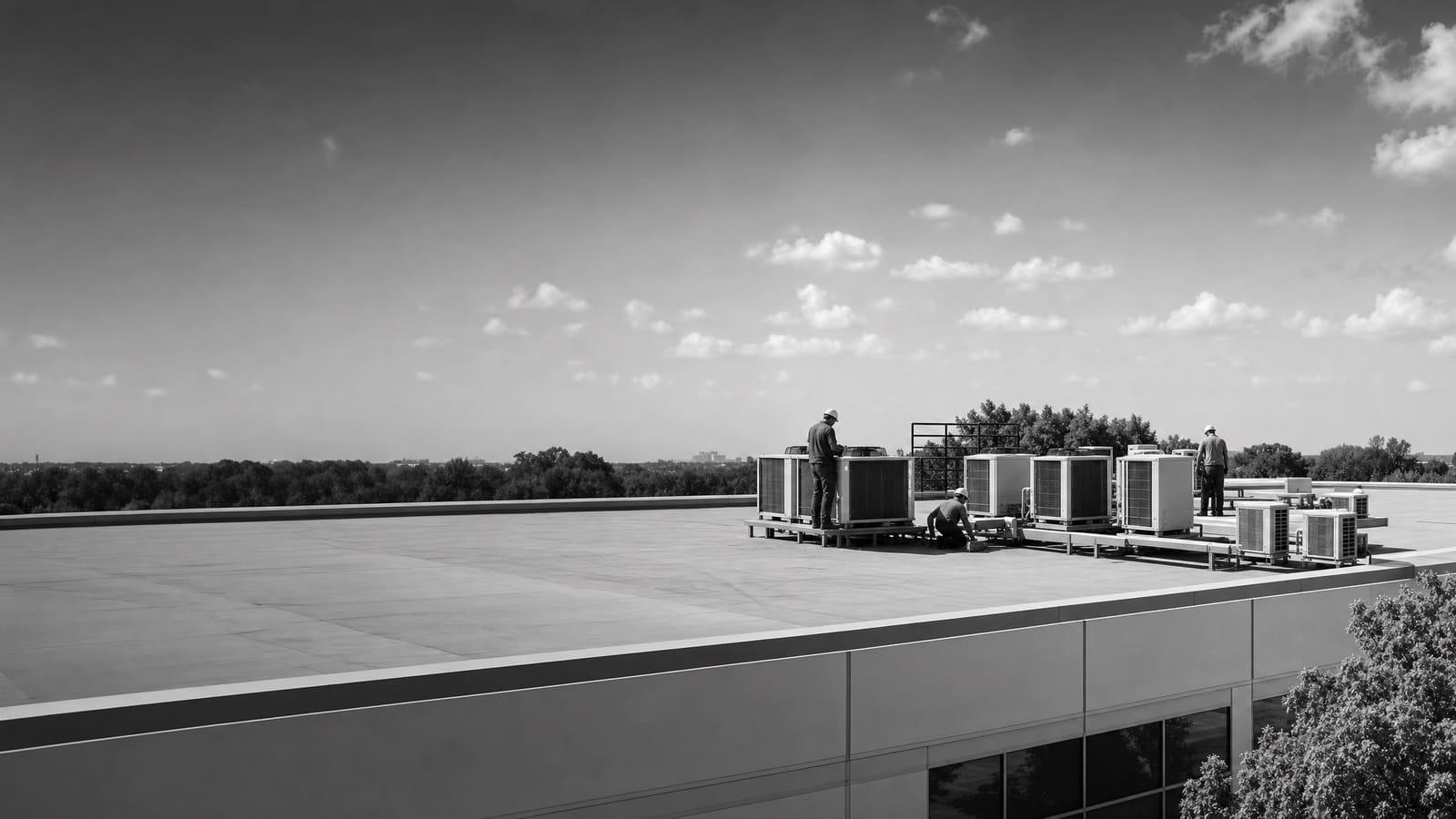
A commercial HVAC replacement covers a load check, equipment selection against real lead times, recovery of the old refrigerant charge, removal of the failed unit, rigging the new one onto a curb or curb adapter, gas, electrical and control connections, permits and inspection, then commissioning. Replacement beats another repair once a unit is past roughly fifteen years and repairs are stacking up. DOE puts the annual energy waste of an old, inefficient rooftop unit at $900 to $3,700.
A site review has to verify tonnage against current occupancy, curb size and roof structure, available electrical capacity, crane reach across the lot, and how the new controls tie into the building automation system.
THREE PATHS
Three ways to handle a failing rooftop unit
Buildings arrive at this decision one of two ways. Either a unit quit in August and the phone is ringing, or a budget cycle put an aging unit on the list. The path you pick should follow three answers: how old the unit is, whether the space is still used the way it was when the unit was sized, and how long the building can run on limited cooling.
DOE guidance is blunt about the cost of waiting. Rooftop units past fifteen years waste substantial energy and money compared with newer models, and facility teams often delay until the unit fails outright. Replacing on failure removes your leverage on price, on equipment selection, and on schedule. Planned replacement keeps all three.
Rooftop systems cool close to half of all commercial floor area in the country, so this decision repeats across most portfolios. Settling it once, with a written rule for when a unit moves from repair to replace, costs less than settling it unit by unit under pressure.
WHAT MOVES THE NUMBER
Budget lines that decide the installed price
No honest installed price exists before someone stands on the roof. These are the lines that separate a straightforward swap from a project, and the ones worth asking every bidder to price separately so the quotes can actually be compared.
IN PRACTICE
Choose the equipment before the crane is booked
The equipment decision comes first, because it sets lead time, and lead time sets the schedule. DOE's guidance for commercial heat pump rooftop units lists the factors worth working through in order: climate zone and geography, cost and utility bill impact, emissions, building type, equipment availability, infrastructure, contractor familiarity, and incentives. Infrastructure is where projects surprise people. It breaks into three checks — electrical capacity at the panel, physical constraints on the roof and at the curb, and what happens to the existing gas line.
Rialto sits in the West, and DOE's read on the South and West is direct: today's heat pump rooftop units are an appropriate solution there and are fully capable of addressing most or all of the winter heating demand. That does not make the switch automatic. Heat pump heating efficiency falls as outdoor temperatures drop, so the value depends on how much heating the building actually calls for and how electricity prices against gas at your meter.
The practical move is to price both. Ask for a like-for-like package and a heat pump package on the same roof, with lead times and any infrastructure work broken out separately. The comparison usually settles itself.
COMPLEXITY
What makes a replacement simple or hard
Two jobs with the same tonnage on the paperwork can be a week apart in reality. The difference is almost never the unit itself. It is the roof, the lot, and what has to change behind the curb.
LOWER COMPLEXITY
Straight swap territory
Same tonnage and heating type, an existing curb that takes an adapter, service and gas already sized correctly, clear crane reach from a lot you can close for a morning, and controls that match what is already installed.
HIGHER COMPLEXITY
Where the schedule stretches
Tonnage changes, a heavier unit that triggers structural review, a fuel switch that pulls in electrical service work, tight or shared parking that limits crane placement, tenants with hours you cannot interrupt, and multi-unit phasing.
SCOPING
What the site review has to settle
A useful site review is short and physical. Someone gets on the roof, photographs the nameplate, measures the curb, checks the structure under it, opens the panel to read available capacity, and walks the lot to work out where a crane can set up and how far it has to reach.
Sizing is the part worth arguing about. The old nameplate records a decision someone made fifteen or twenty years ago about a building that has since changed occupancy, lighting, plug load, and operating hours. Repeating that number is convenient, not correct. If the space now runs longer or holds more people and equipment than it did, the load should be recalculated before anything is ordered.
The refrigerant side belongs in the review too. EPA rules under Section 608 of the Clean Air Act govern how refrigerant is handled and recycled in stationary air conditioning and heat pump equipment, so recovery from the outgoing unit is regulated work, not a line a contractor can wave off. On a mixed fleet, write down what each remaining unit holds while you are up there, so service planning later is not a scavenger hunt.
Ask for this before you sign
A nameplate photo, a curb measurement, a photo of the electrical panel with available capacity noted, and a crane staging plan drawn on the lot. If a bidder priced the job without those four things, the number is going to move.
IN RIALTO
Permits and inspections belong on the schedule
California building departments treat mechanical work as permit work. A representative city permit list groups electrical, plumbing, and mechanical upgrades or repairs with re-roofing and fireplace installation as work that requires a permit before it starts. A rooftop replacement usually touches more than one of those trades at once.
The decision this changes is sequencing. Permit review and inspection are not something you handle after the crane leaves. Confirm with the Rialto building division which permits your specific scope needs, and whether a change in tonnage, footprint, or unit weight adds a structural review, before you lock a crane date. A crane that shows up ahead of an approved permit is an expensive morning spent waiting, and equipment lead time is usually long enough to absorb the review if the application goes in early.
Put the permit on the critical path
Submit while the equipment is still on order. Permit and inspection steps should appear on the schedule with dates, and the installing contractor should own filing and inspection as part of the installed price rather than billing them later as a change.
OWNERSHIP
Two things that outlast the install
The install is a week. What you decided during it runs for the next fifteen to twenty-five years. Two of those consequences are worth choosing on purpose instead of by default.
The first is what the unit costs to run. DOE's Advanced RTU Campaign gives a sense of the scale: more than 200 public and private organizations upgraded over 43,000 rooftop units, and those upgrades save a combined $37 million a year on energy bills. That is real money sitting on a line most owners stop looking at once the invoice clears.
The second is the fleet. Most commercial buildings do not have one rooftop unit. They have several, of different ages, and replacing them one at a time as each one fails guarantees you never get a volume price or a single controls platform.
OPERATING COST
The bill you signed up for
An old, inefficient rooftop unit wastes roughly $900 to $3,700 a year in energy, by DOE's estimate. Across a full replacement cycle, that gap is worth weighing directly against the price difference between efficiency tiers on the quote.
FLEET PLANNING
Replace on a plan, not on failure
Rooftop systems cool close to half the commercial floor area in the country, and DOE notes teams usually wait until a unit fails. Grouping replacements by age buys scheduling leverage, one controls platform, and better equipment pricing.
PROCUREMENT
Phasing a multi-unit replacement
If you own more than two or three rooftop units, phasing beats reacting. Start by listing every unit with its age, tonnage, heating type, refrigerant, and repair history from the last two years. That list tells you which units are candidates this budget year and which can wait, and it turns a vague capital request into something a finance team can actually approve.
Then order the work by risk, not by age alone. The unit serving the space you cannot afford to lose in July goes first, even if it is not the oldest on the list. The unit on a roof section that already needs structural work goes early too, because that scope tends to grow once it is opened up.
Procurement follows. Bidding two or three units together gives a contractor a reason to sharpen equipment pricing and lets you standardize on one controls platform, which pays back every time someone troubleshoots at six in the morning. DOE's guidance also flags incentives as a factor to check before ordering, since program rules and efficiency thresholds change and a unit already on a truck cannot be re-specified to qualify. Check what your utility currently offers while the equipment decision is still open.
THE QUOTE
Five things a comparable quote shows
Two quotes are only comparable when they price the same scope. These five lines make that possible, and their absence is usually where the change order comes from.
01
Equipment, spelled out
Make, model, tonnage, heating type, refrigerant, and efficiency tier — not just "new rooftop unit."
02
Lead time with a date
Quoted availability for that exact model, plus the date the equipment price expires.
03
Rigging and lot plan
Crane size, staging location, stalls affected, and how long the lot is closed.
04
Permits and inspections
Which permits are included, who files them, and who meets the inspector on site.
05
Commissioning and documentation
Startup readings for charge, airflow, and control sequences, handed over in writing with warranty registration.
Get a defensible number
Price the equipment and the building together.
Send the address, operating target, and target opening date. Flux will identify what must be verified before the project can be priced.
Get a free estimateQuestions
Straight answers.
When does replacement beat one more repair?
Age plus repeat repairs. DOE notes rooftop units past fifteen years can waste substantial energy compared with newer models, and puts the annual waste of an old, inefficient unit at $900 to $3,700. Once a unit is in that range and has needed more than one repair in a season, the repair is buying time at a bad rate.
Does a commercial HVAC replacement in Rialto need a permit?
Plan on it. California building departments list mechanical upgrades and repairs among the work that requires a permit, and a rooftop replacement usually involves mechanical and electrical work at the same time. Confirm the exact scope with the Rialto building division, and submit while the equipment is still on order so review does not push your crane date.
Is a heat pump rooftop unit a good fit here?
Often, yes. DOE's guidance says today's heat pump rooftop units are an appropriate solution across most of the U.S. South and West and are capable of handling most or all winter heating demand. The deciding factors are electrical capacity at the panel, what happens to the existing gas line, and how electricity prices against gas at your meter. Price both packages and compare.
What actually takes the longest?
Equipment lead time, almost always. The set itself is a planned morning: the crane arrives, stalls get coned, the old unit comes off, the new one lands on a curb adapter measured weeks earlier. Availability for your specific model is the variable, which is why it belongs on the quote next to the price.
What happens to the refrigerant in the old unit?
It gets recovered under federal rules. Section 608 of the Clean Air Act governs how refrigerant is handled and recycled in stationary air conditioning and heat pump equipment, so recovery from the outgoing unit is regulated work that belongs in the written scope. On a mixed fleet, record what each remaining unit holds so future service planning is straightforward.
Sources used for this guide
- [1]betterbuildingssolutioncenter.energy.gov — DOE Advanced Rooftop Unit Replacement Guidance
- [2]betterbuildingssolutioncenter.energy.gov — DOE Commercial Heat Pump Rooftop Unit Replacement Guidance
- [3]betterbuildingssolutioncenter.energy.gov — DOE High-Efficiency Commercial Rooftop Unit Toolkit
- [4]energy.gov — DOE Efficient Commercial Rooftop Air Conditioner Program
- [5]epa.gov — EPA Stationary HVAC Refrigerant Management
- [6]californiacity-ca.gov — HVAC Permits