THE DIRECT ANSWER
What a commercial HVAC replacement actually includes
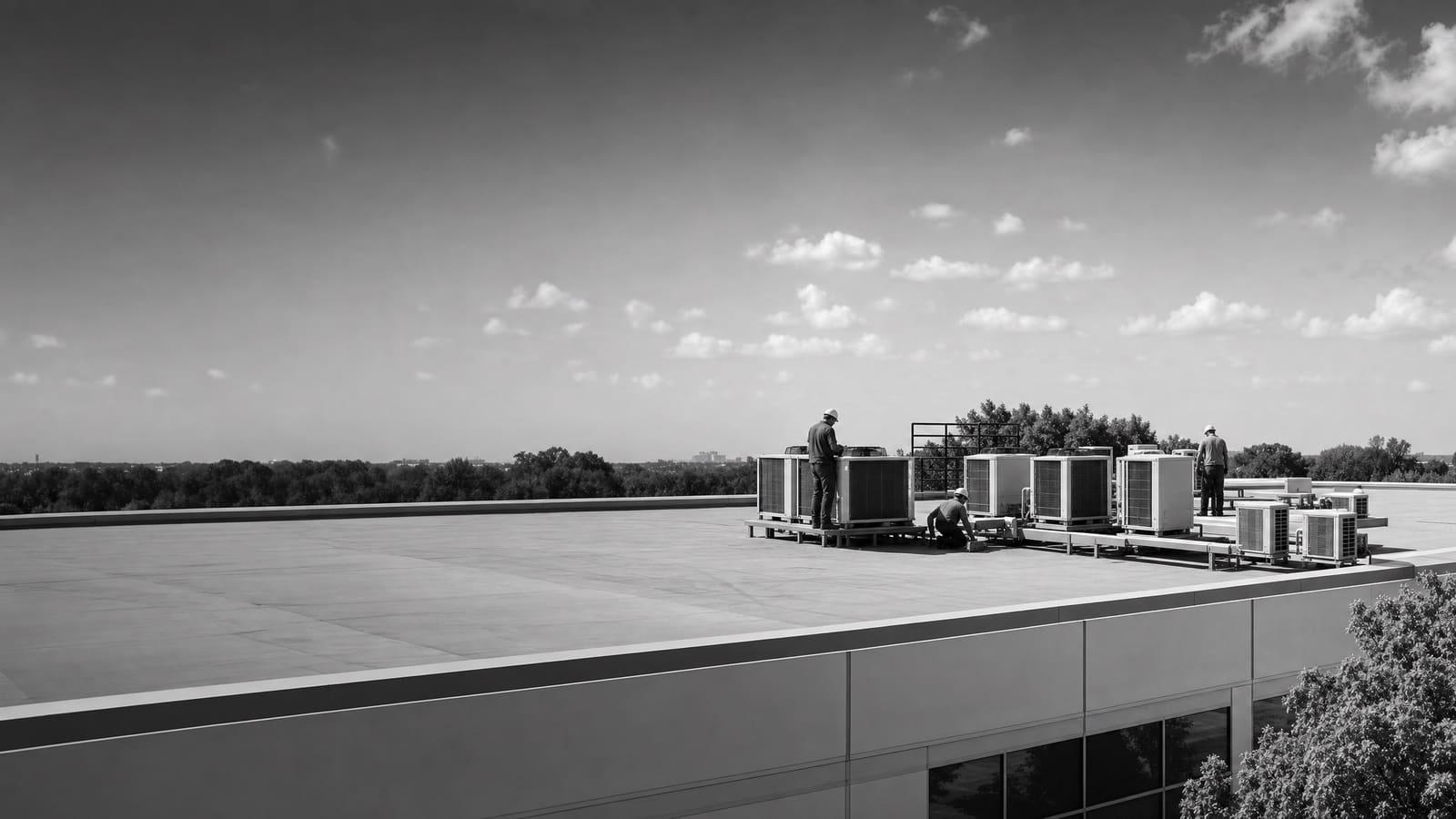
A commercial HVAC replacement is a load check, an equipment selection, a rigging and connection day, and a documented commissioning. Replacement beats another repair once a unit is past about fifteen years and the repairs have gone from rare to routine. DOE puts the annual waste of an old, inefficient rooftop unit at $900 to $3,700 per unit. That money keeps leaving the building whether or not the compressor happens to be running today.
A site review has to confirm curb size and condition, roof structure, available electrical capacity and gas service, crane reach across the lot, and whether current occupancy still matches the old nameplate.
THREE WAYS TO GO
Three paths worth pricing before you commit
Most roofs land on one of three paths, and the split matters because the cheapest install is rarely the cheapest decade. DOE's rooftop unit work frames the core choice as replacing an aging unit with a more efficient one or retrofitting the existing unit with advanced controls, depending on which makes better financial sense for that building.
There is a fourth path, and it picks itself if you wait: replacement on failure. It costs the most in downtime and leaves you no leverage over lead time, equipment selection, or when the crane shows up.
Price at least two of these against each other. One quote tells you what something costs. Two quotes tell you what the choice is worth.
WHAT MOVES THE NUMBER
Where a replacement budget actually goes
Two quotes for the same tonnage can differ by a wide margin, and the difference is almost never the box. It is the work around the box. For each line below, ask what is included, what is excluded, and what is an allowance the contractor expects to revisit once the old unit comes off.
CHOOSING EQUIPMENT
Heat pump or gas heat: how to actually decide
A heat pump rooftop unit is not an exotic machine. DOE describes them as technologically similar to standard air-conditioning rooftop units, with reverse-cycle heating added. The install looks familiar. The real question is whether your building and your utility rates make the heating side pay.
DOE's guidance walks the checks in a useful order: heating load and geography, the utility bill impact at your electric and gas prices, emissions goals, building type, equipment availability, and infrastructure. Infrastructure is the one that surprises owners. Electrical capacity, physical constraints on the roof, and existing gas lines decide whether an all-electric swap is a clean substitution or a small electrical project bolted onto a mechanical one.
Efficiency behavior matters too. As outdoor temperatures drop, heat pump heating efficiency falls and trends toward parity with electric resistance heat. That is why the equipment comes in three shapes: all-electric, dual fuel, and cold climate. Dual fuel keeps a gas heat source for the coldest hours and runs the heat pump the rest of the time.
So ask for both prices. A gas-heat replacement and a heat pump replacement, same tonnage, same roof, with the electrical work priced honestly on the heat pump side. The gap between them is the actual decision, and it is usually either smaller or larger than owners expect.
COMPLEXITY CHECK
What makes this project simple or hard
The same tonnage can be a straightforward substitution or a three-trip project. What separates them is rarely the equipment. It is the curb, the power, and the parking lot.
LOWER COMPLEXITY
Straight substitution
Same tonnage and heating type, a curb that is still square and sound, gas and electric already sized for the new unit, and open lot space for the crane. These get set, connected, and started up in a single visit.
HIGHER COMPLEXITY
Anything that changes the load path
Growing tonnage or footprint, switching to all-electric heat, a curb that needs a custom adapter, a lot tight enough to force a larger crane or an off-hours lift, or controls that have to integrate with an existing building automation system.
BEFORE THE QUOTE
What a real site review has to confirm
A quote written from a nameplate photo is a starting number, not a price. It is genuinely useful for triage when a unit is down and you need options today. It is not what you sign.
The site review exists to close the gaps that later become change orders. Someone gets on the roof and confirms curb dimensions and condition, checks the structure where the load lands, reads the actual electrical service and available capacity at the panel, traces the gas line if one is staying, and looks at the lot the way a crane operator will. Reach, staging, and how many stalls come out of service for how long.
The other half of the review is the building, not the roof. Sizing should come from how the space is used now. Occupancy, plug loads, and the envelope all change over twenty years, and the old nameplate carries forward whatever the last person assumed. If tenants have complained about one zone since before the unit started failing, that is a sizing or distribution problem, and a new box will inherit it.
Get the findings in writing. A site review that produces no document produced no findings.
The question that saves the most money
Ask what happens if the deck under the curb is worse than it looks. A contractor with a real answer — an allowance, a unit price, a defined process — has been on roofs. One with no answer has priced a best case.
OWNING THE DECISION
Two things that outlive the install
The install itself is over quickly. The decision keeps paying or costing for the life of the equipment, and two parts of it get much harder to change after the crane leaves. The first is refrigerant, which is now a compliance and service-planning question rather than a spec-sheet footnote. The second is timing, which is the difference between buying equipment and buying whatever is available the week your compressor dies. Neither shows up in the installed price. Both show up in the operating budget. Raise them while you still have two quotes on the table and some leverage to use.
REFRIGERANT
Service planning on a mixed fleet
EPA regulations under Section 608 of the Clean Air Act govern how refrigerant is handled, recovered, and recycled in stationary air-conditioning and heat pump equipment. New units ship on newer refrigerants, so a roof carrying both old and new equipment needs a service plan that covers both rather than one habit applied to everything.
TIMING
Planned beats replacement-on-failure
DOE notes that facility managers often delay buying a new unit until the old one fails, needs frequent maintenance, or stops conditioning the space, and that proactive replacement with a more efficient unit is often the better business move. Waiting hands the schedule and the equipment choice to the failure.
PHASING AND PROCUREMENT
Sequencing replacements across a roof
Almost nobody replaces one rooftop unit and stops. If you own a roof with several, the real question is sequencing, and the sequence should follow age and waste rather than whichever unit generated the loudest complaint last summer.
Start with an inventory: age, tonnage, heating type, and service history for every unit. DOE flags fifteen years as the point where rooftop units begin wasting substantial energy and money compared with newer models, and puts the annual waste of an old, inefficient unit at $900 to $3,700. Multiply that by the number of units past fifteen years and you have the cost of the do-nothing plan in numbers a finance team will accept.
Then group the work. Replacing two or three units on one crane day costs less per unit than three separate mobilizations, and it lets you standardize on one equipment platform and one controls approach across the roof. Standardizing pays back every year afterward in parts, in training, and in how fast a technician diagnoses something on a Monday morning.
The scale here is not theoretical. Through DOE's Advanced RTU Campaign, more than 200 organizations upgraded over 43,000 rooftop units and saved a combined $37 million a year on energy bills — recurring savings, from equipment that was going to need replacing anyway.
APPLES TO APPLES
Five things a comparable quote shows
Quotes are only comparable when they describe the same scope. When two prices are far apart, one of them is usually missing something below. Ask for these in writing before you compare.
01
Equipment, tonnage, and efficiency tier
Model number, capacity, heating type, and the efficiency step it represents against what is on the roof today.
02
Lead time, dated
Availability with a delivery window, not a description. A price without a date is half a quote.
03
Curb, structural, and roof scope
Adapter or new curb, any deck or structural work, and exactly how surprises under the old unit get priced.
04
Rigging, permits, and inspections
Who owns the crane, the lot closure, the permit applications, and the sign-offs — and whether all of it sits inside the installed price.
05
Commissioning and documentation
Startup, refrigerant charge, airflow, and control settings verified against spec and handed to you as a document.
Get a defensible number
Price the equipment and the building together.
Send the address, operating target, and target opening date. Flux will identify what must be verified before the project can be priced.
Get a free estimateQuestions
Straight answers.
When is replacement better than one more repair?
Once a unit is past about fifteen years, DOE's guidance is that it can waste substantial energy and money compared with a newer model — on the order of $900 to $3,700 a year for an old, inefficient unit. When repairs shift from occasional to routine on top of that, you are paying twice for the same problem.
Should the replacement be a heat pump?
It depends on your heating load, your electric and gas prices, and your electrical capacity. Heat pump rooftop units are technologically similar to standard air-conditioning units with reverse-cycle heating added, and they come as all-electric, dual fuel, or cold climate. Price both options on the same roof and compare.
What is the biggest hidden cost on a rooftop replacement?
Usually the curb and what is under it. New footprints rarely match old curbs, and deck condition is not fully knowable until the unit is lifted. On electrification projects, electrical capacity takes that spot — DOE lists it as a primary infrastructure check for a reason.
How long is the building without conditioning?
The set-and-connect work is short and planned around your lot rather than your tenants. The honest variable is equipment lead time, which is why availability belongs on the quote right next to the price.
Does new equipment change refrigerant service?
New units ship on newer refrigerants, and EPA Section 608 rules govern how refrigerant is handled, recovered, and recycled in stationary air-conditioning and heat pump equipment. Day-one operation is unaffected, but a roof with mixed old and new equipment needs a service plan that accounts for both.
Sources used for this guide
- [1]betterbuildingssolutioncenter.energy.gov — DOE Advanced Rooftop Unit Replacement Guidance
- [2]betterbuildingssolutioncenter.energy.gov — DOE Commercial Heat Pump Rooftop Unit Replacement Guidance
- [3]betterbuildingssolutioncenter.energy.gov — DOE High-Efficiency Commercial Rooftop Unit Toolkit
- [4]energy.gov — DOE Efficient Commercial Rooftop Air Conditioner Program
- [5]epa.gov — EPA Stationary HVAC Refrigerant Management