THE DIRECT ANSWER
What a commercial HVAC replacement actually covers
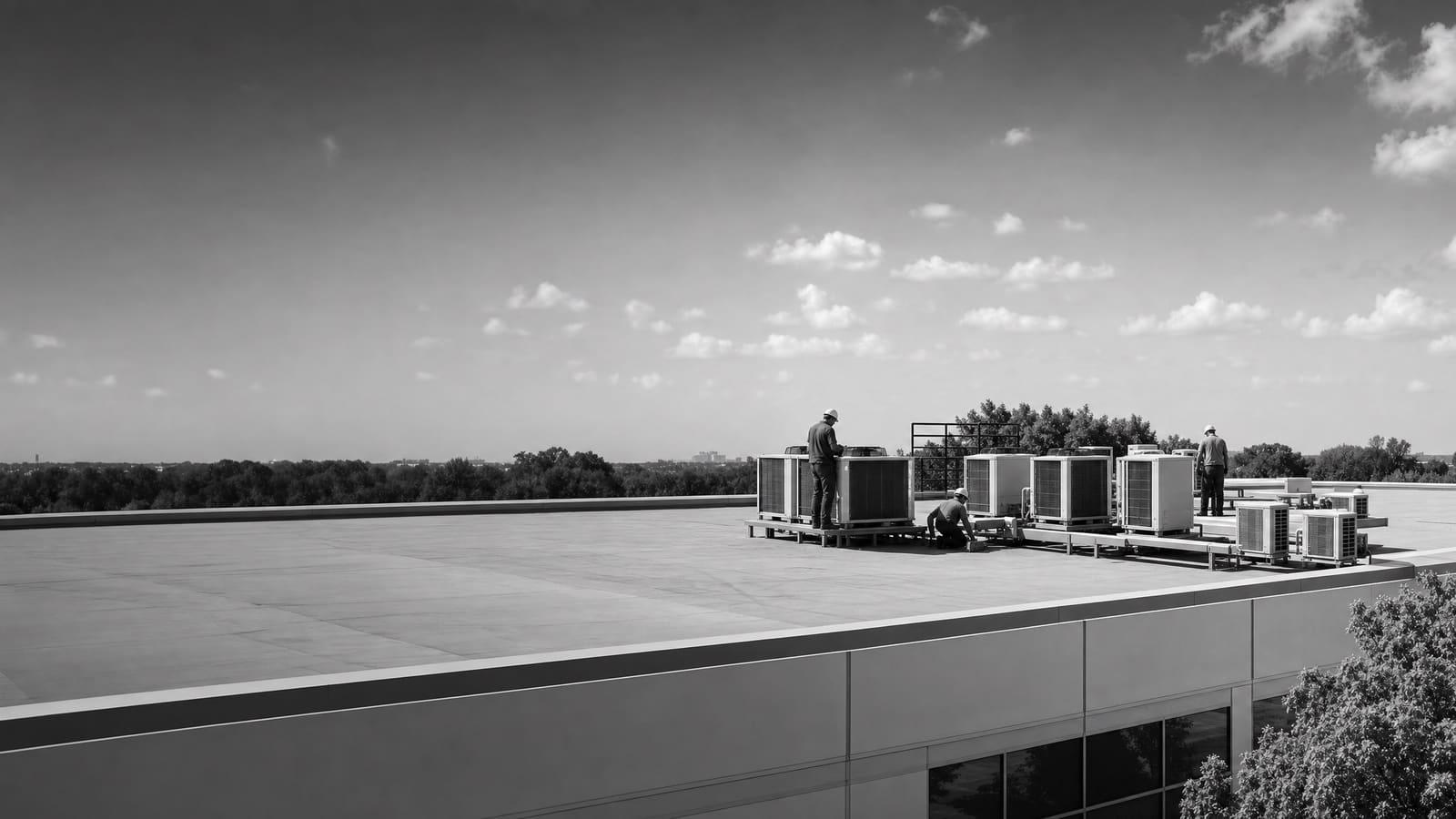
A commercial HVAC replacement covers load verification, equipment selection, rigging and set, gas, electric, and refrigerant connections, controls integration, permitting, and commissioning. Replacement beats another repair once a rooftop unit passes about fifteen years, the point where older units start wasting real energy against current models. An inefficient rooftop unit can burn $900 to $3,700 a year in wasted energy alone, so repair spending is buying time on a machine that loses money every month it runs.
A site review still has to confirm the actual load against how the space is used now, curb and structural fit, available electrical capacity, and whether the gas line stays. Until those four are answered, a number on a quote is an estimate.
THE REAL CHOICE
Three ways this replacement can go
The first fork is not brand, it is what the new unit burns. Three paths cover almost every commercial roof: a conventional air-conditioning rooftop unit, a dual-fuel heat pump that keeps gas for the coldest hours, and an all-electric or cold-climate heat pump. Heat pump heating efficiency falls as outdoor temperature drops, and DOE describes today's standard heat pump rooftop units as fully capable across most of the South and West. Reading is in neither region, so the realistic electric paths here are dual fuel or a cold-climate machine rather than a standard one. Four site facts decide this more often than efficiency ratings do: electrical capacity at the panel, physical constraints on the roof, the status of the gas line, and whether the equipment you want is actually available.
WHAT MOVES THE NUMBER
Where a replacement quote actually spreads
No two roofs price the same, and the spread is not mostly in the equipment. These are the lines that move a commercial replacement quote most, ordered by how far they can swing between a walk-through guess and a real scope.
HOW TO BUY IT
Buying the replacement instead of reacting to it
Most commercial HVAC replacements start the same way. A unit fails in the middle of a season, and the building buys whatever can be on the roof fastest. The pattern is well documented: owners delay until the unit no longer conditions the space, needs constant service, or quits outright, and replacing proactively with a more efficient unit often beats both replacement-on-failure and a like-for-like swap at the end of service life.
The difference is leverage. A planned replacement lets you verify the load, compare an efficient tier against a base model, check what incentives apply, and schedule the crane on a day the building can absorb. A failure replacement lets you pick from what sits in a warehouse this week. Same roof, same tonnage, very different outcome.
If your unit is past fifteen years, treat the next repair quote as a decision point rather than an invoice. Add up what the last two seasons cost in service calls, then set that against what an inefficient unit wastes in energy on its own every year. Rooftop equipment conditions close to half of all commercial floor space in the country, which is why it draws so much efficiency attention. The savings are real, and they repeat annually.
COMPLEXITY CHECK
What makes a replacement simple or hard
Two buildings with the same tonnage can be a one-morning job or a three-trade project. The dividing line is almost always whether the new system stays inside what the building already supports.
LOWER COMPLEXITY
Inside existing capability
Same fuel, same tonnage, existing curb takes an adapter, panel and gas line unchanged. Permitting is simpler, engineering is light, and the work stays a mechanical and electrical scope on a predictable calendar.
HIGHER COMPLEXITY
Beyond what the building supports
Larger tonnage, a footprint change, a fuel switch, or a heating load the panel cannot carry. Structural review, service upgrades, and a fuller permit path all enter, and the schedule stretches with them.
THE SITE REVIEW
What a real scoping visit has to confirm
A quote written from a nameplate photo is a starting number, not a price. The nameplate tells you what someone installed years ago under conditions that may no longer exist. The visit has to establish something different.
Start with load. Sizing should follow how the space is used today, meaning occupancy, plug load, operating hours, and envelope, not what the old tonnage says. Twenty years of tenant changes routinely leave a building oversized in one zone and short in another. Carrying forward the old number carries forward the old complaint.
Then confirm the four infrastructure facts that drive every rooftop decision: electrical capacity at the panel, physical constraints on the roof including curb fit and clearances, whether the gas line stays or goes, and whether the equipment you want is available on a timeline the building can live with. Access comes last, and it is not minor. Crane reach, setbacks, overhead lines, and how long a lot closure your tenants can tolerate all shape the day.
Finally, ask whether the new system exceeds what the old one could do. That single question changes the permit path, the drawings, and the calendar.
The question that reprices the job
Does the new system exceed the capability of the one it replaces? Under Pennsylvania's Uniform Construction Code, staying inside existing capability keeps a supply and exhaust HVAC alteration in the simpler permit lane. Exceeding it does not.
READING AND PENNSYLVANIA CODE
How the permit path gets scoped here
Reading builds under Pennsylvania's Uniform Construction Code, and the state's permitting guidance draws a line worth knowing before you size anything. Alterations to supply and exhaust HVAC systems, including all air distribution systems, sit in the Level 1 alteration category as long as the work does not exceed the capabilities of the existing system. The same holds for hydronic alterations. Push past existing capability and you leave that category.
There is a second requirement that catches replacements more often than owners expect. When work affects the building envelope, mechanical systems, or electrical power and lighting, the application must include a narrative describing how the work satisfies the energy conservation code the state references. A commercial HVAC replacement affects mechanical systems by definition, so that narrative is part of the filing, not an optional attachment.
Scope the permit before you size the unit
If the replacement stays within existing system capability, the alteration path is simpler. If you are adding tonnage or heating capacity the old unit never had, plan for the fuller review and the energy-code narrative from day one, and confirm early who reviews it.
OWNERSHIP QUESTIONS
Two decisions that outlast the install
A rooftop replacement is a fifteen-year-plus commitment to equipment nobody looks at until it stops. Two questions decide whether that decade goes quietly. The first is timing: whether you replace on your calendar or on the unit's. The second is consistency: whether this unit matches the rest of your roof or becomes the one exception your service contractor has to stock parts for. Neither question appears on a quote, and both cost money later. Rooftop decisions are worth making at the portfolio level for exactly this reason, because the choice you make on one unit sets the pattern for the next five.
TIMING
Planned versus replace-on-failure
Proactive replacement with a more efficient unit can beat both waiting for failure and a like-for-like swap at end of life. The saved energy starts the day it runs, and the emergency premium never comes back.
FLEET CONSISTENCY
One roof, one parts strategy
New equipment ships on newer refrigerants, and federal Section 608 rules govern how any of it is handled and recovered. On a mixed roof, decide now whether you are standardizing over time or maintaining two service realities.
PHASING AND LIFETIME COST
Sequencing a roof with more than one aging unit
If several units are aging together, replacing them all in one season is rarely right, and replacing them one emergency at a time is definitely wrong. The usable middle is a ranked plan. Worst performer first, then the units serving spaces where a failure hurts most, then the rest as budget cycles allow. Rank by what each unit costs to run and repair, not by age alone.
Procurement follows the same logic. Equipment availability is one of the factors owners are told to check before committing to a technology, because a specification you cannot get on time is not really a specification. Confirm lead time alongside price on every option, and treat incentives as part of the comparison rather than a discount discovered later. Federal rooftop replacement guidance is published specifically alongside financial incentives, and the efficient tier is usually where that money sits.
The lifetime math tends to favor the better unit. Through DOE's Advanced RTU Campaign, participating organizations upgraded more than 43,000 rooftop units and cut a combined $37 million a year from their energy bills. That is a recurring number, not a one-time rebate. Against equipment that runs fifteen years or more, the tier decision compounds in a way the install-day price difference does not.
QUOTE CHECKLIST
Five things a comparable quote shows
Two quotes are only comparable when they price the same scope. If any of these is missing, the cheaper number is usually the less complete one rather than the better deal.
01
Verified load, not carried-forward tonnage
The sizing basis stated plainly: how the space is used today, not what the old nameplate said.
02
Equipment tier, model, and lead time
The exact unit, its efficiency tier, and when it can realistically be on the roof.
03
Curb, structural, and connection work
Adapter or new curb, any framing, and every gas, electrical, and refrigerant change on the way in.
04
Rigging, access, and lot closure
Who owns the crane, which stalls close, and for how long.
05
Permits, recovery, and commissioning
Permit filing with the energy-code narrative, compliant recovery of the old charge, and documented startup.
Get a defensible number
Price the equipment and the building together.
Send the address, operating target, and target opening date. Flux will identify what must be verified before the project can be priced.
Get a free estimateQuestions
Straight answers.
When does replacement beat one more repair?
Once a rooftop unit is past about fifteen years, it can waste substantial energy against a current model, and an inefficient unit runs $900 to $3,700 a year in wasted energy alone. Set that figure against your last two seasons of service calls and the answer usually stops being close.
Does a heat pump rooftop unit make sense in Reading?
Sometimes, but not the standard version. Heat pump heating efficiency drops as outdoor temperature falls, and DOE describes today's standard heat pump rooftop units as fully capable across most of the South and West. Reading is in neither region, so the realistic options here are a dual-fuel unit that keeps gas for the coldest hours or a cold-climate model.
What permit does a commercial HVAC replacement need in Pennsylvania?
Under the state's Uniform Construction Code, alterations to supply and exhaust HVAC systems fall in the Level 1 alteration category when the work does not exceed the capabilities of the existing system. Because the work affects mechanical systems, the application also has to include a narrative showing energy code compliance. Confirm whether state or local review applies to your building.
What is the biggest cost surprise on a rooftop replacement?
Usually something the roof or the panel forces. Curb and structural work leads the list, followed by electrical capacity when an all-electric unit needs more heating load than the service can carry. Electrical capacity, physical roof constraints, and gas line status are core scoping items for exactly this reason.
What happens to the refrigerant in the old unit?
It gets recovered, not vented. EPA's Section 608 regulations under the Clean Air Act govern how refrigerant is handled and recycled in stationary air-conditioning and heat pump equipment. New units also ship on newer refrigerants, which is worth planning into service contracts and spare-parts strategy on a mixed roof.
Sources used for this guide
- [1]betterbuildingssolutioncenter.energy.gov — DOE Advanced Rooftop Unit Replacement Guidance
- [2]betterbuildingssolutioncenter.energy.gov — DOE Commercial Heat Pump Rooftop Unit Replacement Guidance
- [3]betterbuildingssolutioncenter.energy.gov — DOE High-Efficiency Commercial Rooftop Unit Toolkit
- [4]energy.gov — DOE Efficient Commercial Rooftop Air Conditioner Program
- [5]epa.gov — EPA Stationary HVAC Refrigerant Management
- [6]pa.gov — Apply for a Uniform Construction Code Alterations Level 1 Permit | Commonwealth of Pennsylvania