THE DIRECT ANSWER
Commercial HVAC replacement and installation in Rapid City.
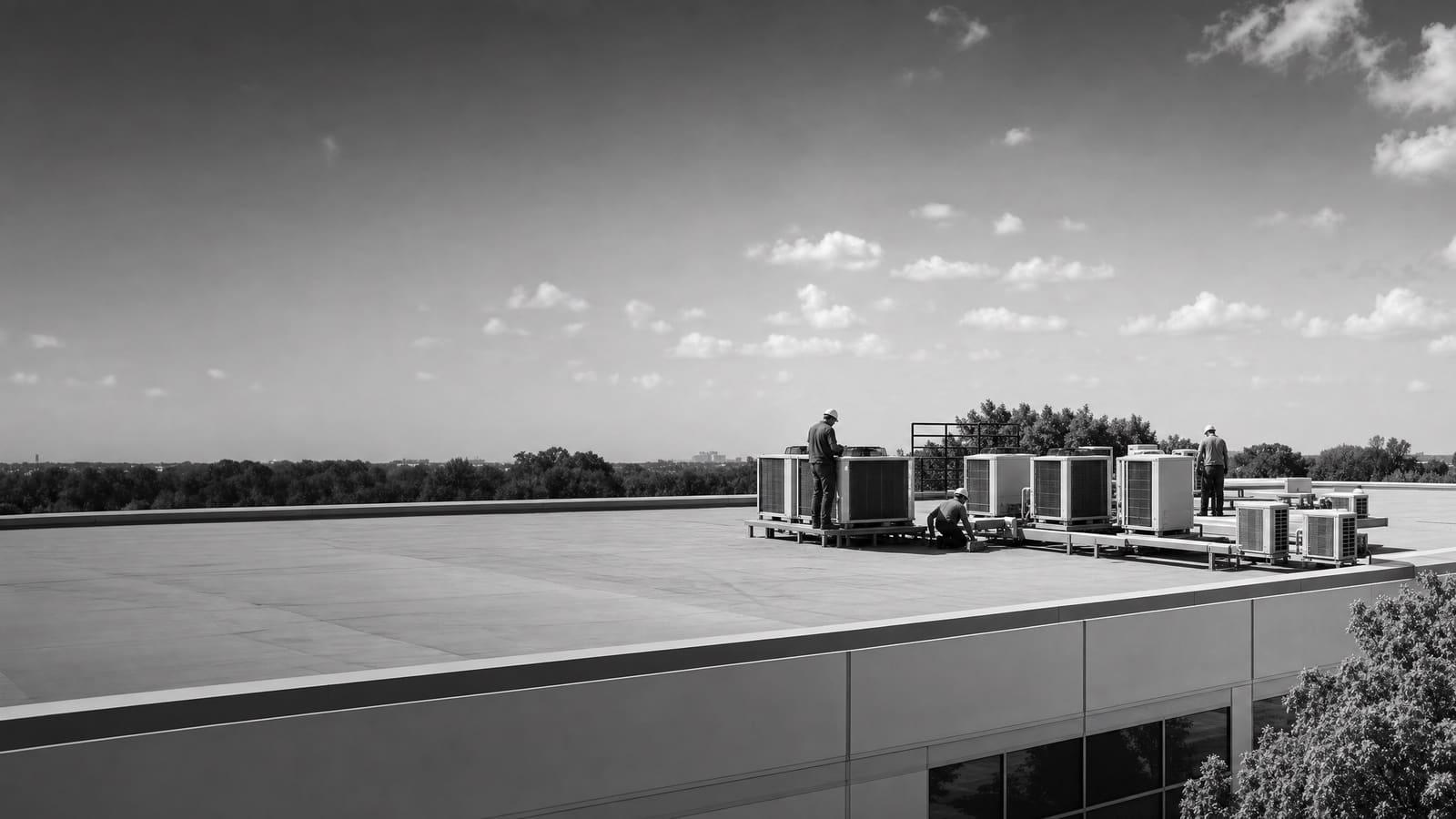
A complete commercial HVAC replacement covers sizing, equipment selection, removal, setting, connections, controls, startup, testing, and refrigerant handling. Replacement becomes more useful than another repair when an older unit cannot hold comfort, needs frequent service, or puts operations at risk. Rooftop units over 15 years old deserve a clear repair-versus-replace review.
A site review must verify the present load, electrical capacity, fuel connections, roof conditions, access, controls, ventilation needs, and equipment availability.
FIRST DECISION
Choose the replacement path before choosing a model
Start with the business problem, not the old equipment label. A failed unit may call for a fast replacement, but speed should not hide a sizing error or a control problem. A working but unreliable unit gives the owner more room to compare efficiency, fuel, and phasing.
The old unit is evidence, not a final design. Review service records, occupied temperatures, complaints, operating hours, and changes in space use. A unit that short-cycles may be too large. A unit that runs without meeting the setpoint may have a load, airflow, control, maintenance, or capacity problem. The review should separate those causes before new equipment is ordered.
Then compare the choices on installed scope, availability, operating effect, and disruption. The right answer may differ across one property. Some units can remain in service, some may need controls work, and some may be good candidates for planned replacement.
BUDGET STRUCTURE
What moves the installed price
There is no supported universal installed price for this project. A useful budget separates the equipment from the labor, access, connection, control, and closeout work needed to deliver an operating system.
EQUIPMENT CHOICES
Compare systems by how the building operates
Packaged rooftop units are common in commercial buildings because one cabinet can combine cooling, ventilation, controls, and heating. A direct replacement may reduce connection work when the curb, duct openings, electrical service, and fuel arrangement remain suitable. That does not mean the old capacity should be copied without review.
A higher-efficiency rooftop unit can use better compressors, fans, staging, and controls to reduce waste at part load. Historical federal work found that older commercial rooftop units could waste substantial energy, while advanced designs could cut energy use sharply compared with the standard used at that time. Those past results are useful context, not a promise for one building. Savings depend on load, schedule, control setup, maintenance, energy rates, and the condition of the system being replaced.
Heat-pump rooftop units add reverse-cycle heating. Options can include all-electric, dual-fuel, and cold-climate designs. The comparison should cover winter heating demand, backup heat, electrical capacity, gas service, equipment availability, and expected utility effects. Owners considering that path can also review commercial heat pump conversion. Model operating cost with current site data before choosing a fuel strategy.
PROJECT COMPLEXITY
A simple swap and a system change are different projects
The same equipment capacity can produce very different scopes. Ask the bidder to classify the job after inspecting the roof, connections, controls, and occupied areas.
LOWER COMPLEXITY
Compatible replacement
The new unit fits the existing arrangement, the building use is stable, capacity remains appropriate, and major electrical, fuel, duct, structural, or control changes are not required.
HIGHER COMPLEXITY
Redesign or conversion
The project changes capacity, fuel, voltage, curb conditions, ventilation, ductwork, controls, or backup heat. It needs more field verification, coordination, and commissioning.
SITE REVIEW
Measure the conditions that can change the design
Begin with equipment records and a physical inspection. Record each unit’s model, capacity, heating source, voltage, controls, refrigerant, condition, and service history. Note which spaces it serves and when those spaces are occupied. Ask staff where comfort, noise, humidity, or airflow problems occur. A nameplate cannot explain how the building now operates.
The load review should account for present occupancy, lighting, process equipment, outside air, envelope conditions, schedules, and internal heat. It should also test whether an equipment problem is really a distribution problem. A new unit cannot correct blocked returns, poor zoning, leaking duct, bad sensors, or a schedule that fights actual occupancy.
Inspect the installation path as closely as the unit. Confirm safe access, lifting needs, roof openings, curb dimensions, equipment weight, duct transitions, electrical service, disconnects, fuel piping, drains, controls, and shutdown limits. For a heat-pump option, review electrical capacity and the proposed source of heat during colder operating conditions. Document unknowns and state how they will be handled in the price.
Useful information to gather
Provide equipment schedules, service records, utility data, control screenshots, floor plans, operating hours, tenant limits, roof information, and a list of known comfort problems.
OWNER PRIORITIES
Balance uptime now with operating value later
The lowest first price is not always the lowest-risk purchase. Compare the full installed scope, expected service needs, control quality, warranty terms, and the cost of disruption. Equipment availability also matters. A theoretically ideal unit has little value if its delivery date conflicts with the facility’s risk window.
Portfolio owners should avoid treating every site as identical. A standard equipment family may simplify parts, training, and controls, but each building still needs a load and infrastructure review. Keep the decision record with the asset file so future staff know why capacity, fuel, controls, and accessories were selected.
OPERATING CONTINUITY
Plan around occupied work
Define acceptable shutdown periods, temporary conditioning needs, noise limits, access controls, protection of indoor areas, and communication duties before the installation date.
LIFETIME OWNERSHIP
Protect serviceability
Compare filter access, replacement parts, technician familiarity, control support, warranty procedures, maintenance needs, and how the unit fits the wider equipment fleet.
PROCUREMENT AND PHASING
Turn the selected design into a workable project
Do not schedule the final shutdown from an estimated ship date alone. The plan should define when equipment is considered ready, who checks it on arrival, where it will be stored, and what site work must finish before setting. Confirm curb or support details, connection locations, controls, and required accessories against approved submittals. Small mismatches can create large delays when the old system is already offline.
For several units, phasing can protect operations and reveal problems early. Start with a representative area when practical. Use its installation and startup findings to refine later work. Keep enough working capacity for occupied zones, and state what happens if weather, delivery, or hidden conditions interrupt the sequence.
Acceptance should mean more than power at the disconnect. Verify fan operation, airflow, temperatures, heating and cooling stages, ventilation, sensors, schedules, alarms, safeties, drainage, and control communication. Record settings and correct deficiencies before final payment. Complete refrigerant work in line with federal handling and recycling requirements. Give the owner startup reports, warranty information, equipment data, control documents, training, and a final asset list.
QUOTE CHECK
Five items every comparable quote should show
Require each bidder to price the same outcome. If an item is excluded, carried as an allowance, or left unknown, the quote should say so clearly.
01
Selected equipment
List capacity, heating type, efficiency, controls, accessories, availability, warranty, and approved alternatives.
02
Complete installation scope
Define removal, rigging, curbs, supports, duct, drains, electrical, fuel, controls, roofing, and protection.
03
Operations plan
State shutdowns, phasing, temporary measures, access limits, work hours, cleanup, and facility communication.
04
Testing and acceptance
Name the startup checks, balancing, control tests, reports, training, and standards for owner acceptance.
05
Price boundaries
Show exclusions, allowances, alternates, change-order rules, payment terms, schedule assumptions, and responsibility for hidden conditions.
Get a defensible number
Price the equipment and the building together.
Send the address, operating target, and target opening date. Flux will identify what must be verified before the project can be priced.
Get a free estimateQuestions
Straight answers.
When should a commercial rooftop unit be replaced instead of repaired?
Replacement deserves serious review when an older unit cannot maintain the space, fails often, requires repeated major repairs, or threatens business continuity. Federal guidance flags rooftop units over 15 years old as possible sources of avoidable energy and maintenance cost. Age alone does not settle the choice. Compare the repair, current condition, expected remaining life, operating effect, replacement availability, and consequence of another failure.
Should the new HVAC unit match the old capacity?
Not automatically. The old nameplate is a starting point. Confirm the current load and investigate comfort history, operating schedules, occupancy, ventilation, internal equipment, airflow, duct conditions, and controls. A direct capacity match may be sensible when the building and load are stable, but copying an oversized or undersized unit carries the same problem into the next equipment cycle.
Is a commercial heat-pump rooftop unit a good replacement option?
It can be, but it needs a site-based comparison. Review heating demand, electrical capacity, gas infrastructure, backup heat, physical fit, available models, utility effects, service support, and organizational goals. Compare all-electric, dual-fuel, and cold-climate configurations where relevant. Do not assume an air-conditioning rooftop unit and a heat-pump rooftop unit have the same electrical or heating requirements.
What should happen during HVAC commissioning?
Commissioning should prove that the installed system operates as selected. Checks should cover airflow, fan rotation, heating and cooling stages, temperatures, sensors, ventilation, schedules, safeties, alarms, drainage, and building automation communication. The contractor should document settings and test results, correct deficiencies, train the owner, and provide final equipment and warranty records.
How can owners compare commercial HVAC installation quotes?
Give bidders the same written scope and equipment requirements. Compare equipment, accessories, removal, rigging, roof work, duct transitions, electrical and fuel work, controls, startup, testing, documentation, schedule, warranty, exclusions, and allowances. A low number may omit work another bidder included. Resolve those gaps before selecting a proposal.
What records should the owner receive after installation?
Request approved equipment data, startup reports, test and balance results when included, control sequences, final settings, warranty information, maintenance requirements, refrigerant records, training materials, and an updated equipment list. Keep these records with service history. They make warranty work, future maintenance, energy review, and the next replacement decision easier.
Sources used for this guide
- [1]betterbuildingssolutioncenter.energy.gov — DOE Advanced Rooftop Unit Replacement Guidance
- [2]betterbuildingssolutioncenter.energy.gov — DOE Commercial Heat Pump Rooftop Unit Replacement Guidance
- [3]betterbuildingssolutioncenter.energy.gov — DOE High-Efficiency Commercial Rooftop Unit Toolkit
- [4]energy.gov — DOE Efficient Commercial Rooftop Air Conditioner Program
- [5]epa.gov — EPA Stationary HVAC Refrigerant Management