THE SHORT ANSWER
What a commercial HVAC replacement actually includes
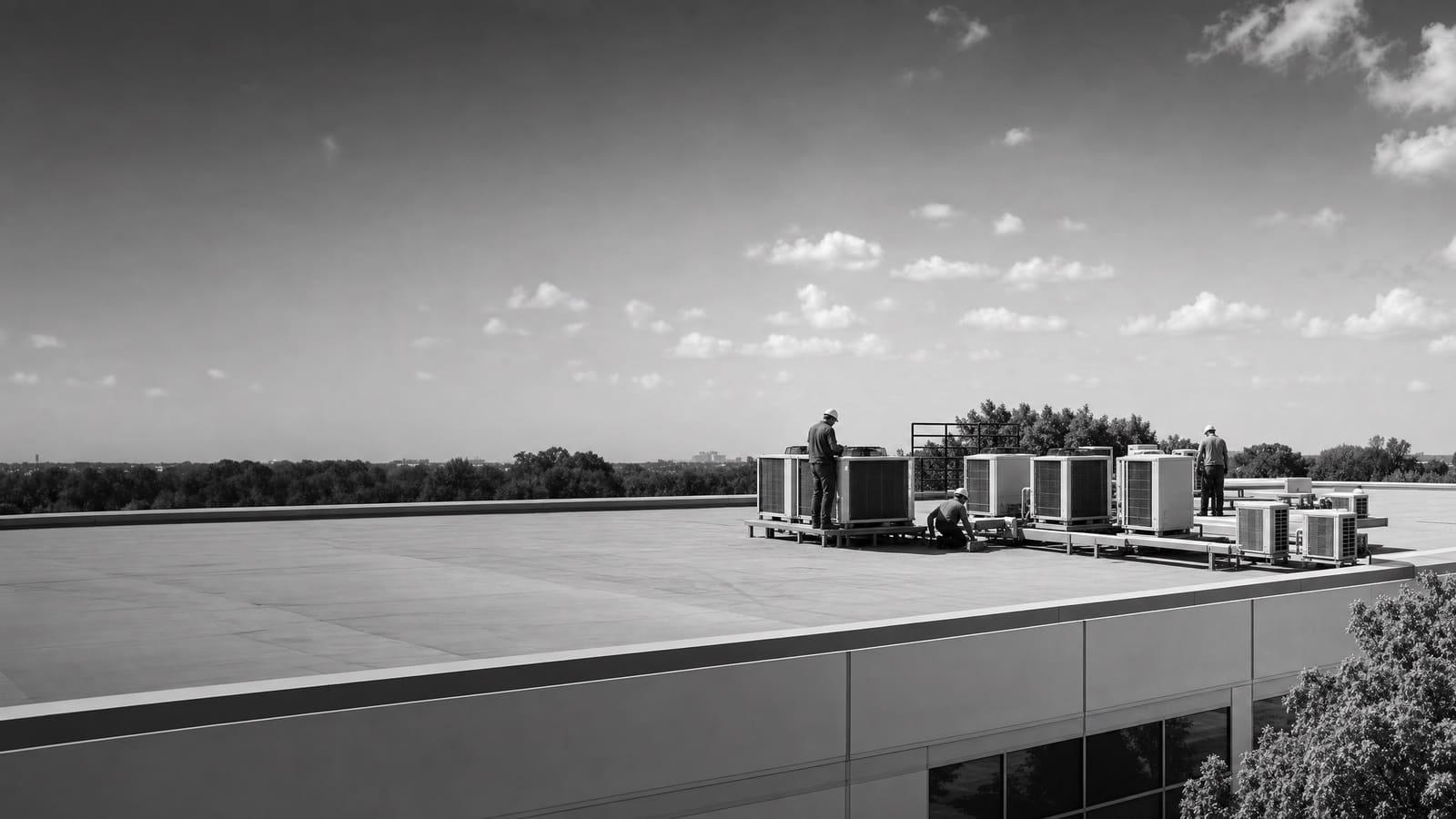
A commercial HVAC replacement covers the load calculation, equipment selection, permits, certified recovery of the old refrigerant, the crane set, curb or curb adapter work, gas and electric connections, controls integration, and commissioning. Replacement beats one more repair once a unit passes about fifteen years. Units that old waste substantial energy — commonly $900 to $3,700 per unit every year — and each repair buys less runtime than the one before it.
A site review still has to verify the real load, the roof structure and curb condition, available electrical capacity, and crane access before any of that becomes a price you can hold a bidder to.
THREE WAYS TO GO
Three replacement paths, and when each one fits
Most buyers think the choice is which brand. The real choice is which path. A like-for-like air-conditioning rooftop unit is the fastest route back to conditioned space and the simplest permit. A heat pump rooftop unit is close-cousin technology — same footprint, same install trade, same crane day — but it adds reverse-cycle heating and moves winter load off gas and onto the electrical service. Advanced controls on an existing unit are the third path: when the cabinet and coil are still sound and the unit is not at end of life, controls capture savings without a rigging plan.
The facts that decide it are the age of the unit, whether the space is used the way it was when the unit was originally sized, and what the building's electrical panel has left. High-efficiency rooftop specifications were written to cut unit energy use by up to half against the older standard, so the efficiency tier is not a rounding error across a fifteen-year life.
WHAT MOVES THE NUMBER
The budget lines that actually swing
An installed price is built from a short list of line items, and almost all of the spread between two bids lives in three or four of them. Ask each bidder which of these is priced and which is sitting in the quote as an allowance.
IN PRACTICE
Choosing equipment without guessing
Start with the load, not the nameplate. A unit sized fifteen or twenty years ago was sized for that building's occupancy, lighting, plug load, and envelope. If the space has since become a call center, a gym, or half warehouse and half office, the old tonnage is a guess being carried forward. Confirming the load is a few hours of work that decides everything downstream.
Then settle gas heat versus heat pump heating, because that choice changes infrastructure, not just a model number. Heat pump rooftop units are technologically similar to air-conditioning units — same shape, same trade, same crane day — but they put winter heating on the electrical service. The checklist is short: what the panel can carry, whether the physical space and curb accept the unit, what happens to the existing gas line, what local utility rates do to operating cost, and whether the equipment is available on your schedule.
Availability belongs in the comparison from day one. A slightly better unit that lands eight weeks out is the wrong unit in July. Ask every bidder for the lead time next to the price, and treat a missing lead time as a missing number.
SCOPE CHECK
What makes one roof simple and another complicated
Two identical units on two different roofs can carry very different installed prices. The gap is almost never the equipment. It is what the building asks of the crew before and after the set.
LOWER COMPLEXITY
Straight swap, open lot
Same tonnage on the existing curb, gas stays gas, the panel already carries the load, and the crane parks close with room to reach. Permits are routine and the outage is a single morning.
HIGHER COMPLEXITY
New footprint or new fuel
Different tonnage or cabinet, an adapter or added framing, a move to electric heating that needs panel capacity, a tight lot that forces a long reach, and tenants who cannot lose cooling during business hours.
BEFORE YOU PRICE IT
What a real site review has to confirm
A quote written from a photo is an estimate. A quote written from a roof visit is a price. The visit exists to answer the questions that change the number, and there are only about six of them.
First, the load: what the space needs today, not what the old unit claims. Second, the roof: whether the existing curb takes the new unit directly, needs an adapter, or needs structural work, and what shape the roofing is in around the opening. Third, power: what the panel has available, especially when the replacement moves heating from gas to electricity. Fourth, the connections: gas line disposition, refrigerant line routing, condensate, and how the unit ties into building controls. Fifth, access: where the crane sets up, how far it reaches, how many stalls close and for how long. Sixth, the schedule: one morning, after hours, or phased around tenants.
Every one of those carries a cost. When a bidder skips the visit, those costs do not disappear. They show up later as change orders.
Ask for the findings, not just the total
A useful site review comes back as a short written scope: measured load, curb disposition, electrical capacity, connection changes, crane plan, and outage window. If a bidder can hand you that page, their number is real. If they cannot, you are comparing guesses.
IN RANCHO CUCAMONGA
What this city changes about the decision
Two things shape the plan here. The first is permitting. In California, mechanical equipment work is permit work, and the electrical and plumbing changes that ride along with a rooftop changeout get permitted alongside it. That is routine, and it is also a schedule item: the installer applies, an inspector comes out, and both belong on the timeline before the crane is booked.
The second is climate. Across most of the Western United States, today's heat pump rooftop units are an appropriate solution and are capable of handling most or all of the winter heating demand, because heat pump efficiency stays strong through mild-to-moderate winters. That keeps the gas-versus-electric question genuinely open on a Rancho Cucamonga roof rather than settled by the weather, and it pushes the deciding factors to electrical capacity and utility rates.
Put the permit on the schedule, not in the footnotes
Ask who pulls the mechanical and electrical permits and where inspection sits on the timeline. On a summer changeout, an inspection nobody scheduled is what turns a one-morning outage into a week of portable cooling.
OWNERSHIP MATH
Two decisions that outlive the install
Two parts of this project keep costing money — or keep saving it — long after the crane leaves, and both are far easier to settle before the purchase order than after. The first is what the new unit's refrigerant means for the rest of the equipment on your roof. The second is what gets documented on day one, which determines whether the warranty holds and whether the next replacement is simpler to scope than this one. Neither is exciting. Both turn into real dollars by year three, and both are cheap to ask about while you still have leverage with the bidder.
MIXED-FLEET SERVICE
Refrigerant strategy
New equipment ships on newer refrigerants. Federal rules require refrigerant to be handled and recovered by certified technicians rather than vented, so a roof running two refrigerant families needs a service plan and a parts plan, not just a maintenance contract.
DOCUMENTATION
Commissioning and records
Startup readings, charge, airflow, and control settings should be recorded and handed over. That package is what keeps the warranty enforceable, tells the next technician how the unit was set, and makes the second replacement cheaper to scope.
PHASING AND PROCUREMENT
When you own more than one unit
Most facilities do not replace one unit. They replace one now and three more over the next several years, usually in the order the units happen to fail. Failure order is the most expensive sequence available. It concentrates work into the hottest weeks, removes any leverage on price, and forces you to take whatever equipment is in stock.
Planned replacement inverts all three. Proactively replacing inefficient, underperforming units with more efficient ones is generally the better business move compared with replacement-on-failure, or even with a like-for-like swap at the end of service life, because you control the timing, the efficiency tier, and the vendor. The organizations that ran this as a program — more than two hundred of them, across over forty-three thousand rooftop units — cut a combined thirty-seven million dollars a year from their energy bills.
In practice that means a roof survey that ages every unit, a replacement order set by age and condition instead of by breakdown, and standardizing on one or two models so parts, controls, and technician familiarity carry across the fleet. Phase the work into shoulder seasons and put the oldest, least efficient unit first, because that is where the annual waste is largest.
QUOTE CHECKLIST
Five things a comparable quote shows
Two quotes are only comparable when both put the same things on paper. Before you compare totals, check that each bid shows these five.
01
Equipment and lead time
Model, tonnage, efficiency tier, heating type, and the real delivery date sitting next to the price.
02
Roof and curb scope
Whether the existing curb is reused, adapted, or replaced, plus any framing or roofing work around the opening.
03
Rigging and access plan
Crane size, setup location, stalls closed, closure hours, and who coordinates with tenants.
04
Permits and refrigerant recovery
Mechanical and electrical permits, inspection scheduling, and certified recovery of the old charge, all inside the base price.
05
Commissioning and closeout
Startup readings, airflow and charge verification, controls setup, and the documentation package handed over at completion.
Get a defensible number
Price the equipment and the building together.
Send the address, operating target, and target opening date. Flux will identify what must be verified before the project can be priced.
Get a free estimateQuestions
Straight answers.
When does replacing a rooftop unit beat repairing it again?
Once a unit is past roughly fifteen years, it is usually wasting substantial energy on its own — commonly $900 to $3,700 per unit per year — while repairs buy shorter and shorter stretches of reliability. At that point the repair invoice is not the real cost. The annual waste is.
Does a heat pump rooftop unit make sense on a Rancho Cucamonga roof?
In most of the West, today's heat pump rooftop units are an appropriate solution and can handle most or all of the winter heating demand. The real gate is not the weather. It is whether the electrical panel has capacity for the added load, and what your utility rates do to operating cost.
Do I need a permit to replace a commercial rooftop unit?
Plan on it. In California, mechanical equipment work is permitted work, and the electrical or plumbing changes that come with a changeout are permitted with it. The installing contractor should pull the permits and carry inspection scheduling inside the installed price, not bill it afterward.
How long is the building without cooling?
The set itself is usually the shortest part of the project, and on a straightforward swap tenants notice the parking cones more than the outage. The long pole is equipment availability. That is exactly why lead time belongs on the quote right next to the price.
What does a new refrigerant mean for my other units?
New equipment ships on newer refrigerants, which changes nothing about day-one operation but does matter for a mixed roof. Refrigerant has to be recovered and handled by certified technicians rather than vented, so plan parts stocking and service coverage for both refrigerant families.
Sources used for this guide
- [1]betterbuildingssolutioncenter.energy.gov — DOE Advanced Rooftop Unit Replacement Guidance
- [2]betterbuildingssolutioncenter.energy.gov — DOE Commercial Heat Pump Rooftop Unit Replacement Guidance
- [3]betterbuildingssolutioncenter.energy.gov — DOE High-Efficiency Commercial Rooftop Unit Toolkit
- [4]energy.gov — DOE Efficient Commercial Rooftop Air Conditioner Program
- [5]epa.gov — EPA Stationary HVAC Refrigerant Management
- [6]californiacity-ca.gov — HVAC Permits