THE DIRECT ANSWER
What a commercial HVAC replacement actually includes
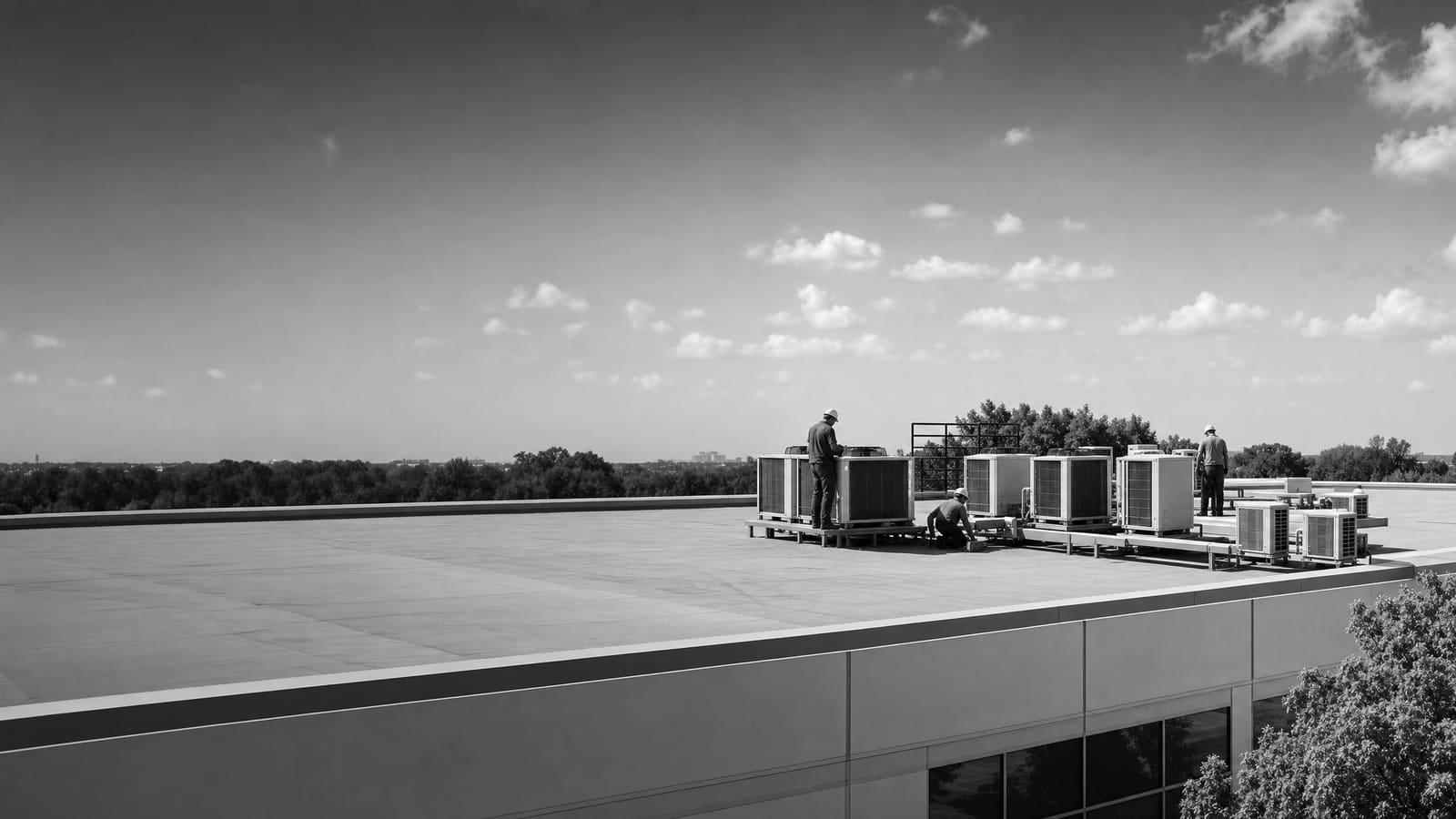
A commercial HVAC replacement covers the load calculation, equipment selection, curb and structural work, the crane set, the gas, electrical and refrigerant connections, and commissioning. Replacement beats one more repair once a unit is past about fifteen years and needs regular service. Old, inefficient rooftop units waste an estimated $900 to $3,700 per unit every year. Choosing the replacement date yourself, instead of letting a failed compressor choose it, is where most of the savings live.
A site review still has to confirm the real load, the roof structure under the curb, the electrical capacity at the panel, and crane access before any of that becomes a price.
THREE WAYS TO PLAY IT
Replace now, replace better, or retrofit the controls
Rooftop units condition close to half of all commercial floor area in the country, so most commercial HVAC decisions are really decisions about what to do with an aging rooftop unit. There are two productive paths and one expensive habit. The productive paths are replacing the unit with a more efficient one, or retrofitting the existing unit with advanced controls, whichever makes better financial sense for that building. The expensive habit is waiting until the unit no longer holds the space, needs constant service calls, or quits outright. Replacing on failure strips away your leverage on every part of the job: which unit you can get, when the crane comes, and whether you can still qualify for an incentive that needs approval before the order is placed. Deciding a year early usually buys a better unit for the same money.
WHAT MOVES THE NUMBER
The line items that decide your installed price
Equipment is rarely the line that surprises anyone. The surprises live in the roof, the electrical panel, and the parking lot. Price these separately so you can see where the risk actually sits before you sign.
IN PRACTICE
Size the replacement against the building you have now
The nameplate on the old unit tells you what somebody decided a long time ago. It does not tell you what the building needs today. Occupancy shifts, plug loads climb, lighting gets swapped out, walls move, and the envelope gets tightened. Any one of those changes the load, and after fifteen or twenty years several of them usually have.
That is why a load calculation belongs at the front of the project, even on a straight swap. If the number comes back close to the existing tonnage, you have confirmed the easy path and paid very little for the certainty. If it comes back meaningfully different, you have just found the reason a wing of the building has been uncomfortable for years, and you get to fix it with the same crane day you were already paying for.
The reverse case matters just as much. An oversized unit short-cycles, dehumidifies poorly, and wears out its compressor early. Carrying that mistake forward because it was already on the roof is the most common avoidable cost in this whole category.
COMPLEXITY CHECK
What keeps this simple and what makes it hard
Two replacements of the same tonnage can differ enormously in price, and almost none of that difference is the equipment. It is access, infrastructure, and whether anything about the installation has to change.
LOWER COMPLEXITY
Straight swap, open site
Same tonnage and fuel, existing curb reused with an adapter, adequate power already at the unit, and a lot with room for the crane during off hours. Scope is short and the schedule holds.
HIGHER COMPLEXITY
Changed equipment, tight site
New footprint or weight, a fuel change that needs electrical capacity added, tenants who cannot lose parking, or a roof that has to be reviewed. Each one adds engineering, permits, or a second mobilization.
THE SITE REVIEW
What has to be verified before anyone quotes a number
A credible installed price comes from a walkthrough, not a phone call. The person quoting needs to see four things with their own eyes, and each one has killed an otherwise clean budget.
First, the roof under the curb. The existing curb rarely matches a new unit exactly, so an adapter is normal, but weight and footprint changes are what trigger structural review. Second, the electrical service. If the replacement adds electric heat or moves to a heat pump, available panel capacity decides whether this is a routine job or a utility conversation. Third, the gas situation, including whether the line stays, gets capped, or feeds a dual-fuel unit. Fourth, access. Crane reach, staging area, and how many hours you can close stalls are not details, they are a real fraction of the price.
Incentive programs are worth checking during this same review rather than after. Efficiency incentives generally attach to a specific efficiency tier, and the approval usually has to come before the equipment order, not after the invoice.
Bring these to the walkthrough
Nameplate photos of every unit, your utility bills for the last full year, the roof plan if you have it, the electrical panel schedule, and the hours when the lot can actually be closed.
THE ELECTRIC QUESTION
All-electric, dual fuel, or stay with gas heat
If the unit coming off the roof burns gas, this replacement is the moment to decide whether the next one does. Heat pump rooftop units are mechanically similar to air-conditioning units and add reverse-cycle heating, so the cooling side of the decision barely changes. The heating side is where it gets real. As outdoor temperature drops, heat pump heating efficiency falls and moves toward parity with electric resistance heat, which is why the honest evaluation runs on your building's heating hours, your electricity and gas rates, and your available electrical capacity rather than on a general preference. Cold-climate and dual-fuel variants exist specifically for buildings with sustained winter heating demand. Contractor familiarity with the equipment belongs on the list too.
OPTION A
All-electric heat pump unit
One fuel, no gas train, and it lines up with emissions targets. Most all-electric and cold-climate units carry electric resistance backup, so panel capacity has to be confirmed before the order.
OPTION B
Dual fuel
Heat pump heating in mild conditions with gas heat taking the cold hours. Keeps the gas service and a smaller electrical ask, at the cost of maintaining two heating systems in one cabinet.
PHASING AND PROCUREMENT
Buying one unit versus planning a fleet
If you have one rooftop unit, this is a project. If you have six, it is a program, and the two get bought very differently.
With a fleet, the useful exercise is ranking units by age, service history, and the space each one serves, then setting a replacement order before anything fails. That turns an unpredictable string of emergencies into a budget line you control. It also gives you buying power. More than two hundred public and private organizations have collectively upgraded over forty-three thousand rooftop units through a coordinated efficiency campaign, saving a combined thirty-seven million dollars a year on energy bills, and none of that came from replacing units one at a time in July.
Phasing also lets you learn cheaply. Do the worst unit first, on the building where the load calculation and the electrical review will teach you the most. What you find there tells you whether the rest of the portfolio is a like-for-like program or an electrification program, before you have committed capital to the wrong answer.
The units that stay in service in the meantime are candidates for the controls retrofit path, which buys performance without buying equipment.
QUOTE CHECKLIST
Five things a comparable quote has to show
Two quotes are only comparable when both spell out the same scope. If any of these are missing, they are not discounted, they are just unpriced and waiting to become a change order.
01
The load basis and the selection
Tonnage and efficiency tier, and whether they came from a calculation or from the old nameplate.
02
Curb, structure, and penetrations
Adapter, any structural review triggered by weight or footprint, and how the roof gets sealed.
03
The rigging plan
Crane size, staging location, closure window, and who coordinates it with tenants.
04
Electrical and gas scope
Existing capacity confirmed, any panel or service work, and what happens to the gas line.
05
Recovery and commissioning
Refrigerant recovered per federal rules, then startup, charge, airflow, and controls verified and documented.
Get a defensible number
Price the equipment and the building together.
Send the address, operating target, and target opening date. Flux will identify what must be verified before the project can be priced.
Get a free estimateQuestions
Straight answers.
When does replacement beat another repair?
Once a unit is past roughly fifteen years and is taking repeated service calls, the math usually flips. Old, inefficient rooftop units waste an estimated $900 to $3,700 per unit per year in energy, and that runs every month whether or not the unit is currently broken. A repair buys time; it does not buy back that operating cost.
Should the replacement be like-for-like or resized?
Run the load calculation either way. If the space and its use have not changed, like-for-like is often correct and the calculation just confirms it cheaply. If occupancy, plug loads, or the envelope have changed, resizing fixes comfort problems the old unit could never solve and lowers operating cost for the life of the equipment.
Is a heat pump rooftop unit the right choice?
It depends on your heating hours, your electricity and gas rates, and your available electrical capacity. Heat pump heating efficiency drops as outdoor temperature falls, so buildings with sustained winter heating demand generally look at cold-climate or dual-fuel units. Panel capacity should be confirmed before ordering, because backup electric resistance heat is common.
What usually blows up the budget?
Rarely the equipment. It is the electrical service when the fuel changes, structural review when the unit's weight or footprint changes, and crane access on a site where the lot cannot be closed during business hours. All three are visible during a walkthrough, which is why quoting without one is a guess.
What happens to the refrigerant in the old unit?
Federal Clean Air Act rules govern how refrigerant in stationary air-conditioning and heat pump equipment is handled and recycled, and they exist to keep it from being released. Recovery is a defined line of work performed during removal, and it should appear in the scope rather than being assumed.
Can we improve performance without replacing the unit?
Sometimes, yes. Retrofitting an existing rooftop unit with advanced controls is a recognized alternative to replacement, and it is worth pricing when the cabinet, coil, and compressor still have real life left. Compare it directly against a high-efficiency replacement rather than treating it as the automatic cheap option.
Sources used for this guide
- [1]betterbuildingssolutioncenter.energy.gov — DOE Advanced Rooftop Unit Replacement Guidance
- [2]betterbuildingssolutioncenter.energy.gov — DOE Commercial Heat Pump Rooftop Unit Replacement Guidance
- [3]betterbuildingssolutioncenter.energy.gov — DOE High-Efficiency Commercial Rooftop Unit Toolkit
- [4]energy.gov — DOE Efficient Commercial Rooftop Air Conditioner Program
- [5]epa.gov — EPA Stationary HVAC Refrigerant Management