THE SHORT VERSION
What a commercial HVAC replacement actually includes
A commercial HVAC replacement covers the load calculation, the equipment, the curb and connection work under it, the crane day, the permits, and the commissioning that proves the system performs. Replacement beats another repair once a unit is past roughly fifteen years and still failing, because units that old commonly waste an estimated $900 to $3,700 each per year compared with newer models. That waste keeps running between service calls.
A site review still has to confirm tonnage against current occupancy, the roof structure under the curb, and the electrical and gas service at the unit before any price is real.
THREE WAYS TO GO
Three replacement paths worth pricing
Most buyers assume the choice is which brand. The real choice is which of three paths the building belongs on, and that depends on the age and condition of what is up there now.
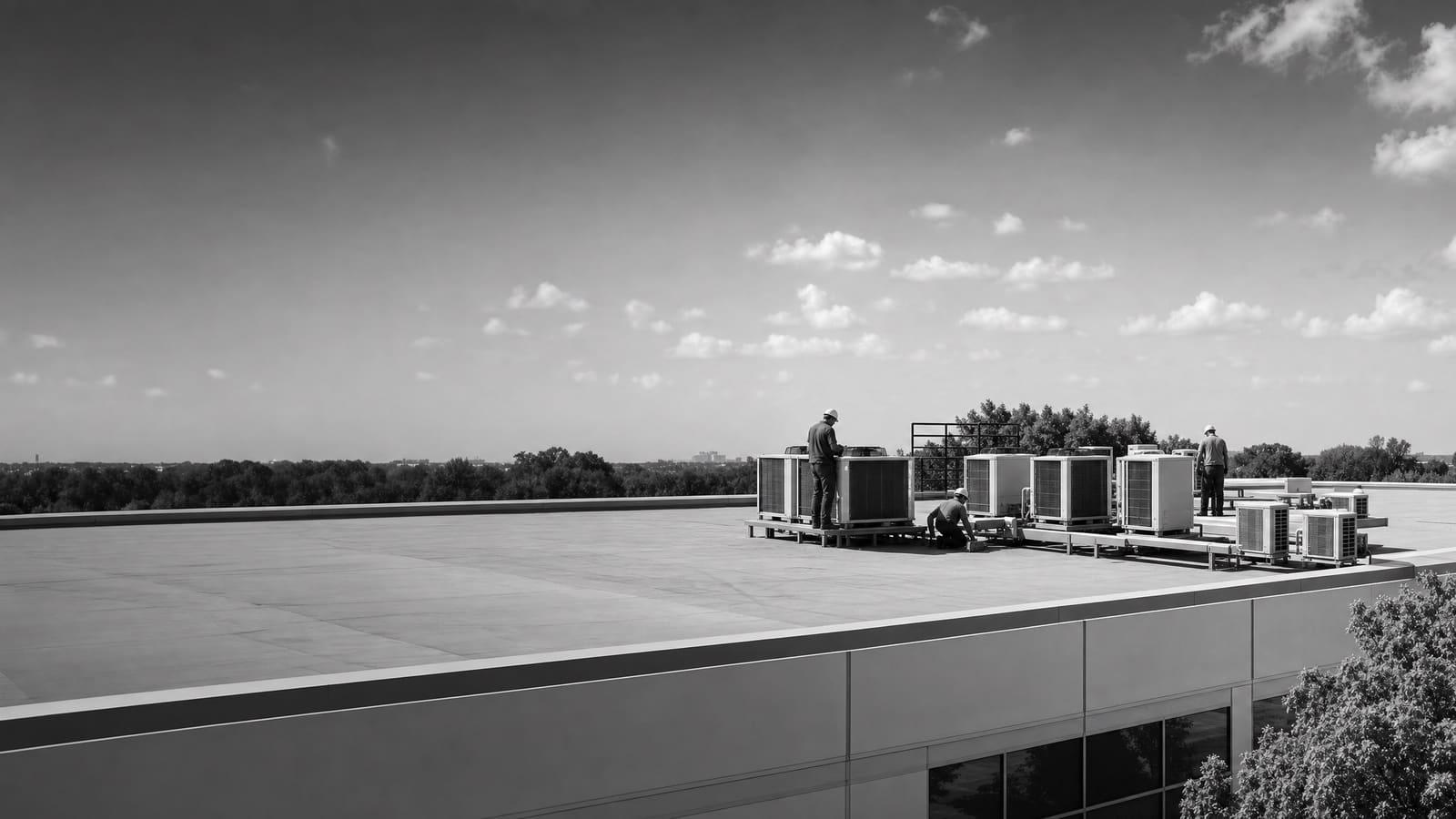
Rooftop units cool close to half of all commercial floor space in the country, so most of these decisions come down to a packaged unit on a roof. Federal guidance is blunt about the common failure: owners wait until the unit stops conditioning the space, needs constant service, or fails outright. Replacing on failure removes the chance to compare paths at all, because by then the only question left is what is in stock and how fast it can be craned up.
Proactive replacement is not only a comfort argument. It is the one condition under which the three options below get priced against each other instead of ruled out by the calendar.
WHAT MOVES THE NUMBER
Where a commercial HVAC budget actually moves
The unit itself is rarely the line that surprises people. What moves the budget is everything the unit has to connect to and everything the roof has to do to hold it.
IN PRACTICE
How to choose the equipment
Start with fuel, not brand. A heat pump rooftop unit is mechanically close to a standard air-conditioning rooftop unit; the difference is that it runs the cycle backwards to heat. That makes it look like a straight swap on paper and a real decision in practice, because the economics turn on winter.
Heat pump efficiency falls as outdoor temperature falls, and at the cold end it drifts toward the same efficiency as electric resistance heat. That is why heat pump rooftops fit best where winter heating demand is mild to moderate. Any site's winter design conditions need to be checked rather than assumed. Where the winter load is real, the honest options are a dual-fuel unit that hands heating back to gas when it gets cold, or a cold-climate heat pump built to hold capacity further down.
If gas stays, the decision moves to efficiency tier. The federal rooftop challenge produced units targeting up to half the energy of the prior standard, and more than twenty models now exceed that spec. That gap is worth pricing across fifteen years of operation, not across the first invoice.
One more thing worth naming: new equipment ships on newer refrigerants. It changes nothing on day one, but it changes parts and service planning across a mixed fleet.
COMPLEXITY CHECK
What makes a replacement simple or hard
Two buildings can buy the identical unit and end up with very different projects. The difference is almost never the equipment. It is the curb, the panel, and the parking lot.
LOWER COMPLEXITY
Same size, same fuel, open roof
The replacement matches the old tonnage and fuel, the existing curb takes an adapter, the electrical service already carries the load, and the crane has a clear staging spot. Permits stay in the mechanical and electrical lane, and the outage is measured in hours.
HIGHER COMPLEXITY
New size, new fuel, tight site
Tonnage grows, the fuel changes, or the panel has no room left. Now you are adding electrical capacity, checking roof structure, deciding what happens to the gas line, and finding a crane position that does not close the whole lot. Lead times stretch and phasing matters.
BEFORE YOU BUY
What the site review has to settle
The site review exists to turn a guess into a scope. Federal replacement guidance runs the same short checklist every time, and it is a good list to hold a contractor to.
Electrical capacity comes first whenever electrification is on the table. A heat pump rooftop may draw more than the gas unit it replaces, and panel headroom is the thing that quietly kills an otherwise good plan. Physical constraints come next: curb size, roof structure, clearances, and whether the new unit's footprint actually lands where the old one sat. Gas lines are the third item, because going all-electric means someone has to decide whether the line gets capped or kept for a future tenant.
Then equipment availability, which is the item most quotes leave out. Efficient and cold-climate models are not always sitting in a regional warehouse, and a unit you cannot get for eight weeks is not really an option for a building in season.
Last, the load itself. A twenty-year-old nameplate describes a building that no longer exists: different occupancy, different plug loads, different envelope. Sizing from it carries the original mistake forward at full price.
The one question that reorders everything
Ask whether the building's electrical service can carry an all-electric unit today. If yes, dual-fuel and all-electric both stay on the table. If no, that answer changes the equipment list, the permit set, and the schedule before you price a single model.
OWNERSHIP MATH
Two things to settle before you sign
A replacement is a fifteen-to-twenty-year decision usually made in a week, under pressure, by whoever answered the phone. Two questions decide whether you still like the choice in year five, and neither one is technical.
The first is who actually pays for the energy the unit burns. The second is who is on the hook for keeping the warranty enforceable. Both get skipped in favor of tonnage and price, and both change what you should buy. They are also the two answers a good contractor will ask you for, because the right recommendation looks different for an owner-occupier than it does for a landlord with triple-net leases. Settle them before the purchase order, not after the crane leaves.
SPLIT INCENTIVE
Who pays the power bill
If tenants pay utilities and you buy the unit, the efficiency upgrade saves someone else money. That is a lease conversation rather than an HVAC one, but it decides whether the high-efficiency tier is worth the premium to you at all.
WARRANTY AND SERVICE
Who keeps it in warranty
Startup documentation, refrigerant handling records, and a real maintenance schedule are what keep a manufacturer's warranty enforceable. Decide before install whether that sits with your in-house team or with the installing contractor.
PLANNING AHEAD
Phasing, procurement, and the fifteen-year number
The best-priced replacement is the one you scheduled. The worst is the one a July failure scheduled for you. If you own several units, the useful exercise is a plain age and condition list. Anything past fifteen years goes in the planned column, and you replace one or two a year on your own calendar instead of the equipment's.
That approach also fixes procurement. Ordering ahead of season means you compare real models instead of taking what is available, and it gives the efficiency tier a fair hearing instead of a rushed one. Nationally, the organizations that treated rooftop replacement as a program rather than an emergency have upgraded more than 43,000 units and cut roughly $37 million a year off their combined energy bills. The mechanism is not exotic. They stopped replacing on failure.
Then run the fifteen-year number instead of the invoice. Take the annual waste on the old unit, compare the operating cost of the tiers you are considering, and add the difference in service cost. A base-tier unit that saves a few thousand dollars at purchase can give all of it back well before the warranty expires. That comparison belongs in the quote, and it is fair to ask for it.
APPLES TO APPLES
Five things every quote should show
Two quotes for the same roof are only comparable if both spell out the same five things. If one leaves an item blank, that is not a lower price. It is a line that shows up later as a change order.
01
Model, tonnage, and efficiency tier
The exact unit, its capacity, and where it sits against the current minimum standard. A brand name is not a spec.
02
Lead time in writing
Committed availability with a date, not the word typical. In season, this matters more than a few percent on price.
03
Curb, structural, and roof work
Whether an adapter is included, what the structural check found, and who repairs the roof around the new footprint.
04
Electrical, gas, and refrigerant scope
Service changes, any panel work, recovery from the old unit, and which fuel connections stay, move, or get capped.
05
Permits, crane, and commissioning
Who pulls permits, who owns the rigging plan and lot closure, and what startup documentation you receive at handoff.
Get a defensible number
Price the equipment and the building together.
Send the address, operating target, and target opening date. Flux will identify what must be verified before the project can be priced.
Get a free estimateQuestions
Straight answers.
When is replacement better than one more repair?
Once a unit is past about fifteen years and failing repeatedly, repairs stop buying much time. Units that old commonly waste an estimated $900 to $3,700 a year each compared with newer models, and that waste keeps running between service calls.
What does a commercial HVAC installation cost?
There is no honest universal number, because tonnage, curb and structural work, electrical scope, and crane access each move it independently. What you can pin down before buying is the operating side: what the old unit wastes annually, and what each efficiency tier costs to run.
Is a heat pump rooftop unit a straight swap?
Mechanically it is close to a standard air-conditioning rooftop unit. The decision is winter and electrical capacity. Heat pump efficiency drops as outdoor temperature drops, and the panel has to carry the unit. Dual-fuel and cold-climate models exist for exactly that situation.
What if a full replacement is not in this year's budget?
An advanced controls retrofit on a sound existing unit is a recognized alternative to replacing it. It will not fix a failing unit or a wrong size, but on equipment with service life left it captures part of the savings for far less capital.
Does refrigerant handling belong in the scope?
Yes. Federal rules govern how refrigerant is recovered and handled when equipment is serviced or removed, and the contractor owns that work. New equipment also ships on newer refrigerants, which is worth planning for in service contracts across a mixed fleet.
Should we size the new unit from the old nameplate?
No. Twenty years changes occupancy, plug loads, and the building envelope. Sizing from the old nameplate carries any original mistake forward and can leave you paying for capacity the building no longer uses.
Sources used for this guide
- [1]betterbuildingssolutioncenter.energy.gov — DOE Advanced Rooftop Unit Replacement Guidance
- [2]betterbuildingssolutioncenter.energy.gov — DOE Commercial Heat Pump Rooftop Unit Replacement Guidance
- [3]betterbuildingssolutioncenter.energy.gov — DOE High-Efficiency Commercial Rooftop Unit Toolkit
- [4]energy.gov — DOE Efficient Commercial Rooftop Air Conditioner Program
- [5]epa.gov — EPA Stationary HVAC Refrigerant Management