THE SHORT ANSWER
What a commercial HVAC replacement actually includes
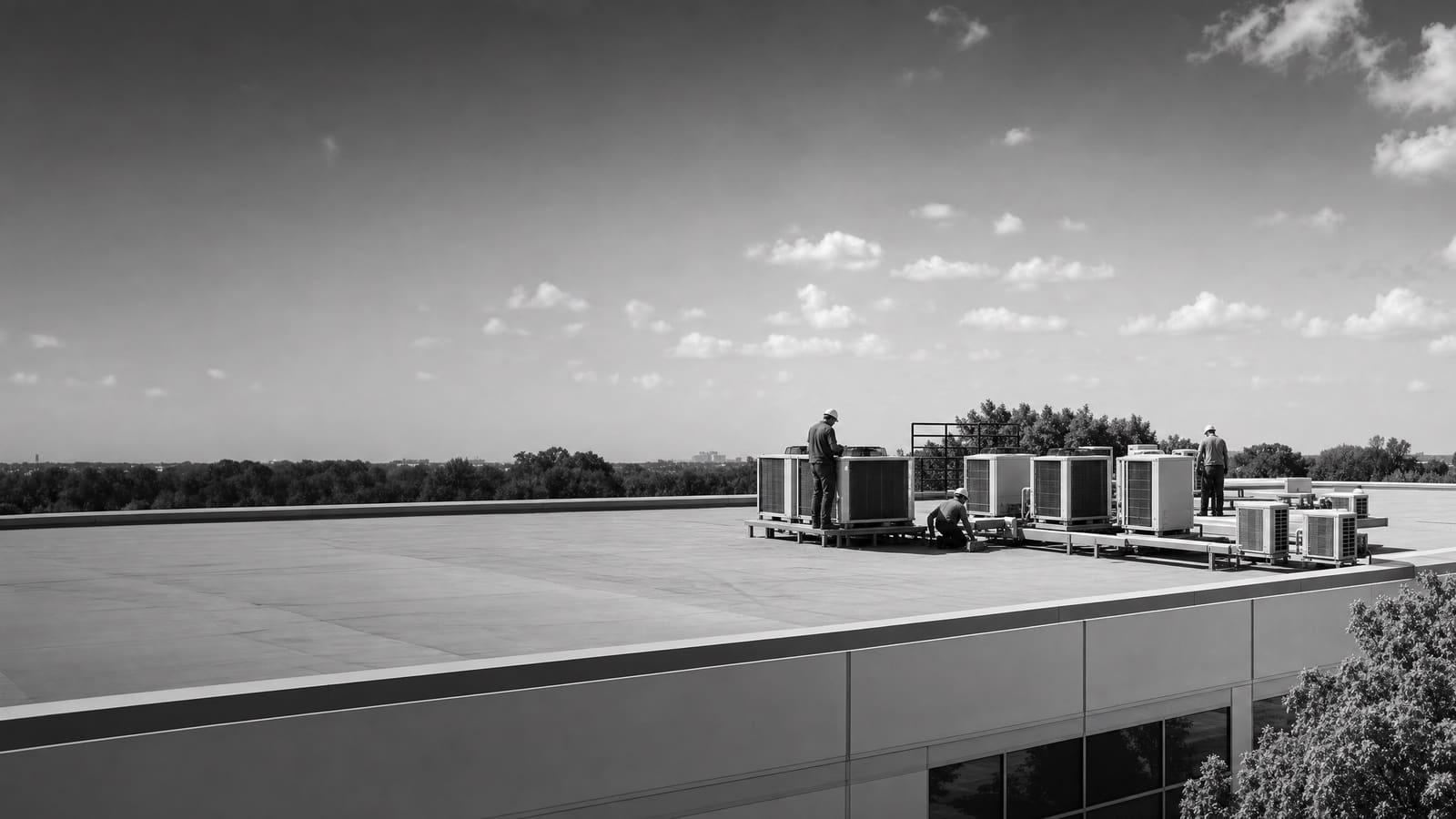
A commercial HVAC replacement is a load check, an equipment selection, a removal and disposal, a set, and a commissioning. Replacement starts beating one more repair once a rooftop unit passes about fifteen years. The Department of Energy puts the energy waste from old, inefficient rooftop units at $900 to $3,700 per unit every year. Add the third compressor call of the season and the repair path stops being the cheaper one.
A site review still sets the number. Tonnage, curb condition, roof structure, electrical capacity, gas service, crane access, and controls scope all change the price before any quote is real.
THE THREE PATHS
Choosing what goes back on the roof
Almost every commercial replacement comes down to three paths. The right one depends on how long you plan to hold the building and what the roof and the electrical service can carry.
Rooftop units condition close to half of all commercial floor space in the country, so most owners are choosing between a like-for-like packaged unit, a higher-efficiency packaged unit, or a heat pump unit that handles heating too. The Department of Energy's high-efficiency rooftop specification targets up to fifty percent less energy use than the older standard, which is why the efficiency tier is a real decision and not a checkbox.
A heat pump swap adds one more question. Does the building have the electrical capacity and the physical room to support it? That answer comes off the panel schedule and the roof, not off a brochure.
WHAT MOVES THE NUMBER
The lines that actually swing a commercial install price
No two roofs price the same. These are the lines that move a commercial installation number, ordered roughly by how much they can swing between one quote and the next.
IN PRACTICE
Planned replacement buys options that emergency replacement cannot
Most facility managers wait. The unit gets nursed through another season, fails in July, and the replacement gets bought under duress. The Department of Energy is blunt about this pattern: replacing inefficient and underperforming rooftop units proactively is usually the better business move, compared with both replacement-on-failure and a like-for-like swap at the end of service life.
The reason is simple. When you buy on failure, you take whatever tonnage is sitting in a regional warehouse. You skip the load check. You pay for rushed rigging. And you carry whatever sizing mistake the old unit had into the next fifteen years.
When you plan the same project ninety days out, you get a load calculation against how the space is used today, a real shot at the efficiency tier that pays, and a crane day scheduled around your tenants instead of around a failure. The install work is identical. The options are not.
SIDE BY SIDE
Why two identical tonnages price differently
Two commercial replacements can carry the same tonnage and land at very different prices. What separates them is access, infrastructure, and how much has changed on the roof since the last unit was set.
LOWER COMPLEXITY
A straight swap
Same tonnage and footprint, an existing curb in good shape, gas and electric already sized, an open lot for the crane, and standalone controls. The scope is knowable before anyone climbs the ladder.
HIGHER COMPLEXITY
A changed system
Different tonnage or footprint, a curb adapter, added electrical capacity for a heat pump, tight rigging access, or integration into building automation. Each one adds an unknown a site visit has to close.
BEFORE THE QUOTE
What a real site review has to confirm
A quote written off a nameplate photo is a starting point, not a price. It tells you the tonnage and the age. It tells you nothing about the curb, the roof deck, the panel, or the parking lot.
The DOE checklist for rooftop replacement is a good frame, and it is mostly about infrastructure. Electrical capacity comes first: is there panel space and feeder capacity for the unit being proposed, especially if heating moves from gas to the compressor? Physical constraints come next: roof access, structural support, clearances, and whether the new unit fits the existing curb or needs an adapter. Gas lines matter in both directions, including what stays, what gets capped, and who does it.
Then there is the part owners forget. Equipment availability and contractor availability are part of the decision, not a footnote. A unit you cannot get for fourteen weeks is a different project than one on the shelf, even when the model numbers look close. The right time to learn that is during scoping, not after the deposit clears.
Ask for the checks in writing
Before you sign, ask which items were verified on site: panel capacity, curb condition and fit, roof structural support, crane reach and lot closure, gas line disposition, and controls scope. Anything answered from memory is an allowance waiting to become a change order.
OWNERSHIP AND OPERATIONS
Two decisions that outlive the install
The install ends. The equipment does not. Two choices made during procurement set what the next fifteen years cost you.
The first is refrigerant. New commercial equipment ships on newer refrigerants, and EPA regulations under Section 608 of the Clean Air Act govern how refrigerant is handled, recovered, and recycled in stationary air conditioning and heat pump equipment. If you run a mixed fleet on one roof, you now have two service realities, two parts strategies, and two sets of technician requirements.
The second is documentation. Commissioning records, meaning charge, airflow, controls settings, and startup readings, are what protect the warranty and let the next technician diagnose the unit without guessing. If the handoff package is a receipt and a business card, you paid for a system and got a box.
REFRIGERANT
Plan the fleet, not the unit
Once one unit on the roof runs a newer refrigerant, service planning splits. Decide whether you standardize the roof over time or carry both, and put that decision in the maintenance contract.
HANDOFF
Own the commissioning file
Startup readings, charge, airflow, and control settings belong to you in writing. Comfort complaints in month two are almost always answered by that file, when it exists.
OVER TIME
Phasing a roof full of aging units
If you own more than one unit, the question is not which one to replace. It is what order to replace them in, and how to stop repeating the same emergency every summer.
The pattern that works is straightforward. Rank by age and by service history, not by which unit is loudest. Anything past fifteen years goes on the list. Anything with two compressor events in a season moves up. Then replace on a schedule you set, one or two units a season, so the capital request is predictable and the crane mobilization gets shared across more than one unit.
This is not theoretical. Through the Department of Energy's Advanced RTU Campaign, more than two hundred organizations upgraded over 43,000 rooftop units, and those upgrades cut a combined $37 million a year from their energy bills. That result came from portfolios treating replacement as a program instead of a series of failures.
The lifetime number matters more than the install number. A unit you hold for fifteen years keeps spending every month, which is why the efficiency tier deserves more argument than the crane line ever gets.
WHAT TO CHECK
Five things a comparable quote has to show
Two quotes are only comparable when both spell out the same things. If one is a single number and the other is a scope, you are not comparing prices. You are comparing how much risk each one left out.
01
Unit, tonnage, and efficiency tier
Model number and capacity, not "equivalent unit." The efficiency tier stated plainly, so you can price the operating difference and not just the install.
02
Lead time, in writing
Weeks to delivery for the specific model quoted, and what changes if it slips. Availability belongs next to the price, not in a phone call later.
03
Curb, structural, and access scope
Adapter or no adapter, any structural review, crane reach, lot closure hours, and who pulls the permits and meets the inspector.
04
Electrical and gas work included
Panel, feeder, disconnect, and gas line disposition spelled out. This is the most common place an allowance turns into a change order.
05
Commissioning and handoff
Startup, charge, airflow, and controls verification, with the documentation you receive named. A warranty is only as good as the startup record behind it.
Get a defensible number
Price the equipment and the building together.
Send the address, operating target, and target opening date. Flux will identify what must be verified before the project can be priced.
Get a free estimateQuestions
Straight answers.
When does replacement beat another repair?
Age and repeat failures decide it. Past about fifteen years, the Department of Energy puts the annual energy waste from an old, inefficient rooftop unit at $900 to $3,700 before you count a single service call. Two in-season failures on a unit that old usually settle the argument on their own.
Should we switch to a heat pump rooftop unit?
That depends on infrastructure and heating load, not preference. The Department of Energy's checks are electrical capacity, physical constraints, gas lines, equipment availability, and incentives. Heat pump rooftop units perform best where winter heating demand is mild to moderate, so confirm your building's heating design conditions before committing.
How much of the project is the crane day?
The crane is usually the shortest part. Most of the calendar goes to scoping, equipment lead time, permitting, and commissioning. If a quote gives you an install date but no equipment lead time, you are looking at half the schedule.
What happens to the refrigerant in the old unit?
It gets recovered by a certified technician. EPA regulations under Section 608 of the Clean Air Act cover how refrigerant is handled, recovered, and recycled in stationary air conditioning and heat pump equipment. Recovery and disposal should appear as a line on your quote.
Can we replace like-for-like and skip the load calculation?
Sometimes that is the right call. But the old nameplate reflects the building as it was when that unit was set. If occupancy, plug loads, lighting, or operating hours have changed since then, like-for-like carries the wrong size forward for another fifteen years.
Sources used for this guide
- [1]betterbuildingssolutioncenter.energy.gov — DOE Advanced Rooftop Unit Replacement Guidance
- [2]betterbuildingssolutioncenter.energy.gov — DOE Commercial Heat Pump Rooftop Unit Replacement Guidance
- [3]betterbuildingssolutioncenter.energy.gov — DOE High-Efficiency Commercial Rooftop Unit Toolkit
- [4]energy.gov — DOE Efficient Commercial Rooftop Air Conditioner Program
- [5]epa.gov — EPA Stationary HVAC Refrigerant Management