THE SHORT ANSWER
What commercial HVAC replacement and installation covers
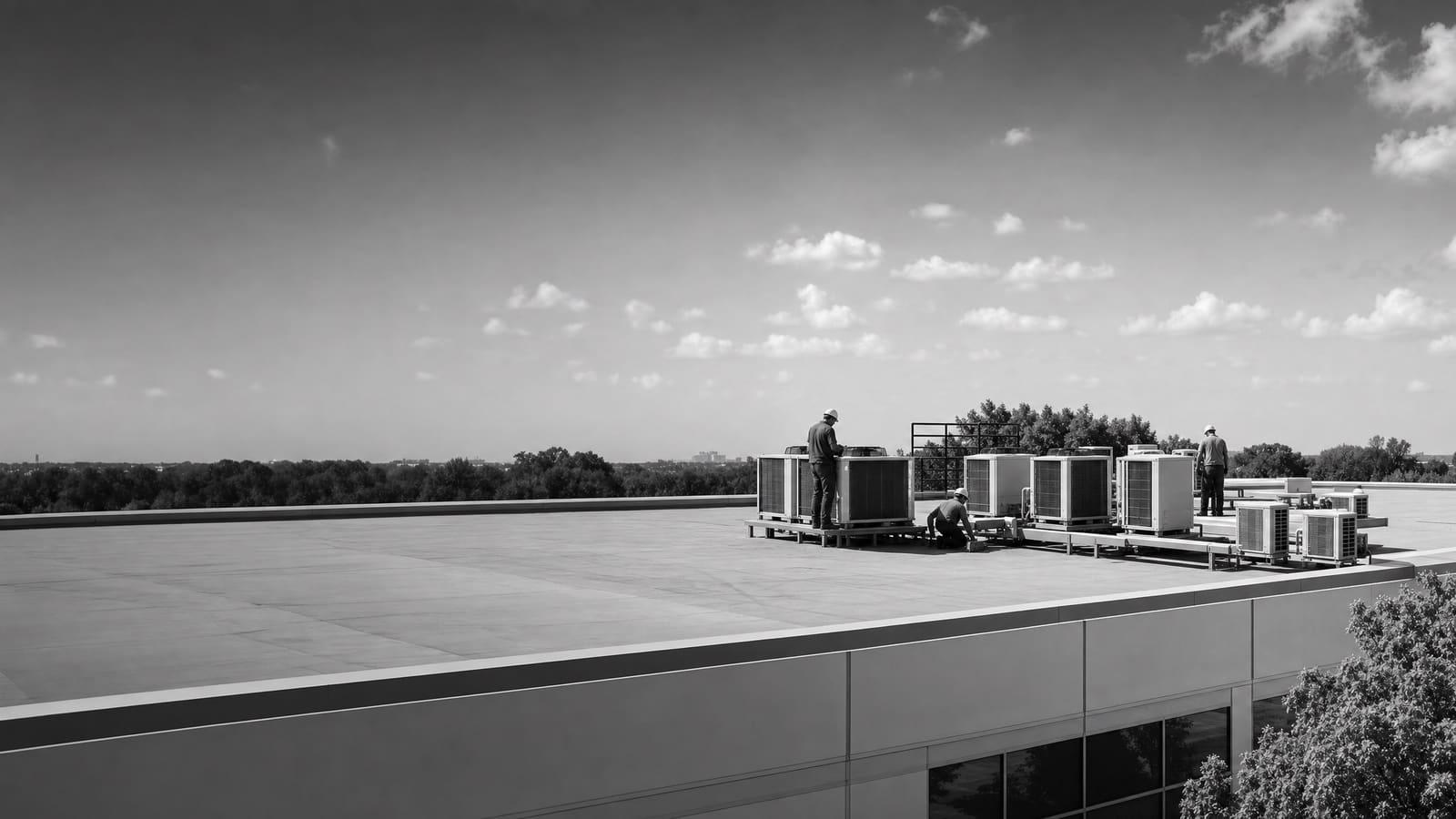
Commercial HVAC replacement covers a confirmed load, equipment selected against real lead times, rigging and set, gas and electrical connections, controls, permits, and commissioning. Replacement beats one more repair once a unit passes roughly 15 years and the same failures keep returning. An old, inefficient rooftop unit can waste about $900 to $3,700 a year in energy by itself, so the unit you are nursing is already charging you every month it stays.
A site review still has to confirm tonnage against how the space is used now, curb and roof structure, crane access and lot closure, electrical service capacity, and whether the gas line stays or gets retired.
THE REAL DECISION
Three ways to replace a commercial unit
Most Portland replacements come down to what the new unit burns. A like-for-like air-conditioning rooftop unit is the fastest path back to conditioned air, because the curb, the gas line, and the electrical feed all stay as they are. A heat pump rooftop unit is technically similar but adds reverse-cycle heating, so one box handles both seasons.
Heat pump units come in three shapes. Dual-fuel keeps a gas burner for the coldest hours. All-electric drops the gas line and falls back on electric resistance heat when it gets cold. Cold-climate models push efficient heating further down the temperature scale.
Heat pump efficiency falls as the outdoor temperature drops, and at the bottom it trends toward parity with electric resistance heat. So this is a design-temperature question, not a brand question. Across most of the West, today's heat pump rooftop units can cover most or all of a building's winter heating demand, which puts the electric path in play here rather than on a someday list.
WHAT MOVES THE NUMBER
The lines that decide your installed price
Installed price is the equipment plus everything the roof, the access, and the code make you do on the way in. These are the lines that move it most, and the ones worth pricing before you sign anything.
IN PRACTICE
Sizing, timing, and the efficiency tier
The old nameplate records what somebody sized twenty years ago. It is not a spec for today. Occupancy changes, plug loads change, and envelope work changes the load. Confirm the number against how the space is used now, then decide whether to match it or correct it.
Timing is the other half. Replacement on failure is the most expensive way to buy equipment, because you take whatever is available at whatever it costs, in whatever week a crane is free. Most teams wait until a unit no longer holds the space, needs constant service, or quits outright. Planning the swap a season ahead usually buys a better unit at a better price on a day you picked.
The efficiency tier deserves a real look instead of a default. High-performance rooftop units were built to cut energy use by up to half against the older baseline, and more than twenty models on the market now exceed that specification. Set that premium against an old unit quietly wasting $900 to $3,700 a year, and the payback is usually shorter than the finance conversation assumes.
SIDE BY SIDE
Simple swap or engineered project
Two replacements at the same tonnage can be a week apart on schedule and far apart on price. The difference is almost never the equipment. It is the roof, the access, and the service already coming into the building.
LOWER COMPLEXITY
Straight replacement
Same tonnage and same heating type, a matched curb, clear crane reach, and a lot you can close for a morning. Permits stay routine and the new unit lands on the existing connections.
HIGHER COMPLEXITY
Changed footprint or fuel
Larger tonnage, a new curb, tight urban access, or a fuel switch that needs electrical service work. Expect structural review, longer permitting, and a lift plan built around street and lot constraints.
BEFORE YOU BUY
What the site review has to settle
A good scoping visit answers a short list, and every item on it can change the equipment you order.
Start with load and schedule: what the space does now, how many hours it runs, and how much heating the building actually needs at design conditions. Then price impact. Your electricity and gas rates decide whether an electric heating path lowers the operating bill or raises it, and that math is local rather than national.
Next comes infrastructure. Electrical capacity is the one that stops projects, because an all-electric unit can need more service than the panel has. Physical constraints matter too: curb size, roof structure, clearances, and whether a crane can reach. If the gas line is being abandoned, that belongs in the plan instead of the discovery phase.
Finally, availability. Equipment lead time, whether crews are trained on the unit you picked, and any current utility incentive all belong in the decision, because each one can change what you order and when it lands.
The five answers that decide the order
Design heating load, your electric and gas rates, available electrical capacity, curb and crane access, and a confirmed lead time. Settle those five before signing and the rest of the project is scheduling instead of surprises.
PORTLAND CONTEXT
Why heat pump units are a real option here
Heat pump rooftop units perform best where winters are mild to moderate, because that is where reverse-cycle heating stays efficient. Most of the West sits in that band, and today's units are considered capable of covering most or all of the winter heating demand in those regions. Portland buildings fall inside that picture, which is why the electric option deserves a look before you default to another gas unit.
Two things still decide it building by building. The first is price: the ratio between what you pay for electricity and what you pay for gas sets whether the utility bill drops or climbs after the switch. The second is the building itself, because electrical service capacity, roof structure, and crane access do not care what the climate map says.
Check both before you commit
Run the operating-cost comparison on your own rate schedules, and confirm the panel can carry an electric heating path. If either one comes up short, dual-fuel keeps most of the benefit and leaves the gas burner for the coldest hours.
AFTER THE LIFT
Two things that outlast the install day
The install is one morning. The next fifteen to twenty years are the part you actually pay for, and two decisions made during the project shape them. One is refrigerant, which now touches parts availability, technician certification, and how you plan service across a mixed fleet of old and new equipment. The other is what proof you get at handoff, because a unit that was never verified against spec becomes a comfort complaint in month two and a warranty argument later. Neither shows up in the price comparison. Both show up in the operating budget.
REFRIGERANT
Handling and fleet planning
Refrigerant in commercial equipment is federally regulated. It has to be recovered and handled by certified technicians rather than vented. New units ship on newer refrigerants, so a mixed roof needs a deliberate parts and service plan.
COMMISSIONING
Proof the unit performs
Startup readings, refrigerant charge, airflow, economizer operation, and control settings verified against spec and documented. That record is what keeps the warranty intact and what you hand the next service contractor.
PLANNING AHEAD
Phasing a roof full of units
If you own more than one unit, treat the roof as a portfolio instead of a series of emergencies. Age is the sorting tool. Units past fifteen years are usually the ones quietly burning money, and they belong at the top of the list whether or not they have failed yet.
Sequencing pays twice. Ordering two or three units together gives you one mobilization, one crane day, and better pricing than three separate panic calls. It also lets you stage the work into the shoulder seasons, when losing a unit for a day costs tenants almost nothing.
The scale here is not theoretical. More than two hundred organizations working through a national upgrade effort have replaced or upgraded over forty-three thousand rooftop units, and the combined result is about thirty-seven million dollars saved on energy bills each year. That works out to roughly $850 a year for every unit upgraded, which is the arithmetic that makes proactive replacement beat replacement on failure. Run your own version of it on the oldest units first, then let the schedule follow the list.
APPLES TO APPLES
Five things a comparable quote shows
Two quotes are only comparable when both cover the same scope. If one is missing a line the other includes, the cheaper number is usually the incomplete one. Ask for these five in writing.
01
Equipment spelled out
Tonnage, efficiency tier, heating type, and model number, so you compare units instead of comparing totals.
02
A real lead time
The confirmed availability date for the unit quoted, not a general range.
03
Roof and rigging scope
Curb adapter, any structural work, crane size, lot closure hours, and who coordinates tenants.
04
Permits and inspections
Which permits are included, who pulls them, and which inspections the price already covers.
05
Commissioning and documentation
Startup readings, charge and airflow verification, control settings, and the handoff record that keeps the warranty valid.
Get a defensible number
Price the equipment and the building together.
Send the address, operating target, and target opening date. Flux will identify what must be verified before the project can be priced.
Get a free estimateQuestions
Straight answers.
When does replacement beat another repair?
Age plus repeat failures. Past roughly fifteen years, a unit is usually wasting energy on top of costing service calls, and old inefficient rooftop units can burn $900 to $3,700 a year on their own. Once the same repairs return in a single season, the money is better spent on new equipment.
Should a Portland building go all-electric?
Often it can. Heat pump rooftop units suit mild-to-moderate winters, and most of the West falls in that band. Confirm two things first: your electricity-to-gas rate ratio and your available electrical capacity. If either is tight, dual-fuel is the safer version of the same move.
How long does the swap take on site?
The set is usually a morning to a day for a single packaged unit. Equipment lead time is the real schedule driver, which is why the confirmed availability date belongs on the quote right next to the price.
What does a replacement trigger that the old unit avoided?
Commonly economizer and controls requirements, sometimes structural review when tonnage or footprint grows, and always proper recovery of the old refrigerant by certified technicians. Get these named in the scope so they do not arrive later as change orders.
Is a higher efficiency tier worth the premium?
Usually, on a unit that runs real hours. High-performance rooftop units were designed to cut energy use by up to half against the older baseline, and more than twenty models now exceed that specification. Compare the premium against the annual waste of the unit you are replacing.
Sources used for this guide
- [1]betterbuildingssolutioncenter.energy.gov — DOE Advanced Rooftop Unit Replacement Guidance
- [2]betterbuildingssolutioncenter.energy.gov — DOE Commercial Heat Pump Rooftop Unit Replacement Guidance
- [3]betterbuildingssolutioncenter.energy.gov — DOE High-Efficiency Commercial Rooftop Unit Toolkit
- [4]energy.gov — DOE Efficient Commercial Rooftop Air Conditioner Program
- [5]epa.gov — EPA Stationary HVAC Refrigerant Management