THE SHORT VERSION
What a commercial HVAC replacement actually includes
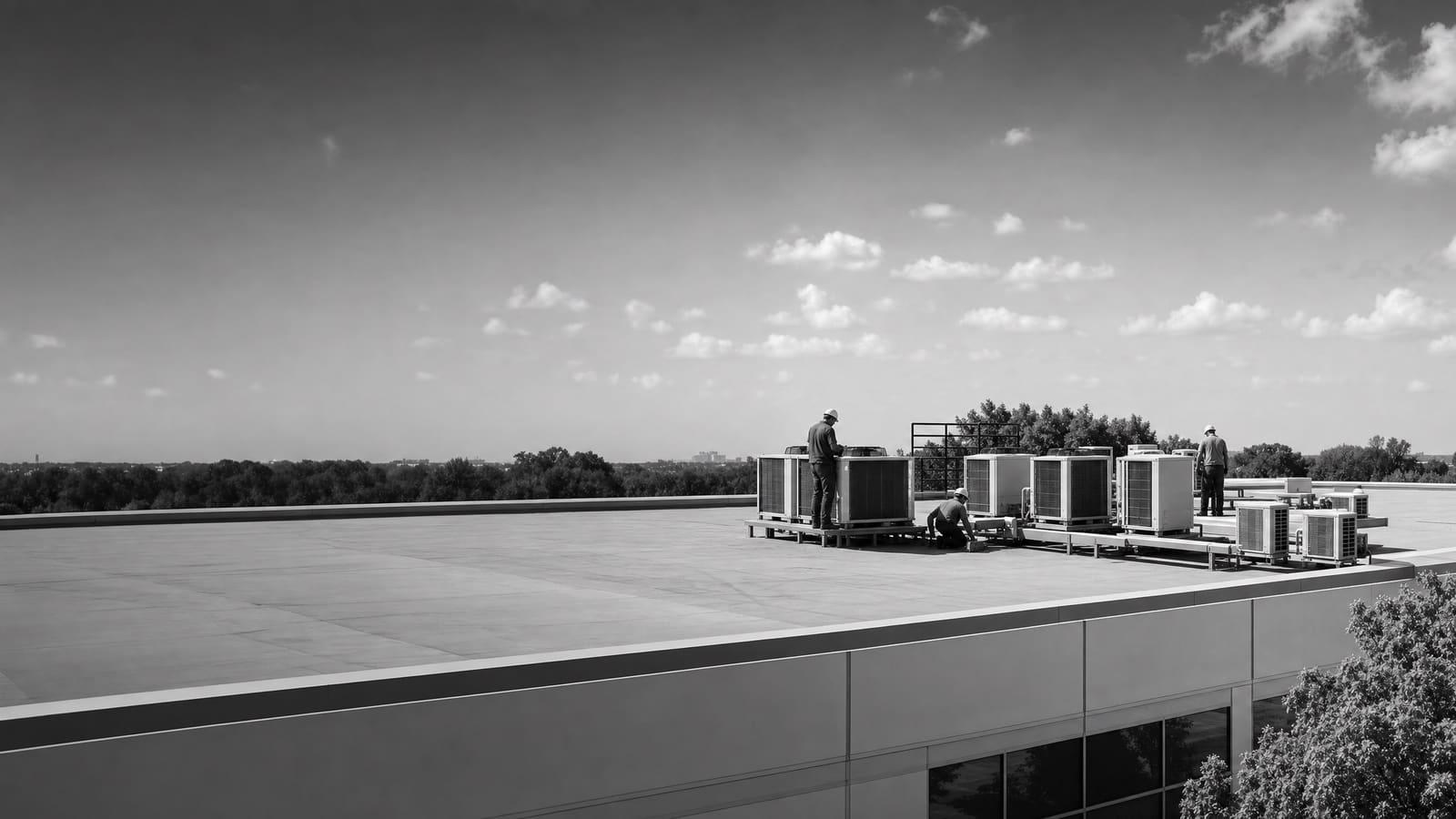
A commercial HVAC replacement means confirming the load your building carries today, selecting equipment against real availability, rigging the old unit off and the new one onto the roof, and commissioning the result so it performs to the spec you paid for. Replacement usually beats another repair once a rooftop unit passes about fifteen years, because aging units waste substantial energy — commonly $900 to $3,700 per unit every year. That yearly waste, not the failure itself, is what should drive the timing decision.
A site review still has to verify curb fit and roof structure, electrical capacity at the unit, gas line status, and crane access before any of that translates into a price for your building.
THE REAL CHOICE
Three ways the building can heat and cool
Once a unit is coming off the roof, you are choosing how the building operates for the next fifteen-plus years, not just what fits the curb. DOE guidance frames that choice around a short list: climate and geography, the effect on your utility bill, emissions goals, building type, what equipment is actually available, the infrastructure already at the unit, contractor familiarity with the equipment, and any incentive you qualify for.
Two of those items decide more than the rest. Infrastructure — electrical capacity, physical room on the roof, and existing gas service — determines whether an electric option is even available without a second project attached. Equipment availability determines whether the right unit can land while the building still needs it.
Heat pump rooftop units are technologically similar to the air-conditioning units most roofs already carry; they add reverse-cycle heating. Their efficiency drops as outdoor temperatures fall, trending toward electric resistance in the coldest hours, so the heating side deserves modeling against local energy prices rather than assumption.
WHAT MOVES THE NUMBER
The line items that separate two bids
No two roofs price out the same way, so read a quote as a set of line items rather than one number. These are the items that move most between two bids on the same building, and the ones worth confirming before you compare prices at all. Each carries a different amount of risk.
IN PRACTICE
Buy the replacement, not the emergency
Most rooftop units get replaced the hard way. A unit fails in season, and the building buys whatever is available that week at whatever it costs. DOE's guidance is blunt about the alternative: facility managers often delay until a unit no longer conditions the space, needs frequent service, or fails completely, and replacing an inefficient, underperforming unit proactively is usually the smarter business move — better than replacement-on-failure, and often better than a like-for-like swap at the end of service life.
Proactive does not mean replacing everything. It means knowing which units on your roof are past fifteen years, what each one is costing you in wasted energy, and which one is next. An old, inefficient unit can burn $900 to $3,700 a year more than it should. Across a roof carrying several units, that figure is the budget case.
The efficiency side is just as real. The high-performance specification DOE developed with manufacturers targeted cutting energy use by up to half against the standard in place at the time, and more than twenty models eventually exceeded it. That matters because rooftop units cool close to half of all U.S. commercial floor area — for most buildings, this is the entire HVAC decision, not part of one.
SIDE BY SIDE
Straightforward swap or a real project
Two replacements on the same building can be very different jobs, and what separates them is usually infrastructure and access rather than the box itself. Knowing which one you have before bids arrive is what keeps the quotes comparable and keeps allowances off the page.
LOWER COMPLEXITY
Same fuel, same footprint
The replacement matches the old unit in size and fuel, the existing curb accepts an adapter, electrical capacity at the unit is already sufficient, and the crane has clear reach from the lot. Scope stays tight, and the work fits inside a planned shift instead of spreading across a week.
HIGHER COMPLEXITY
New fuel or a bigger unit
Moving to an all-electric unit raises capacity questions at the panel and at the roof. A larger or heavier unit brings structural review, curb work, and often a longer lead time. Tight sites, obstructed crane reach, and occupied operating hours each add planning before anything gets lifted.
BEFORE YOU BID
What the site review has to settle
A useful site review answers the questions the price depends on, and it does that before a vendor quotes. Start on the roof: nameplate data on every unit, age, curb dimensions, and the physical space around each unit for a larger footprint. Then look at the services feeding them. DOE's heat pump checklist puts infrastructure at the center of the decision — electrical capacity, physical constraints, and gas lines — because those three items decide whether an electric option is on the table at all without a separate upgrade project behind it.
Next, the operating picture. How the space is used now, not how it was used when the unit was installed, sets the load. Occupancy, plug load, operating hours, and envelope changes all move it. Sizing to the old nameplate quietly carries forward whatever was wrong twenty years ago.
Last, availability. Equipment availability and contractor familiarity with the specific equipment are named considerations in that guidance, not afterthoughts. A unit that is right on paper and unavailable for months is not the right unit for a building running warm today.
None of this needs an engineer on day one. A walk of the roof with a phone camera, the panel schedule, and a list of what each unit serves covers most of it.
The five-minute version
Photograph every nameplate on the roof, mark which units are past fifteen years, and check the panel that feeds them. That much detail turns a guess into a scoped quote and lets two bids be compared line for line.
OWNERSHIP
Two things that outlive the install
The visible install ends in a morning. The decisions inside it stay with the building for the life of the equipment. Two of them deserve attention while you can still change them: what refrigerant your fleet ends up running, and who keeps the new unit performing the way it was commissioned.
Neither shows up as an obvious line item, and both show up in the operating budget later. A quote that treats commissioning as optional and says nothing about refrigerant handling is not actually cheaper — it has moved two costs off the page and into next year. Ask about them while there is still a purchase order to change.
REFRIGERANT
Your fleet drifts
EPA Section 608 governs how refrigerant is handled, recovered, and serviced in stationary air-conditioning and heat pump equipment. As units get replaced one at a time, a roof ends up running more than one refrigerant. Plan spare parts and service coverage around that instead of discovering it mid-season.
PERFORMANCE
Commissioning is not startup
Startup makes a unit run. Commissioning verifies charge, airflow, and control settings against the specification you actually bought, then documents it. Skip it and an efficiency purchase quietly becomes an ordinary one, showing up as comfort complaints in month two rather than a savings line.
PLANNING AHEAD
Phasing a roof full of units
Buildings rarely have one rooftop unit, and they rarely have the budget to replace all of them at once. That makes sequencing the real decision. Rank by age and by what each unit costs to run, not by which one drew the most complaints last summer. Units past fifteen years are the candidates; the ones already on frequent service calls move first.
Phasing also gives you leverage that emergencies never do. A planned sequence lets you specify equipment instead of accepting what happens to be in stock, line up incentives while application windows are open, and bring the same crew and crane back for the next unit at a known price. DOE's campaign work put more than 43,000 rooftop units through this kind of planned upgrade across more than 200 organizations, saving a combined $37 million a year — evidence the case holds across a portfolio, not just in a model.
Procurement follows the same logic. A scheduled replacement can hold a specification, take bids on identical scope, and time the order against a lead time you already know. An emergency order has none of that. The building takes what is available at the price it is available for, and the efficiency conversation never happens.
Lifetime cost is what makes phasing obvious. The purchase happens once. The energy bill happens every month for fifteen years or more, and it is the larger number.
QUOTE CHECKLIST
Five things a comparable quote shows
Bids only compare if they show the same things. Ask every vendor to break out these five, and the differences between quotes stop being mysterious. Anything missing here usually returns later as a change order.
01
Make, model, tonnage, and efficiency tier
Not just "replace RTU-3." The model number is what makes two bids genuinely comparable.
02
Equipment availability and lead time
A delivery window in writing, sitting next to the price rather than promised verbally.
03
Curb, structural, and rigging scope
Adapter, any framing work, crane size, and how long the lot is closed.
04
Electrical, gas, and refrigerant work
Every service change the new unit needs, listed separately from the equipment itself.
05
Commissioning and documentation
Charge, airflow, and controls verified against spec, with a report you keep on file.
Keep planning locally
Related mechanical pages in Sacramento
Get a defensible number
Price the equipment and the building together.
Send the address, operating target, and target opening date. Flux will identify what must be verified before the project can be priced.
Get a free estimateQuestions
Straight answers.
When does replacing a rooftop unit beat repairing it again?
Once a unit passes about fifteen years, it can waste substantially more energy and money than a newer model — commonly $900 to $3,700 per unit each year for old, inefficient equipment. At that point another repair buys time rather than value, and the operating cost is usually the stronger argument than the failure itself.
Is a heat pump rooftop unit a realistic replacement?
Often, yes. Heat pump rooftop units are technologically similar to air-conditioning units and add reverse-cycle heating. DOE guidance treats them as capable of covering most or all winter heating demand across most of the West, with the real decision resting on local electricity and gas prices, electrical capacity at the unit, and what equipment is actually available.
What changes the price most between two bids?
Infrastructure and access. Electrical capacity, physical space on the roof, existing gas lines, and crane reach are the items that separate a straightforward swap from a project carrying structural or electrical work. Confirm those before comparing numbers, or the quotes are describing different jobs.
Should the new unit match the old one, or be resized?
Confirm the load either way. If use, occupancy, and the building envelope have not changed, matching is often the right call. If they have, the old nameplate carries forward a sizing decision made for a different building and a different tenant.
Does refrigerant matter on a replacement?
For day-one operation, not much. For service planning, yes. EPA Section 608 governs refrigerant handling, recovery, and servicing in stationary equipment, and replacing units one at a time leaves a roof running more than one refrigerant. Account for that in service contracts and spare-parts strategy.
Sources used for this guide
- [1]betterbuildingssolutioncenter.energy.gov — DOE Advanced Rooftop Unit Replacement Guidance
- [2]betterbuildingssolutioncenter.energy.gov — DOE Commercial Heat Pump Rooftop Unit Replacement Guidance
- [3]betterbuildingssolutioncenter.energy.gov — DOE High-Efficiency Commercial Rooftop Unit Toolkit
- [4]energy.gov — DOE Efficient Commercial Rooftop Air Conditioner Program
- [5]epa.gov — EPA Stationary HVAC Refrigerant Management