THE SHORT ANSWER
What a commercial HVAC replacement actually includes
A commercial HVAC replacement covers load verification, equipment selection, rigging and set, gas or electrical connections, controls integration, permits, and commissioning. Replacement usually beats another repair once a unit is past about fifteen years and needs regular service. DOE puts the annual energy waste of an old, inefficient rooftop unit at roughly $900 to $3,700. Rooftop units condition close to half of all U.S. commercial floor area, so this is the most common commercial replacement there is.
A site review still has to confirm actual tonnage against current use, curb and structural condition, available electrical capacity, and how a crane reaches the roof before any of those numbers apply to your building.
THREE WAYS TO GO
Three replacement paths, and when each one is right
Most commercial buildings have three real options when a rooftop unit reaches the end of its life. The right one depends on how the space is used now, not on what the old nameplate says.
Like-for-like is the fastest and cheapest engineering path. It reuses the curb, the connections, and the existing controls, and it carries forward whatever sizing decision was made twenty years ago.
A right-sized replacement starts with a load calculation against today's occupancy, plug load, lighting, and envelope. Buildings change use more often than owners expect, and an oversized unit short-cycles, holds humidity, and wears itself out early.
An electric swap trades a gas-heat unit for a heat pump rooftop unit. DOE guidance is direct about where that works: heat pump rooftop units suit mild-to-moderate winter heating, and across most of the U.S. South and West they can meet most or all of the winter heating demand. Southern California sits squarely inside that description.
WHAT MOVES THE NUMBER
The budget lines that actually swing a rooftop replacement
No two roofs price the same, so the useful thing is knowing which lines move and which sit close to fixed. These are the ones that separate a low bid from a complete one. If a line is missing from a quote, it has not disappeared — it becomes a change order later.
IN PRACTICE
Buy the replacement, not just the box
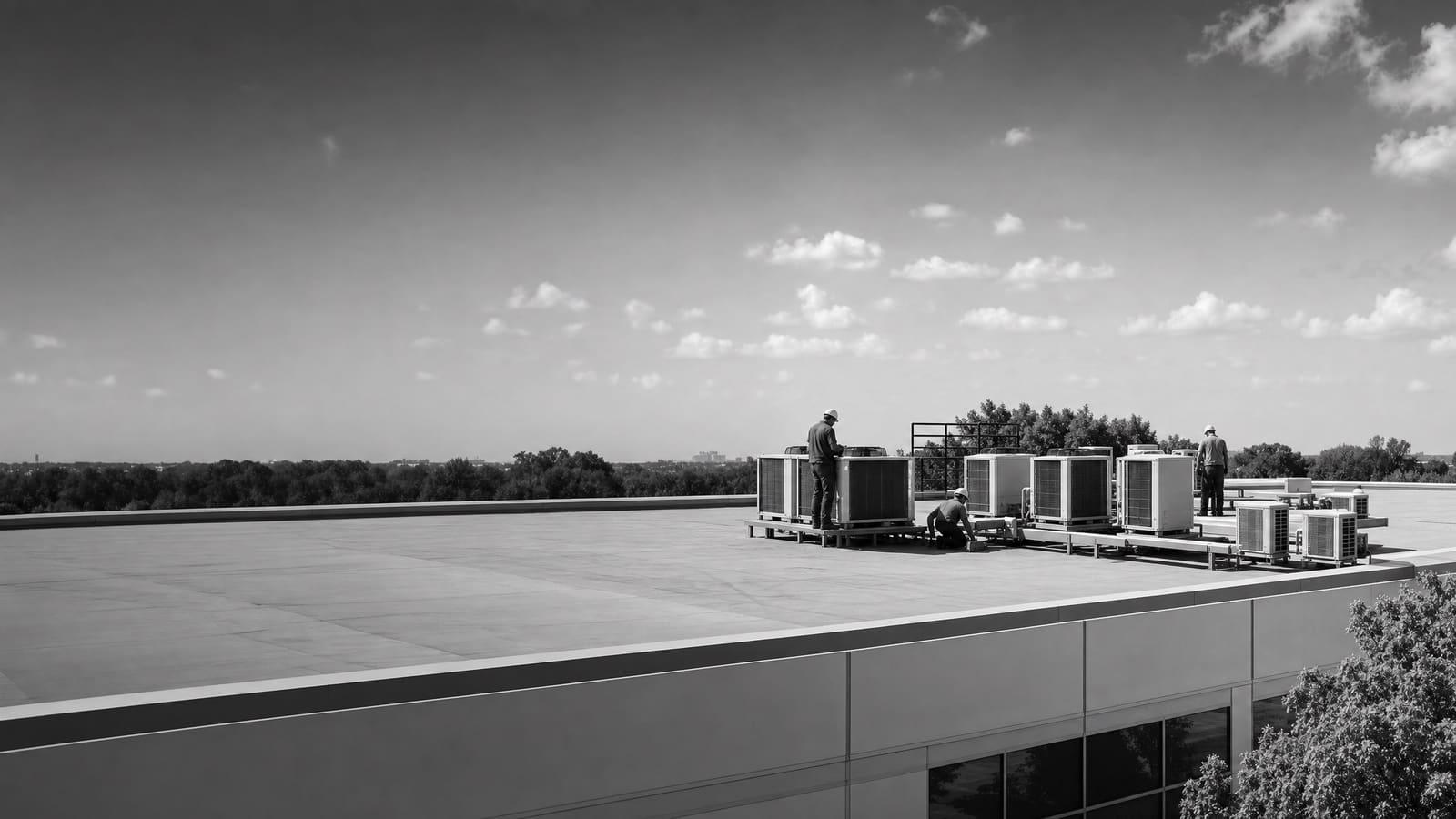
The visible part of a rooftop replacement is one morning. A crane arrives, stalls get coned, the old unit comes off, and the new one lands on a curb adapter that was measured weeks earlier. Everything that makes that morning boring happened in advance.
The buying decision is really about timing. DOE's guidance notes that facility managers usually delay a new unit until the old one no longer conditions the space, needs constant service, or fails outright — and that proactive replacement often beats both replacement-on-failure and a like-for-like swap at the end of service life. The difference is leverage. A planned replacement lets you compare equipment, take a delivery date that fits your calendar, and set the crane on a Sunday. An emergency replacement takes whatever is on the regional shelf.
That is the strongest argument for putting aging units on a written list. Anything past fifteen years belongs on it. Rank by age, service history, and what the space underneath does, because a unit over a dining room is a different risk than one over storage. Then replace on your schedule instead of losing the choice to a July compressor failure.
COMPLEXITY CHECK
What makes a replacement simple, and what makes it hard
Before you set a budget, work out which of these two projects you actually have. The gap between them is mostly access and infrastructure rather than the equipment itself, and it is visible from the roof in about twenty minutes.
LOWER COMPLEXITY
Straight swap on a clear roof
Same tonnage, same fuel, a curb in good shape, and a lot where a crane can set up without closing a drive aisle. Single-tenant buildings with off-hours access sit here. The work is one morning and a permit.
HIGHER COMPLEXITY
Fuel switch or tight access
Growing tonnage, a new curb footprint, an all-electric conversion that touches the panel, or a roof reachable only over an occupied lot. DOE flags electrical capacity, physical constraints, and gas lines as the three infrastructure items that decide this.
BEFORE YOU QUOTE
What a real site review has to confirm
A quote written from a nameplate photo is a starting number, not a price. The photo gives a contractor the tonnage, the fuel, and the age. It does not say whether the curb is sound, whether the panel has room, or whether a crane can reach the far corner of the roof.
DOE's heat pump rooftop guidance frames the scoping question well, and it applies to any replacement rather than only an electric one. It asks about electrical capacity, physical constraints, gas lines, equipment availability, and whether crews qualified on the technology you picked are available. Those five answers set the schedule.
Two more items belong on the walk. First, refrigerant handling. EPA Section 608 rules govern how refrigerant is recovered from the unit coming off the roof, and that work belongs to certified technicians using proper recovery equipment. It is not optional, and it should not be a cost you discover afterward. Second, controls. If the building runs an automation system, someone has to own the point mapping and the sequence of operation on the new unit, and that responsibility needs a name on it before the crane is booked.
The five-minute version
Ask for photos of the curb, the disconnect, and the crane setup location, plus a written answer on electrical capacity and refrigerant recovery. A contractor who has stood on your roof can produce all five. One who has not, cannot.
IN SANTA ANA
Permit the mechanical work and the roof together
California building departments permit mechanical upgrades and repairs, and they permit re-roofing separately, covering both overlay and tear-off. That matters more than it sounds. A rooftop unit and the roof membrane under it have overlapping lives, and plenty of Santa Ana buildings reach the end of both at the same time.
If the roof is close to replacement, doing the unit first means paying to lift and reset it later, or cutting a new membrane around a curb you just installed. Sequencing the roof and the unit in one window means a single crane mobilization, one set of roof penetrations, and one round of inspections.
Confirm current permit and inspection requirements with the local building department before you commit to a date, since submittal packages and review times change. Then build the inspection window into the tenant notice instead of announcing it after.
One decision this changes
Check the roof's remaining life before you order the unit. If the membrane is near the end of it, price the two together and lift once — the crane day, the penetrations, and the inspection window are shared.
OWNERSHIP
Two things that outlast the install
The install is a week. The decisions made during it stay on the roof for fifteen or twenty years, and two of them shape every service call after handoff.
The first is refrigerant. New commercial equipment ships on lower-GWP refrigerants, which changes nothing about day-one operation but does change parts and service planning when the rest of the fleet is older. EPA Section 608 governs recovery, handling, and recordkeeping across all of it, so a mixed roof needs a service agreement that covers both generations.
The second is who owns performance after startup. Commissioning is where charge, airflow, economizer operation, and control settings get verified against spec and written down. Skip it and the problems surface as comfort complaints in month two, once the crew that set the unit has moved on and nobody can say what the airflow was supposed to be.
FLEET STRATEGY
Plan for two refrigerant generations
Once one unit is replaced, the roof runs mixed. Make sure the service agreement covers recovery, certified handling, and parts for both, and keep the Section 608 records with the unit file.
HANDOFF
Get the commissioning report
Startup readings, charge, airflow, and control settings in writing. It protects the warranty, settles the month-two comfort argument, and gives your next technician a baseline.
OVER TIME
Phasing a roof full of aging units
Most buildings do not have one aging unit. They have four, and three went up the same year. That is a budgeting problem more than a mechanical one, because replacing all of them at once is a capital event and replacing them one failure at a time is the most expensive path available.
Phasing works. Rank the units by age, service history, and how much disruption the space below can absorb, then replace one or two per fiscal year on a planned schedule. Every planned replacement earns what an emergency cannot: a real equipment comparison, a delivery date you chose, off-hours crane time, and a single mobilization when two units go up the same day.
Lifetime cost is usually what settles the argument. DOE's per-unit waste figure for old, inefficient rooftop units — roughly $900 to $3,700 a year — is energy alone, before parts, before emergency labor, before the tenant conversation. Across a four-unit roof that compounds every year the decision is deferred. The national campaign built on that math has upgraded more than 43,000 units and reports $37 million in combined annual energy savings.
COMPARING QUOTES
Five things every quote should state
Bids are only comparable when they cover the same scope. When two numbers land far apart, one of these five lines is usually the reason. Ask for each in writing before you sign anything.
01
Tonnage, fuel, and efficiency tier
The exact model and rating, not a category. Efficiency tier is the line that quietly separates two otherwise identical bids.
02
Equipment availability
A real lead time sitting next to the price. Availability is part of the offer, not a detail to sort out after the deposit.
03
Curb, structural, and roofing work
Adapter or new curb, any framing, and who patches the membrane. Name the responsible party for each one.
04
Rigging and site access plan
Crane size, staging location, stalls closed, and the hours of the lift. This is the line your tenants actually feel.
05
Permits, commissioning, and refrigerant recovery
Who pulls permits, who meets the inspector, what the startup report includes, and how the old refrigerant is recovered and documented.
Keep planning locally
Related mechanical pages in Santa Ana
Get a defensible number
Price the equipment and the building together.
Send the address, operating target, and target opening date. Flux will identify what must be verified before the project can be priced.
Get a free estimateQuestions
Straight answers.
When does replacement beat one more repair?
Once a rooftop unit is past about fifteen years and needs regular service, another repair usually buys months rather than years. DOE puts the annual energy waste of an old, inefficient unit at roughly $900 to $3,700 and notes that proactive replacement often beats waiting for a failure.
Should you replace like-for-like or resize?
Confirm the load either way. If the space and its schedule have not changed, like-for-like is often the right call. If occupancy, equipment, or hours changed, right-sizing fixes comfort problems the old unit was never able to solve.
How long does a rooftop replacement take on site?
The set itself is short, often a single crane day for a straightforward swap. The real schedule risk lives in equipment availability and permit review, which is why both belong on the quote next to the price.
Is a permit required to replace a rooftop unit?
Yes. California building departments permit mechanical upgrades and repairs, and re-roofing is permitted separately. Confirm current submittal and inspection requirements with the local building department before you commit to a schedule.
Is a heat pump rooftop unit a good fit here?
Often, yes. DOE guidance says heat pump rooftop units suit mild-to-moderate winter heating, and that across most of the U.S. South and West they can meet most or all of the winter heating demand. The deciding factor is usually electrical capacity at the panel, not the climate.
What happens to the refrigerant in the old unit?
It has to be recovered under EPA Section 608 rules, which govern handling and recycling of refrigerant in stationary air-conditioning and heat pump equipment. Recovery, certified technicians, and documentation should be named in the quote.
Sources used for this guide
- [1]betterbuildingssolutioncenter.energy.gov — DOE Advanced Rooftop Unit Replacement Guidance
- [2]betterbuildingssolutioncenter.energy.gov — DOE Commercial Heat Pump Rooftop Unit Replacement Guidance
- [3]betterbuildingssolutioncenter.energy.gov — DOE High-Efficiency Commercial Rooftop Unit Toolkit
- [4]energy.gov — DOE Efficient Commercial Rooftop Air Conditioner Program
- [5]epa.gov — EPA Stationary HVAC Refrigerant Management
- [6]californiacity-ca.gov — HVAC Permits