THE SHORT VERSION
What a commercial HVAC replacement includes
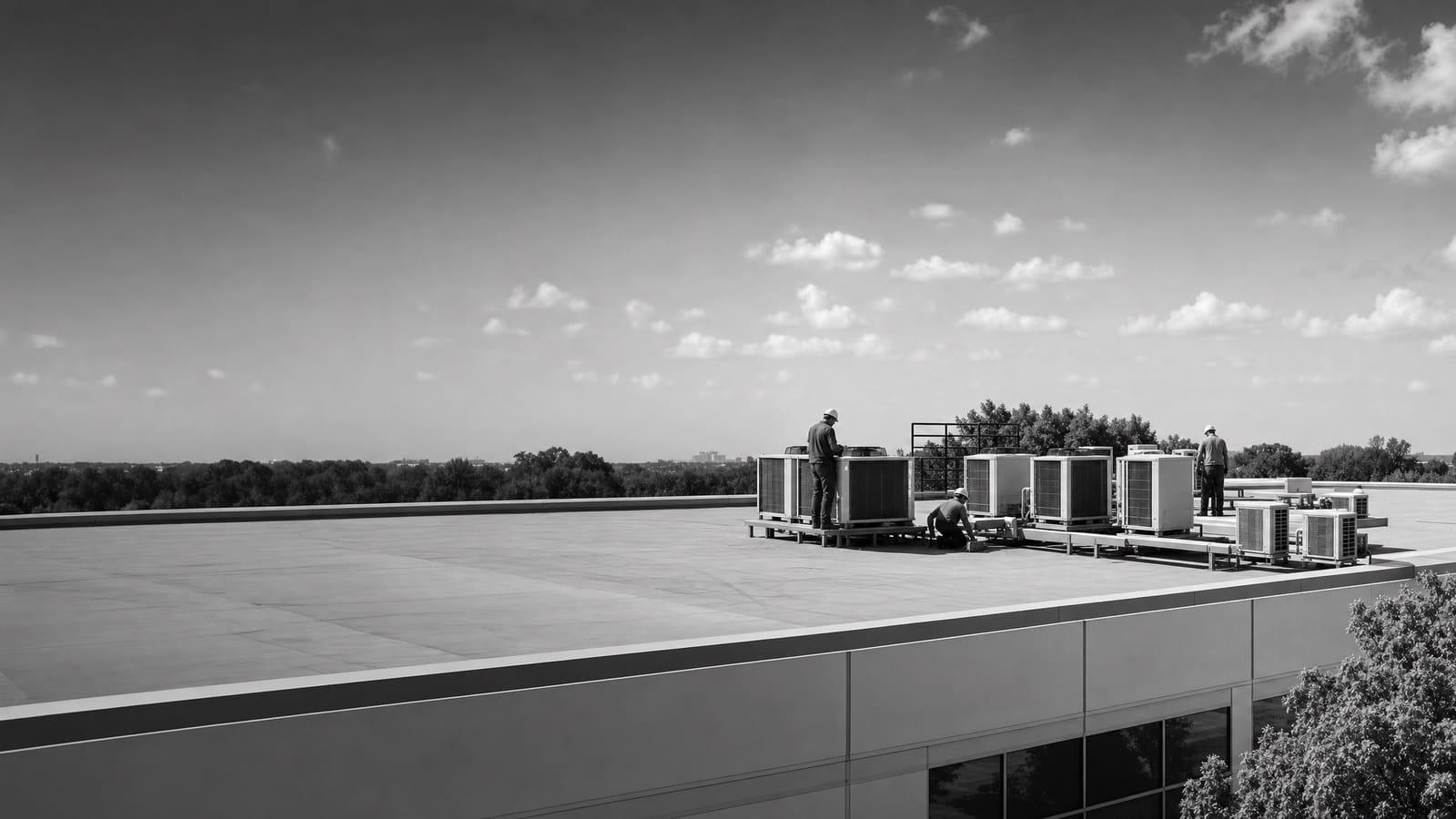
A commercial HVAC replacement covers a load check, equipment selection, rigging and set, new connections, permitting, and commissioning. Replacement beats one more repair once the unit is losing money while it runs. Old, inefficient rooftop units waste $900 to $3,700 each per year, and units past 15 years old can waste a great deal next to current models. On most commercial roofs the honest question is not whether to fix it again, but what to put back.
A site review still has to confirm tonnage against how the space is used today, curb and roof condition, and the electrical and gas service already at the unit.
THREE PATHS
Three ways to replace a rooftop unit
Most commercial replacements come down to three choices, and the difference between them is what you want the next fifteen years to cost.
Like-for-like keeps the same equipment type and roughly the same capacity. It is the fastest path back to conditioned space and the cheapest engineering, but it carries forward whatever the old unit got wrong.
A high-efficiency replacement is the same install day with better equipment. DOE's high-performance rooftop specification targeted units that cut energy use by up to 50% against the standard in place at the time, and more than twenty models now exceed it. Over 200 organizations upgraded more than 43,000 units through the Advanced RTU Campaign and cut a combined $37 million a year off their energy bills.
A heat pump rooftop unit adds reverse-cycle heating to the same box on the same curb. That decision turns on your heating load, your electrical service, and what electricity costs against gas at your meter.
WHAT MOVES THE NUMBER
What drives a commercial HVAC installation quote
Nobody can price a roof from a phone call, but the lines that swing a commercial quote are predictable. These are the ones worth asking about before you set two numbers side by side.
BUYING GUIDANCE
Buying the unit you will actually operate
The most expensive mistake in a rooftop replacement is buying the old unit again. Sizing from the nameplate assumes nothing changed in fifteen or twenty years: same occupancy, same lighting, same plug load, same envelope. That is rarely true. A load check against how the space is used today either confirms the old size or explains why one corner of the building has been uncomfortable since before you took over.
The second decision is efficiency tier, and it is easier than it looks. Old rooftop units waste between $900 and $3,700 a year each, so the gap between a base unit and a better one tends to show up on the bill within a few seasons on equipment that runs long hours. DOE's work with manufacturers moved the whole market up, and more than twenty models now exceed a high-performance specification that once had no products behind it at all.
The third is whether to keep burning gas. DOE's guidance is direct: heat pump rooftop units are best suited to mild-to-moderate winter heating, and across the West they can handle most or all of the heating demand. Whether they lower your bill depends on local electricity and gas prices, so model it before you commit.
SIDE BY SIDE
What makes a swap simple or complicated
Two buildings with the same tonnage can be a one-morning job and a three-week project. The difference is almost never the unit itself. It is what surrounds it: the curb, the service, and the access.
STRAIGHTFORWARD
Same size, same fuel, same curb
Replacing a gas-electric unit with the same type and capacity, on a curb the new footprint fits, with open lot space for the crane and no change to the electrical or gas service. Permitting is routine and the outage is a morning.
MORE INVOLVED
New footprint, new service, or a fuel change
Going all-electric, growing tonnage, or landing a unit the old curb will not take. DOE flags electrical capacity, physical constraints, and gas lines as the three infrastructure items to check first. Structural review, a service upgrade, or phased work follows.
SCOPING
What a real site review confirms
A quote written from a phone call is a guess with a number attached. The site review is what turns it into a price someone can be held to, and it is short: usually an hour on the roof and a few minutes at the panel.
On the roof, the reviewer confirms nameplate data, curb dimensions and condition, the state of the deck around it, and whether the existing footprint will take the replacement without an adapter. They check where refrigerant lines, gas, condensate, and power land, and they read the existing refrigerant type off the plate, because that decides how the old charge gets recovered and what a mixed fleet needs for service.
At the panel, they confirm available capacity and spare breaker space. This matters most on an electric or heat pump replacement, where DOE flags electrical capacity as a gating item that can cost more than the unit itself.
On the ground, they pick the crane setup spot, count the stalls coming out of service, and check the swing path against wires and the building edge. That last one usually decides whether the job is one morning or two.
Before anyone quotes your roof
Send photos of the unit nameplate, the curb from two sides, the electrical panel with the door open, and the lot from the street. Most of a first-pass scope comes out of those four pictures.
LOCAL DETAIL
How Long Beach handles the permit
Long Beach runs an express mechanical permit for small, simple work. The express path covers a like-for-like HVAC change-out only when the total capacity on the application stays at or under 33,000 btu/hr. Most commercial rooftop units are well past that ceiling, so a commercial replacement goes through the standard mechanical permit instead of the counter path. Plan for review time rather than a same-day permit.
The city's application also states that HERS verification is required for heating, air conditioning, or HVAC equipment change-outs, and for more than 40 linear feet of new or replaced ductwork. A computer-generated CF-1R has to exist before any HERS verification can be performed. That sequence, documentation and then verification, is the part that surprises owners who booked the crane first.
Ask who owns the paperwork
The quote should say who produces the CF-1R, who schedules the HERS rater, and whether both sit inside the installed price. If nobody is named, sign-off stalls after the unit is already running.
OWNERSHIP
Two things that change the answer
Who signs the check and who pays the utility bill are often not the same person, and that single fact changes which unit gets bought. Settle it before the options land in front of you.
The second is fleet, not building. One replacement is a project. Six units across three roofs is a program and should be planned like one. Refrigerant is the newer wrinkle there: a fleet caught mid-transition ends up with more than one refrigerant type on the roof, and EPA rules require certified handling and recovery for each of them.
SPLIT INCENTIVE
Owner-occupied or leased
In a leased building the landlord usually buys the unit and the tenant pays to run it. If the lease does not push efficiency into the spec, the cheapest unit wins and the tenant funds that choice for fifteen years.
ONE UNIT OR SIX
Single roof or portfolio
Portfolio replacement changes procurement. Standard models and controls cut training time, let you stock fewer parts, and make it possible to schedule replacements before failure instead of during one.
PLANNING AHEAD
Planned replacement beats replacement on failure
Most rooftop units get replaced the week they die, in the season they are needed most. That is the worst possible time to buy: no leverage on price, no time to compare equipment, no room to check what incentives apply, and whatever sits on a nearby truck becomes the specification. DOE's guidance says it plainly. Replacing an inefficient, underperforming unit proactively is often the better business move than replacing it on failure, or even than a like-for-like swap at the end of its service life.
Planning ahead is not complicated. Walk the roof once and write down each unit's age, tonnage, refrigerant, and condition. Rank them. The oldest unit over the busiest space is next, and now you have a year to buy it properly instead of a weekend.
That lead time is where the money is. It lets you check equipment availability, which DOE lists as a real consideration alongside contractor availability and knowledge. It lets you confirm what incentive programs cover before the order is locked. And it lets the crane day land on a quiet Sunday in a shoulder month instead of a Tuesday in August, when the outage costs more than the unit.
COMPARING QUOTES
Five things a comparable quote shows
Two quotes are only comparable when they scope the same work. If one of these is missing, you are not looking at a lower price. You are looking at a shorter scope.
01
The exact unit
Make, model, tonnage, efficiency rating, and refrigerant type, not just a line that says new rooftop unit.
02
The sizing basis
What the capacity was calculated from: today's use of the space, or the old nameplate. The quote should say which.
03
Roof and curb scope
Curb adapter, any structural work, and whether patching and flashing around the new footprint is included.
04
The crane day
Rigging plan, date window, lot closure hours, and who notifies tenants before stalls are coned off.
05
Permits, verification, and startup
Mechanical permit, CF-1R and HERS scheduling, refrigerant recovery, and a startup report documenting charge, airflow, and controls.
Keep planning locally
Related mechanical pages in Long Beach
Get a defensible number
Price the equipment and the building together.
Send the address, operating target, and target opening date. Flux will identify what must be verified before the project can be priced.
Get a free estimateQuestions
Straight answers.
How do you know it is time to replace instead of repairing again?
Age and running cost matter more than the last breakdown. Old, inefficient rooftop units waste $900 to $3,700 a year each, and units past 15 years old can waste a great deal next to current models. When the repair bill and the utility bill are both climbing, another repair buys time at full price.
Does Long Beach require a permit to replace a commercial rooftop unit?
Yes. The city's express mechanical permit covers like-for-like HVAC change-outs only up to 33,000 btu/hr total across the application, and most commercial rooftop units exceed that. Expect a standard mechanical permit and plan for review time rather than a same-day counter permit.
What is HERS verification and who schedules it?
It is a third-party check on the installed equipment. Long Beach's mechanical permit application calls for HERS verification on heating, AC, or HVAC equipment change-outs and on more than 40 linear feet of new or replaced ductwork, and a computer-generated CF-1R must be produced before verification can happen. Ask which party owns both steps.
Is a heat pump rooftop unit a good fit here?
Often, though it should be modeled rather than assumed. DOE's guidance puts heat pump rooftop units at their best in mild-to-moderate winter heating and says today's units can cover most or all of the heating demand across the West. The gating items are electrical capacity, physical constraints on the roof, and what electricity costs against gas at your meter.
What happens to the refrigerant in the old unit?
It gets recovered, not vented. EPA regulations under Section 608 of the Clean Air Act cover handling and recycling of refrigerant in stationary air conditioning and heat pump equipment, and recovery belongs on the quote as its own line. On a mixed fleet, record which unit holds which refrigerant so service planning keeps up.
Sources used for this guide
- [1]betterbuildingssolutioncenter.energy.gov — DOE Advanced Rooftop Unit Replacement Guidance
- [2]betterbuildingssolutioncenter.energy.gov — DOE Commercial Heat Pump Rooftop Unit Replacement Guidance
- [3]betterbuildingssolutioncenter.energy.gov — DOE High-Efficiency Commercial Rooftop Unit Toolkit
- [4]energy.gov — DOE Efficient Commercial Rooftop Air Conditioner Program
- [5]epa.gov — EPA Stationary HVAC Refrigerant Management
- [6]longbeach.gov — App-014 Express Mechanical Permit Application