THE DIRECT ANSWER
What a commercial HVAC replacement includes
A commercial HVAC replacement confirms the load the building carries today, selects equipment against real availability, permits and seals the mechanical drawings, rigs the old unit off and the new one on, and commissions the system before handoff. Replacement beats one more repair once a unit passes about 15 years: the Department of Energy puts the annual waste from old, inefficient rooftop units at $900 to $3,700 each, against a repair bill that keeps coming back.
A site review still has to verify curb size and roof structure, electrical capacity at the unit, gas line status, and crane access before any of that becomes a firm price.
THREE PATHS
The choice you are actually making
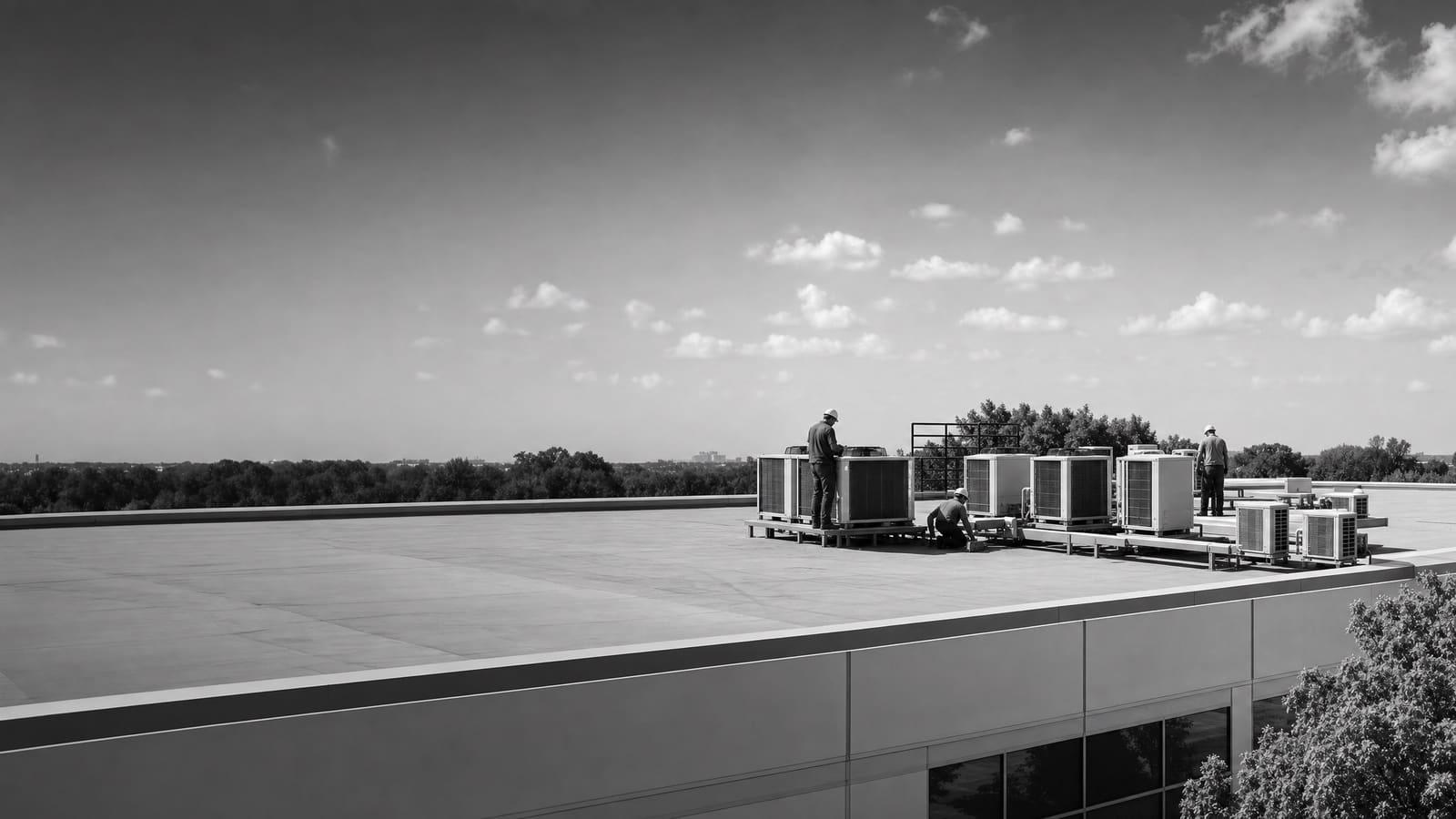
Most commercial buildings this size run packaged rooftop units, and rooftop systems cool close to half of all U.S. commercial floor space, so this is the decision most owners face. The Department of Energy frames three live paths, plus one that skips new equipment: keep the same type of unit, step up to a high-efficiency unit, or move to a heat pump rooftop unit that heats and cools on one electric system. Owners who are not ready to replace can retrofit advanced controls onto a serviceable unit instead, which is the cheaper move when the cabinet and coil still have life left. What decides it is rarely the equipment. It is whether the space is used the way it was when the old unit was picked, what the electrical service at the roof can carry, and how long you plan to hold the building.
WHAT MOVES THE NUMBER
The lines that separate two quotes
None of these are visible from the parking lot, which is why two bids on the same building can differ by far more than the equipment does.
IN PRACTICE
Buy the replacement instead of reacting to it
The most expensive version of this project starts with a phone call in August. DOE's guidance is blunt about the pattern: facility managers usually wait until a rooftop unit can no longer hold the space, needs constant service, or fails outright — and by then the choice has narrowed to whatever is on a truck this week. Replacing proactively, on your schedule, generally beats both replacement-on-failure and a reflex like-for-like swap at the end of the unit's life.
Buying ahead changes what you can compare. You can price two efficiency tiers instead of one. You can find out what the electrical service at the roof actually carries before a salesperson tells you. You can put the crane day on a morning when the lot is empty rather than mid-week because a tenant is calling.
It also changes the sizing conversation. The nameplate on a twenty-year-old unit describes the building as it was, not as it runs now — different occupancy, different plug load, different hours. Confirming the load either validates the old tonnage or finally explains a comfort complaint nobody ever solved.
SCOPE CHECK
One morning, or a phased project
The same tonnage can be a single planned outage or a months-long project. What separates them is rarely the equipment itself.
STRAIGHTFORWARD
Same size, same connections
The load confirms the existing tonnage, the new unit fits the existing curb or a standard adapter, the electrical service and gas line stay as they are, and the crane has clear reach from the lot. Permit review is routine and the swap lands in one planned outage.
MORE INVOLVED
Different size, fuel, or footprint
Tonnage grows, the footprint changes, or the building goes all-electric. Now you may add structural review, feeder or panel work, new energy calculations, and controls integration. Occupied tenants push the work into phases and off-hours, which stretches both schedule and cost.
SITE REVIEW
What the walk has to settle before pricing
A site review is what turns an estimate into a price. Start at the nameplate: make, model, tonnage, refrigerant, and manufacture date. Age is the first filter, since DOE flags units past 15 years as the ones wasting real money against newer equipment. Then look at what the unit sits on. Curb dimensions decide whether an adapter works or the roof opening changes, and a footprint change is where structural review appears.
Next is what feeds it. DOE's checklist for rooftop decisions puts three infrastructure items up front: electrical capacity, physical constraints, and gas lines. Electrical capacity is the one that surprises owners on all-electric conversions, because the panel, feeders, and disconnect at the roof may not carry the new unit. Physical constraints cover clearances, reach, and where a crane can actually set up.
Last is the part that gets skipped. If the unit talks to a building automation system, the point list and integration belong in the scope, not in a change order after startup.
Bring these four things to the walk
A nameplate photo, the last two years of service tickets, a photo of the electrical disconnect and panel at the roof, and the lot layout with your allowed closure hours. That is usually enough to price the job without a second visit.
PORT ST. LUCIE CONTEXT
Permitting sets the calendar here
Florida commercial alteration permitting drives this schedule more than the crane does. When the scope includes installing or relocating HVAC equipment, Florida jurisdictions expect mechanical plans signed and sealed by a Florida-licensed engineer or architect, energy calculations covering the heating, ventilation, and air-conditioning work, and drawings showing exactly where the equipment sits. That is a design step with a real calendar cost, and it happens before anything is ordered. Confirm the current submittal checklist with the Port St. Lucie building department, since requirements vary by jurisdiction and code edition.
Climate helps the equipment decision. DOE places the South in the group where today's heat pump rooftop units can carry most or all of the winter heating demand, so an all-electric unit is a reasonable option to price here rather than an experiment.
Decide fuel type before the plans are sealed
Switching from gas to all-electric after the drawings are stamped means new energy calculations, a revised electrical scope, and a resubmittal that can cost more time than the equipment lead does.
OWNERSHIP
Two things that change the answer
Two questions decide how much of this project you should take on at once: who pays for the energy, and how many units you own.
In a leased building, the split between capital cost and utility savings decides everything. If tenants pay their own power, an efficiency upgrade you fund returns to them, not to you, unless the lease lets you recover it. Owner-occupied buildings have no such gap, which is why they justify the higher tier more easily.
Fleet size matters just as much. One unit is a purchase. Six units on one roof is a program, and it should be sequenced by age and condition rather than by whichever one fails first.
WHO BENEFITS
Who captures the savings
If tenants pay the power bill, an efficiency step-up you fund shows up on their statement instead of yours. Read the lease before pricing the higher tier.
SCALE
One unit or a fleet
DOE's portfolio guidance evaluates suitability one roof at a time, because electrical capacity, physical constraints, and gas service differ from unit to unit across a fleet.
OVER TIME
Phasing, procurement, and lifetime cost
Fleet replacement works better as a rolling program than one capital event. Through DOE's Advanced RTU Campaign, more than 200 organizations upgraded over 43,000 rooftop units and cut a combined $37 million a year from their energy bills. That came from ranking units and working the list, not from replacing everything in one summer.
Rank yours by age first, then by service history. Any unit past 15 years is a candidate, because that is where DOE draws the line for substantial waste against newer models. Units with repeat compressor or control failures move up. Units already generating comfort complaints move up again, since you pay for those twice — once in service calls and once in tenant patience.
Then price the lifetime, not the invoice. The gap between a base unit and a high-efficiency one is a one-time number. The energy difference repeats every month for the life of the equipment, and DOE's high-performance specification targeted cutting rooftop energy use by up to half against the old minimum standard. Ask what incentives are live at the time you buy, because programs change and a stale rebate assumption is not a plan.
COMPARING BIDS
Five things a comparable quote shows
Two quotes are only comparable when both cover the same scope. Ask every bidder to break the price into these five, in writing, before you compare totals.
01
Equipment
Make, model, tonnage, efficiency tier, refrigerant, and the quoted lead time.
02
Roof work
Curb adapter or new curb, structural review if the footprint changes, flashing, and roof patching.
03
Utilities
Electrical scope through the disconnect, any feeder or panel work, and how the gas line is handled.
04
Rigging day
Crane size, staging and lot closure hours, and who carries the rigging cost and insurance.
05
Permits and closeout
Sealed mechanical drawings, energy calculations, inspections, commissioning report, and warranty start date.
Get a defensible number
Price the equipment and the building together.
Send the address, operating target, and target opening date. Flux will identify what must be verified before the project can be priced.
Get a free estimateQuestions
Straight answers.
When does replacing a rooftop unit beat another repair?
Age and repeat service are the honest triggers. DOE points at units past 15 years as the ones wasting substantial energy compared with newer models, and puts the annual waste from old, inefficient rooftop units at $900 to $3,700 each. Once that number plus recurring service approaches a capital payment, replacement is the cheaper path.
Does a heat pump rooftop unit make sense in Port St. Lucie?
It is usually worth pricing. DOE describes today's heat pump rooftop units as capable of most or all winter heating demand across the South, which is the mild-to-moderate heating profile Florida has. The limiting factor is rarely comfort. It is whether the electrical service at the roof can carry an all-electric unit.
What do the permit drawings have to include?
Florida commercial alteration guidance calls for mechanical plans signed and sealed by a Florida-licensed engineer or architect whenever the scope includes installing or relocating HVAC equipment, along with energy calculations and drawings showing equipment location. Confirm the exact submittal list with the Port St. Lucie building department before you assume a schedule.
What happens to the refrigerant in the old unit?
It has to be recovered, not vented. EPA rules under Section 608 of the Clean Air Act govern how refrigerant is handled and recycled in stationary air-conditioning and heat pump equipment, and that work belongs to certified technicians. Recovery and its documentation should appear in the removal scope on your quote.
How much does a commercial HVAC installation cost?
There is no honest universal price, because tonnage, curb and structural work, electrical scope, and crane access all move it. The reliable way to compare is to make every bidder show the same five line items, then weigh the price gap against energy. DOE's high-performance specification targeted cutting rooftop energy use by up to half against the old minimum standard.
Sources used for this guide
- [1]betterbuildingssolutioncenter.energy.gov — DOE Advanced Rooftop Unit Replacement Guidance
- [2]betterbuildingssolutioncenter.energy.gov — DOE Commercial Heat Pump Rooftop Unit Replacement Guidance
- [3]betterbuildingssolutioncenter.energy.gov — DOE High-Efficiency Commercial Rooftop Unit Toolkit
- [4]energy.gov — DOE Efficient Commercial Rooftop Air Conditioner Program
- [5]epa.gov — EPA Stationary HVAC Refrigerant Management
- [6]tampa.gov — Permit Application Guide Commercial Alteration