THE DIRECT ANSWER
What commercial HVAC replacement covers in Pompano Beach
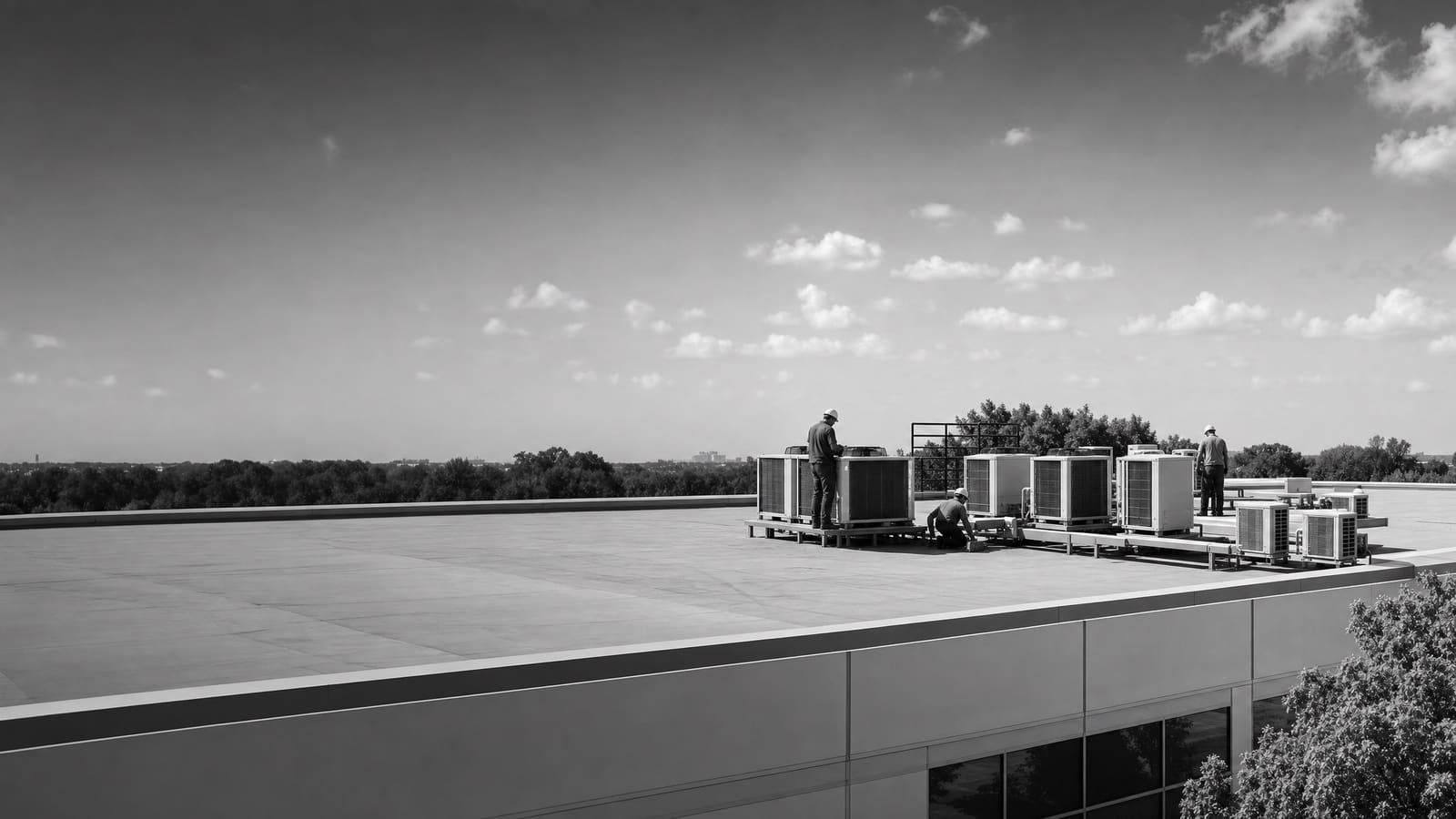
Commercial HVAC replacement means confirming the load the building carries today, selecting equipment against real availability, permitting the work, recovering refrigerant from the old unit, setting the new one, and commissioning it before handoff. Replacement usually beats another repair once a rooftop unit passes fifteen years. DOE flags old, inefficient rooftop units as wasting $900 to $3,700 per unit every year — money spent whether the unit holds the space or not.
A site review still has to confirm curb size and condition, the roof deck under it, electrical capacity at the unit, crane reach across the lot, and which code items the swap pulls into scope.
THREE PATHS
The three replacement choices worth pricing
Most commercial replacements come down to three choices, and the right one depends on whether the building's use has changed since the last unit went in.
A like-for-like swap reuses the existing curb and connections, so it is the fastest way back to conditioned space and the cheapest to engineer. It also carries forward whatever sizing error the old unit had.
A right-sized, higher-efficiency unit costs more up front and takes a load calculation, but it targets the waste DOE measured in aging rooftop equipment. The high-efficiency specification DOE built with manufacturers aimed to cut rooftop energy use by up to half against the older standard, and the challenge drove more than twenty models past it.
An all-electric heat pump rooftop unit adds heating without gas. DOE's guidance places heat pump RTUs at their best in mild-to-moderate winters and says that across most of the South they can meet most or all of the winter heating demand — which describes South Florida.
WHAT MOVES THE NUMBER
The budget lines that decide the total
No two roofs price the same, so read a quote by what moves the number rather than by the total alone. These are the lines that separate a clean swap from a project, and the ones where competing quotes most often disagree with each other.
TIMING
Planned replacement versus replacement on failure
The most expensive commercial HVAC decision is usually the one nobody makes. DOE's rooftop guidance describes the pattern plainly: facility managers put off buying a new unit until the old one stops holding the space, needs constant attention, or fails outright. Replacing on failure removes every option that saves money. You take whatever unit is available, at whatever price, on whatever schedule the crane and the permit desk allow.
Planned replacement gives those levers back. You can run a competitive bid instead of an emergency call. You can pick the efficiency tier on purpose, which matters because rooftop units cool close to half of all commercial floor space in the country and old ones waste between $900 and $3,700 each per year. And you can put the crane on a Sunday morning instead of a Tuesday lunch rush.
The practical trigger is age plus behavior. A unit past fifteen years that still holds setpoint and has a clean service history can often wait one more season. The same unit with two compressor events, a coil leak, or an obsolete refrigerant is telling you the next repair is a down payment on a replacement you are going to make anyway.
SCOPE
A simple swap and a real project
Not every replacement is the same job. The gap between a straightforward swap and a project with a schedule is usually access, load change, and whether the fuel source stays the same.
LOWER COMPLEXITY
A clean one-morning swap
Same tonnage on the existing curb, an accessible roof with crane reach from the lot, adequate electrical at the disconnect, and a space whose use has not changed since the last install. Permit scope stays mechanical and electrical.
HIGHER COMPLEXITY
A project with a schedule
Larger tonnage, a different footprint, a gas-to-electric conversion, tight or interior roof access, tenants who cannot lose cooling, or a fleet replaced in phases. Engineering, sealed plans, and staging all enter the number.
SITE REVIEW
What a site review has to confirm before pricing
A quote that arrives without anyone climbing the ladder is an estimate with a price attached. The rooftop visit exists to answer the questions that actually change the number, and there are only about six of them.
The first is the curb: its dimensions, its condition, and whether the replacement lands on it or needs an adapter. The second is the deck under that curb, because a heavier unit or a larger footprint can pull a structural review into scope. The third is electrical — the disconnect, the feeder, and whether the panel has capacity, which matters most when a gas unit is being replaced by an all-electric one. The fourth is access: where the crane sets up, how far it has to reach, and how long the lot is partly closed.
The fifth is what the existing system is doing wrong, since complaints a building has lived with for years often trace back to sizing or airflow rather than to the equipment itself. The sixth is code: what the current energy code asks of a replacement at this tonnage, including outside air and economizer provisions, and what documentation the permit will require.
The question that ends a bad quote
Ask each contractor what they measured on the roof. If the answer is the nameplate and nothing else, the curb, the deck, the panel, and the crane path are all still unpriced — and every one of them can move the total after you sign.
POMPANO BEACH
Florida permitting starts before the crane is booked
Florida permitting is where a rooftop replacement stops being a purchase and becomes a permitted job. Florida building department guidance for commercial alteration is consistent on a few points: mechanical plans must be signed and sealed by a Florida licensed engineer or architect, mechanical plans are required whenever the scope includes installing or relocating HVAC equipment, and energy calculations are required when the scope includes heating, ventilation, or air conditioning. The plans also have to show equipment location.
That turns into a scheduling decision. Sealed drawings and energy calculations take design time before anything is submitted, so on a planned replacement that work should start weeks ahead of the crane date rather than after the unit is ordered. Confirm the current submittal checklist with the Pompano Beach building department, since local requirements sit on top of the state code.
Put the drawings on the critical path
If a quote does not name who seals the mechanical plans and who prepares the energy calculations, that cost and that lead time are still coming. They just have not landed on the page yet.
OPERATING
Two decisions that outlive the install
Two things outlive the installation itself. The first is refrigerant, which is federally regulated and follows the equipment for its whole service life. The second is how this unit fits the rest of the building's equipment, because most commercial roofs do not carry a single unit and rarely carry units of the same age.
Both are worth deciding before the order goes in rather than after. A refrigerant choice made once quietly sets your parts strategy and service contract for a decade. A replacement sequence chosen on purpose turns a run of emergencies into a budget line you control.
REFRIGERANT
Section 608 follows the equipment
EPA rules under the Clean Air Act govern how refrigerant is handled and recycled in stationary cooling and heat pump equipment, so recovery from the old unit is regulated work, not a line to trim. New units arrive on newer refrigerants, which changes parts and service planning on a mixed roof.
PORTFOLIO
One unit or the whole roof
When several units share an age, the second replacement is cheaper than the first: one mobilization, one crane day, one permit cycle. DOE's rooftop campaign counted more than 43,000 units upgraded across its partners, largely through planned replacement rather than emergencies.
PROCUREMENT
Phasing, ordering, and lifetime cost
Procurement is where planned replacement pays for itself. When the unit is chosen ahead of failure, the order goes out against a real delivery date, the sealed drawings and energy calculations run in parallel, and the crane is booked for a morning the building can afford to lose. When the unit fails first, all three of those happen in whatever order the market allows, and each one adds days the tenants feel.
Phasing matters when the roof carries several units of similar age. Replacing all of them in one season earns the best equipment pricing and needs only one mobilization, but it lands the entire cost in a single budget year. Splitting the work across two or three years spreads the capital and keeps a crew familiar with the building, at the cost of running the oldest units through another summer. The deciding question is usually how much the oldest unit costs to keep alive.
Lifetime cost is the part that survives the invoice. The efficiency tier chosen on install day sets the utility line for the next fifteen years or more, and it is the one decision that cannot be revisited without another crane. Ask for the operating difference between tiers in writing before choosing on first cost alone.
THE QUOTE
Five things a comparable quote shows
Two quotes are only comparable when both show the same things. Ask every bidder for these five in writing before you compare totals, because anything missing here tends to return later as a change order.
01
Load basis, not nameplate copy
The tonnage and the calculation behind it, tied to how the space is occupied and used today.
02
Model, efficiency tier, and availability
Exact model number, efficiency rating, and a written lead time you can hold the schedule against.
03
Rooftop scope in writing
Curb adapter, flashing, structural check, and any duct or electrical modification on the way in.
04
Permit and drawing responsibility
Who seals the mechanical plans, who prepares the energy calculations, and who attends inspections.
05
Commissioning and closeout
Charge, airflow, and controls verified against spec, with a startup report and warranty registration.
Get a defensible number
Price the equipment and the building together.
Send the address, operating target, and target opening date. Flux will identify what must be verified before the project can be priced.
Get a free estimateQuestions
Straight answers.
When does replacement beat one more repair?
Age plus behavior. DOE flags rooftop units over fifteen years old as substantial energy wasters, putting the loss from old, inefficient units at $900 to $3,700 each per year. Add a second major failure, a coil leak, or an obsolete refrigerant and the next repair is really a deposit on a replacement you will make anyway.
Does a heat pump rooftop unit make sense in Pompano Beach?
For most buildings, yes on the heating side. DOE's guidance puts heat pump rooftop units at their best in mild-to-moderate winters and says that across most of the South they can meet most or all of the winter heating demand. The item to verify first is electrical capacity at the unit, since dropping the gas section moves that load onto the panel.
What does the permit require for an HVAC replacement in Florida?
Florida commercial alteration guidance calls for mechanical plans signed and sealed by a Florida licensed engineer or architect whenever the scope includes installing or relocating HVAC equipment, energy calculations when the scope includes heating, ventilation, or air conditioning, and equipment location shown on the plans. Confirm the current checklist with the Pompano Beach building department before submitting.
How much does commercial HVAC installation cost?
There is no universal installed price, and any quote that offers one without seeing the roof is guessing. The number is built from tonnage and efficiency tier, curb and roof work, crane access, electrical, and the code items the swap triggers. Ask for those as separate lines so two bids can actually be compared.
What happens to the refrigerant in the old unit?
It is recovered by certified technicians under EPA Section 608 rules, which govern how refrigerant is handled and recycled in stationary cooling and heat pump equipment. New units ship on newer refrigerants, so a roof with mixed vintages needs a parts and service plan that covers both.
Sources used for this guide
- [1]betterbuildingssolutioncenter.energy.gov — DOE Advanced Rooftop Unit Replacement Guidance
- [2]betterbuildingssolutioncenter.energy.gov — DOE Commercial Heat Pump Rooftop Unit Replacement Guidance
- [3]betterbuildingssolutioncenter.energy.gov — DOE High-Efficiency Commercial Rooftop Unit Toolkit
- [4]energy.gov — DOE Efficient Commercial Rooftop Air Conditioner Program
- [5]epa.gov — EPA Stationary HVAC Refrigerant Management
- [6]tampa.gov — Permit Application Guide Commercial Alteration