THE SHORT VERSION
What a commercial HVAC replacement actually covers
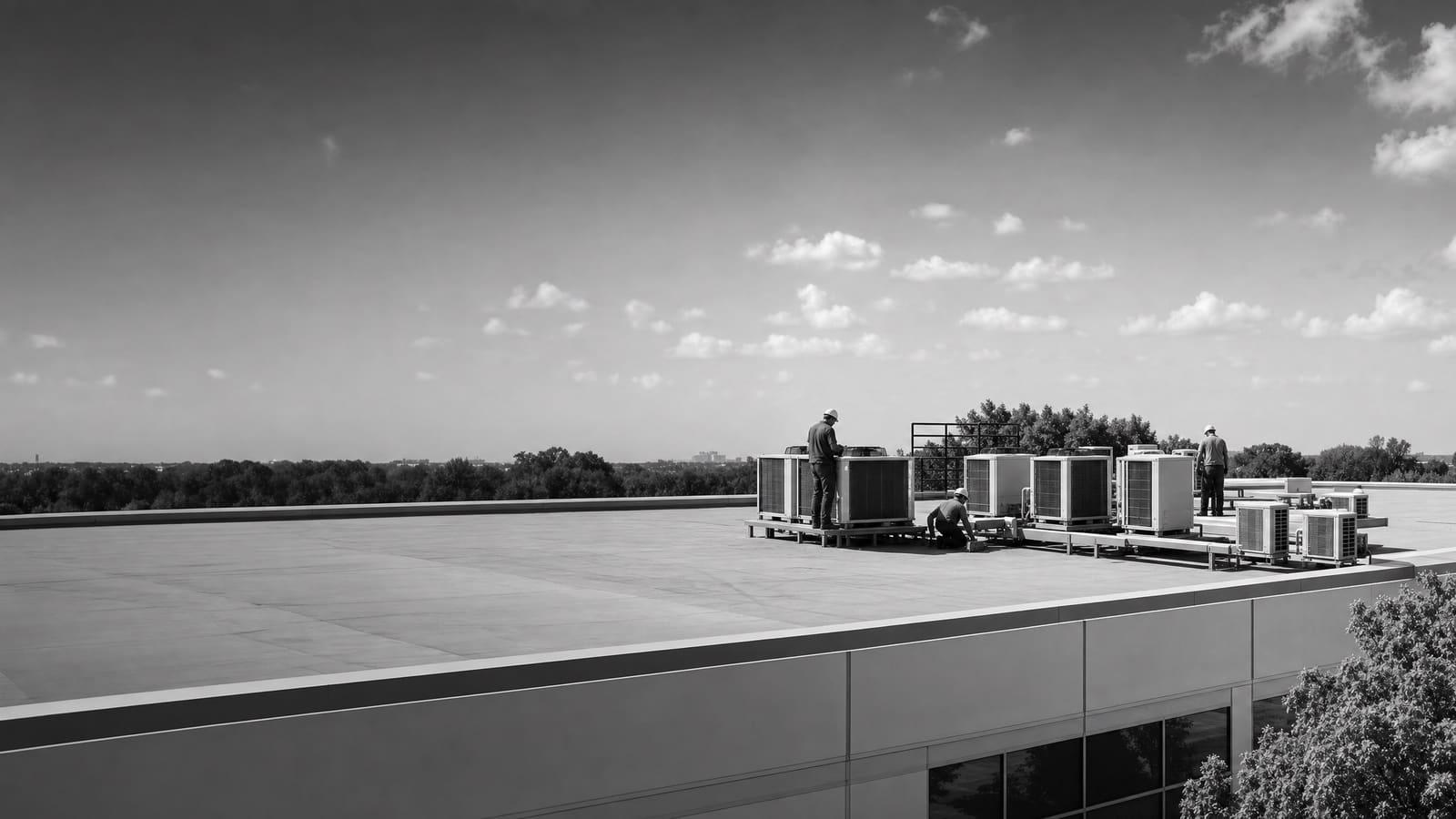
A commercial replacement covers a fresh load check, equipment selection against real lead times, permits, rigging and the crane set, a curb or curb adapter, gas and electrical connections, controls integration, and commissioning. Replacement usually beats one more repair once a unit passes about fifteen years, because an old, inefficient rooftop unit can waste roughly $900 to $3,700 a year in energy on its own, before the next compressor bill arrives.
A site review still has to confirm the real load, the curb and roof structure, available electrical capacity at the panel, and crane access before any of that becomes a price.
THREE PATHS
Pick what you are buying before you compare prices
Three replacement paths cover most commercial roofs, and the right one depends on what the building does now and where it is headed. Packaged rooftop units condition close to half of all commercial floor area in the country, so this choice usually happens one curb at a time.
Start by deciding whether you are buying back cooling or buying down operating cost. A like-for-like swap answers the first question. A high-efficiency unit answers the second. A heat pump rooftop unit answers a third question about fuel, and Southern California sits in the mild-winter part of the country where a heat pump can carry most or all of the winter heating load.
WHAT MOVES THE NUMBER
The lines that separate two quotes
Nobody can price a commercial rooftop replacement from a phone call, but the pieces that move the number are predictable. These are the lines to look for on a proposal, ordered roughly by how much they swing between two buildings on the same street.
IN PRACTICE
Buy the unit, not just the installation
The nameplate on the old unit tells you what somebody sized in a different decade. Occupancy changes, plug loads change, lighting changes, and a roof or window project changes the envelope. Confirm the load against how the building is used today, then decide whether the answer is the same tonnage or a smaller one. Sizing down is common, and it lowers both the equipment price and the running cost for the life of the unit.
Efficiency tier is where the money actually sits. A unit past fifteen years is often the most expensive equipment in the building on a per-year basis, and the waste is invisible because it shows up as a utility bill instead of an invoice. High-performance rooftop designs were developed to cut unit energy use by up to half against the old federal minimum, and that federal minimum was itself raised roughly a decade ago. A tired unit is behind on both counts.
Availability decides your calendar. Ask for the actual lead time on each option before you compare prices, and ask whether the crew has installed the equipment type before. On reverse-cycle units, inexperience shows up first in startup and controls setup, long after the crane has left.
SCOPE
Why one replacement is a morning and the next is a project
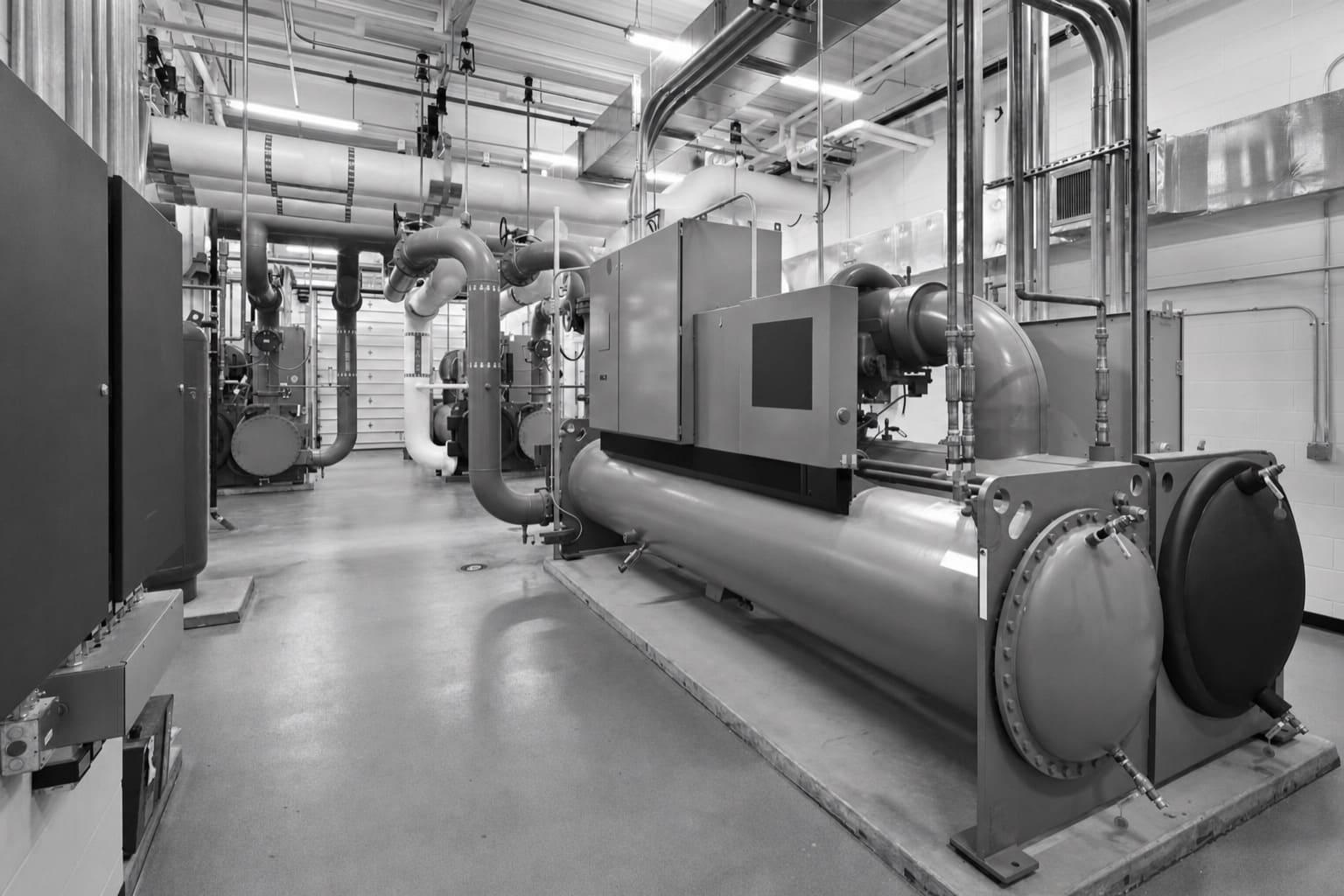
Two buildings with the same tonnage can be a one-morning job and a six-week project. The difference is almost never the unit. It is what surrounds the unit: the curb, the panel, the roof, and the parking lot.
LOWER COMPLEXITY
One-morning swap
Matching tonnage, an existing curb that adapts cleanly, electrical service that already carries the load, an open lot for the crane, and a tenant schedule that tolerates an early start. Permits stay routine mechanical and electrical.
HIGHER COMPLEXITY
Engineered replacement
A different footprint or added weight, structural review on the roof, a fuel switch that needs new electrical capacity, a tight lot that forces a larger crane or a closure, and controls that have to land inside an existing building automation system.
BEFORE YOU SIGN
What the site review has to settle
A good site review is short, but it is physical. Somebody gets on the roof, measures the existing curb, and checks the condition of the structure under it. Somebody opens the panel and confirms what capacity is actually available, not what the drawings said in 1998. Somebody walks the access route the crane will use and decides where the truck sets up, which stalls close, and whether the reach works from that position.
The rest is disposition questions. If the old unit burned gas and the new one does not, what happens to the gas line? If the roof has warranty coverage, who owns the penetrations and the patching? If the unit ties into a building automation system, who commissions the points and proves they work? Each of these is cheap to answer in advance and expensive to discover on the day of the set.
Ask for the answers in writing. A proposal built on a real look at the roof and a proposal built on a nameplate photo can look identical in price and behave nothing alike once the work starts.
Four answers to insist on
Confirmed load, confirmed curb and structural condition, confirmed electrical capacity at the panel, and a written crane and access plan with the closure window. Anything missing here comes back later as a change order.
POMONA SPECIFICS
Permits come before the crane, not after
In California, mechanical and electrical upgrades and repairs are permitted work, and a rooftop replacement is usually both at once. That single fact should shape your schedule. Establish the permit path first, then book the crane against it, rather than landing a unit and trying to paper it afterward.
The permit set also forces the design questions into the open. Tonnage, electrical scope, and any structural change get reviewed by someone other than your contractor, which is a useful second opinion on the scope you are buying.
If a utility incentive is part of how you justified the upgrade, confirm the program is open and confirm its pre-approval steps before the equipment ships. Incentive rules change, and a program that paid last year may be closed, revised, or fully subscribed now.
The sequence that protects your date
Permit application, then the equipment order against a confirmed lead time, then the crane date, then inspection. Booking the crane first is the most common way a replacement slips and costs more than it needed to.
OWNERSHIP
Who pays, and what else is on that roof
A replacement decision is not only technical. Who owns the equipment, who pays the utility bill, and how many other units sit on the same roof all change what the right answer is. Two buildings with identical loads can justify completely different equipment tiers once you account for who captures the savings and what else comes due in the next three years. Work these out before you compare proposals, because they decide which proposal is actually the cheaper one.
LEASED SPACE
Read the lease before the proposal
Who owns the rooftop unit and who pays the power bill decides whether a higher efficiency tier is worth buying. When the landlord buys the equipment and the tenant pays the utility, nobody captures the savings. Name that split out loud, then divide it deliberately.
MULTIPLE UNITS
One roof, several ages
Most commercial roofs carry units of different ages and different refrigerants. Decide now which ones get replaced and which run to failure, because service planning, spare parts, and certified refrigerant handling all follow from that list.
PLANNING
Phasing, procurement, and lifetime cost
Most facility teams wait. The unit keeps limping, the repairs stay small on paper, and replacement happens the week it dies in season. That is the most expensive version of this project. You lose the equipment choice, you lose the schedule, and you pay for whatever is available instead of what fits. Replacing proactively is usually the better business move than replacement on failure, and often better than a like-for-like swap at the very end of service life.
Planning also unlocks the arithmetic that makes a portfolio move worth it. Across a national upgrade effort, more than two hundred public and private organizations replaced or retrofitted over 43,000 rooftop units and cut a combined $37 million a year from their energy bills. Those savings come from doing the work on a schedule, not from any single heroic install.
So phase it. Rank the units by age, repair history, and how badly a failure would hurt that space. Replace the worst one this year with the equipment tier you actually want, learn what the crane day costs at your site, and use those numbers to budget the next two. The cheapest quote on a single unit is rarely the cheapest decision across a roof.
THE CHECKLIST
Five things a comparable quote shows
If two proposals do not show these five items, you are not comparing them. You are guessing at the difference and hoping the cheaper one included the same work.
01
Make, model, tonnage, and efficiency tier
Not "equivalent unit." The model number is what makes two quotes comparable.
02
Quoted lead time, in writing
Availability moves your date more than price does.
03
Curb, structural, and roof penetration scope
Who buys the adapter, who handles structural work, and who patches the roof.
04
Crane, rigging, and lot closure plan
Which stalls close, for how long, and on what day.
05
Permits, inspection, and commissioning
Named on the quote, with the startup documentation that keeps the warranty intact.
Get a defensible number
Price the equipment and the building together.
Send the address, operating target, and target opening date. Flux will identify what must be verified before the project can be priced.
Get a free estimateQuestions
Straight answers.
When does replacement beat one more repair?
Once a unit is past roughly fifteen years and repairs are stacking up, replacement usually wins. An old, inefficient rooftop unit can waste around $900 to $3,700 a year in energy by itself. That number never shows on a repair invoice, which is why tired units get kept far longer than they should be.
Do I need a permit to replace a rooftop unit in Pomona?
Plan on it. In California, mechanical and electrical upgrades and repairs are permitted work, and a rooftop replacement is normally both. Establish the permit path before you book the crane, and make sure your proposal says clearly that the installing contractor owns the applications and the inspections.
Should we replace like-for-like or resize?
Confirm the load either way. If the space and how it is used have not changed, like-for-like is often the right call and the fastest one. If occupancy, equipment, or the envelope changed, resizing fixes comfort problems the old unit could never solve and lowers the running cost.
Does a heat pump rooftop unit make sense here?
Often, yes. Southern California is in the mild-winter part of the country where heat pump rooftop units can carry most or all of the winter heating demand. The gating items are electrical capacity at the panel, what happens to the existing gas line, and whether the installing crew has real experience with the equipment.
What happens to the refrigerant in the old unit?
It gets recovered, not vented. Federal rules govern the handling, recovery, and recycling of refrigerant in stationary air conditioning equipment, and the work has to be done by certified technicians. On a roof with several units of different ages, keep track of which refrigerant is in which unit for service planning.
Sources used for this guide
- [1]betterbuildingssolutioncenter.energy.gov — DOE Advanced Rooftop Unit Replacement Guidance
- [2]betterbuildingssolutioncenter.energy.gov — DOE Commercial Heat Pump Rooftop Unit Replacement Guidance
- [3]betterbuildingssolutioncenter.energy.gov — DOE High-Efficiency Commercial Rooftop Unit Toolkit
- [4]energy.gov — DOE Efficient Commercial Rooftop Air Conditioner Program
- [5]epa.gov — EPA Stationary HVAC Refrigerant Management
- [6]californiacity-ca.gov — HVAC Permits