THE DIRECT ANSWER
What a commercial HVAC replacement actually covers
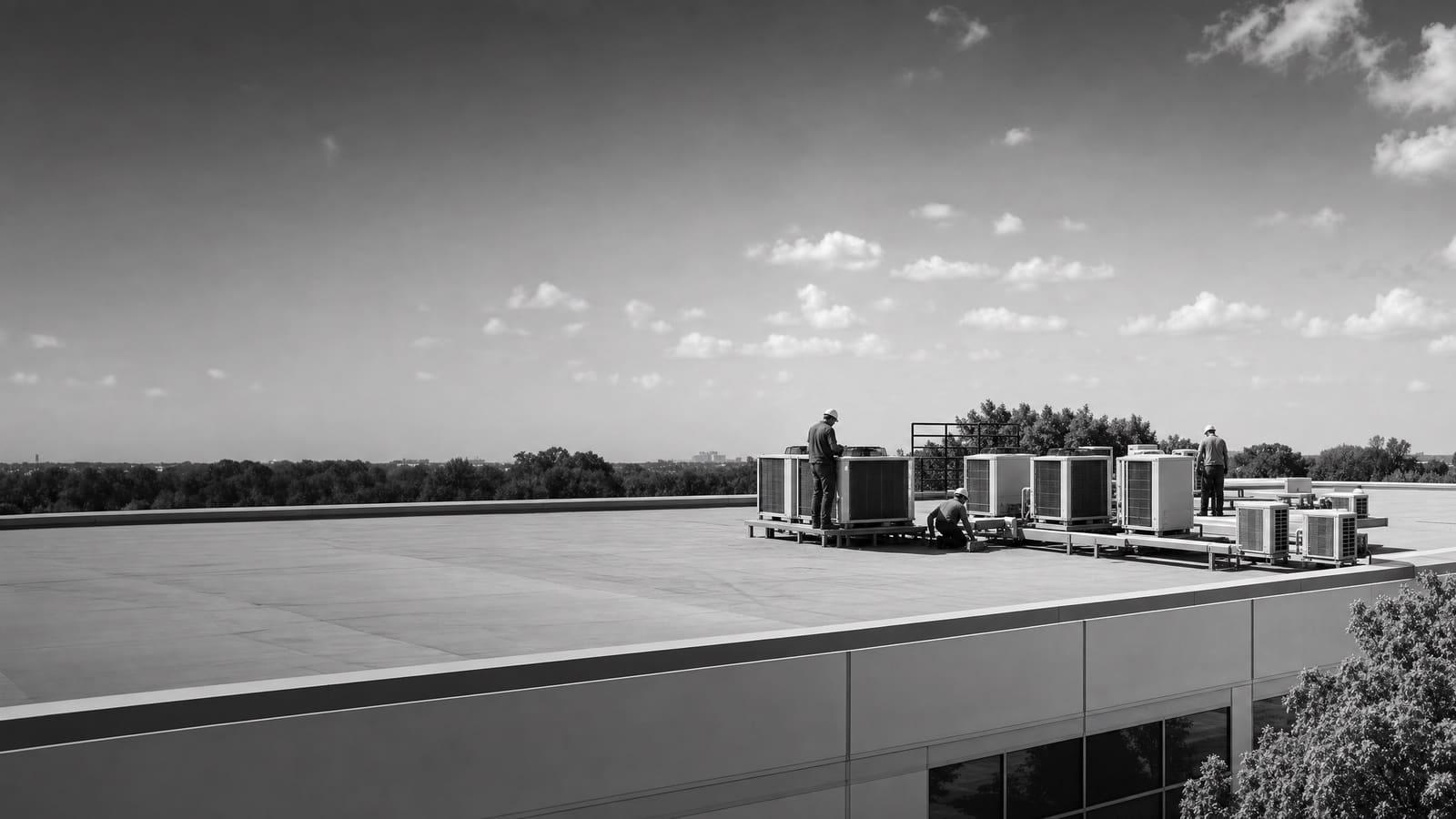
A commercial HVAC replacement covers more than the unit: load confirmation, equipment selection, rigging and set, gas and electrical connections, controls, and commissioning. Replacement usually beats another repair once a unit passes fifteen years, because old, inefficient rooftop units commonly waste $900 to $3,700 each per year in energy — a number that keeps running whether or not the compressor has failed yet.
A site review still has to verify curb fit and roof structure, electrical capacity, gas service, crane access, and how many hours the space can run without conditioning.
THREE WAYS TO GO
Three equipment paths for a rooftop replacement
Most commercial replacements land on one of three paths, and the choice is worth making before anyone prices equipment.
Like-for-like keeps the same fuel and roughly the same performance tier. It is the fastest to engineer and the cheapest to install, and it carries forward whatever the old unit got wrong.
A high-efficiency gas/electric unit keeps the same fuel but buys back operating cost. Rooftop units built to the high-performance specification were designed to cut energy use by up to half against the older baseline, and that gap is where the payback lives.
A heat pump rooftop unit adds reverse-cycle heating. All-electric, dual-fuel, and cold-climate versions exist, and they behave differently as outdoor temperature falls: heat pump heating efficiency drops as it gets colder and trends toward parity with electric resistance heat. Buildings carrying a real winter heating load usually look at dual-fuel or cold-climate equipment rather than a standard all-electric swap.
WHAT MOVES THE NUMBER
Where the installed price actually comes from
There is no universal installed price for a commercial unit, and any quote that hands you one without seeing the roof is guessing. These are the lines that separate a routine swap from a project.
IN PRACTICE
Planned replacement versus replacement on failure
Facility managers usually delay a rooftop replacement until the unit no longer conditions the space, needs constant service, or fails outright. That is the most expensive way to buy equipment. When a unit dies in August, you take whatever sits in the regional warehouse, at whatever price, on whatever schedule the crane company has open. Sizing, efficiency tier, and fuel choice all get decided by availability instead of by you.
Planned replacement flips that. You confirm the load against how the space is used now — occupancy, plug loads, and envelope all change over twenty years — then price two or three equipment options against real lead times. You pick the week. You pick the crane day. Tenants see parking cones and nothing else.
There is enough evidence behind this now to make it an easy argument internally. More than 200 organizations working through the federal rooftop unit campaign upgraded over 43,000 units and cut a combined $37 million a year from their energy bills. None of that shows up when the decision gets made in a panic on a Friday afternoon.
SCOPE CHECK
What makes one replacement simple and another a project
Two buildings can run the same tonnage and land in completely different price bands. The difference is almost never the unit itself. It is what the roof, the panel, and the schedule allow.
LOWER COMPLEXITY
Straight swap conditions
Same fuel and similar tonnage, an existing curb that accepts an adapter, clear crane reach from the lot, adequate panel capacity already at the unit, and a space that can go a workday without conditioning.
HIGHER COMPLEXITY
Project conditions
A fuel switch, growing tonnage, structural work at the curb, a long crane reach or street closure, new electrical service for an all-electric unit, or a tenant that cannot lose cooling during business hours.
BEFORE YOU PRICE IT
The site review that makes a quote comparable
Federal replacement guidance works off the same short checklist every time, and it is a good one to hold a bidder to: climate and heating load, utility bill impact, building type and how the space is used, equipment availability, and infrastructure — meaning electrical capacity, physical constraints on the roof, and existing gas lines. Add installer familiarity with the equipment and any incentive you plan to claim, and you have covered most of what turns a good idea into a working install.
The infrastructure line is where projects go sideways, especially on an electric conversion. A heat pump rooftop unit can need more electrical capacity than the gas/electric unit it replaces. If the panel is already full, that upgrade belongs inside the equipment comparison from day one, not in a change order after the crane has left.
The other thing a walk should settle is the outage window. How long the space can run unconditioned decides whether this is a one-morning swap or a phased job with temporary cooling.
Ask for this before signing
A confirmed load calculation, the electrical and gas verification, the rigging plan, the quoted lead time for the specific model, and who owns permits and inspections. If any of the five is missing, you are comparing bids that are not describing the same project.
OWNERSHIP MATH
Two things that outlast the install
The install is one morning. What you actually bought is fifteen to twenty years of operating cost, service calls, and parts availability, and two decisions at the quote stage set most of it.
The first is efficiency tier, because the gap between a minimum-efficiency unit and a high-performance one compounds every month you own it. The second is refrigerant. New commercial equipment ships on newer, lower-GWP refrigerants, which changes nothing about day-one operation but does change how you plan service contracts and spare parts across a mixed fleet. Federal rules govern how refrigerant is handled, recovered, and recycled on stationary commercial equipment, so the contractor's certification and recovery practice are part of what you are paying for.
OPERATING COST
The efficiency gap compounds
An old unit's waste runs whether the building is busy or not. Efficiency tier is the one line on the quote that keeps paying you back long after the crane leaves.
FLEET PLANNING
Mixed refrigerants across a portfolio
Once one roof is on new refrigerant and the rest are not, your service contract and parts stock have to cover both. Worth deciding the sequence before the first swap.
PHASING AND PROCUREMENT
How to sequence a roof with several aging units
Buildings rarely have one tired unit. They have five, bought the same year, aging on the same curve. Replacing them one failure at a time is how a portfolio ends up with five vendors, five efficiency tiers, and no leverage on price.
A better pattern is to rank the roof. Pull nameplate ages and service history, then sort by which units are past fifteen years, which ones drive the most callbacks, and which serve space you cannot afford to lose. That order becomes a two or three year plan you can budget against instead of a series of emergencies.
Bundling matters more than people expect. Two or three units in one crane mobilization spreads the rigging and lot-closure cost across the group, and an order for several units of the same model tends to get better treatment on lead time than a one-off. If heat pump units are on the table for any part of the roof, do the electrical study once for the whole building rather than per unit, because the panel answer either opens the door for all of them or closes it.
Lock the sequence, then let equipment availability tell you which one goes first.
QUOTE CHECKLIST
Five things a comparable quote has to show
Bids that look far apart are usually describing different scopes rather than different prices. Make every bidder put these five on paper, and the gaps stop being mysterious.
01
The load it was sized to
A calculation based on how the space is used now, not the tonnage stamped on the unit coming off.
02
Model, efficiency tier, and lead time
The named model with its quoted availability window, because schedule is half the decision.
03
Roof and curb scope
Adapter, any structural work, and who pays if the deck opens up worse than expected.
04
Rigging and access plan
Crane size, staging, stalls closed, and how many hours the lot is affected.
05
Commissioning and closeout
Charge, airflow, and controls verified against spec and documented, with permits and inspections named.
Get a defensible number
Price the equipment and the building together.
Send the address, operating target, and target opening date. Flux will identify what must be verified before the project can be priced.
Get a free estimateQuestions
Straight answers.
When does replacement beat another repair?
Once a unit passes about fifteen years, repairs stop being the cheap option. Old, inefficient rooftop units commonly waste $900 to $3,700 each per year in energy, and that cost runs whether or not anything is currently broken. If you are also paying for repeat in-season callbacks, the math is usually already settled.
Should a gas rooftop unit be replaced with a heat pump?
That depends on the heating load and the electrical panel. Heat pump rooftop units lose heating efficiency as outdoor temperature drops, trending toward parity with electric resistance heat. Buildings with a real winter heating load usually look at dual-fuel or cold-climate models, and every electric option needs a capacity check before it gets priced.
How much does commercial HVAC installation cost in Peoria?
There is no honest universal number, because tonnage, curb work, crane access, electrical changes, and controls each move it independently. What a good quote gives you instead is those lines broken out, so you can see what you are paying for and compare bids that describe the same scope.
How long is the building without cooling?
A straight swap onto an existing curb is set and connected quickly, and the disruption tenants notice is the parking closure. The real variable is equipment lead time, which is why availability belongs on the quote right next to the price.
What happens to the refrigerant in the old unit?
It has to be recovered by a certified technician. Federal Clean Air Act rules govern how refrigerant is handled, recovered, and recycled on stationary commercial air conditioning and heat pump equipment, so recovery and its documentation belong in the installer's scope rather than as an afterthought.
Sources used for this guide
- [1]betterbuildingssolutioncenter.energy.gov — DOE Advanced Rooftop Unit Replacement Guidance
- [2]betterbuildingssolutioncenter.energy.gov — DOE Commercial Heat Pump Rooftop Unit Replacement Guidance
- [3]betterbuildingssolutioncenter.energy.gov — DOE High-Efficiency Commercial Rooftop Unit Toolkit
- [4]energy.gov — DOE Efficient Commercial Rooftop Air Conditioner Program
- [5]epa.gov — EPA Stationary HVAC Refrigerant Management