THE SHORT VERSION
What a commercial HVAC replacement includes
A commercial HVAC replacement covers a confirmed load calculation, equipment selected against real availability, permit drawings, rigging and the crane set, a new curb or curb adapter, electrical and fuel connections, controls integration, and documented startup. Replacement usually beats another repair once a unit is past about fifteen years and the failures start stacking. Federal analysis puts the annual waste from an old, inefficient rooftop unit at roughly $900 to $3,700 — the number your next repair has to beat.
A site review has to verify the actual load, roof and curb condition, available electrical capacity, crane access, and which code items the replacement triggers. Those five findings move the price more than the unit does.
THREE WAYS TO PLAY IT
Three ways to handle an aging rooftop unit
Most buildings pick one of three paths, usually without ever naming it. The default is to keep repairing until the unit quits, then replace whatever can be delivered fastest. That path costs the least attention and the most money, because a failure removes every choice at once — efficiency tier, controls, even tonnage. Federal guidance is blunt about the pattern: facility managers tend to wait until a unit no longer conditions the space adequately, needs frequent maintenance, or fails completely, when proactive replacement of an inefficient unit is often the better business move.
The other two paths are planned. One replaces the unit in kind on your schedule. The other treats the replacement as the moment to change efficiency tier or heating fuel, since the crane, the curb, and the permit are already paid for either way. South Florida winters are mild, and mild-to-moderate heating is exactly the condition federal guidance describes as well suited to heat pump rooftop units.
WHAT MOVES THE NUMBER
Where a replacement budget actually goes
Equipment is the line everyone looks at first. The items below are what separate two quotes for the same tonnage, and they are usually where a low bid is quietly incomplete. Ask for each one to appear separately rather than folded into a single installed number.
IN PRACTICE
Choosing the unit, not just replacing it
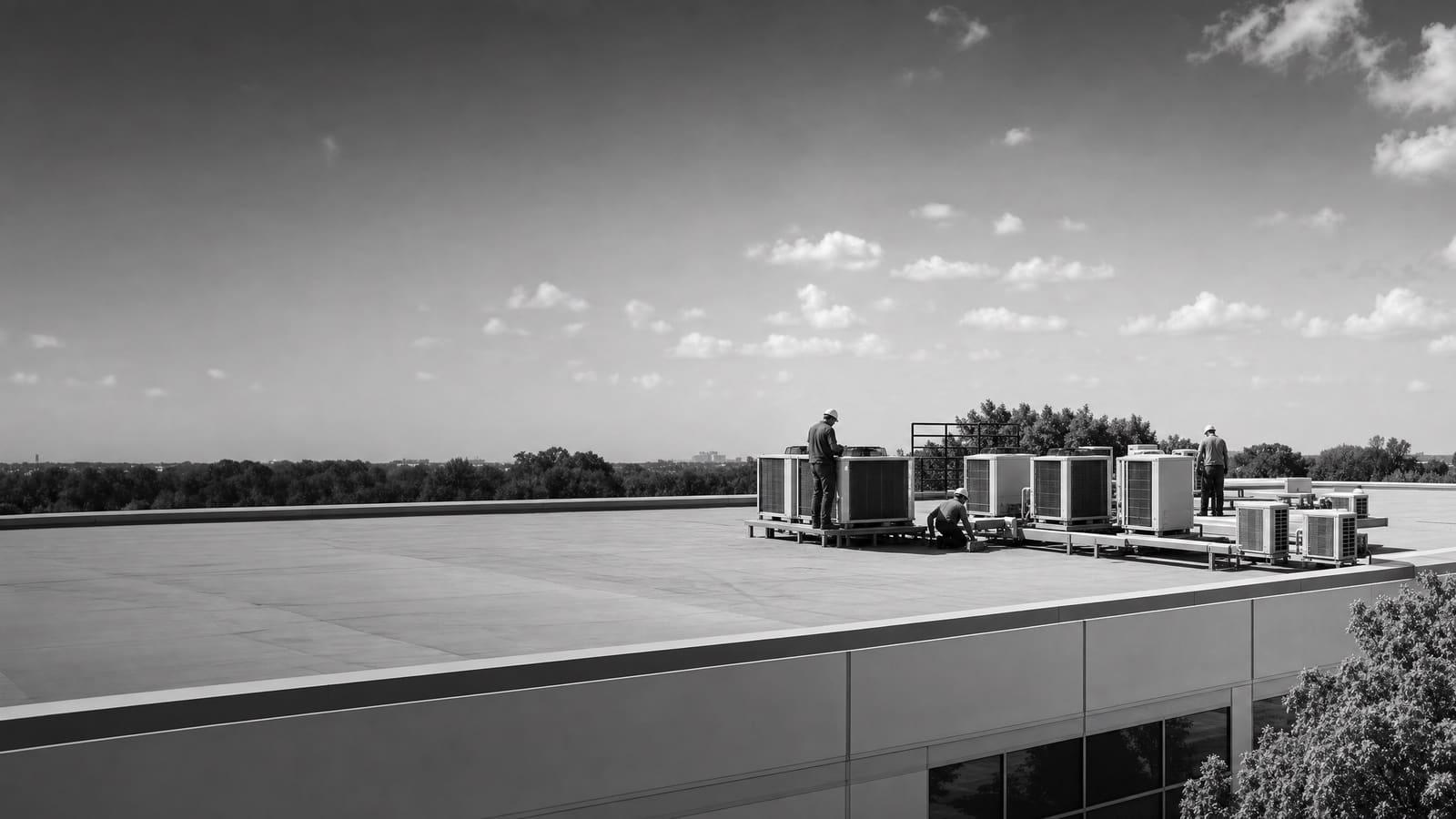
The visible part of the job is one morning. The crane arrives, stalls get coned, the old unit comes off, the new one lands, and the connections get made. Everything that makes that morning uneventful happened weeks earlier: the load was confirmed, the curb was measured, the rigging plan was drawn, and the weather call was made the day before.
The selection deserves more attention than it usually gets. Rooftop units condition close to half of all commercial floor area in the country, so the equipment feels routine — which is exactly why buyers accept the first like-for-like quote and move on. A unit set twenty years ago was sized for the occupancy, lighting, and plug load of that building, not this one. Confirming the load takes hours, and it either validates the old tonnage or catches an oversizing problem that has been costing comfort and money since the day it landed.
Efficiency tier is the second decision. The federal rooftop unit challenge targeted units using up to half the energy of the standard in place at the time, and more than twenty models eventually exceeded that specification. You do not need the top tier on every roof. You do need the quote to show what each tier costs and what it saves, so the difference is a decision instead of a default.
SCOPE CHECK
What makes this project simple or hard
Two replacements of identical tonnage can differ by weeks and by a wide margin in price. The split is almost always about what the roof, the panel, and the schedule allow — not about the unit itself.
LOWER COMPLEXITY
Same footprint, open lot
Matching tonnage on the existing curb, adequate electrical service already in place, an open parking area for the crane, and a building that can run warm for a few hours during the set.
HIGHER COMPLEXITY
New load, tight site, no downtime
Tonnage or footprint changes, a panel that needs upsizing for electric heat, a lift over occupied space or a shared drive, and a tenant or process that cannot lose conditioning during business hours.
BEFORE THE QUOTE
What a real site review has to settle
A quote written from a nameplate photo is a starting number, not a price. It is genuinely useful in an emergency, when the real choice is between what can be delivered this week. It is not what you want on a planned project.
The review that produces a firm price walks the roof and the electrical room. The federal checklist for rooftop replacement decisions leads with infrastructure: electrical capacity, physical constraints, and gas lines. Those three answer most of the open questions. Electrical capacity decides whether an all-electric unit is a swap or a service upgrade. Physical constraints decide whether the existing curb carries the new unit or an adapter has to be fabricated. Gas lines decide whether dropping gas heat simplifies the job or complicates the permit.
The review also has to settle access and timing. Where the crane sets up, how many stalls close, how far the reach is, and what happens to the tenants underneath. On a planned replacement, the answer to when is often worth more than the answer to how much, because equipment availability, not labor, sets the calendar.
Ask for these before you sign
Confirmed load calculation, curb and structural findings, available electrical capacity at the panel, the rigging and lot-closure plan, and a written equipment availability date. A quote missing all five is a price on a unit, not a price on your project.
PEMBROKE PINES SPECIFICS
What Florida permitting adds to the schedule
Replacing commercial HVAC equipment in Florida is a permitted alteration, and the paperwork runs heavier than most owners expect. Florida commercial alteration permit guidance calls for mechanical plans signed and sealed by a Florida licensed architect or engineer whenever the scope includes installing or relocating HVAC equipment, and those plans have to show equipment location. Energy calculations are required as well when the scope includes heating, ventilation, or air conditioning. If the work touches roof framing — which happens when a larger unit needs a bigger opening or added support — framing plans and details come with it.
That shapes sequencing more than cost. Sealed drawings and energy calculations take design time, design time runs before permit review, and permit review runs before the crane. Confirm the current submittal checklist with the City of Pembroke Pines building department for your address, since requirements vary by jurisdiction.
Start drawings before you order
On a planned replacement, get the sealed mechanical plans and energy calculations moving at the same time you release the equipment order. Permit review and equipment lead time can run in parallel. Run them in sequence and you add weeks for nothing.
OWNERSHIP REALITIES
Two things that outlast the install
A rooftop unit is a decision you live with well past fifteen years. Two parts of it follow you long after the crane leaves, and both are easier to handle before the order than after.
The first is refrigerant. New commercial equipment ships on newer low-GWP refrigerants, and EPA rules under Section 608 of the Clean Air Act govern how refrigerant is handled, recovered, and recycled in stationary air conditioning and heat pump equipment. Day-one operation is unaffected. What changes is service planning across a roof that now runs two generations of equipment.
The second is sequencing. If a roof carries six units of similar age, replacing them one failure at a time buys six mobilizations, six permit cycles, and potentially three control platforms.
REFRIGERANT
Plan for a mixed fleet
Once one unit lands on a new refrigerant, your roof carries two service inventories. Tell your service contractor before the order goes in, not after the first callback.
SEQUENCING
Replace in groups, not in panic
Units set in the same year tend to fail in the same window. Grouping the next two or three buys one mobilization, one permit cycle, and one controls platform.
OVER THE LIFE OF THE UNIT
Procurement, phasing, and cost after year one
The purchase price is the smaller half of the number. Federal analysis puts the annual waste from an old, inefficient rooftop unit at roughly $900 to $3,700, and that gap does not close on its own. Multiply it across a roof carrying several aging units and the case for planned replacement usually makes itself.
Scale is what proved the point. More than 200 organizations working through the federal advanced rooftop unit campaign upgraded over 43,000 units, and the reported savings came to about $37 million a year across that group. That is what the arithmetic above looks like when a large portfolio runs it one unit at a time.
Phasing is how a single-building owner gets there. Take the worst unit first — the one with the most service tickets and the most complaints under it. Fund the second from what the first one stops wasting. Keep the specification consistent so filter sizes, controls, and service procedures stay the same across the roof. And ask about available utility and manufacturer incentives before the order is placed; incentives are one of the standard considerations in a rooftop replacement decision, and eligibility is easier to establish beforehand than to argue afterward.
APPLES TO APPLES
Five things a comparable quote shows
Two quotes for the same roof are only comparable if both show the same five things. Ask for them in writing, in this order, and most of the price difference explains itself.
01
Confirmed load and tonnage
The calculated load for how the space is used now, not the old nameplate, and the tonnage selected against it.
02
Equipment, tier, and availability date
Model, efficiency tier, heating type, and a committed availability date sitting right next to the price.
03
Curb, structural, and roof scope
Adapter or new curb, flashing, any framing work, and who carries responsibility for the roof warranty.
04
Permits, sealed drawings, inspections
Who prepares the sealed mechanical plans and energy calculations, who pulls the permit, and who meets the inspector.
05
Startup and commissioning records
Charge, airflow, economizer, and control settings verified against spec and handed to you in writing.
Get a defensible number
Price the equipment and the building together.
Send the address, operating target, and target opening date. Flux will identify what must be verified before the project can be priced.
Get a free estimateQuestions
Straight answers.
When does replacement beat another repair?
Usually once a unit is past about fifteen years and the failures start stacking. Federal analysis puts the annual waste from an old, inefficient rooftop unit at roughly $900 to $3,700, so the next repair has to beat that number, not just get the building cool again.
How fast can a failed rooftop unit be replaced?
The on-site work is short. The calendar is set by equipment availability and permit review, which is why a committed availability date belongs on the quote next to the price rather than in a phone call later.
Should we replace like-for-like or resize?
Confirm the load either way. If the space, occupancy, and schedule have not changed, like-for-like is often correct. If any of them have, right-sizing fixes comfort problems the old unit could never solve.
Does a commercial HVAC replacement need sealed drawings in Florida?
Florida commercial alteration permit guidance calls for mechanical plans signed and sealed by a Florida licensed architect or engineer when the scope includes installing or relocating HVAC equipment, plus energy calculations. Confirm the current checklist with the Pembroke Pines building department.
Is a heat pump rooftop unit reasonable here?
Heat pump rooftop units are best suited to mild-to-moderate winter heating, and federal guidance says today's units can handle most or all of the winter heating demand across most of the U.S. South. The real check is available electrical capacity.
Sources used for this guide
- [1]betterbuildingssolutioncenter.energy.gov — DOE Advanced Rooftop Unit Replacement Guidance
- [2]betterbuildingssolutioncenter.energy.gov — DOE Commercial Heat Pump Rooftop Unit Replacement Guidance
- [3]betterbuildingssolutioncenter.energy.gov — DOE High-Efficiency Commercial Rooftop Unit Toolkit
- [4]energy.gov — DOE Efficient Commercial Rooftop Air Conditioner Program
- [5]epa.gov — EPA Stationary HVAC Refrigerant Management
- [6]tampa.gov — Permit Application Guide Commercial Alteration