THE SHORT VERSION
What a commercial HVAC replacement actually includes
A commercial HVAC replacement covers load verification, equipment selection, rigging and set, curb or curb adapter work, electrical and gas or refrigerant connections, controls integration, and documented startup. Replacement beats one more repair once a rooftop unit passes about fifteen years, because units that old waste substantial energy against current models — federal work on this equipment put the annual waste of a single old, inefficient unit at roughly $900 to $3,700. An in-season failure only sharpens that math.
A site review still has to confirm the real load, the roof structure under the curb, available electrical capacity, and crane access before any of that becomes a price.
THREE WAYS TO GO
Three replacement paths worth pricing
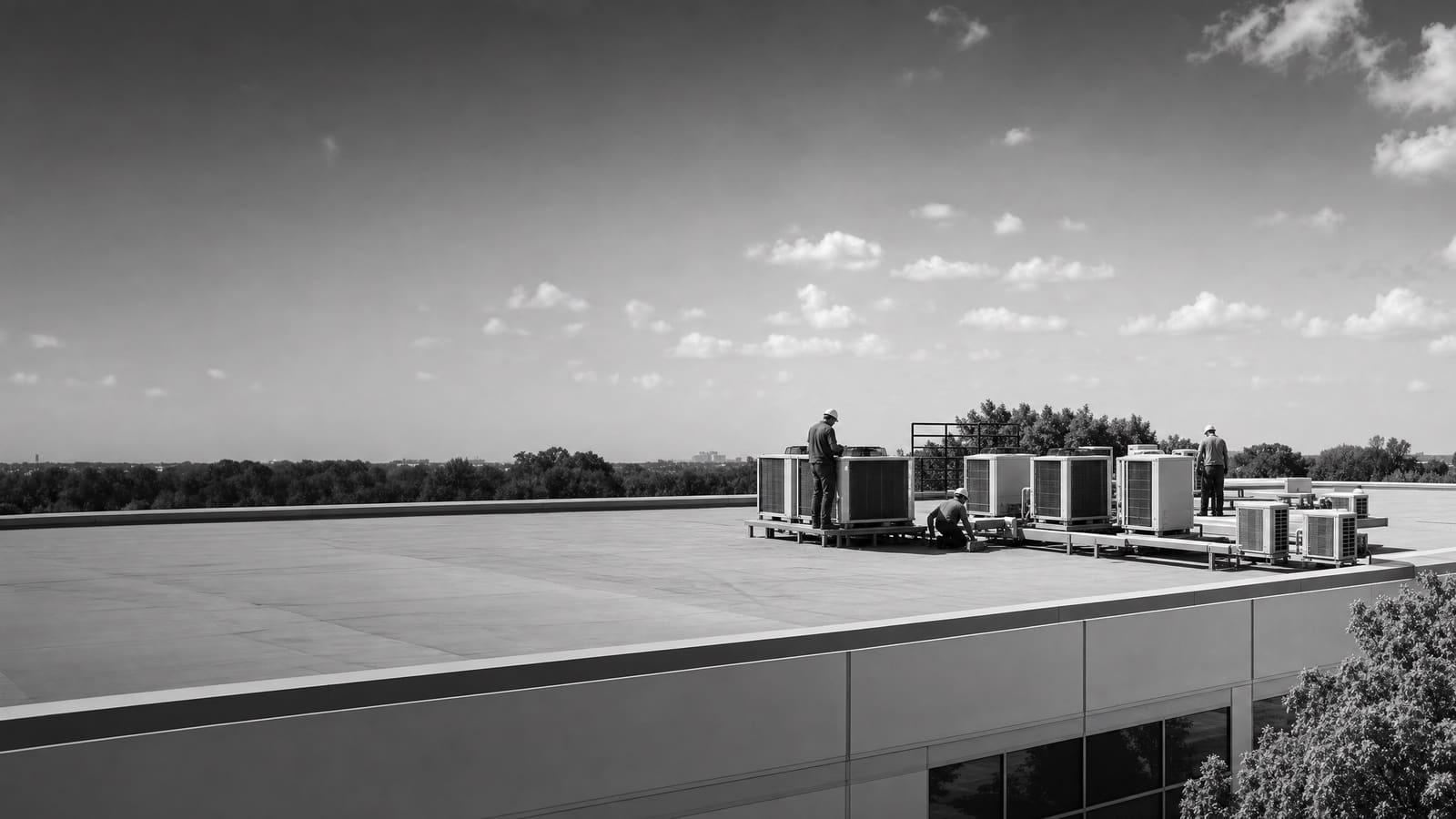
Most commercial buildings run packaged rooftop units — they cool close to half of all U.S. commercial floor area — so most replacement decisions come down to what goes back on the curb. There are three honest answers, and the right one depends on how long you plan to hold the building and what the roof and the panel can already support.
Ask for all three on one quote. The install labor, the crane day, and the curb work are close to identical across them, so the comparison lands on equipment price, efficiency, and what the electrical service has to do. Federal efficiency standards already raised the floor on new units, so even the plain replacement performs better than what came off. The real question is how much further you want to go, and whether the payback lands inside your hold period.
WHAT MOVES THE NUMBER
The lines that decide your installed price
Nobody can quote a rooftop replacement from a phone call, because the same tonnage prices very differently on two roofs a mile apart. These are the lines that move most, roughly in the order they surprise owners.
BUYING GUIDANCE
How to buy the replacement, not just the unit
The cheapest way to buy a rooftop unit is to wait until it dies, and it is also the most expensive way to own one. Replacement on failure hands you whatever equipment is available that week, at whatever price, on whatever schedule the crane can manage. Planned replacement lets you pick the efficiency tier, line up the electrical work, and set the unit on a Saturday instead of a Tuesday afternoon in August.
That is the argument for putting aging units on a calendar. Federal guidance is blunt about it: facility managers usually delay until the unit stops holding the space, needs constant service, or quits entirely, and proactive replacement with a more efficient unit often beats both replacement-on-failure and a like-for-like swap at end of life. The savings are not theoretical, either. More than 43,000 rooftop units upgraded through a federal campaign saved a combined $37 million a year in energy costs.
When you do buy, buy the installed project rather than the box. A quote showing only equipment and labor hides the parts that actually vary: curb work, rigging, electrical, controls, and startup. Ask each bidder to price those lines separately and to state equipment availability next to the price. Two bids with the same tonnage and different totals are almost always different scopes, not different margins.
SIMPLE OR NOT
What makes one roof simple and another complicated
Two buildings can need the same tonnage and land in very different price and schedule brackets. Complexity usually comes from the roof, the panel, and the parking lot rather than from the unit itself. Here is what separates a one-morning set from a phased project.
LOWER COMPLEXITY
One-morning set
Same tonnage and footprint, an existing curb that takes an adapter, straight crane reach from the lot, adequate electrical service already at the unit, and a space whose use has not changed since the original install. Permits stay routine and the building keeps operating.
HIGHER COMPLEXITY
Phased project
Larger tonnage or a heavier unit that triggers structural review, a gas-to-electric switch that pushes service and panel work, tight or shared parking that limits crane placement, occupied tenant space directly below, or a fleet of units that has to come off in stages.
BEFORE THE QUOTE
What a real site review has to settle
A site review is not a formality, and the gap between a good one and a walk-by shows up later as change orders. Federal guidance on rooftop replacement keeps returning to the same short list of things that decide feasibility: electrical capacity, physical constraints on the roof, gas line arrangements, equipment availability, and whether contractors in the area know the equipment being specified. Any one of those can turn a straightforward swap into a redesign.
Start with load. Sizing from the old nameplate copies forward every mistake in the original design, plus twenty years of changes to occupancy, lighting, plug load, and envelope. Then check the structure under the curb, because a heavier or larger unit can trigger framing work that never appears on an equipment-only quote. Then check the panel, especially if an electric option is on the table, since capacity is the most common reason a heat pump plan stalls after the equipment is already picked.
Finally, settle the day itself: crane placement, lot closure, which stalls disappear, whether the set has to happen outside business hours, and who talks to tenants. Those answers belong in the quote, not in a phone call the week of.
Bring these to the walk
Nameplate photos of every unit, the age of each, a roof plan if you have one, your panel schedule, recent utility bills, and your operating hours. Those six items turn a rough estimate into a real number and cut days off the quote.
OWNERSHIP QUESTIONS
Two things to decide before you sign
Equipment choice gets the attention, but two ownership questions usually matter more to what the building costs you over the next fifteen years. The first is fuel. The second is refrigerant, and specifically what you plan to do with the units you are not replacing this year.
Neither has one right answer. Both have a wrong way to answer them, which is to decide unit by unit as each one fails, and end up with a roof full of mismatched equipment that no single service contract covers cleanly.
FUEL
Gas, electric, or both
Heat pump rooftop units cover most or all winter heating demand across the U.S. South, which makes an all-electric replacement realistic for southern buildings. Texas has still seen sharp cold snaps, most notably in February 2021, so backup heat and dual-fuel options deserve a real look rather than a default.
REFRIGERANT
Managing a mixed fleet
Refrigerant in stationary air conditioning and heat pump equipment is regulated under the Clean Air Act, which governs how it is handled and recycled when a unit comes down. New equipment arrives on newer refrigerants, so plan service coverage and spare parts for a roof running two generations at once.
OVER TIME
Phasing a roof full of units
Owners with more than two or three rooftop units rarely replace them all at once, and they should not have to. The useful move is to rank the fleet by age, service history, and how much space each unit serves, then replace on a schedule instead of on failure. Units past fifteen years belong at the top of that list, since that is the point where wasted energy starts to be measurable against a new unit.
Phasing also buys leverage. Two or three units replaced in one mobilization share a crane day, a permit cycle, and one round of electrical work, which costs less per unit than three separate emergencies. It also lets you standardize on one manufacturer and one control platform, which quietly reduces what service costs for the rest of that equipment's life.
Lifetime cost should drive the order. Purchase price is the smallest part of what a rooftop unit costs across its service life; the energy it burns and the service it needs are larger. That is why federal programs push proactive replacement and advanced control retrofits as two options worth pricing side by side. For some units, controls buy several good years. For others, the unit simply needs to come off the roof.
COMPARE APPLES TO APPLES
Five things a comparable quote shows
Bids that look far apart usually differ in scope, not in price. Ask every bidder to put these five items in writing, and the comparison gets simple.
01
Equipment, named
Manufacturer, model, tonnage, efficiency tier, and heating type — not just "new rooftop unit."
02
Availability beside the price
Stated lead time for the specific unit quoted, and what changes if that date slips.
03
Curb, structure, and rigging
Adapter or new curb, any framing work, crane size, lot closure, and the set window.
04
Electrical, gas, and refrigerant
Service or panel work, gas line changes, and certified recovery of the old charge.
05
Commissioning and closeout
Verified airflow, charge, and control settings, plus permits, inspections, and warranty documents.
Get a defensible number
Price the equipment and the building together.
Send the address, operating target, and target opening date. Flux will identify what must be verified before the project can be priced.
Get a free estimateQuestions
Straight answers.
When is replacement better than another repair?
Once a unit is past about fifteen years, repairs stop competing well. Older rooftop units waste substantial energy against current models, and federal figures put the annual waste of one old, inefficient unit at roughly $900 to $3,700. Add a second in-season failure and the decision usually makes itself.
Should the new unit match the old one's tonnage?
Only if the space and its use have not changed. The old nameplate reflects the load at the time of install, not today's occupancy, plug load, or envelope. Confirm the load first. If it still matches, like-for-like is the fastest and simplest path.
Is a heat pump rooftop unit a realistic replacement?
For most buildings in the U.S. South, yes. Today's heat pump rooftop units handle most or all winter heating demand there. The decision turns on electrical capacity, roof constraints, and what happens to the gas line. Texas cold snaps like February 2021 are why backup or dual-fuel heat is worth pricing rather than assuming.
What happens to the refrigerant in the old unit?
It has to be recovered properly. Refrigerant in stationary refrigeration, air conditioning, and heat pump equipment is regulated under Section 608 of the Clean Air Act, which covers handling and recycling. That work should appear on the quote as scoped, not assumed.
Can controls extend the life of an existing unit instead?
Sometimes. Federal guidance treats advanced control retrofits and full replacement as competing options, and the better one depends on the unit's age and condition. Price both for units that are aging but still running well, and price replacement for units at the end of useful life.
How disruptive is the crane day?
For a straightforward swap, the visible part is one morning. Stalls get coned off, the old unit comes up, and the new one lands on the curb. Everything that keeps it short — rigging plan, curb adapter, confirmed connections, a weather call — happens weeks earlier.
Sources used for this guide
- [1]betterbuildingssolutioncenter.energy.gov — DOE Advanced Rooftop Unit Replacement Guidance
- [2]betterbuildingssolutioncenter.energy.gov — DOE Commercial Heat Pump Rooftop Unit Replacement Guidance
- [3]betterbuildingssolutioncenter.energy.gov — DOE High-Efficiency Commercial Rooftop Unit Toolkit
- [4]energy.gov — DOE Efficient Commercial Rooftop Air Conditioner Program
- [5]epa.gov — EPA Stationary HVAC Refrigerant Management