THE DIRECT ANSWER
What a commercial HVAC replacement actually includes
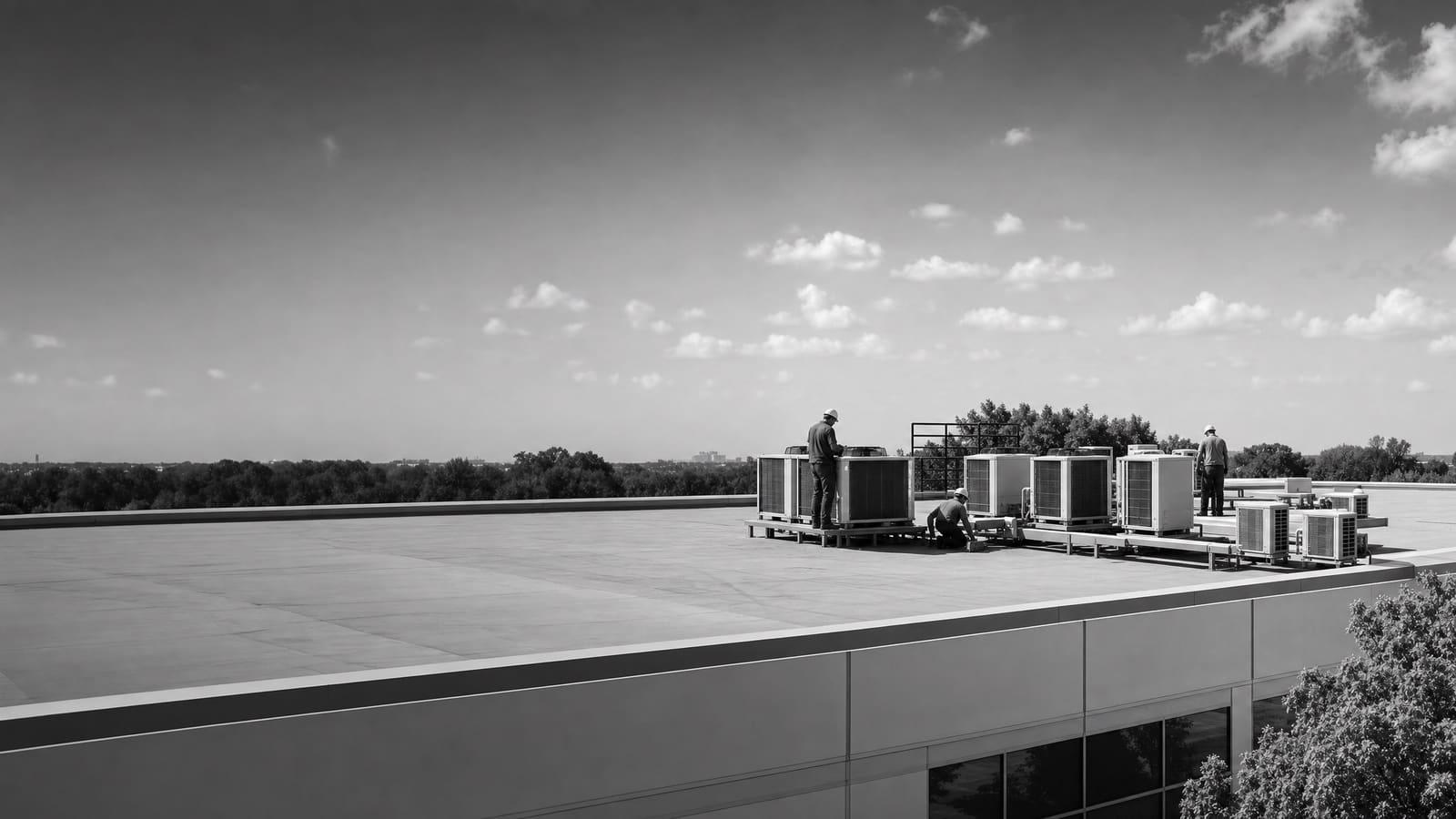
A commercial HVAC replacement covers load verification, equipment selection, rigging and set, gas or electrical connections, curb and duct transitions, controls integration, permits, and commissioning. Replacement usually beats one more repair once a unit passes about 15 years, when service calls start repeating, or when it no longer holds the space. Old, inefficient rooftop units waste $900 to $3,700 a year each in energy alone — often more than the repair invoice you keep approving.
A site review has to confirm the real load, curb size and roof framing, available electrical capacity and gas service, crane reach across the lot, and whether replacement triggers ventilation work the old unit never had.
THE THREE CHOICES
Three ways to handle a unit at end of life
Most buyers are really choosing between three paths, and the right one depends on how much runway the building needs — not on which quote is cheapest today.
Waiting for failure is the most common approach and the most expensive one. Facility teams routinely delay until a unit stops conditioning the space, needs constant attention, or dies outright. Replacing proactively beats replacement-on-failure, and it often beats a like-for-like swap made in a panic at the end of service life, because panic costs you the ability to shop equipment, schedule the crane, and take the efficiency step up.
The second path is a straight replacement in kind. Same fuel, same tonnage, same curb where it fits. It is fast and predictable, and it is the right answer when the space and its use have not changed.
The third path is a system change: moving a gas-heat unit to a heat pump or a dual-fuel unit. That decision turns on winter heating hours, electric and gas rates, available electrical capacity, and whether an incentive is on the table. It is a real option in 2026, but it needs a scoping conversation before it goes on a quote.
WHAT MOVES THE NUMBER
The budget lines that actually swing
Ask for the quote broken into these lines. Two buildings with the same tonnage can land far apart, and the gap is almost always below the equipment line, not in the unit itself. Tag each one by how likely it is to move once somebody is actually standing on the roof.
IN PRACTICE
How to buy the equipment, not just the install
Start with the load, not the nameplate. A unit installed twenty years ago was sized for the occupancy, plug load, and envelope of that building at that time. If the tenant changed, if lighting was retrofitted, if a wall moved or a server closet appeared, the correct tonnage moved with it. Copying the old nameplate is how a building inherits a comfort problem for another two decades, and oversizing costs as much as undersizing — it short-cycles, dehumidifies poorly, and wears itself out early.
Then decide how far above the code minimum to buy. The high-efficiency rooftop specification manufacturers build to was written to cut energy use by up to half against the older baseline, and the federal minimum standard itself has been raised since. That gap shows up on every bill for the life of the unit, so the efficiency tier deserves a real conversation instead of a default to the cheapest listed option.
Finally, pin the schedule to equipment availability. A unit you cannot get for ten weeks is not a cheaper unit — it is ten more weeks of the old one running, and ten more weeks of exposure to a failure. Ask for two or three viable options with real lead times attached, and let the calendar help make the pick.
COMPLEXITY CHECK
What makes a replacement simple or hard
Before you compare numbers, figure out which project you actually have. The same tonnage can be a one-morning swap or a phased install with an electrical upgrade in front of it, and the two do not belong on the same budget line. Most of that difference is decided by the roof and the lot, not by the equipment.
LOWER COMPLEXITY
Same footprint, same fuel
The new unit lands on the existing curb or a simple adapter, tonnage is unchanged, the fuel source is unchanged, and the crane has clear reach from a spot you can legally close. Permitting is typically mechanical and electrical, and the building sees traffic cones for a morning.
HIGHER COMPLEXITY
New tonnage, new fuel, or hard access
Growth in tonnage or footprint pulls in structural review. An all-electric conversion pulls in panel and service capacity. Tight sites with no crane reach, occupied space directly below, or units that cannot come down at all push the work into nights, phases, or temporary cooling.
BEFORE THE QUOTE
What a proper site review checks
A quote written from a nameplate photo is an estimate. A quote written from a roof visit is a price. The difference is a short list of things only somebody standing on the roof can settle.
The physical checks come first: curb dimensions and condition, roof framing under the unit, clearances, and whether the crane can reach the spot from somewhere you are allowed to close. Then the services: electrical capacity at the panel and the service, gas line size and routing if heat stays gas, condensate, and where control wiring lands. Infrastructure is the single most common reason a heat pump conversion that looked good on paper becomes a two-phase project — electrical capacity and physical constraints have to be verified before equipment is ordered, not after it arrives. The visit should also settle how the building operates during the work: which hours are usable, whether tenants below need notice, and whether any critical space needs temporary cooling.
The last check is regulatory and easy to skip. Refrigerant in stationary commercial equipment is federally regulated for handling, recovery, and recycling, so the old charge has to be recovered by a certified technician and documented. If a quote does not mention recovery, ask where that line went.
Ask for this before you sign
A comparable quote names the exact model and efficiency tier, the lead time, the curb or adapter approach, who pulls which permit, the crane and lot plan, refrigerant recovery, and the commissioning steps. When two bids differ sharply, the gap is usually in what one of them left off this list.
OWNERSHIP MATH
Two things to settle before you sign
Two questions decide whether this replacement still feels like a win in year three, and neither one is about the equipment.
The first is who pays and who benefits. In a leased building, the party writing the check for the unit is often not the party paying the utility bill, and that split quietly decides whether anyone is willing to fund the efficiency tier. Settle it before the bid goes out, not after the invoices start arriving.
The second is what the new unit does to your service program. It changes your parts strategy, your refrigerant handling, and which technicians can work on it. Newer equipment ships on newer low-GWP refrigerants, so a roof carrying a mix of old and new units needs a contract that covers both. Contractor familiarity with the equipment type is a genuine selection factor, especially on heat pump and dual-fuel installs — the install is only as good as the crew that commissions it and the crew that maintains it afterward.
WHO BENEFITS
Lease structure decides the tier
If the tenant pays utilities and the owner buys the equipment, the efficiency upgrade has no natural sponsor. A pass-through, a cost share, or a rent adjustment usually has to be negotiated before the specification is locked.
AFTER HANDOFF
The service plan changes too
Plan maintenance alongside the purchase. A mixed fleet needs refrigerant handling, parts stocking, and technician coverage for two generations of equipment at once, and that shows up in the contract you sign next year.
OVER TIME
Phasing a roof full of units
If you own more than one unit, stop thinking about this replacement and start thinking about the sequence. Rooftop equipment conditions close to half of all commercial floor space in the country, and most buildings carry several units of different ages. Replacing them one emergency at a time means you never negotiate, never schedule, and never get a volume price.
A phased plan is simple. Rank the units by age, service history, and how critical the space below is. Replace the worst one on your schedule. Put the next two in next year's capital plan with an efficiency target already chosen. Keep the rest on maintenance and watch them. When a watched unit fails early, you already know what replaces it and roughly what it costs, because the decision was made months ago.
Phasing also lets you handle the harder conversions deliberately. If an electrical upgrade is needed to support all-electric equipment, doing that work once and sizing it for the whole roof is far cheaper than paying for a partial service upgrade three separate times. Check whether utility or federal incentives apply to each phase as you reach it, since program terms change and what is available this year may not be there for the next one. Judge each phase on lifetime cost: the purchase is a single event, and the energy bill arrives every month for the rest of the unit's service life.
THE CHECKLIST
Five things every comparable quote shows
Bids only compare if they cover the same scope. Ask each contractor to show these five items in the same order, then read the differences rather than the totals. A lower number usually means something on this list is missing.
01
Model, tonnage, and efficiency tier
The exact unit and where it sits against the minimum standard, so you can price the operating difference and not just the purchase.
02
Lead time and a backup option
A firm availability date, plus a second unit you would accept if the first one slips.
03
Curb, structural, and duct work
Adapter or new curb, any framing review, and every duct or plenum transition the new footprint requires.
04
Rigging, permits, and lot plan
Who supplies the crane, which stalls close and for how long, which permits get pulled, and who meets the inspector.
05
Commissioning and closeout
Startup, charge, airflow, and controls verified against spec, refrigerant recovery documented, and warranty paperwork handed over.
Get a defensible number
Price the equipment and the building together.
Send the address, operating target, and target opening date. Flux will identify what must be verified before the project can be priced.
Get a free estimateQuestions
Straight answers.
When does replacement beat one more repair?
Once a unit passes about fifteen years, repairs stop buying much runway. Old, inefficient rooftop units can waste $900 to $3,700 a year each in energy, so the quiet cost of waiting often exceeds the repair you keep approving. Replacing on your own schedule also beats replacing on failure, because you keep the ability to shop equipment and pick the crane day.
Should we switch from gas heat to a heat pump?
It depends on your heating hours, your electric and gas rates, and your electrical capacity. Heat pumps are most efficient in mild to moderate winter conditions and lose efficiency as outdoor temperatures drop, trending toward electric resistance in deep cold. Dual-fuel and cold-climate models exist for exactly that reason. Confirm panel and service capacity before ordering anything.
How long does the installation take?
The visible part of a straight rooftop swap is usually a morning: cone the stalls, lift the old unit off, set the new one, connect, and commission. The schedule risk sits upstream. Equipment lead time, permits, and any structural or electrical work decide the real date, which is why availability belongs on the quote right next to the price.
Do we have to size the new unit like the old one?
No, and often you should not. Confirm the load against how the space is used today. If occupancy, plug load, lighting, or the envelope changed since the last install, copying the old nameplate carries an old mistake forward for another twenty years.
What happens to the refrigerant in the old unit?
It has to be recovered and handled by a certified technician under federal rules covering stationary refrigeration, air conditioning, and heat pump equipment. That work should be visible on the quote. New equipment ships on newer low-GWP refrigerants, so plan service coverage and spare parts for a roof running two generations at once.
Sources used for this guide
- [1]betterbuildingssolutioncenter.energy.gov — DOE Advanced Rooftop Unit Replacement Guidance
- [2]betterbuildingssolutioncenter.energy.gov — DOE Commercial Heat Pump Rooftop Unit Replacement Guidance
- [3]betterbuildingssolutioncenter.energy.gov — DOE High-Efficiency Commercial Rooftop Unit Toolkit
- [4]energy.gov — DOE Efficient Commercial Rooftop Air Conditioner Program
- [5]epa.gov — EPA Stationary HVAC Refrigerant Management