THE DIRECT ANSWER
Commercial HVAC replacement and installation in Pasco.
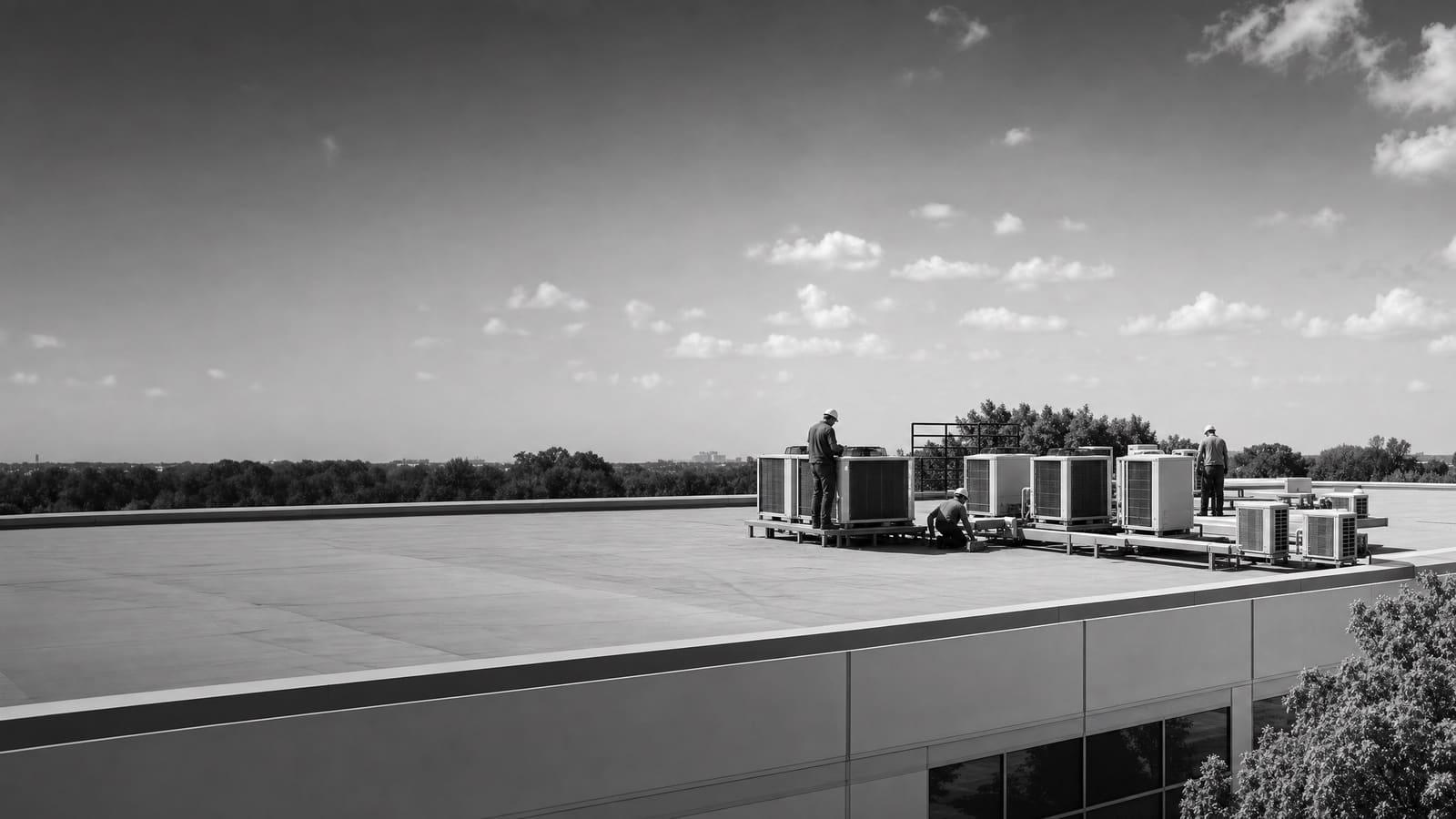
A commercial HVAC replacement includes sizing, equipment selection, removal, rigging, connections, controls, startup, and performance checks. Replacement becomes more useful than another repair when an older unit needs frequent service, no longer conditions the space well, or creates a growing failure risk. DOE guidance notes that rooftop units over 15 years old may waste substantial energy compared with newer equipment.
A site review must verify the building load, existing curb, roof access, electrical capacity, fuel connections, controls, ventilation needs, and available equipment.
THREE OPERATING CHOICES
Choose the replacement path before choosing a model
Start with the business problem, not the equipment catalog. A failed unit may require a fast replacement, while a working but unreliable unit gives you time to compare efficiency, controls, and heating options. The old nameplate is useful, but it does not prove that the old unit was sized correctly. Occupancy, internal equipment, operating hours, ventilation, and space use may have changed.
A planned project also makes room for a heat pump review. Commercial heat pump rooftop units can provide cooling and reverse-cycle heating. The right choice depends on heating demand, electricity and gas costs, electrical capacity, physical constraints, equipment availability, and operating goals. If the existing system uses gas, review commercial heat pump conversion before assuming a like-for-like replacement is the best fit.
Whichever path you choose, compare complete installed scopes. A low equipment price means little if controls, curb work, rigging, electrical changes, startup, or disposal appear later as extras.
BUDGET BUILDING BLOCKS
What changes the installed price
The supplied research does not support one universal installed price. Ask for these cost areas separately so equipment bids can be compared on the same basis.
EQUIPMENT FIT
Compare systems by how the building operates
Packaged rooftop units combine major heating, cooling, and air-moving components in one cabinet. They are common across commercial buildings and condition nearly half of U.S. commercial floor area. They can simplify replacement when the existing roof location, duct layout, and service access still work. That does not make every packaged unit interchangeable. Capacity, heating source, supply fan, ventilation features, controls, physical dimensions, and connection points all matter.
A conventional air-conditioning rooftop unit may pair cooling with gas or another heating source. A heat pump rooftop unit adds reverse-cycle heating. All-electric, dual-fuel, and cold-climate configurations solve different problems. DOE guidance says the review should include climate, utility-bill impact, emissions goals, building type, equipment availability, electrical capacity, physical constraints, gas lines, and contractor knowledge. Treat that as a screening list, not a promise that one technology always wins.
High-efficiency equipment can also include better compressors, fans, and controls. Older DOE demonstrations found meaningful energy reductions from advanced rooftop systems, but an owner should not apply a national demonstration result directly to one building. Request a site-specific operating comparison based on the proposed unit, expected schedule, heating and cooling demand, and local utility rates supplied for the analysis.
PROJECT COMPLEXITY
A box swap and a system change are different projects
The visible lift may be brief, but project complexity is set by everything that must match below and around the unit. Define those conditions before comparing totals.
LOWER COMPLEXITY
Compatible replacement
The capacity remains appropriate, the curb can be adapted, utilities are adequate, ducts stay in place, controls are simple, and roof access supports a direct replacement plan.
HIGHER COMPLEXITY
Changed system
Resizing, fuel changes, added electrical load, new ventilation needs, structural work, automation integration, tight access, or phased occupancy require more design and coordination.
SITE REVIEW
Measure the conditions that can break the budget
A strong site review starts at the occupied space. Record hot and cold complaints, operating hours, use changes, equipment loads, ventilation concerns, and areas that cannot lose conditioning. Then trace the system from thermostats and controls to ducts, utilities, roof openings, drainage, and service clearances. Photograph nameplates and connections, but do not use the old unit’s capacity as the only sizing method.
At the roof, verify cabinet dimensions, curb condition, duct orientation, connection locations, equipment weight, access path, and lifting limits. Confirm whether an adapter or transition is needed. Below the roof, inspect the electrical service, disconnects, fuel piping, control wiring, and building automation interface. A heat pump option requires special attention to available electrical capacity and the proposed heating sequence.
The review should also identify how the old refrigerant will be recovered and documented. EPA Section 608 rules address refrigerant handling and recycling for stationary air-conditioning and heat pump equipment. Put recovery, disposal, and related records in the contractor’s scope rather than leaving them as an assumption.
Ask for an assumptions log
The proposal should list what was verified, what remains unknown, and which concealed conditions could change the price. That makes exclusions easier to judge before work starts.
OWNER PRIORITIES
Balance failure risk against lifetime operation
Waiting for complete failure may preserve capital today, but it can shrink your equipment choices and force work into a difficult operating period. Planned replacement gives the owner time to confirm loads, compare systems, coordinate access, and decide whether controls or fuel changes belong in the project. DOE guidance specifically identifies frequent maintenance, inadequate conditioning, and complete failure as common triggers for replacement.
Do not judge lifetime value from efficiency labels alone. Include expected operating hours, maintenance access, filter and belt service, controls support, parts strategy, heating source, and how the equipment fits the rest of the facility. A more efficient unit that is poorly sized or poorly commissioned can still disappoint. A modest selection with clear controls, good access, and verified airflow may be easier to own.
REACTIVE
Replacement after failure
Restores service under pressure, but available equipment and temporary comfort needs may control the decision.
PLANNED
Replacement before failure
Creates time for load review, option pricing, access planning, phasing, and commissioning requirements.
DELIVERY PLAN
Control disruption through phasing and procurement
Set the project schedule backward from the period when the building can best tolerate an outage. Equipment availability is only one part of procurement. The contractor may also need approved submittals, curb information, controls parts, electrical components, rigging arrangements, and access coordination. Do not schedule removal until the replacement, adapter, critical accessories, and installation resources are confirmed.
For occupied buildings, divide responsibility for notices, work zones, parking controls, roof access, indoor protection, and after-hours work. Identify spaces that need temporary conditioning and processes that cannot stop. If several units are being replaced, phasing can preserve service and let the team apply lessons from the first installation to later units. It may also support a portfolio approach in which the poorest-performing or highest-risk units move first.
Closeout should be a planned deliverable, not a folder assembled afterward. Require startup reports, approved submittals, operating instructions, warranty information, control sequences, setpoints, service contacts, and equipment records. Train the facility team on filters, alarms, schedules, heating changeover, and shutdown procedures. Keep the final equipment data with the maintenance history so the next service call starts with reliable information.
QUOTE CHECKLIST
Five things every comparable quote should show
Give each bidder the same requirements, then compare scope as well as price. These five items expose most gaps before they become change orders.
01
Exact equipment
List model, capacity, heating type, efficiency features, accessories, controls, warranty, and stated availability.
02
Complete field scope
Show removal, rigging, curb work, ducts, drainage, utilities, wiring, roof protection, and disposal.
03
Known assumptions
Identify verified conditions, exclusions, allowances, owner duties, and circumstances that can change price.
04
Startup and proof
Require airflow checks, control testing, safety verification, operating records, and documented handoff.
05
Schedule and responsibility
State procurement milestones, outage needs, phasing, access coordination, cleanup, training, and closeout ownership.
Get a defensible number
Price the equipment and the building together.
Send the address, operating target, and target opening date. Flux will identify what must be verified before the project can be priced.
Get a free estimateQuestions
Straight answers.
When should a commercial rooftop unit be replaced instead of repaired?
Consider replacement when the unit needs frequent service, cannot maintain the space, presents a serious failure risk, or no longer fits the building’s use. DOE guidance notes that rooftop units over 15 years old can waste substantial energy compared with newer models. Age alone is not the decision; review condition, repair history, performance, parts, and operating impact together.
Should the new HVAC unit match the old unit’s capacity?
Not automatically. The old nameplate is a starting point, not a load calculation. Confirm current occupancy, schedules, internal equipment, ventilation, envelope conditions, and comfort problems. A like-for-like capacity may be reasonable when the space and its use are unchanged, but it can also repeat an old sizing error.
Is a commercial heat pump rooftop unit worth considering?
Yes, as an option to evaluate rather than a default answer. Compare heating demand, electricity and fuel costs, electrical capacity, physical constraints, equipment availability, controls, emissions goals, and maintenance capability. Review all-electric, dual-fuel, and other suitable configurations against the same operating assumptions.
What should commissioning include after installation?
Commissioning should confirm that the installed system does more than turn on. The contractor should verify airflow, heating and cooling operation, controls, schedules, sensors, safeties, drainage, ventilation functions, and communication with any building automation system. The owner should receive startup records, settings, instructions, and warranty information.
How should refrigerant removal be handled during replacement?
Put refrigerant recovery, handling, documentation, and equipment disposal in the written scope. EPA Section 608 rules govern refrigerant practices for stationary air-conditioning and heat pump equipment. The proposal should identify who performs this work and what records will be delivered.
Why can two commercial HVAC installation quotes differ so much?
The proposals may not include the same work. One may include rigging, adapters, electrical changes, controls, roof protection, startup, and disposal while another excludes them. Compare exact equipment, assumptions, allowances, exclusions, schedule, commissioning, warranty, and closeout documents line by line.
How can a facility reduce disruption during HVAC replacement?
Plan the outage before ordering. Confirm equipment and critical accessories, define work zones, coordinate roof and parking access, notify occupants, and identify spaces that need temporary conditioning. For several units, phase the work so part of the building remains served and lessons from the first installation improve later replacements.
Sources used for this guide
- [1]betterbuildingssolutioncenter.energy.gov — DOE Advanced Rooftop Unit Replacement Guidance
- [2]betterbuildingssolutioncenter.energy.gov — DOE Commercial Heat Pump Rooftop Unit Replacement Guidance
- [3]betterbuildingssolutioncenter.energy.gov — DOE High-Efficiency Commercial Rooftop Unit Toolkit
- [4]energy.gov — DOE Efficient Commercial Rooftop Air Conditioner Program
- [5]epa.gov — EPA Stationary HVAC Refrigerant Management