THE SHORT ANSWER
What a commercial HVAC replacement actually covers
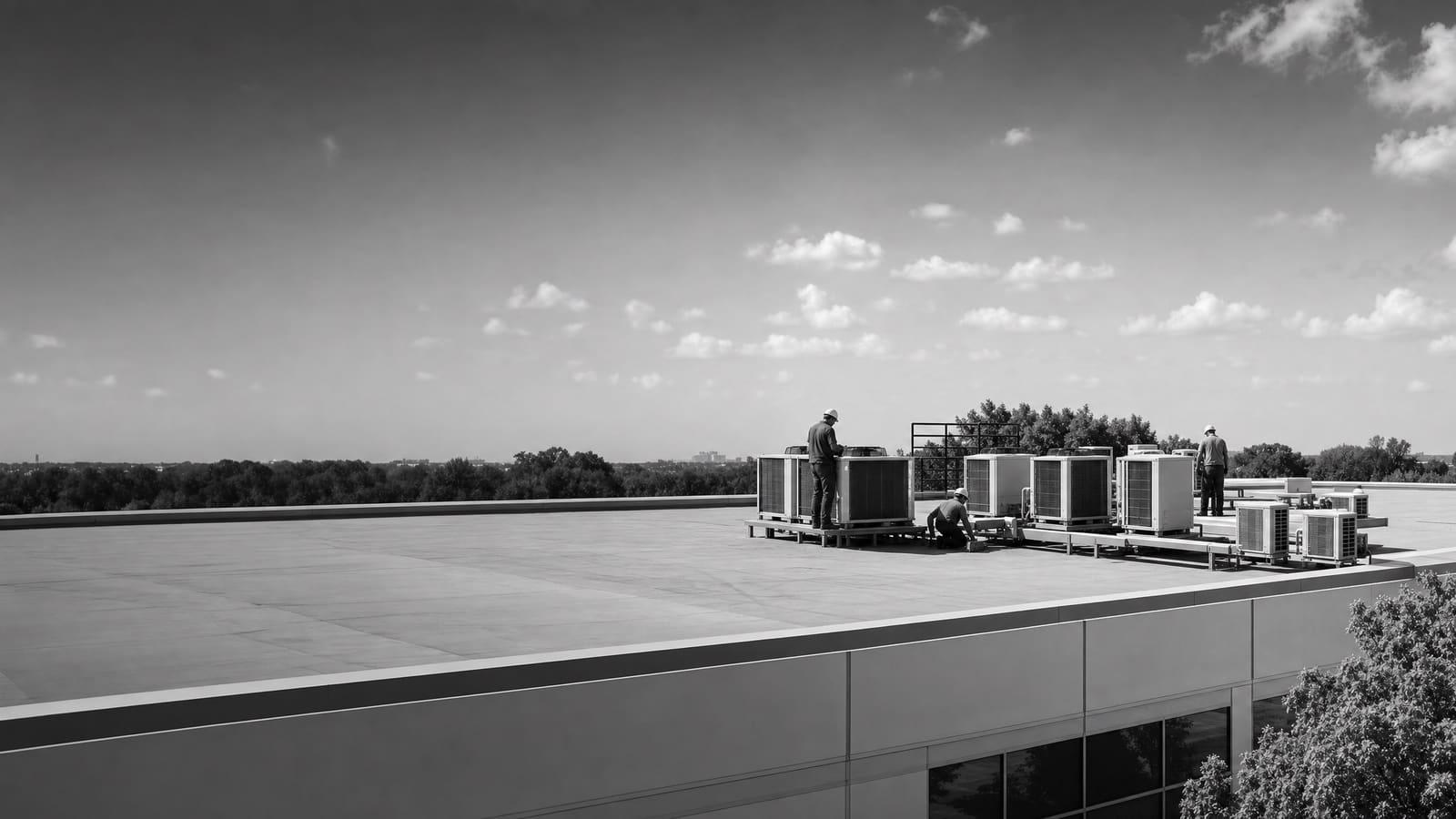
A commercial HVAC replacement covers the load calculation, the equipment order, rigging and set, the curb, gas and electrical connections, controls, permits, and commissioning. Replacement usually beats one more repair once the unit is past about fifteen years and service calls have become routine. Federal research puts the annual waste from an old, inefficient rooftop unit at $900 to $3,700 per unit, which often exceeds what another compressor repair buys you.
A site review still has to confirm the real load, the curb and roof structure, available electrical capacity, and crane access before any number on a quote means anything.
THE REAL DECISION
Three ways to replace a rooftop unit
Most commercial replacements come down to three options, and the difference between them is not really the box. It is what the building can feed, and what you want the next fifteen years to cost.
A like-for-like swap reuses the existing curb, fuel, and connections. It is the shortest path back to conditioned air, and it carries forward whatever sizing decision the last owner made.
A high-efficiency unit costs more up front. The federal performance specification behind these models targets up to 50% less energy than the standard it was written against, and manufacturers now offer a deep list of units that meet or exceed it, so the premium buys measured savings rather than a marketing claim.
A heat pump rooftop unit adds reverse-cycle heating and drops the gas connection. Federal guidance says heat pump units suit most of the South and West, where they handle most or all of winter heating demand. In Pasadena the climate is rarely the obstacle. The panel is.
WHAT MOVES THE NUMBER
The lines that actually differ between bids
These are the items that separate two quotes for the same roof. When one bid comes in far below the others, one of these is usually missing rather than discounted.
BUYING GUIDANCE
Pick the unit before you argue about the price
Start with the load, not the nameplate. The old unit was sized for a building that may have had different occupancy, different lighting, different plug loads, and a different envelope. Carrying the old tonnage forward is a decision, and it should be a deliberate one rather than a default.
Then settle the fuel question at the top. Rooftop units condition close to half of all commercial floor area in the country, so the equipment market is deep on both sides. Federal guidance frames the heat pump decision around a short list: climate, electrical capacity, physical constraints on the roof, what happens to the gas line, equipment availability, incentives, and whether local contractors work on the technology regularly. Answer those and the choice usually makes itself.
Efficiency tier is the last piece, and it is the one buyers most often defer. An old, inefficient rooftop unit wastes between $900 and $3,700 a year, which means the tier you skip today shows up on twelve bills a year for as long as the unit runs. Ask for the efficiency premium priced as its own line so you can weigh it on its merits instead of burying it in a lump sum.
SCOPE CHECK
Simple swaps and the ones that grow
Not every replacement carries the same risk. The difference usually shows up in whether the job stays on the roof or reaches into the panel, the structure, or the building's controls.
LOWER COMPLEXITY
Straight curb-to-curb swap
Same tonnage, same fuel, the existing curb fits, clear crane reach from the lot, and no controls beyond a thermostat. These jobs are mostly a scheduling exercise: order the unit, book the crane, pull the mechanical permit, set and commission.
HIGHER COMPLEXITY
Anything that changes the roof or the panel
Larger footprint, heavier unit, structural review, an all-electric conversion that needs feeder or panel work, tight access for the lift, or integration into an existing automation system. Each one adds a trade, a review, and calendar time before the crane can be booked.
SITE REVIEW
What a real walk has to confirm
A quote written from a photo is a guess with a number attached. The site review is where the guess turns into a price someone can be held to.
On the roof, the reviewer checks existing curb dimensions against the replacement, the condition of the deck and membrane around the unit, and whether the proposed equipment weighs more than what is up there now. Physical constraints matter as much as tonnage: clearance for airflow, service access, and whether the unit can be flown into position at all.
Below the roof, the questions turn electrical and mechanical. Is there panel capacity and feeder size for the unit being proposed, especially if it is all-electric? Where does the gas line terminate, and who caps it if it is being abandoned? How does the new unit talk to the controls that already run the building?
Outside, the review covers the crane. Reach, setup footprint, which stalls close and for how long, and whether the lift happens before tenants arrive. That answer belongs in writing, because it is the part your tenants will actually notice.
Get these four in writing
Before you sign, have the curb dimension, the electrical capacity finding, the crane setup location, and the lot closure window written into the proposal. Those four are where change orders come from, and all four are knowable on a one-hour walk.
LOCAL CONTEXT
What Pasadena changes about the job
Two local realities shape the decision here.
The first is permitting. California building departments treat mechanical, electrical, and plumbing work as permitted work, including upgrades and repairs, and re-roofing is permitted as well. A rooftop replacement normally touches at least two of those categories, and an all-electric conversion adds the third. Confirm the permit scope with the local building department before the equipment is ordered, not after it lands.
The second is climate. Federal guidance is direct that heat pump rooftop units are well suited to most of the West, where mild winters let them carry most or all of the heating demand. That removes the usual objection to going electric in Pasadena and moves the real question to the electrical service.
There is a sequencing point buried in the first item. If the roof membrane is near the end of its life, pair the re-roof with the unit replacement rather than treating them as separate projects.
Sequence the roof with the unit
If the membrane under the curb is aging, replacing the unit first means cutting around new equipment later. Ask the roofer and the mechanical contractor for a combined schedule before either scope goes to permit, since both are permitted work and both want the same access.
OWNERSHIP
Two questions that outrank the equipment
Two questions decide more about a replacement than the model number does: who pays for it, and whether you are buying on your schedule or the unit's.
Neither is technical, which is why both get skipped when a unit is already down. They are worth ten minutes before the first site visit, because the answers change what you ask contractors to quote. A landlord funding a capital replacement that a tenant will pay the bills on has a different efficiency calculation than an owner-occupier. And a building that plans replacements a year out gets to shop equipment, apply for incentives, and pick its own shutdown window, while a building that waits for failure takes whatever is available.
LEASE STRUCTURE
Who funds it, who benefits
In many net-lease arrangements the owner buys the equipment while the tenant pays the utility bill. Settle that split before you price the efficiency tier, or the upgrade gets cut for the wrong reason.
TIMING
Planned beats replace-on-failure
Federal guidance is blunt here: proactively replacing an inefficient unit is usually the smarter business move than waiting for failure, and often beats a like-for-like swap at end of life. Emergency replacement removes every choice worth having.
PLANNING AHEAD
Phasing, procurement, and lifetime cost
If your roof carries more than one unit, treat them as a fleet instead of a series of emergencies. Rank them by age, service history, and how critical the space below each one is. Anything past fifteen years belongs on a replacement list with a date beside it, even if it is running fine today.
Standardizing helps more than most owners expect. Choosing one manufacturer and a narrow band of tonnages across a roof means one set of filters, one controls language, and technicians who already know the equipment. Federal guidance lists contractor familiarity with the technology as a genuine selection factor, and that matters most when you are moving to heat pumps.
Procurement order matters too. Incentive programs generally want the application filed before equipment is purchased, so confirm what is available and what the paperwork requires before a purchase order goes out. Ask about equipment availability in the same conversation, because a unit that is months out reshapes your phasing plan far more than a small price difference does.
Finally, plan for refrigerant. Federal rules govern how refrigerant is recovered and handled when equipment is serviced or removed, so recovery on the old unit is a documented step, not a courtesy. New equipment ships on newer refrigerants, which is worth knowing when you are maintaining a mixed-age fleet.
COMPARE FAIRLY
Five things every quote should show
Two bids are only comparable when both show the same things. Ask each contractor for these five, in this form, and the gap between proposals stops being a mystery.
01
The load basis
The calculation or assumption behind the tonnage, stated plainly, including whether it reflects how the space is used today or the old nameplate.
02
Equipment and availability
Make, model, tonnage, efficiency tier, refrigerant, and a real ship date. Availability belongs next to the price, not in a follow-up email.
03
Everything between unit and building
Curb adapter, structural work, electrical capacity changes, gas line disposition, and controls integration, each priced as its own line.
04
Permits and who pulls them
Which permits the scope triggers, who files, and whether inspection coordination is included in the installed price.
05
Commissioning and closeout
Startup readings, charge and airflow verification, controls setup, refrigerant recovery records for the removed unit, and warranty registration.
Get a defensible number
Price the equipment and the building together.
Send the address, operating target, and target opening date. Flux will identify what must be verified before the project can be priced.
Get a free estimateQuestions
Straight answers.
When does replacement beat one more repair?
Once a unit is past about fifteen years, repairs stop being events and start being a schedule. Federal research pegs the waste from an old, inefficient rooftop unit at $900 to $3,700 per year, so the arithmetic often favors replacement well before the unit finally quits.
Is a heat pump rooftop unit a good fit in Pasadena?
Climate is not the obstacle here. Federal guidance says heat pump rooftop units suit most of the West, where mild winters let them cover most or all of the heating demand. The real gate is electrical: panel capacity and feeder size have to support an all-electric unit.
Do I need a permit to replace a commercial rooftop unit?
Plan on it. California building departments treat mechanical, electrical, and plumbing work as permitted work, including upgrades and repairs. Confirm the exact scope with the local building department before ordering equipment, and have the installing contractor pull the permits as part of the installed price.
Should I replace like-for-like or resize?
Confirm the load either way. If occupancy, equipment, and the envelope have not changed, like-for-like is often correct and it is the fastest path back. If the space is used differently than when the old unit was specified, resizing fixes comfort problems the old unit could never solve.
What happens to the refrigerant in the old unit?
Federal rules govern how refrigerant is handled and recycled when stationary air-conditioning equipment is serviced or removed, so recovery is a required, documented step on the unit coming off. Ask for that documentation at closeout, alongside startup readings and warranty registration.
Sources used for this guide
- [1]betterbuildingssolutioncenter.energy.gov — DOE Advanced Rooftop Unit Replacement Guidance
- [2]betterbuildingssolutioncenter.energy.gov — DOE Commercial Heat Pump Rooftop Unit Replacement Guidance
- [3]betterbuildingssolutioncenter.energy.gov — DOE High-Efficiency Commercial Rooftop Unit Toolkit
- [4]energy.gov — DOE Efficient Commercial Rooftop Air Conditioner Program
- [5]epa.gov — EPA Stationary HVAC Refrigerant Management
- [6]californiacity-ca.gov — HVAC Permits