THE SHORT VERSION
What a commercial HVAC replacement includes
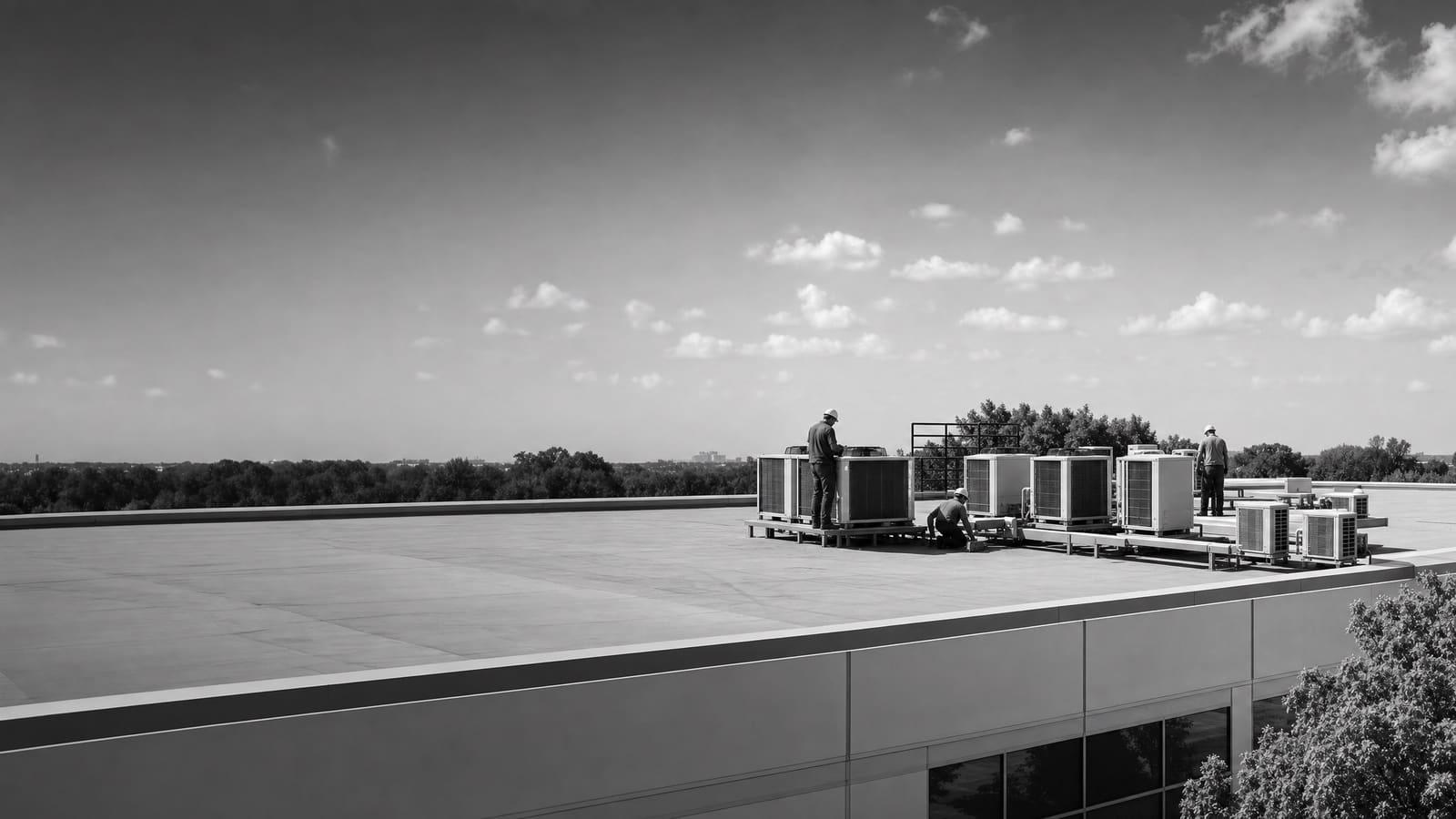
A commercial HVAC replacement covers the load check, equipment selection, rigging and set, connections, permits, and commissioning — not just the unit itself. Replacement beats one more repair when the unit is past about fifteen years, needs frequent service, or no longer holds the space. Federal guidance is blunt about waiting: an old, inefficient rooftop unit can waste roughly $900 to $3,700 a year in energy, per unit, before the next breakdown ever happens.
A site review still has to confirm tonnage against how the space is used today, plus curb fit, roof structure, electrical capacity, and crane access. Those five items decide whether the price holds.
THE THREE PATHS
Three ways to replace a rooftop unit
Most commercial replacements land in one of three lanes, and the lane gets chosen before anyone prices equipment.
The first is like-for-like: same tonnage, same fuel, same curb. It is the fastest path back to cooling and the cheapest to engineer, but it carries forward whatever sizing mistake the old unit had.
The second is a high-efficiency air-conditioning unit. The Department of Energy pushed manufacturers toward a high-performance specification built to cut rooftop energy use by up to half against the older standard, and more than twenty models now exceed it. That premium is paid back through the meter, not at handover.
The third is a heat pump rooftop unit. It installs on a familiar footprint but heats by reverse cycle, and federal guidance treats most of the West as suitable for it. The catch is infrastructure — panel capacity, feeder size, and what happens to the gas line — which is why it belongs in the conversation early instead of arriving as a change order.
WHAT MOVES THE NUMBER
What actually drives the price
No two roofs price the same, so treat these as the lines that separate a cheap quote from a complete one. Each is a place where the number can move after the crane is already booked.
BUYING GUIDANCE
Choosing equipment you can live with for fifteen years
The most expensive mistake in a rooftop replacement is not picking the wrong brand. It is replacing on failure, in August, with whatever is on a truck. Federal guidance describes the pattern plainly: facility managers usually wait until a unit stops holding the space, needs constant service, or dies outright — then buy under the worst possible conditions. A unit chosen that way gets sized off a twenty-year-old nameplate and priced off urgency.
Planned replacement changes all three variables. Load gets confirmed against how the building is used now, because occupancy, plug loads, and lighting have all shifted since the old unit was specified. Equipment gets selected against real availability instead of what happens to be in stock this week. And the efficiency question gets asked while there is still time for the answer to matter.
That last part is worth sitting with. Rooftop units condition close to half of all commercial floor space in the country, which is why the efficiency gap on old equipment shows up so plainly on a bill. The high-performance specification DOE drove was built to cut rooftop energy use by up to half against the older standard. Whether your building captures the full spread depends on run hours and how the controls are set, but the direction is not in question.
SIDE BY SIDE
Simple swaps and complicated ones
Two rooftop replacements on the same street can differ by weeks of schedule and a wide margin of cost. The difference is almost never the unit. It is everything surrounding the unit.
LOWER COMPLEXITY
Straight replacement
Same tonnage on an existing curb, open roof with clear crane reach, electrical service already sized for the load, and a tenant who can take a one-morning outage. Permits are mechanical and electrical, inspection is routine, and the schedule is driven by equipment availability rather than by the building.
HIGHER COMPLEXITY
Anything that changes the footprint
Larger tonnage, a switch to electric heating, a new curb location, or a deck that needs structural review. Add a panel upgrade, a gas line to cap, controls to integrate with an existing system, and occupied hours that push the lift to a weekend. Each item adds lead time before it adds cost.
SCOPE IT PROPERLY
What the site review has to settle
A quote written from a nameplate photo is a starting number, not a price. It tells the estimator tonnage, fuel, and age. It does not tell them whether the curb is square to the new unit, whether the deck under it is sound, or whether the panel has room for a larger compressor.
The site review is where those unknowns get priced. Someone should walk the roof, open the panel, measure the curb, and stand in the parking lot working out where a crane sets up and how many stalls that takes. The federal checklist for rooftop decisions is built around the same short list: electrical capacity, physical constraints, gas service, equipment availability, and whether qualified installers are on hand for the technology being chosen.
That last one matters more than buyers expect. A heat pump rooftop unit lands on a familiar footprint, but the controls, staging, and defrost behavior are not identical to a gas-heat unit. If a building is going electric, the commissioning scope should say so explicitly, and the startup report should show heating mode verified — not just cooling on a warm afternoon.
Before the quote is signed
Ask for the roof photos the estimator took, the curb dimensions they measured, and the electrical service they confirmed. If those three things do not exist, the price is an estimate wearing a quote's clothes.
PALMDALE SPECIFICS
Permits and roof sequencing in Palmdale
Plan on a permit. Building departments in this part of California publish a dedicated HVAC permit application, and their permit lists treat any mechanical, electrical, or plumbing upgrade or repair as work that requires one — with re-roofing on the same list. A rooftop changeout usually touches at least two of those trades on its way in.
There are two practical consequences. First, the permit and the inspections belong to the installing contractor and should be named in the scope, not billed afterward as an allowance. Second, if the roof membrane is near the end of its life, sequence the roof and the unit as one project. Both are permitted work, both need the same access, and setting a new unit on a roof you plan to tear off next year means paying for the crane and the flashing twice.
One scheduling call worth making early
Ask your roofer and your mechanical contractor for their timelines in the same week. If the membrane has only a few years left, the curb work, flashing, and crane day are all cheaper done once.
AFTER THE INSTALL
Two things owners weigh past day one
The install is a week of attention. The unit is a fifteen-year relationship with a service contract, a parts supply, and an energy bill. Two decisions made during procurement shape all three, and both are easy to skip while you are focused on getting cooling back.
The first is refrigerant. Current commercial equipment ships on newer, lower-GWP refrigerants, and EPA rules under Section 608 govern how any refrigerant is handled and recovered and who is certified to touch it. On a mixed rooftop fleet, that can mean two service protocols and two parts inventories for a while.
The second is the rest of the roof. If four units are the same age, the one that failed is a preview of the other three.
REFRIGERANT
Plan for a mixed fleet
Recovery from the old unit is regulated work performed by certified technicians, and it belongs as a visible line on the quote. Going forward, ask your service provider how they will stock and handle two refrigerants across the same roof.
FLEET AGE
Look at the units nobody called about
Pull the nameplate dates on every unit up there. Past fifteen years, federal guidance treats them as replacement candidates rather than assets. A two-unit lift on one crane day beats two separate emergencies.
PLANNING AHEAD
Phasing, procurement, and lifetime cost
If the roof holds several aging units, the cheapest path is almost never all at once and almost never one at a time. It is a phased plan with a fixed order, set by unit age, service history, and which spaces suffer most when a unit goes down. Write the order down while nothing is broken. That document is what lets you buy on a schedule instead of under pressure, and it turns next year's failure into a scheduled swap.
Phasing also improves your position on price. A contractor quoting three units over eighteen months is quoting a program, and programs earn sharper equipment pricing and shared mobilizations. Ask about current utility and federal incentives for high-efficiency rooftop equipment before the order goes in rather than after installation — program terms change from year to year, and the middle of a crane day is a bad time to learn that a paperwork step came first.
Then there is the number the invoice never shows. An old, inefficient rooftop unit can burn roughly $900 to $3,700 a year in wasted energy. Across a four-unit roof, even the low end of that range is real money every year you defer. Nationally, organizations working through the federal rooftop campaign upgraded more than 43,000 units and cut a combined $37 million a year from their energy bills. Your building will not see those proportions exactly. It will see the same direction.
COMPARE FAIRLY
Five things a comparable quote shows
Two quotes for the same roof are only comparable when both spell out the same five things. If one is missing an item, it is not cheaper — it is just quieter about where the number can move later.
01
Equipment, spelled out
Make, model, tonnage, efficiency tier, heating type, and refrigerant, plus expected availability given as a date range rather than "in stock."
02
Curb, roof, and structural scope
Curb adapter or new curb, any framing or deck repair, flashing, and who carries the cost if the deck opens up worse than expected.
03
Rigging and site plan
Crane size, set-up location, how many stalls close and for how long, and which day and hours the lift happens.
04
Permits, inspections, and code items
Which permits get pulled and by whom, plus any economizer, controls, or ventilation work the replacement triggers.
05
Startup and commissioning report
Charge, airflow, and control settings verified against spec in both cooling and heating, documented in writing before final payment.
Get a defensible number
Price the equipment and the building together.
Send the address, operating target, and target opening date. Flux will identify what must be verified before the project can be priced.
Get a free estimateQuestions
Straight answers.
When is replacing a rooftop unit better than one more repair?
Past about fifteen years, federal guidance treats a rooftop unit as a replacement candidate rather than an asset, because old and inefficient units can waste roughly $900 to $3,700 each in energy every year. Add frequent service calls or a space that no longer holds temperature, and the repair is just rent on the eventual failure.
Should the replacement be like-for-like or resized?
Confirm the load either way. If occupancy, equipment, and operating hours have not changed, like-for-like is often right and is the fastest path back to cooling. If the building's use did change, a like-for-like swap simply reinstalls the original sizing mistake for another fifteen years.
Is a heat pump rooftop unit a real option in Palmdale?
Federal guidance treats most of the West as well suited to heat pump rooftop units, and dual-fuel versions exist for buildings with meaningful winter heating load. Feasibility turns on electrical capacity and physical constraints at the panel and on the roof, so that check comes before the equipment decision, not after.
Who pulls the permit for a commercial changeout?
The installing contractor should, and the quote should say so in writing. Building departments in this part of California require a permit for mechanical upgrades and repairs, and the same requirement covers electrical, plumbing, and re-roofing work — which a rooftop replacement often touches on its way in.
What happens to the refrigerant in the old unit?
It is recovered under EPA Section 608 rules, which govern handling, recovery, and technician certification for stationary air-conditioning equipment. That is regulated labor and belongs as a line on the quote rather than a rounding item. Ask which certification the crew holds before the old unit is opened.
Sources used for this guide
- [1]betterbuildingssolutioncenter.energy.gov — DOE Advanced Rooftop Unit Replacement Guidance
- [2]betterbuildingssolutioncenter.energy.gov — DOE Commercial Heat Pump Rooftop Unit Replacement Guidance
- [3]betterbuildingssolutioncenter.energy.gov — DOE High-Efficiency Commercial Rooftop Unit Toolkit
- [4]energy.gov — DOE Efficient Commercial Rooftop Air Conditioner Program
- [5]epa.gov — EPA Stationary HVAC Refrigerant Management
- [6]californiacity-ca.gov — HVAC Permits