THE SHORT VERSION
What a commercial HVAC replacement actually includes
A commercial HVAC replacement covers the load check, equipment selection, permitting, rigging and set, utility connections, and commissioning. Replacement usually beats one more repair once a rooftop unit passes fifteen years. The Department of Energy puts the annual energy waste from old, inefficient rooftop units at roughly $900 to $3,700 per unit. A failed compressor on a unit that age is a replacement decision, not a repair decision.
A site review has to confirm tonnage against current occupancy, the curb and roof structure, crane reach from the lot, and whether the panel has capacity for the unit you want.
THREE WAYS TO GO
Three replacement paths worth pricing
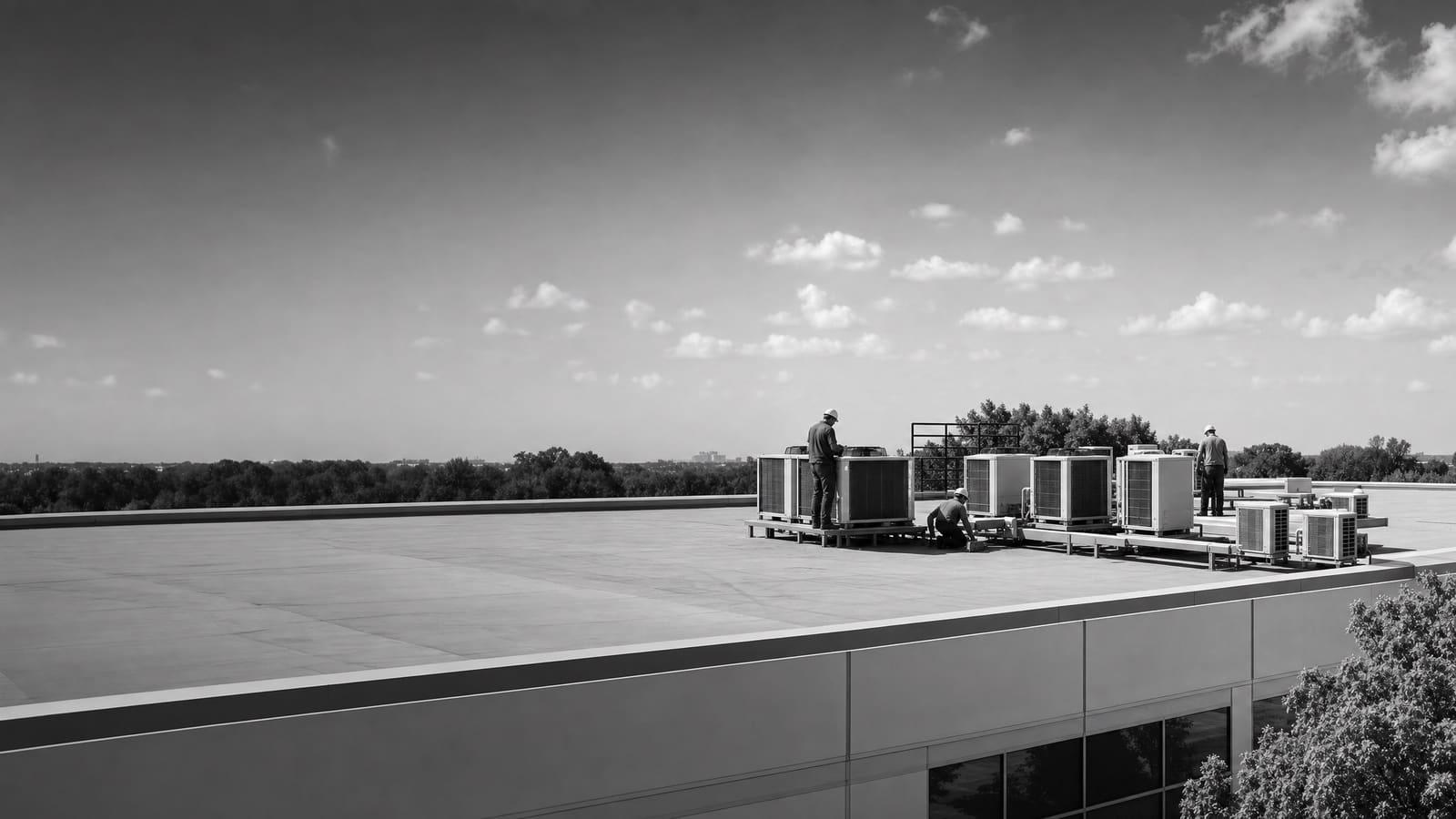
Most commercial buildings here run packaged rooftop units, and that matches the national picture: rooftop systems cool close to half of all US commercial floor area. So the replacement decision is mostly a rooftop unit decision, and there are three honest versions of it.
The cheapest is a like-for-like swap onto the existing curb. The middle path is a high-efficiency unit at the same tonnage. The Department of Energy's rooftop unit challenge pushed manufacturers to build units that cut energy use by up to half against the old minimum standard, and more than twenty models now exceed that spec. The third path is a heat pump rooftop unit, which adds reverse-cycle heating and takes the gas line out of the picture.
Price all three when the old unit is near end of life. Ask about current utility incentives while you do it, since program terms change from year to year.
WHAT MOVES THE NUMBER
Six lines that decide the price
No two roofs price the same, so the useful thing is knowing which lines actually move. These six carry most of the variance on a commercial replacement. Ask for each one to appear separately, so you can compare bids that look different on the cover page.
IN PRACTICE
How to choose the unit, not just the price
The first question is not which unit. It is what the building needs today. A twenty-year-old nameplate tells you what someone sized for the occupancy, lighting, and equipment of two decades ago. Offices got fewer people and more computers. Retail changed its lighting. Warehouses added or dropped a shift. Size to the building you have now, and the comfort complaints that never went away usually leave with the old unit.
The second question is what the unit costs to run. The Department of Energy worked with manufacturers and building owners to define a high-efficiency spec, verified it in real buildings, then drove it into a federal minimum standard. Owners who upgraded through that campaign, more than two hundred organizations covering over forty thousand units, cut a combined thirty-seven million dollars a year from their energy bills. That is the part of the decision that keeps paying after the crane leaves.
The third question is fuel. If the old unit heats with gas, a heat pump rooftop unit is worth pricing. Heat pump heating is most efficient in mild-to-moderate winters, and Florida sits squarely in that range, so the usual cold-weather objection does not carry much weight here.
SCOPE CHECK
What makes a replacement simple or hard
Two projects with the same tonnage can end up weeks apart on schedule. The difference is almost never the equipment. It is the curb, the panel, the roof access, and whether the new unit changes anything a plan reviewer has to look at again.
LOWER COMPLEXITY
Straight swap on an open roof
Same tonnage, the existing curb fits or takes a standard adapter, the panel already has capacity, and the crane has clear reach from the lot. Permit scope stays mechanical and electrical.
HIGHER COMPLEXITY
New footprint or new fuel
Tonnage grows, the footprint changes, or the unit goes all-electric. Now you may need structural review, a feeder upgrade, updated energy calculations, and a sealed drawing set before anything gets ordered.
BEFORE THE QUOTE
What a real site review has to confirm
A quote written from a nameplate photo is a starting number, not a price. It is genuinely useful for triage when a unit is down and you need options the same day. It is not enough to order equipment against.
The site review is where the surprises get found. Someone should measure the existing curb and confirm what adapter the new unit needs. Someone should look at the roof structure where the load lands, because a heavier unit on an older deck is a structural question, not a preference. Someone should open the panel and confirm there is capacity, especially if an all-electric option is being priced. The Department of Energy lists electrical capacity, physical constraints, and existing gas lines as the infrastructure items that decide whether a heat pump rooftop unit is realistic at a given site.
Then there is access. The crane has to reach, the lot has to give up stalls for a morning, and somebody has to tell tenants before the cones appear. None of that is hard. All of it gets expensive when it is discovered on install day.
Ask for this in writing
Before you sign, the contractor should confirm in writing that they measured the curb, verified panel capacity for the unit quoted, and walked the crane path from the street. If any of those three is still an assumption, the price is still an estimate.
PALM BAY SPECIFICS
What Florida permitting adds to your schedule
Start the permit package before you order equipment, not after. Florida commercial alteration permitting expects mechanical plans signed and sealed by a Florida licensed architect or engineer whenever the scope includes installing or relocating HVAC equipment. The submittal also expects energy calculations for any HVAC scope, plus a drawing showing where the equipment sits.
That has a real schedule effect. A sealed drawing set takes a design professional's time, and that time only runs in parallel with equipment lead time if you start it early. Owners who wait for the unit to show up before starting the permit package end up storing a rooftop unit while a reviewer reads the plans.
Confirm the current submittal checklist with the Palm Bay building department before you assemble the package, since local forms and requirements change.
Start the drawings first
If the replacement changes tonnage, footprint, or fuel, get a Florida licensed engineer engaged before the purchase order goes out. Sealed plans and energy calculations are the item most likely to push a schedule, and the easiest one to start early.
OWNING THE SYSTEM
Two things that outlive the install
The install takes a week or two of your attention. The unit sits on the roof long after that, and two decisions you make during the project shape all of it.
The first is refrigerant. New commercial equipment ships on newer refrigerants, and EPA rules under Section 608 govern how refrigerant is handled, recovered, and recycled in stationary air conditioning and heat pump equipment. That matters most when you own several units on different refrigerants. Your service contractor needs to be certified for what you actually own, and your spare-parts plan has to cover a mixed fleet.
The second is timing. Replacing on failure means paying whatever the market charges for whatever is in stock, in the season when nothing is. Replacing on a plan means you pick the unit, the day, and the price.
REFRIGERANT
Know what your fleet runs on
EPA Section 608 rules cover handling, recovery, and recycling for stationary air conditioning and heat pump equipment. If you own units on different refrigerants, confirm your service contractor is certified for all of them.
TIMING
Plan the swap before it plans you
Failure-driven replacement means taking whatever is in stock at whatever it costs. A planned swap lets you choose the efficiency tier, the install date, and the tenant notice.
OVER TIME
Phasing a roof with more than one unit
If you own several rooftop units, resist the urge to treat each one as its own emergency. Walk the roof once, write down every nameplate and install year, and sort the list by age. Anything past fifteen years belongs on a replacement plan, whether or not it is currently limping.
Then phase it. Replace the oldest one or two units with the efficiency tier you actually want, and use that first project to settle the questions that will repeat: which curb adapter works on this deck, what the crane setup costs on this lot, how long the permit package really takes, which controls platform you are standardizing on. The second project prices better and moves faster because those answers already exist.
Procurement gets easier too. A known unit family means a known lead time and a spare-parts plan that covers the whole roof instead of one machine. And when a unit fails out of sequence, you already know what replaces it, which turns an emergency into a phone call.
Lifetime cost is where phasing pays. The purchase price is one line in one year. The energy bill is every year, and it is the line a rushed like-for-like swap quietly locks in.
THE QUOTE
Five things a comparable quote shows
Bids that look wildly different usually differ in what they left out. Ask every contractor to show these five items separately. If one quote is missing a line another one includes, you found the gap rather than the better price.
01
Make, model, tonnage, efficiency tier
The exact model number and its efficiency rating, not a category like high-efficiency.
02
Equipment lead time
A real availability date sitting next to the price, because the schedule is usually the equipment.
03
Curb, structural, and rigging scope
Adapter, any deck work, crane size, and how many parking stalls close and for how long.
04
Permits, sealed plans, and inspections
Who pulls the permit, who seals the mechanical plans, and who meets the inspector.
05
Startup and commissioning documentation
Charge, airflow, and control settings verified against spec and handed to you in writing.
Get a defensible number
Price the equipment and the building together.
Send the address, operating target, and target opening date. Flux will identify what must be verified before the project can be priced.
Get a free estimateQuestions
Straight answers.
When is replacing a rooftop unit better than repairing it?
Once a unit passes fifteen years, the math shifts. The Department of Energy puts the annual energy waste from old, inefficient rooftop units at roughly $900 to $3,700 each. An expensive repair on a unit that age buys time on a machine that is already costing you money every month.
Does a heat pump rooftop unit make sense in Palm Bay?
It is usually worth pricing. Heat pump rooftop units are most efficient in mild-to-moderate winter heating, and Florida sits squarely in that range. The deciding factor here is rarely climate. It is whether the electrical panel has capacity for an all-electric unit.
What does the permit package require?
For Florida commercial alteration work that installs or relocates HVAC, expect mechanical plans signed and sealed by a Florida licensed architect or engineer, energy calculations, and a drawing showing equipment location. Confirm the current checklist with the Palm Bay building department before you submit.
Should we replace like-for-like or resize?
Confirm the load either way. If occupancy, equipment, and operating hours have not changed, like-for-like is often right and it is the fastest path back online. If any of those changed, a like-for-like swap locks in the old sizing mistake for the life of the new unit.
What happens to the old refrigerant?
It has to be recovered by a certified technician before the unit is disposed of. EPA Section 608 rules cover handling, recovery, and recycling for stationary air conditioning and heat pump equipment, and that recovery should appear as a line on your quote.
Why will nobody quote a firm price over the phone?
You can get equipment options and lead times from a nameplate photo the same day. A firm price needs the curb measured, the roof structure checked, the panel opened, and the crane path walked. Those four items are exactly where replacement quotes go wrong.
Sources used for this guide
- [1]betterbuildingssolutioncenter.energy.gov — DOE Advanced Rooftop Unit Replacement Guidance
- [2]betterbuildingssolutioncenter.energy.gov — DOE Commercial Heat Pump Rooftop Unit Replacement Guidance
- [3]betterbuildingssolutioncenter.energy.gov — DOE High-Efficiency Commercial Rooftop Unit Toolkit
- [4]energy.gov — DOE Efficient Commercial Rooftop Air Conditioner Program
- [5]epa.gov — EPA Stationary HVAC Refrigerant Management
- [6]tampa.gov — Permit Application Guide Commercial Alteration