THE SHORT VERSION
What a commercial HVAC replacement actually includes
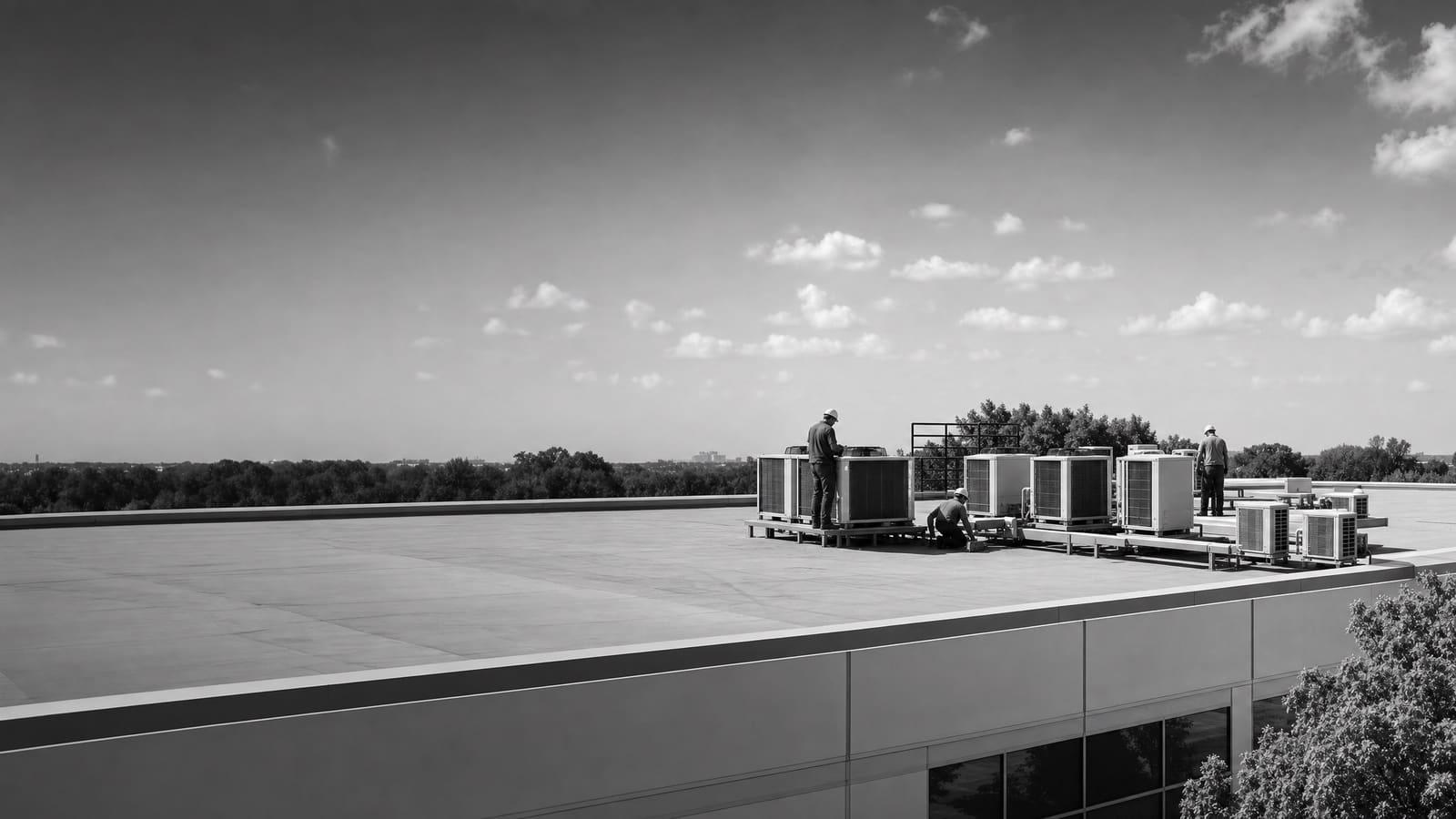
A commercial HVAC replacement covers load verification, equipment selection, rigging and set, connections, controls, and commissioning — not just the unit itself. Replacement usually beats another repair once a rooftop unit is past roughly fifteen years, because units that old waste substantial energy compared with current models. Department of Energy figures put that waste at $900 to $3,700 per unit each year on old, inefficient rooftop equipment. Repair still wins when the failure is one component on a younger, well-maintained unit.
A site review has to confirm the real load, the curb and roof structure, available electrical capacity, gas service, and crane access before any of those numbers mean anything for your building.
THE MAIN CHOICE
Three ways a commercial replacement can go
Most commercial replacements now come down to three paths, and the right one depends on the building's heating hours and the electrical service at the roof. A like-for-like swap keeps the same fuel and usually the same curb. An all-electric heat pump rooftop unit heats by reverse cycle and drops the gas connection. A dual-fuel or cold-climate unit keeps a backup heat source for the coldest hours. Heat pump heating efficiency falls as outdoor temperature drops, trending toward electric resistance performance at the bottom of the range, so the honest comparison is heating hours weighed against local electricity and gas prices — not a general claim that one fuel wins everywhere. Electrical capacity, physical space on the curb, and equipment availability decide whether the electric options belong on your shortlist at all.
WHAT MOVES THE NUMBER
The lines that decide your installed price
No two roofs price the same, and most of the spread is not the unit itself. These are the lines that move an installed number the most, ordered roughly by how much they tend to vary between a clean swap and a hard one.
HOW TO BUY IT
Planned replacement versus replacement on failure
The most useful thing a buyer can do is decide whether this is a planned replacement or a replacement on failure. Rooftop units over about fifteen years old waste substantial energy compared with newer models, and an old inefficient unit can burn $900 to $3,700 a year on its own. Waiting for the unit to die means paying that waste first, then buying whatever is available in a hurry, on whatever schedule the supplier and the crane allow.
Planning it buys you the choice back. You can compare a like-for-like unit against a higher-efficiency model and against a heat pump. You can price the electrical or curb work honestly instead of discovering it on the roof. You can also put the outage in a shoulder season instead of the week the building needs cooling most.
Sizing deserves the same treatment. The old nameplate reflects the load the building had when it was built, not the occupancy, plug loads, and envelope it has now. Confirming the load either validates the existing tonnage or finally explains the comfort complaints the old unit was never able to fix. Either answer is worth the hour it takes.
SIDE BY SIDE
Why two same-size jobs price differently
Two replacements with identical tonnage can price and schedule very differently. The gap is almost always in what has to change around the unit, not in the unit itself.
LOWER COMPLEXITY
Straight swap on an existing curb
Same fuel, same footprint, and a curb adapter that fits. The lot has room for the crane, electrical service is unchanged, and controls are a like-for-like reconnect. Permits stay mechanical and electrical, and the visible disruption is one morning of coned-off parking.
HIGHER COMPLEXITY
New footprint, new fuel, or a tight site
Larger tonnage, added weight, or a switch to all-electric heating. Now you may need structural review, service upgrades, gas capping, and a longer reach over an occupied lot. Long-lead or specialty equipment stretches it further, so the order date matters as much as the install date.
SCOPING IT
What a real site review looks at
A useful site review answers the questions that are expensive to answer later. It starts on the roof: unit nameplate, curb dimensions, the condition of the roof around the unit, and whether the structure carries the weight of what you want to put there. It continues at the electrical panel, because available capacity decides whether an all-electric option is realistic at all, and it checks the gas line for anything that has to be capped, moved, or kept in service.
Then it moves inside. How the space is actually used now — occupancy, operating hours, equipment heat, and any zone that never held temperature — is what a load calculation depends on. A reviewer who skips this step is quoting the nameplate, not your building.
The last piece is logistics. Where the crane sets up, how far it has to reach, how many stalls close, and how long tenants lose that part of the lot. Equipment availability belongs in the same conversation, because a unit that ships in two weeks and a unit that ships in three months are different projects even when the price matches.
Confirm before anyone quotes a number
Nameplate and curb dimensions, roof structure and weight, electrical capacity at the panel, gas service, a load based on today's use, crane setup and reach, and the actual lead time on every unit being quoted.
AFTER THE INSTALL
Two things that outlive the install date
Two considerations follow the equipment long past handoff, and both belong in the decision rather than the punch list. The first is refrigerant. New commercial equipment ships on newer refrigerants, and federal rules govern how the old charge is recovered and how the new system is serviced over its life. That matters most to owners running a mixed fleet, because parts and service planning split across two refrigerant families. The second is what happens across a portfolio. Rooftop equipment conditions close to half of all commercial floor area in the country, so one building's replacement is rarely the last one, and the decisions you make on this roof set the pattern for the next.
REFRIGERANT
Handling and service obligations
Federal regulations cover how refrigerant is handled, recovered, and recycled in stationary air-conditioning and heat pump equipment. Recovery on the old unit is certified work, and the new unit's refrigerant type shapes your parts inventory and service contract for the rest of its life.
PORTFOLIO
One roof, or the template
If you own more than one building, treat the first replacement as the template. Confirm which sites have electrical headroom, which carry long heating hours, and which run units old enough to be wasting money right now. Replacing on a plan beats reacting one failure at a time.
PHASING AND PROCUREMENT
Order dates, phasing, and lifetime cost
Procurement is where most schedule pain starts. The crew can only work as fast as the equipment arrives, so the order date is the real project start. Ask for availability next to price on every option quoted, and treat a long-lead unit as a different plan rather than the same plan running late. If the building cannot go without cooling, that constraint should shape the shortlist, not surface after the purchase order.
Phasing helps when there is more than one unit on the roof. Replacing the oldest and worst performer first funds the next one out of avoided waste, and it gives you a real installed cost to plan the rest against. It also spreads capital across budget years without leaving the whole building exposed at once.
Lifetime cost is the part buyers skip most often. Federal efficiency standards for commercial rooftop units were adopted specifically for the utility bill savings they lock in over the life of the equipment, and more than 200 organizations that upgraded over 43,000 rooftop units through a national campaign reported a combined $37 million in annual energy savings. The efficiency tier you choose shows up on every bill for as long as that unit is on the roof.
BEFORE YOU SIGN
Five things a comparable quote has to show
Quotes are only comparable when they cover the same scope. When one number comes in well under the others, it is usually missing one of these five lines rather than beating the market.
01
The equipment, spelled out
Make, model, tonnage, efficiency tier, heating type, and refrigerant. A line that reads "new rooftop unit" is not a quote.
02
Lead time next to the price
The date the unit can actually ship, not just when the crew is free. Availability is part of the offer, not a footnote.
03
Curb, structure, and roof work
Curb adapter or new curb, any framing or weight review, and how the roof membrane gets closed up around the new unit.
04
Rigging, permits, and inspections
Who owns the crane, the lot closure, the mechanical and electrical permits, and the inspection sign-off — included, not extra.
05
Startup and commissioning records
Verified charge, airflow, and control settings, documented at handoff so the warranty holds and later complaints have a baseline.
Get a defensible number
Price the equipment and the building together.
Send the address, operating target, and target opening date. Flux will identify what must be verified before the project can be priced.
Get a free estimateQuestions
Straight answers.
When does replacement beat another repair?
Age and repeat failures are the two signals worth trusting. Rooftop units past roughly fifteen years waste substantial energy compared with current equipment, and old inefficient units can cost $900 to $3,700 a year each in wasted energy alone. When a unit that old needs a major component, that repair usually buys a short extension on an expensive problem.
Should we switch to a heat pump rooftop unit?
It depends on four things: how many hours the building actually needs heat, your local electricity and gas prices, whether the electrical service has capacity for the added load, and whether the unit you want is available. Heat pump heating efficiency drops as outdoor temperature falls, so buildings with long cold stretches often land on a dual-fuel or cold-climate unit instead of all-electric.
How much does commercial HVAC installation cost?
There is no honest universal number, because tonnage, efficiency tier, curb and structural work, crane access, and electrical or gas changes each move the total independently. The right way to compare is a scoped quote from a real look at your roof. What is measurable up front is the cost of waiting: an old, inefficient unit can waste $900 to $3,700 a year while you decide.
What drives the project schedule?
Equipment lead time, almost always. The rigging plan, permits, and curb work can be arranged in parallel, but nothing lands on the roof until the unit ships. Ask for availability alongside price on every option, and if the building cannot lose cooling, let that constraint narrow the shortlist before you order rather than after.
What happens to the refrigerant in the old unit?
Federal rules govern how refrigerant is handled, recovered, and recycled in stationary air-conditioning and heat pump equipment, so the old charge is recovered by certified technicians as part of the removal, not vented. New equipment ships on newer refrigerants, which is worth planning for in service contracts and spare parts if you run a mix of old and new units.
Sources used for this guide
- [1]betterbuildingssolutioncenter.energy.gov — DOE Advanced Rooftop Unit Replacement Guidance
- [2]betterbuildingssolutioncenter.energy.gov — DOE Commercial Heat Pump Rooftop Unit Replacement Guidance
- [3]betterbuildingssolutioncenter.energy.gov — DOE High-Efficiency Commercial Rooftop Unit Toolkit
- [4]energy.gov — DOE Efficient Commercial Rooftop Air Conditioner Program
- [5]epa.gov — EPA Stationary HVAC Refrigerant Management