THE DIRECT ANSWER
What a commercial HVAC replacement actually includes
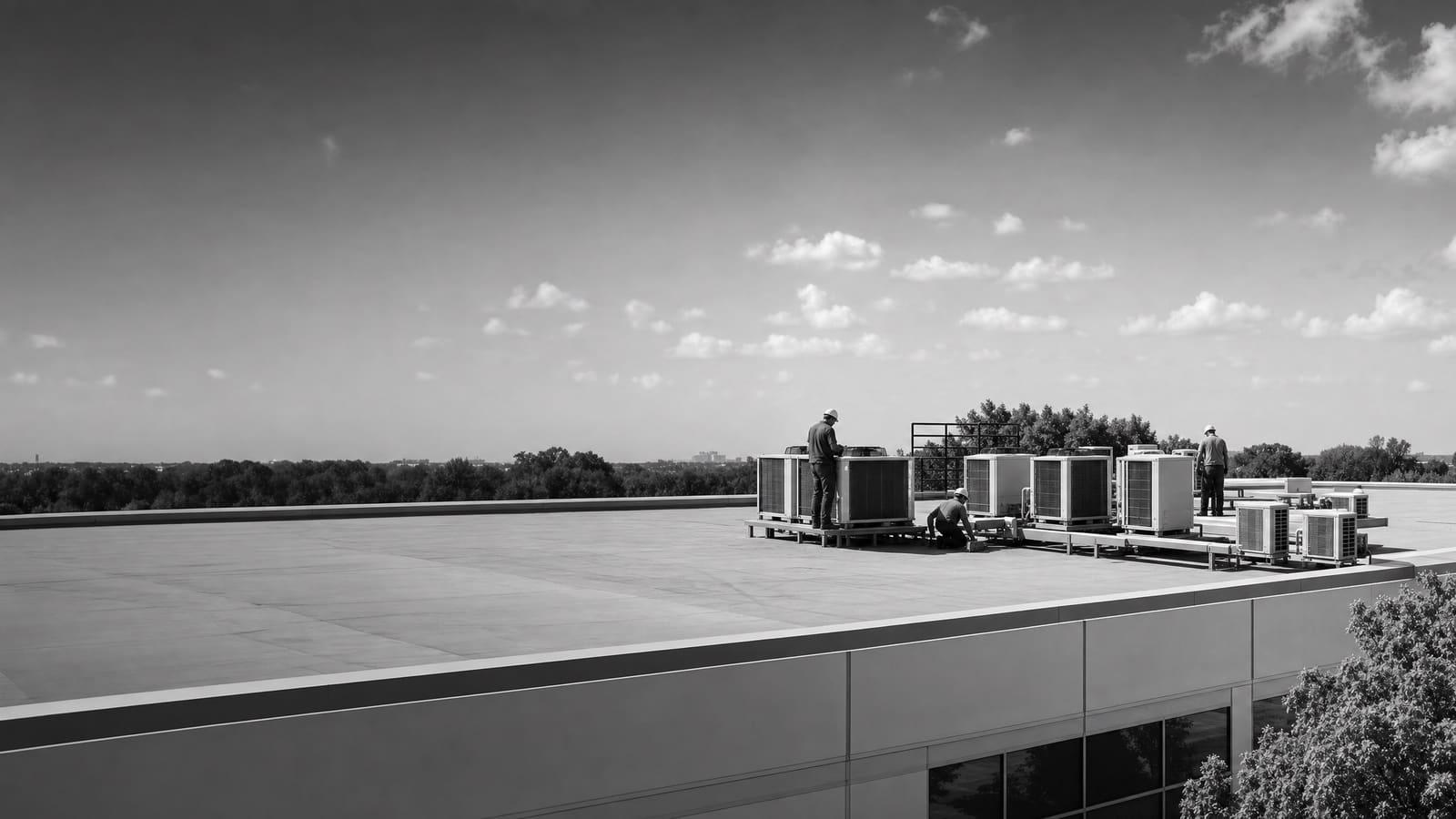
A commercial HVAC replacement is the whole job, not just the box on the roof. It covers confirming the load the building carries today, selecting equipment you can actually get on schedule, rigging the old unit off and the new one on, reconnecting power, gas, and controls, then commissioning and documenting the result. Replacement beats one more repair once a unit passes fifteen years and failures turn into a pattern. An old, inefficient rooftop unit can waste $900 to $3,700 a year in energy alone.
A site review still has to verify curb size and roof structure, electrical capacity at the panel, gas service, crane reach across the lot, and whether the swap triggers economizer or controls work.
THREE PATHS
The three ways this replacement usually goes
Most commercial replacements come down to three paths, and the right one depends on how much the building has changed since the last unit went in.
Rooftop units condition close to half of all commercial floor space in the country, so this is a well-mapped decision. Units past fifteen years old waste real money every month, and what you pick now sets the operating cost for the whole next equipment cycle. A like-for-like swap carries the old sizing forward, right and wrong. A right-sized high-efficiency unit costs more up front and pays it back through the meter. A heat pump rooftop unit adds reverse-cycle heating and drops the gas connection, which matters more in a mild-winter climate than it would up north.
The trap is deciding this the morning the unit dies. Under pressure, whatever is on the truck wins. Choosing the path before failure is what keeps the high-efficiency and heat pump options on the table at all, because equipment availability is one of the things that decides whether they are reachable in your timeline.
WHAT MOVES THE NUMBER
The lines that actually change the price
Nobody can price your roof from a search result. These are the lines that move a commercial HVAC installation number, roughly in the order they tend to surprise people.
CHOOSING EQUIPMENT
Choose the unit, not just the price
A quote that names only a brand and a tonnage is not something you can compare. What decides the next decade of operating cost is the efficiency tier, the controls, and whether the unit heats with gas or with reverse-cycle refrigerant.
Start with heating. Winters in this part of the state are mild, and current heat pump rooftop units can carry most or all of a building's winter heating demand across the West. That makes the all-electric option genuinely available here in a way it is not everywhere. Whether it pays comes down to your electric and gas rates, your panel capacity, and how the building is actually used, not to the technology itself.
Then look at controls. An older unit usually runs one stage off a thermostat and reports nothing. Newer equipment stages capacity, manages outside air, and flags faults. That is where the savings on an efficiency upgrade actually come from, and it is also where a sloppy handoff erases them. If the new unit ties into a building automation system, the integration scope belongs in the quote, in writing, before the crane is booked.
SIDE BY SIDE
Why two identical tonnages price differently
Two replacements at the same tonnage can land far apart. What separates them is rarely the unit. It is the roof, the lot, and what the swap drags in with it.
SIMPLER
Lower-complexity replacement
Same tonnage on an existing curb, adequate power already at the unit, clear crane reach from the lot, and a control tie-in that matches what was there. This is a one-morning set with routine mechanical permitting.
MORE INVOLVED
Higher-complexity replacement
A changed footprint or added weight that needs structural review, a service upgrade for an all-electric conversion, a long reach over an occupied lot, or code items like an economizer the old unit never had. Plan this one in weeks.
SCOPING THE JOB
What a real site review covers
Ask for a walk before you ask for a number. A quote written off a nameplate photo is a guess wearing a price tag.
The walk should settle four things. What load the building carries now, because occupancy, plug loads, hours, and envelope have all moved since the old unit was specified, and copying the old nameplate copies whatever was wrong with it. What the roof will accept, meaning curb dimensions, structural capacity for the new weight, and the condition of the membrane around the unit. What services are available, meaning capacity at the panel and at the unit, gas if it stays, and where condensate and control wiring run. And how the equipment gets there: crane position, reach, overhead obstructions, and how many stalls close for how long.
Everything after that is scheduling. Availability of the specific unit shapes the calendar more than the crew does, so a scope that names a model without naming its lead time is half a plan. The contractor who owns rigging, permits, and inspection inside the installed price is the one you can hold to a date.
A red flag in a bid
A same-day price with no roof visit, no load discussion, and no mention of permits or lead time is not a bid. It is a placeholder, and the gap usually reappears as a change order after the old unit is already off the roof.
IN ORANGE
What Orange changes about the project
Two practical things shape a rooftop replacement here. The first is climate. Winters in this part of California are mild, and current heat pump rooftop units are capable of covering most or all of the winter heating demand across the West. So the all-electric path is a real option on most Orange buildings, and the deciding factors become panel capacity and utility rates rather than whether the equipment can keep up in January.
The second is paperwork. Local building departments in California permit mechanical work, including upgrades and repairs rather than new installations only, and they permit re-roofing separately. If the roof section under the unit is near the end of its life, sequence the two jobs together instead of setting new equipment on a membrane you plan to tear off.
Check the roof before you book the crane
A curb, a crane path, and a permit are all easy to plan around. A roof that needs replacing a year after a new unit lands is not. Confirm membrane condition and permit scope during the site walk, while both jobs can still be sequenced together.
WHO PAYS, WHO BENEFITS
Ownership changes the math
Who funds the unit and who receives the savings is worth settling before the quote arrives. Efficiency upgrades pay back through the utility meter, but capital comes out of the building budget. When those are two different pockets, the better long-run option loses arguments it should win, so put the operating-cost comparison in front of whoever signs, not just the installed price.
Operating hours pull the same lever. A building running long hours recovers an efficiency premium faster than one on a short weekday schedule, and it also has fewer windows where a crane day is painless.
OWNER-OCCUPIED
If you own the building
Capital cost and utility savings land in the same place, so the efficiency tier is a straight financial decision. Check whether an incentive applies before the order is placed, since programs generally attach to the equipment as purchased.
LEASED
If the space is leased
Settle early who funds the unit and who receives the savings. A landlord buying the cheapest compliant unit while a tenant pays the bill is the most common way a building ends up with equipment nobody is happy with.
PLANNING AHEAD
Stop buying units one emergency at a time
If you own more than one unit, get off the failure cycle. Walk the roof once, record age, tonnage, refrigerant, and condition for every unit, then rank them and replace on a schedule you set. Organizations that took the planned approach have upgraded tens of thousands of rooftop units between them and cut tens of millions of dollars a year in energy costs. The mechanism is not exotic. It is replacing before failure instead of after.
Planned replacement buys three things an emergency cannot. You get competitive pricing instead of whatever is available. You get the efficiency tier and heating type you actually chose. And you get to put the crane on a day the lot can spare the stalls.
Lifetime cost is the other half of the decision. The purchase price is one number; the utility bill is every year after. An old, inefficient unit can burn $900 to $3,700 a year more than it should, which is often larger than the price gap between efficiency tiers at purchase. Ask for the operating-cost comparison alongside the installed price, and confirm any utility incentive before the order goes in rather than after.
BEFORE YOU SIGN
Five things a comparable quote shows
A comparable quote lets you set two bids side by side and read the same rows. When one is missing these, ask before you compare. The gap is usually hiding inside the cheaper-looking number.
01
The equipment, in full
Manufacturer, model, tonnage, efficiency tier, heating type, and refrigerant, plus the current lead time for that exact unit.
02
Roof and curb scope
Curb adapter or new curb, any structural work, membrane and flashing repair, and who is responsible for each item.
03
Rigging and site plan
Crane size and position, staging area, stalls closed, hours of the lift, and how the weather call gets made.
04
Permits and inspections
Which permits are pulled and by whom, and whether inspection sign-off is included in the installed price.
05
Startup and commissioning
Charge, airflow, and control settings verified against spec and documented at handoff, with warranty terms and start date in writing.
Get a defensible number
Price the equipment and the building together.
Send the address, operating target, and target opening date. Flux will identify what must be verified before the project can be priced.
Get a free estimateQuestions
Straight answers.
When is replacement better than one more repair?
When repairs stop being events and become a pattern, and the unit is past fifteen years. Old, inefficient rooftop units can waste $900 to $3,700 a year in energy on their own, which often exceeds what the repair cycle is costing you.
Should you replace like-for-like or resize?
Confirm the load either way. If the space and its use have not changed, like-for-like is usually right. If occupancy, operating hours, or equipment changed, the old nameplate is the wrong starting point and the new unit will inherit the same complaints.
Does a heat pump rooftop unit make sense in Orange?
Often, yes. Winters here are mild, and current heat pump rooftop units can cover most or all of the winter heating demand in western climates. The deciding factors are usually electrical capacity at the building and your electric and gas rates.
How much does commercial HVAC installation cost?
There is no honest universal number, because tonnage, curb work, electrical scope, and crane access move it substantially. What can be priced is your specific roof. A site walk produces an installed number with the equipment lead time attached to it.
Who handles the crane, permits, and inspections?
The installing contractor should own rigging, lot coordination, permits, and inspection sign-off as part of the installed price. Local building departments in California permit mechanical work and re-roofing separately, so confirm exactly what the bid includes.
What happens to the refrigerant in the old unit?
Recovery and handling are regulated federally under the Clean Air Act, so the old charge is removed by certified technicians rather than vented. If the new unit runs a different refrigerant than the rest of your fleet, plan parts and service around that.
Sources used for this guide
- [1]betterbuildingssolutioncenter.energy.gov — DOE Advanced Rooftop Unit Replacement Guidance
- [2]betterbuildingssolutioncenter.energy.gov — DOE Commercial Heat Pump Rooftop Unit Replacement Guidance
- [3]betterbuildingssolutioncenter.energy.gov — DOE High-Efficiency Commercial Rooftop Unit Toolkit
- [4]energy.gov — DOE Efficient Commercial Rooftop Air Conditioner Program
- [5]epa.gov — EPA Stationary HVAC Refrigerant Management
- [6]californiacity-ca.gov — HVAC Permits