THE SHORT VERSION
What a commercial HVAC replacement actually covers
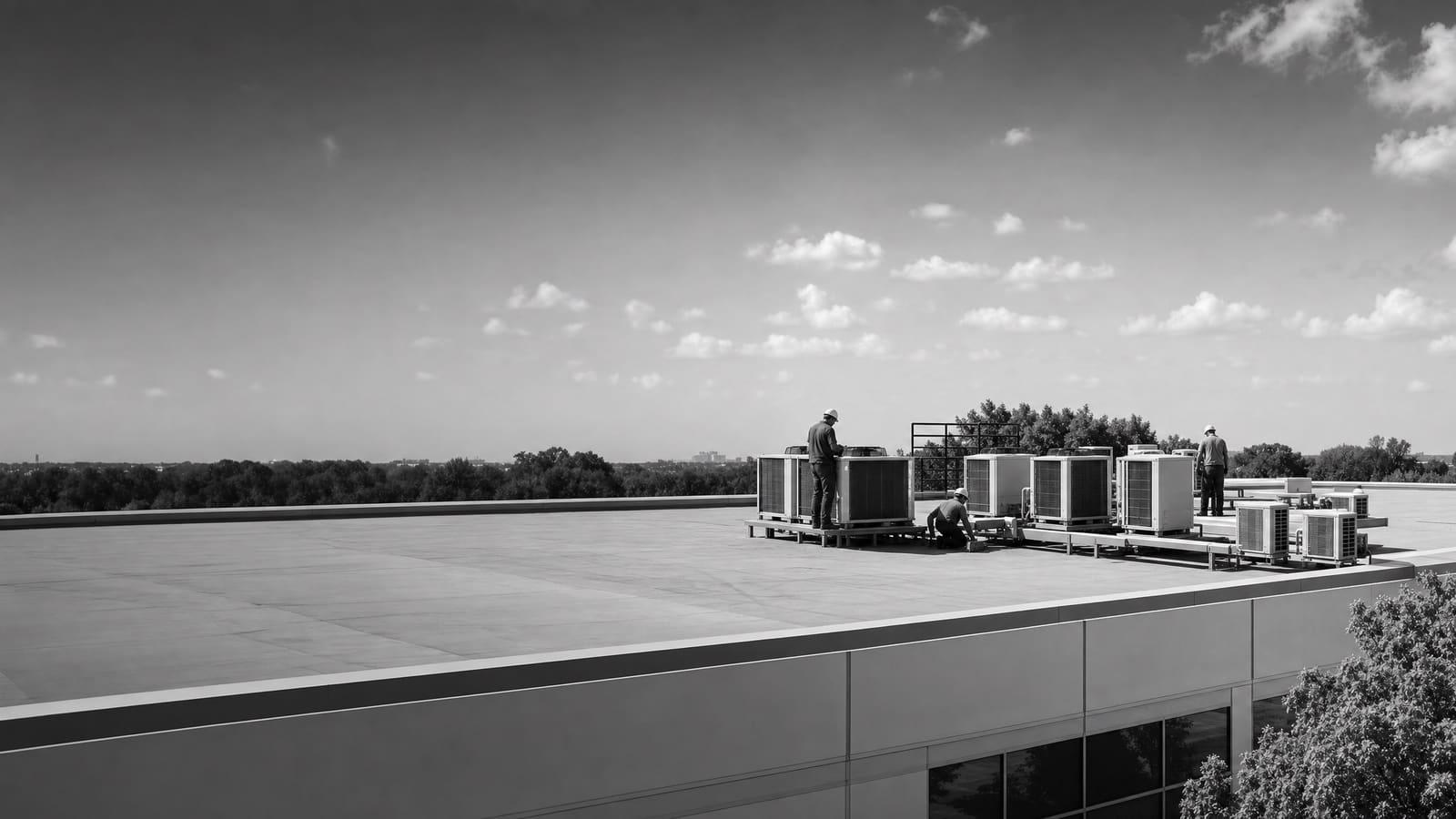
A commercial HVAC replacement covers the load calculation, the unit itself, the curb or connection work under it, the crane or rigging day, the electrical and gas or refrigerant tie-ins, controls, and commissioning. Replacement beats another repair once the unit is old enough to be the expensive part of your utility bill. Federal work found that aging, inefficient rooftop units waste roughly $900 to $3,700 per unit each year, and units past fifteen years are the usual offenders.
A site review still has to confirm tonnage against how the space is used now, the roof structure under the curb, available electrical capacity, and whether the existing gas line stays or goes.
THREE WAYS TO GO
Three replacement paths for the same rooftop
Almost every commercial replacement lands on one of three paths, and the right one depends less on the failed unit than on what you want the building to cost to run for the next fifteen years.
The cheapest path in the moment is a like-for-like gas-electric unit on the existing curb. The middle path is the same footprint with a high-efficiency unit; the federal High-Performance Rooftop Unit Challenge pushed manufacturers to build units that cut energy use by up to half against the standard of the time, and models exceeding that specification have been on the market since. The third path swaps the heating source entirely for a heat pump rooftop unit, which is mechanically similar to the air conditioner you already have but runs the cycle in reverse for heat.
Federal guidance frames the heat pump decision around a short list: climate and heating load, utility bill impact, emissions, building type, equipment availability, on-site infrastructure, contractor familiarity, and incentives. Answer those before you pick, not after the old unit is already on the ground.
WHAT MOVES THE NUMBER
Where the money actually goes
No two roofs price the same, so treat these as the lines that separate a low bid from a real one. Each is a place where a thin quote leaves the cost sitting with you as a change order later.
IN PRACTICE
How to choose between the paths
Start with the age of what you have. Federal guidance is blunt about it: rooftop units past fifteen years waste a meaningful amount of energy compared to current models, and most facility managers still wait until the unit fails completely, needs constant service, or stops holding the space. Replacing on failure is the most expensive version of this project, because you lose the ability to shop equipment, schedule the crane, or take the efficiency step up.
Second, decide whether you are buying a box or buying an operating cost. Rooftop units condition close to half of all commercial floor space in the country, which is why so much federal attention went to them. The Advanced RTU Campaign tracked more than two hundred organizations upgrading over forty-three thousand units, and those upgrades together cut roughly thirty-seven million dollars a year off their energy bills. That is the case for spending on the tier, not just the tonnage.
Third, if a heat pump is on the table, understand where its efficiency lives. Heat pump heating gets less efficient as outdoor temperature falls, and at the cold end it approaches plain electric resistance. That is why the technology comes in dual-fuel, all-electric, and cold-climate forms. The version that fits your building depends on your winter heating load and on what electricity and gas actually cost you, which is a modeling question your contractor should answer with your bills in hand.
SCOPE CHECK
What keeps this simple, and what makes it complicated
Two replacements of the same tonnage can differ by weeks and by real money. The difference is almost always infrastructure and access, not the unit on the invoice.
LOWER COMPLEXITY
Same footprint, same fuel
The new unit matches the existing curb, the electrical service has room, the gas line stays where it is, and the crane has clear reach from the lot. This is the one-morning version, and the quote should read that way.
HIGHER COMPLEXITY
New footprint or new fuel
A larger or heavier unit brings in curb adapters and a structural look at the roof. An all-electric conversion brings in panel capacity and feeder runs. Tight sites add crane staging and off-hours work.
BEFORE THE QUOTE
What a real site review checks
A quote written from a nameplate photo is a starting number, not a price. It is useful for triage when a unit is down in season, and it is not what you should sign for a planned replacement.
The review that produces a real number walks the roof and the electrical room. On the roof, it confirms the curb dimensions and condition, the structural support under it, the clearances around the unit, and the path a crane would take. It also confirms the existing connections: the gas line, the disconnect, and how the unit currently talks to your controls.
In the electrical room, it confirms available capacity. Federal heat pump guidance treats electrical capacity, physical constraints, and gas lines as first-order screening items, because those are what turn a straightforward equipment swap into an electrical project. Finding that out during the review is a scheduling conversation. Finding it out on crane day is a change order.
The last part of the review is the load itself. Twenty years changes occupancy, plug loads, lighting, and sometimes the envelope. Sizing from how the space is used today is what stops you from buying the same comfort complaint twice.
Get these three before you compare bids
The confirmed load calculation, the curb and structural finding, and the available electrical capacity. When two quotes disagree on price, they almost always disagree on one of those three first. Put them in writing and the comparison becomes straightforward.
OWNING THE DECISION
Two things the quote will not tell you
Equipment choice sets your operating cost for the next decade and a half, but two things outside the equipment decide how well that plays out: who can service what you bought, and what the money looks like after incentives.
Both are worth checking before selection is locked, because both can quietly change which path is actually cheapest. A unit nobody nearby wants to service is a slow problem. An incentive you learn about after the purchase order is a missed one. Neither question takes long to answer, and neither gets easier once the equipment is ordered.
SERVICEABILITY
Who maintains it after year one
Federal guidance lists contractor availability and familiarity as a real screening factor for heat pump rooftop units. If the technology is new to your service bench, ask how the maintenance contract and parts stocking change before you sign.
INCENTIVES
Check programs before you order
Federal rooftop unit guidance treats incentives as part of the selection decision, not an afterthought. Confirm what currently applies to your equipment choice and what the paperwork requires while the unit is still a proposal.
PLANNING AHEAD
Phasing a fleet instead of replacing on failure
If you have more than one unit on the roof, the useful question is not which one to replace but what order to replace them in. Replacement on failure sets the order for you, always at the worst time and usually at the worst price. A short survey of age, service history, and tonnage gives you a list you can budget against over three or four years.
Ordering matters for a second reason. Equipment availability is a real constraint, and the federal guidance names it directly for heat pump units. Knowing next year's replacement now means the unit can be ordered on your timeline instead of whatever sits on a regional shelf the week yours dies.
Phasing also lets you learn on one unit before committing the fleet. Put the higher-efficiency or heat pump unit on the space with the most predictable schedule, run it a full heating and cooling season, and compare the bills against the untouched units next to it. Federal demonstration work took the same approach for the same reason: owners wanted verified real-world performance before adopting broadly. You can run that test on your own roof, at the scale of one unit.
APPLES TO APPLES
Five things a comparable quote shows
Any bid can be made cheap by leaving something out. These five lines are where quotes usually differ, so make every bidder show them. Then the lowest number is actually the lowest number.
01
Tonnage, efficiency tier, and model
The specific unit, not a category. The efficiency tier is the line that shows whether you are buying the standard box or the better one.
02
Equipment lead time in writing
Availability belongs next to price on an honest quote, because it is what actually sets your date.
03
Curb, structural, and rigging scope
Adapter, any roof work, crane size, lot closure, and who coordinates it. Named, not assumed.
04
Electrical, gas, and refrigerant work
Including recovery of the old charge, which is federally regulated work, plus any panel or feeder changes.
05
Commissioning and closeout documents
Startup readings, charge, airflow, and controls verified against spec, plus permits, inspections, and warranty registration.
Get a defensible number
Price the equipment and the building together.
Send the address, operating target, and target opening date. Flux will identify what must be verified before the project can be priced.
Get a free estimateQuestions
Straight answers.
When does replacement beat another repair?
Once the unit is old enough that energy is the bigger cost. Federal work puts the annual waste from aging, inefficient rooftop units at roughly $900 to $3,700 each, and flags fifteen years as the point where that gap gets real. Frequent service calls and a space that no longer holds temperature are the other two signals.
Should you replace like-for-like or step up efficiency?
Like-for-like is right when the space and its use have not changed and the budget is fixed. Stepping up is right when you plan to hold the building, since challenge-spec units were built to cut energy use by up to half against the older standard. Confirm the load either way.
Is a heat pump rooftop unit the right swap?
It depends on your winter heating load, your electricity and gas prices, and your electrical capacity. Heat pump heating loses efficiency as outdoor temperatures drop and approaches electric resistance at the cold end, which is why dual-fuel and cold-climate versions exist. Model it against your own bills before deciding.
What usually causes a change order?
Electrical capacity and the curb. Federal guidance treats panel capacity, physical constraints, and gas lines as screening items for a reason, because each one can turn an equipment swap into a bigger project. A site review that opens the electrical room catches them before crane day.
What happens to the refrigerant in the old unit?
It has to be recovered and handled under federal rules rather than released, and that work belongs on the quote. It is also worth asking which refrigerant the new unit uses, so your service contract and spare-parts plan stay consistent across a mixed roof.
Sources used for this guide
- [1]betterbuildingssolutioncenter.energy.gov — DOE Advanced Rooftop Unit Replacement Guidance
- [2]betterbuildingssolutioncenter.energy.gov — DOE Commercial Heat Pump Rooftop Unit Replacement Guidance
- [3]betterbuildingssolutioncenter.energy.gov — DOE High-Efficiency Commercial Rooftop Unit Toolkit
- [4]energy.gov — DOE Efficient Commercial Rooftop Air Conditioner Program
- [5]epa.gov — EPA Stationary HVAC Refrigerant Management