THE DIRECT ANSWER
What a commercial HVAC replacement actually covers
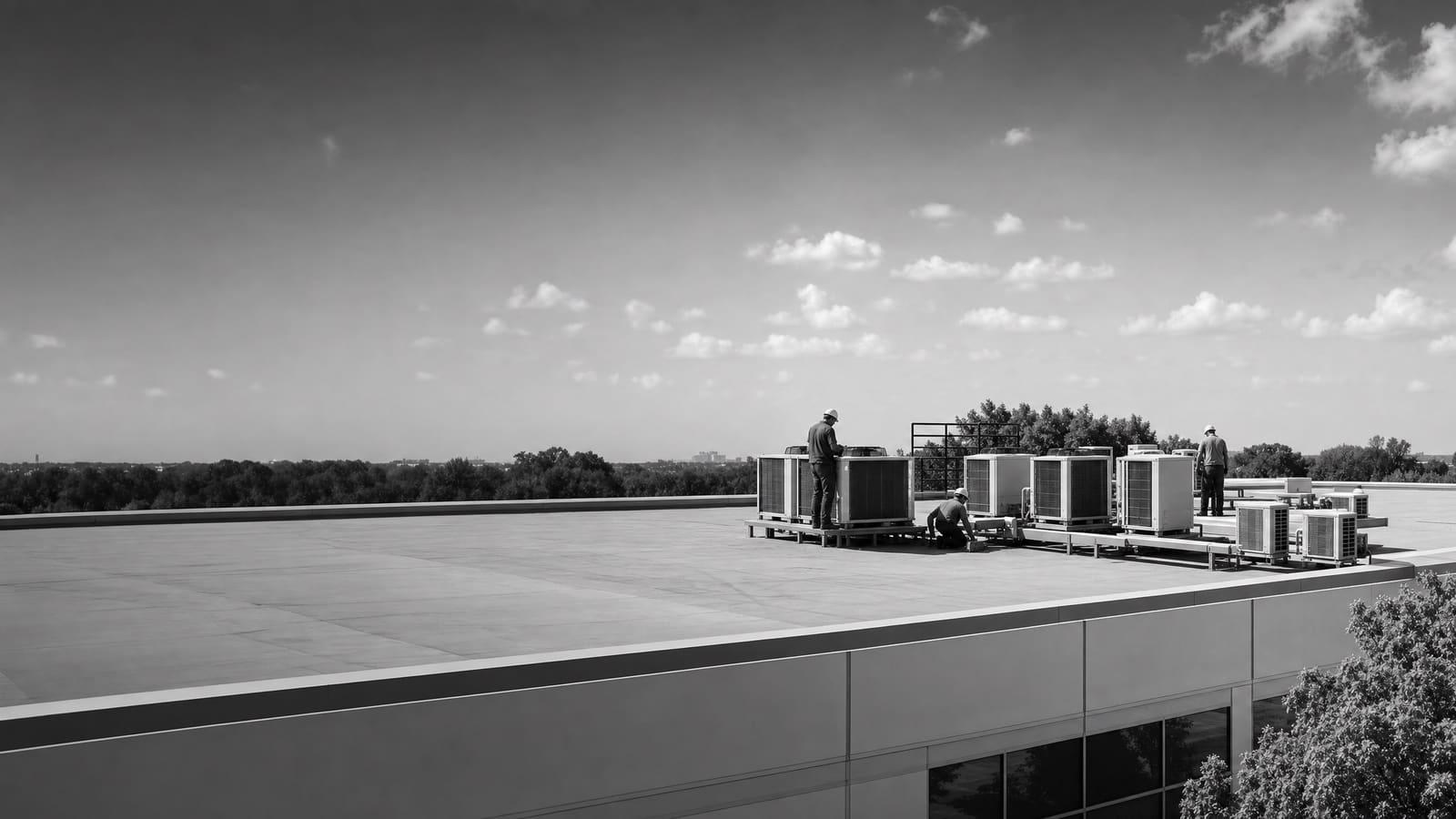
A commercial HVAC replacement covers load verification, equipment selection against real lead times, curb and structural work, the crane set, gas and electrical and refrigerant connections, controls, permits, and commissioning. Replacement beats another repair once the unit is past fifteen years and the repairs start stacking up. An old, inefficient rooftop unit wastes roughly $900 to $3,700 a year in energy on its own, and that number usually settles the argument faster than the last service invoice does.
A site review still has to verify tonnage against current occupancy, curb dimensions and roof structure, available electrical capacity, crane reach and access, and whether the existing controls and refrigerant carry forward.
THREE WAYS TO GO
Like-for-like, high-efficiency, or heat pump
Most replacements land on one of three choices, and the right one depends on how much of the building you are willing to touch.
A like-for-like swap reuses the curb and the connections and gets cooling back fastest. A high-efficiency unit costs more up front and earns it back through the meter, since the high-performance rooftop specification targets up to half the energy use of a baseline unit. A heat pump rooftop unit adds reverse-cycle heating and retires the gas connection, and mild winters are exactly the conditions where heat pump rooftop units run at their best.
The choice is easier when you make it before the unit fails. Replace on failure and availability decides for you. Plan the change-out and you get to weigh utility cost, emissions goals, electrical capacity, and incentives on your own schedule.
WHAT MOVES THE NUMBER
Budget lines that decide the installed price
Nobody can price a rooftop replacement from a phone call, because most of the spread sits in the work around the unit rather than in the unit itself. These are the lines that move a quote the most, and each one should show up as its own number instead of disappearing into a lump sum.
BUYING GUIDANCE
How to choose the unit you will live with for twenty years
Start with the load, not the nameplate. A unit installed twenty years ago was sized for a floor plan, an occupancy, and a lighting load that probably no longer exist. Oversized equipment short-cycles, dehumidifies poorly, and wears itself out early. The load calculation is a few hours of work that decides two decades of operating cost.
Then decide how long you plan to hold the building. Rooftop units condition close to half of all commercial floor space in the country, and the waste really begins to show once a unit passes fifteen years. If you are selling in three years, the cheapest compliant replacement is a defensible answer. If you are holding, the efficiency tier and the fuel decision are the two levers with real money behind them.
Last, treat availability as part of the specification. A unit you cannot get in season is not an option, it is a delay. Ask for two or three configurations with current lead times attached and choose with the calendar in front of you. Crew familiarity matters too, because a heat pump rooftop unit is a different commissioning exercise than a straight air conditioner, and that difference shows up in month two.
SCOPE CHECK
What makes this project simple or hard
Two rooftop replacements that look identical from the parking lot can differ by weeks and by a lot of money. The difference is almost always what the new unit asks of the building underneath it.
LOWER COMPLEXITY
Same size, same fuel, same curb
Matching tonnage on the existing curb, gas and electrical service unchanged, clear crane access from the lot, and controls that carry over. The permit is mechanical and electrical, and the set happens in a morning.
HIGHER COMPLEXITY
New footprint, new fuel, or a tight roof
Larger tonnage, a different curb footprint, or an all-electric conversion that needs panel capacity. Expect structural review, a longer permit path, possible utility coordination, and a crane plan built around limited street or lot access.
BEFORE THE QUOTE
The site review that makes a quote real
A price written from a nameplate photo is a starting point, not a quote. The visit that turns it into a number is short, and it looks at the building more than at the equipment.
On the roof, the crew measures the curb, checks the structure under it, and confirms clearances and service access. In the electrical room, they confirm available capacity at the panel and the feeder, which is the single item most likely to change the plan on an all-electric conversion. On the ground, they walk the crane path: where the truck sets up, how far it has to reach, which stalls close, and what has to happen on a weekend instead of a Tuesday.
They should also look at what is already installed. Controls and building automation integration, economizer condition, distribution, and whether the existing refrigerant is one your service contract still covers all belong in the same walkthrough. On a coastal site it is worth checking how the last unit's coils and cabinet aged, because that tells you what to specify this time.
The output of that visit belongs in writing. If the walkthrough does not produce a scope you could hand to another contractor and get a comparable number, it was a sales call.
Ask for this in writing
The scope should name tonnage, efficiency tier, refrigerant, curb approach, electrical work, the crane and lot plan, permits, and commissioning deliverables. That document is what makes two quotes comparable, and it is what you hold the installer to on crane day.
OCEANSIDE SPECIFICS
Permits, the roof, and a mild-winter advantage
California cities require a permit for mechanical upgrades and repairs, and many issue a dedicated HVAC permit for the change-out itself. Confirm the current requirements with the Oceanside building division before a crane date is booked, because the inspection has to land in the same window as the install.
Re-roofing is permitted work too, and that is the sequencing decision worth making early. If the roof is within a few years of replacement, doing it before or alongside the unit swap avoids paying twice for penetrations, flashing, and a second crane mobilization.
The climate helps on the equipment side. Heat pump rooftop units are most efficient in mild-to-moderate winter heating, and the Southern California coast sits squarely in the range where they can carry most or all of the heating load without leaning on electric resistance backup.
One call worth making first
Before you sign, call the Oceanside building division with the tonnage and the roof detail and ask whether the change-out needs mechanical and electrical permits alone or triggers structural review. That answer belongs in your schedule before the crane is booked, not after.
OWNERSHIP
Two decisions that outlive the install
The install is a week. The consequences run for the life of the unit, and two of them are worth deciding on purpose rather than by default.
The first is refrigerant. New commercial equipment ships on newer low-GWP refrigerants, and federal rules govern how the refrigerant in the old unit is recovered and handled at removal. The practical effect lands on your service plan rather than on day-one operation: a mixed fleet means two parts strategies and technicians who can work on both.
The second is standardization. If you own several units on one roof, or several buildings, replacing them toward one specification makes maintenance, spare parts, and controls integration simpler every year afterward.
REFRIGERANT
Recovery is regulated work
Refrigerant in the unit being removed has to be recovered and handled under federal rules by certified technicians. Confirm the quote includes recovery and the paperwork that goes with it rather than treating it as an assumed courtesy.
FLEET STRATEGY
One spec beats five
Replacing units one at a time with whatever is available leaves you with five control schemes and five parts lists. Setting a standard tonnage range, efficiency tier, and control platform pays back on every service call after.
PHASING AND PROCUREMENT
Replacing on your schedule instead of the equipment's
Most commercial HVAC work happens under pressure. A unit fails in season and the building needs it handled today. That is the most expensive way to buy equipment, because availability makes the decision and the efficiency conversation never happens at all.
The alternative is to rank the roof. Walk the units once, note age, refrigerant, condition, and how critical the space each one serves is, then put them in replacement order. The failures you cannot prevent then land on units you already have a plan for. Replacing an aging unit proactively, rather than on failure or with a reflexive like-for-like swap at the end of its service life, is usually the better business decision.
Phasing also lets you use money better. Two units a year on a planned budget is easier to approve than five in an emergency, and it gives you time to check for the utility and federal incentives that are a standard part of the rooftop replacement decision. Lifetime cost is the number that matters more than install cost. At roughly a thousand to a few thousand dollars of waste per old unit per year, an aging rooftop fleet quietly bills you every month the decision gets postponed.
QUOTE CHECKLIST
Five things a comparable quote shows
Two bids are only comparable when they describe the same scope. If a quote arrives as a single line and a price, send it back with these five questions attached.
01
Equipment, spelled out
Make, model, tonnage, efficiency tier, refrigerant, and heating type. A price without a model number is not a quote.
02
Current lead time
Dated availability for the unit specified, plus the alternative configuration if that date slips.
03
The work around the unit
Curb adapter, structural work, electrical, gas, refrigerant lines, and controls integration, each priced on its own line.
04
Crane and site plan
Rigging approach, staging area, stalls closed, and the hours the work actually happens.
05
Permits and commissioning
Who pulls the permits, who meets the inspector, and what startup documentation you receive at handoff.
Get a defensible number
Price the equipment and the building together.
Send the address, operating target, and target opening date. Flux will identify what must be verified before the project can be priced.
Get a free estimateQuestions
Straight answers.
When is replacing a commercial rooftop unit better than repairing it?
Once a unit passes fifteen years, repairs stack up and efficiency losses compound. An old, inefficient rooftop unit wastes roughly $900 to $3,700 a year in energy before you count a single service call. If the next repair is a compressor or a coil, put that money toward replacement instead.
Does a heat pump rooftop unit make sense in Oceanside?
It is usually worth pricing. Heat pump rooftop units are most efficient in mild-to-moderate winter heating, and the Southern California coast sits in that range. The deciding factor is electrical capacity at the panel, so have that checked before the equipment conversation goes very far.
Do I need a permit to replace a rooftop unit?
Yes. California cities require a permit for mechanical upgrades and repairs, and a change-out is typically mechanical plus electrical. Structural review enters the picture when tonnage or footprint grows. Confirm the specifics with the Oceanside building division before booking the crane.
What happens to the refrigerant in the old unit?
It has to be recovered and handled under federal rules by certified technicians when the unit is serviced or removed. Make sure recovery and documentation appear in the quote, and check whether the new unit's refrigerant changes your parts and service planning on a mixed fleet.
How do I keep the replacement from disrupting the building?
Plan the crane day. The set itself is short. What makes it uneventful is the rigging plan, the lot closure, the curb adapter staged in advance, and a weather call made the day before. Tenants should see cones in the lot and nothing else.
Sources used for this guide
- [1]betterbuildingssolutioncenter.energy.gov — DOE Advanced Rooftop Unit Replacement Guidance
- [2]betterbuildingssolutioncenter.energy.gov — DOE Commercial Heat Pump Rooftop Unit Replacement Guidance
- [3]betterbuildingssolutioncenter.energy.gov — DOE High-Efficiency Commercial Rooftop Unit Toolkit
- [4]energy.gov — DOE Efficient Commercial Rooftop Air Conditioner Program
- [5]epa.gov — EPA Stationary HVAC Refrigerant Management
- [6]californiacity-ca.gov — HVAC Permits