THE SHORT ANSWER
What a commercial HVAC replacement actually includes
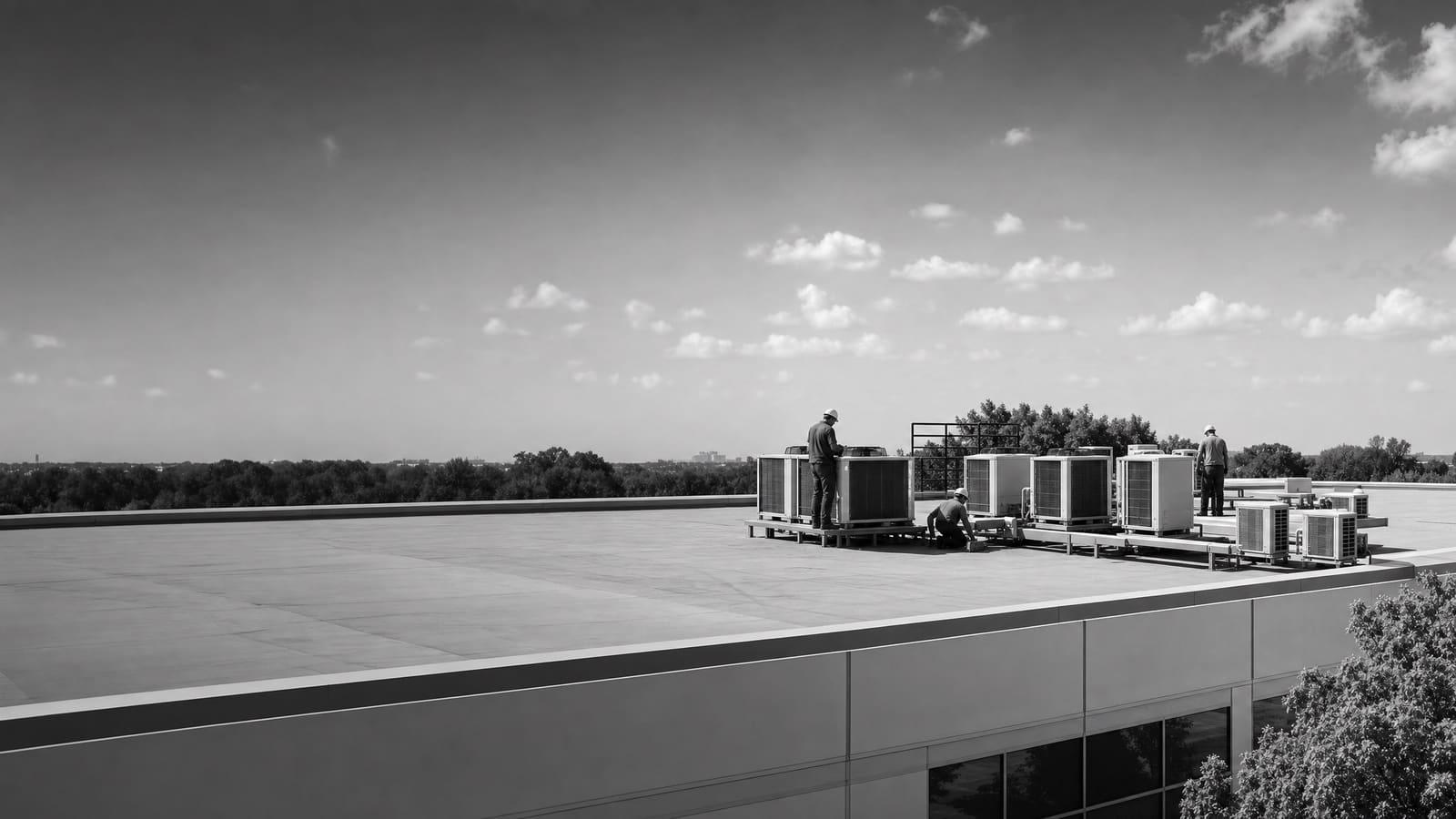
A commercial HVAC replacement means confirming the load the building carries today, selecting equipment against real lead times, setting the unit with a crane, tying in power, gas, and controls, then commissioning it so it performs to spec instead of just turning on. Replacement usually beats another repair once a unit is past roughly 15 years. Old, inefficient rooftop units waste an estimated $900 to $3,700 each per year in energy alone, before you count the service calls.
A site review still has to verify the curb and roof structure, the electrical capacity available at the roof, crane reach across your lot, and which code items the swap triggers.
THE THREE PATHS
Repair, swap, or upgrade
Three paths cover almost every commercial replacement decision, and the difference between them is runway. How many seasons does this unit realistically have left, and how long do you plan to hold the building?
The expensive answer is no answer at all. A unit gets run to failure, then replaced in August with whatever is on a truck that week. Federal guidance on rooftop replacement is direct about this: replacing an aging unit proactively usually beats replacement-on-failure, and it often beats a like-for-like swap at the end of service life, because the planned version lets you choose the equipment instead of accepting it. Units past about 15 years belong on a list now, not on a work order later.
WHAT MOVES THE NUMBER
The lines that decide a rooftop price
These are the lines that move a rooftop quote. Ask which ones are priced and which are allowances, because an allowance is a number that changes after the crane leaves.
BUYING GUIDANCE
Load first, then fuel, then efficiency
Start with the load the building carries now. A nameplate from 2004 records a decision someone made about a different tenant, different lighting, and different plug loads. Sizing from it repeats an old guess. A short load review against today's occupancy and hours is the cheapest step in the whole project, and it decides whether the new unit fixes the comfort complaints or inherits them.
Then settle fuel before you shop equipment. Rooftop units cool close to half of all commercial floor area in the country, and much of that fleet still heats with gas. Heat pump rooftop units do the same cooling and heat by reverse cycle, and their heating efficiency falls as outdoor temperatures drop. That is why the mild-winter West is where they cover most or all of the heating load without leaning hard on electric resistance, and Oakland sits in that range. The catch is infrastructure. An all-electric unit needs the electrical capacity to support it, and learning that after the order is placed is an expensive way to learn it.
Efficiency tier is the last lever. High-performance rooftop units were built to cut energy use by up to half against the older standard, which is the gap that turns an annual waste figure into a payback argument.
SCOPE CHECK
Simple swap or engineered project
Two projects can sit on the same roof and price nothing alike. What separates them is whether anything about the footprint, the fuel, or the access changes.
LOWER COMPLEXITY
Same curb, same fuel
Existing rooftop unit, comparable tonnage, matching footprint, heating fuel unchanged, and open lot access for the crane. Engineering is light, the permit path is simple, and the set lands in a morning.
HIGHER COMPLEXITY
New footprint or new fuel
Larger unit, structural work at the curb, a switch to all-electric heat that needs service capacity, or a tight site with nowhere to set the crane. Expect engineering, longer review, and phased work around your hours.
THE SITE REVIEW
What has to be verified before a real price exists
A site review for a rooftop replacement is mostly about things you cannot see from the ground, and four of them decide the price.
The curb comes first. Old units sit on curbs that rarely match a new footprint, so someone has to measure it and confirm the roof structure carries the new weight. Second is electrical: what capacity is actually available at the roof, what the panel has left, and whether a larger unit or an electric heating section forces a feeder upgrade. Third is access. Crane reach, setup space, which stalls close and for how long, and whether the lift can happen outside business hours. Fourth is the code items a replacement triggers, such as an economizer on a unit that never had one.
Refrigerant belongs on that list too. Federal rules govern how the existing charge is recovered and handled, so recovery is a scoped task performed by certified technicians and documented, not something a crew absorbs on the day.
What to have ready
A photo of the unit nameplate, your panel schedule or one-line, the roof access route, your real operating hours, and the last two years of service tickets. That packet usually turns a two-visit scoping process into one.
OAKLAND SPECIFICS
What Oakland changes about the schedule
Oakland's Planning and Building department runs an Online Permit Center with a rapid same-day digital path, and mechanical, electrical, and plumbing permits are part of it. That matters for sequencing. A clean like-for-like swap, where the tonnage and footprint stay put, can often move through that path quickly, so the crane date is driven by equipment lead time rather than by counter review.
Scope that grows behaves differently. Once the project adds structural work at the curb, a larger footprint, or a service upgrade to support electric heat, it stops being a simple mechanical filing. Ask which path your scope qualifies for before you book the lift, not after the equipment ships.
Ask this before you set a date
Have the contractor state in writing which permit path the scope qualifies for, who pulls it, and what would push it into a longer review. On a straightforward swap, that single answer moves the crane date more than anything else.
OWNERSHIP
Who pays and who lives with it
The same unit is a different purchase depending on who holds the energy bill and who occupies the space. Sort that out before you compare efficiency tiers, because the tier only pays for itself if the savings land on the party writing the check.
OWNER-OCCUPIED
You keep the savings
Every dollar of avoided energy use comes straight back to you, so a higher efficiency tier and a right-sized load review are easy to justify. You also control the shutdown window, which makes phasing simpler.
LEASED OR MULTI-TENANT
The savings and the cost split
If tenants pay utilities, the efficiency upgrade costs you and saves them unless the lease says otherwise. Check recovery language early, and plan the crane day and lot closures around tenant access rather than around your crew.
PLANNING AHEAD
Phasing a fleet instead of chasing failures
If you have more than one unit on the roof, treat this as a schedule rather than an event. Inventory age, tonnage, and service history for every unit, then rank them. The oldest units with the heaviest ticket history come first, because they are the ones carrying both the energy waste and the failure risk. Replacing two a year on your terms is almost always cheaper than replacing four in a single bad summer on the equipment's terms.
Standardizing helps more than most owners expect. Picking one platform across the roof shortens future lead times, simplifies spare parts, and means your service contractor is familiar with the controls on every unit rather than three different ones.
Not every unit needs to be replaced to improve. For units with real service life left, retrofitting advanced controls is a recognized alternative that captures part of the savings without a crane day. Use that as the bridge for the middle of your fleet while the worst units get replaced, and buy equipment ahead of the season you actually need it in.
COMPARING QUOTES
Five things a comparable quote shows
Two quotes are only comparable when both spell these out. If one leaves an item blank, it has not been priced, it has been deferred to you.
01
Equipment, spelled out
Model number, tonnage, efficiency tier, and heating type, plus what load basis the size came from.
02
A real lead time
A ship window for that specific unit, not a general range, so the crane date can be planned around it.
03
Curb, structure, and roofing
Curb adapter, any framing, and who patches and warranties the roof penetrations afterward.
04
The crane day scope
Rigging plan, lot closures, hours of work, and whether after-hours or weekend time is included or extra.
05
Permits, recovery, and commissioning
Who pulls permits, certified refrigerant recovery, startup, and the documentation handed over at close.
Get a defensible number
Price the equipment and the building together.
Send the address, operating target, and target opening date. Flux will identify what must be verified before the project can be priced.
Get a free estimateQuestions
Straight answers.
When is replacement better than one more repair?
Once a unit is past roughly 15 years, or when the failure is in the compressor or coil rather than a single component. Aging rooftop units waste an estimated $900 to $3,700 each per year in energy, so the repair keeps costing after it is paid for.
How much does a commercial HVAC replacement cost in Oakland?
It is priced per unit, and the drivers are tonnage, efficiency tier, curb and structural work, electrical capacity, and crane access. Any number quoted before someone measures the curb and checks the panel is a guess, not a price.
Should we replace like-for-like or resize?
Confirm the load either way. If the space and its use have not changed, like-for-like is often right. If occupancy, hours, or plug loads changed, right-sizing fixes complaints the old unit could never resolve.
Does a heat pump rooftop unit make sense here?
Heat pump rooftop units lose heating efficiency as temperatures drop, which is why the mild-winter West is where they cover most or all of the heating load. The deciding factor is usually electrical capacity at the roof, so check that first.
How long does the permit take?
Oakland offers a rapid same-day digital path through its Online Permit Center that covers mechanical, electrical, and plumbing permits. A straight swap often fits it. Added structural work or a service upgrade moves the project into a fuller review.
Sources used for this guide
- [1]betterbuildingssolutioncenter.energy.gov — DOE Advanced Rooftop Unit Replacement Guidance
- [2]betterbuildingssolutioncenter.energy.gov — DOE Commercial Heat Pump Rooftop Unit Replacement Guidance
- [3]betterbuildingssolutioncenter.energy.gov — DOE High-Efficiency Commercial Rooftop Unit Toolkit
- [4]energy.gov — DOE Efficient Commercial Rooftop Air Conditioner Program
- [5]epa.gov — EPA Stationary HVAC Refrigerant Management
- [6]oaklandca.gov — Rapid "Same-Day" Permits | City of Oakland, CA