THE SHORT VERSION
What a commercial HVAC replacement actually includes
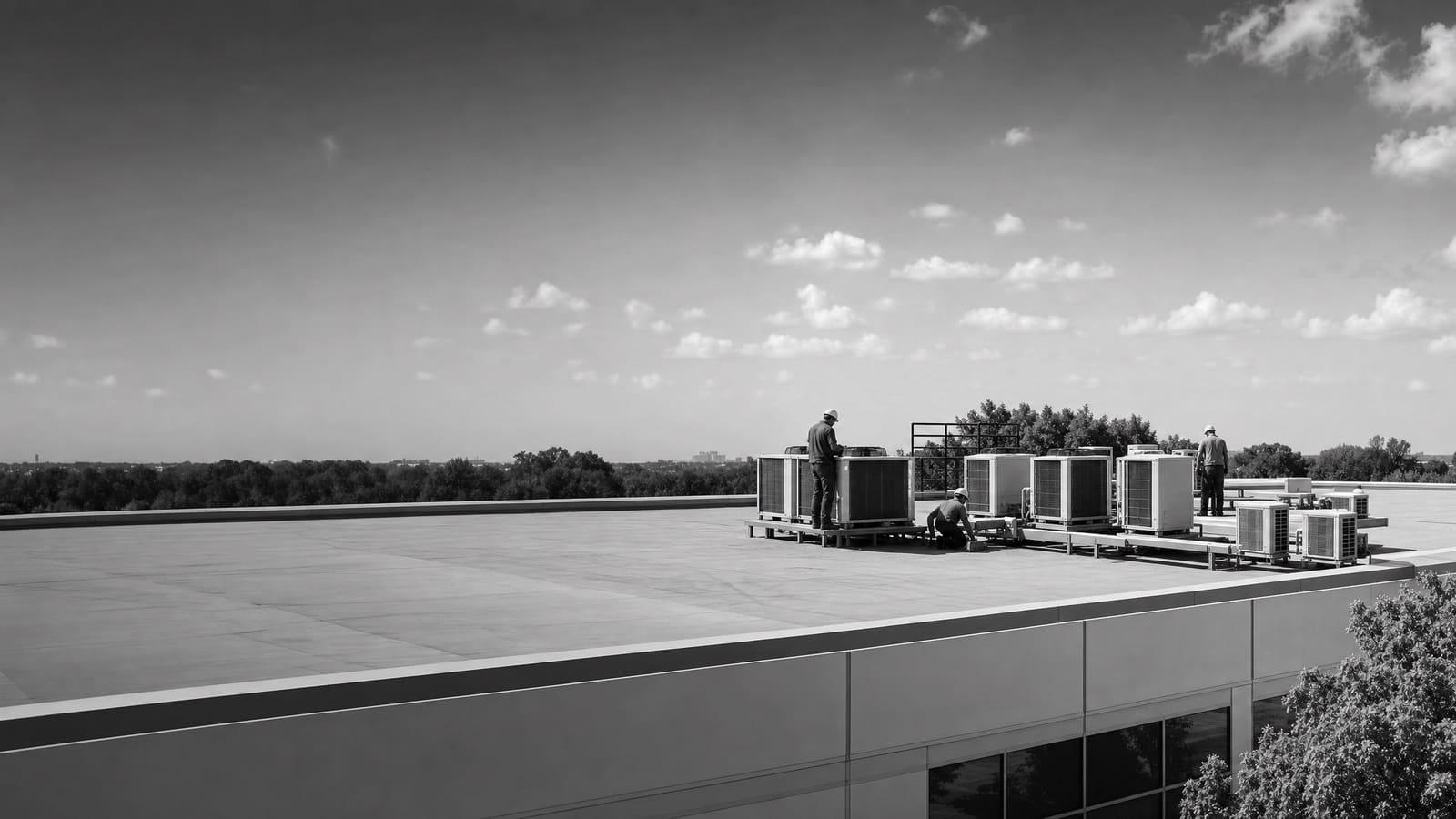
A commercial HVAC replacement covers the load calculation, equipment selection, refrigerant recovery and removal of the old unit, curb and structural work, rigging, any gas or electrical change, controls, permits, and commissioning. Replacement usually beats one more repair once a unit is past about fifteen years and the service calls, comfort complaints, and energy waste have all become predictable. An old, inefficient rooftop unit can waste $900 to $3,700 a year in energy on its own.
A site review has to confirm four things before that number means anything: the current load, the condition of the roof and curb, crane access, and whether the electrical service and gas line support the unit you want.
THE THREE PATHS
Which kind of unit to put back on the roof
Most replacements come down to three choices, and the right one depends on what the building's heating load actually looks like. A like-for-like gas-heat, electric-cool rooftop unit is the shortest schedule and the simplest permit, because the curb, gas line, and electrical service already fit. A high-efficiency unit of the same type costs more up front and returns it through the meter, which is a fair trade when the old equipment is well past fifteen years and the roof carries several of them. A heat pump rooftop unit is the third path, and it is the one that needs the most homework in a Northeast building. Reverse-cycle heating loses efficiency as the outdoor temperature drops, and in the coldest hours it trends toward the cost of plain electric resistance heat. That is exactly why dual-fuel and cold-climate models exist. Price the heat pump option, but price it against your electric rate, your gas rate, and the capacity of the service feeding the roof rather than against a national payback claim.
WHAT MOVES THE NUMBER
The lines that decide a replacement price
Tonnage and efficiency tier set the floor. Everything after that is site condition, and site condition is where two quotes for the same building stop matching. Ask for these priced as separate lines so you can see what you are paying for.
HOW TO BUY IT
Replace on your schedule, not the equipment's
Rooftop units cool close to half of all commercial floor area in the country, which means most buildings run their heating and cooling on equipment nobody thinks about until it stops. That is the pattern worth breaking. Facility managers usually wait until a unit can no longer hold the space, needs constant attention, or fails outright. Replacing proactively often beats both replacement-on-failure and a rushed like-for-like swap at the end of a unit's service life, because you get to choose the equipment instead of taking whatever is on a truck that week.
The practical version of that looks simple. Know which units are past fifteen years and what each one costs you in service calls and energy. Confirm the load against how the space is used today, not how it was used when the last unit went up. Then get equipment options with real availability attached, so the decision is schedule-aware from the first conversation rather than a surprise after you sign.
When a unit does fail in season, the same discipline still applies in compressed form. A nameplate photo, a look at the roof, and honest lead times will tell you whether the fastest path back to conditioning is the right unit or just the available one.
SCOPE CHECK
Simple swap or a real project
Two replacements on the same street can be different jobs. What separates them is rarely the unit itself — it is what the unit needs from the roof, the service, and the parking lot.
LOWER COMPLEXITY
Same fuel, same footprint
The new unit matches the curb, the gas and electrical connections already fit, the roof carries the weight, and the crane has clear reach from the lot. This is the one-morning swap, with permits and commissioning as the only fixed steps.
HIGHER COMPLEXITY
New size, new fuel, or tight access
Changing tonnage, moving to electric heating, or landing a heavier unit brings in curb adapters, structural review, and possible electrical service work. Tight access adds a larger crane, a longer closure, or a night lift, and each of those changes the number.
BEFORE THE QUOTE
What a site review has to answer
A price that arrives without anyone looking at the roof is a guess dressed up as a number. The review does not take long, but it has to close a specific set of questions. The first is load: what does the space need now, given current occupancy, plug loads, hours, and envelope, rather than what the nameplate said twenty years ago. Carrying an old sizing mistake forward is the most common way a replacement fails to fix the complaints that prompted it.
The second is infrastructure. Electrical capacity, physical constraints on the roof, and the gas line all decide which equipment is even a candidate. This matters most when an electric or dual-fuel option is on the table, because heating that used to come from gas now shows up as electrical demand.
The third is access and sequence: where the crane sets up, which stalls close, how long, and how that fits your operating hours. The fourth is what leaves the site. The old unit's refrigerant has to be recovered and handled under federal rules by qualified technicians, not vented. That work is routine, but it belongs on the quote rather than in a footnote.
Ask for the load calculation, not just the tonnage
If a proposal lists a size without showing where the size came from, ask. A current load calculation is the difference between a unit that solves the hot-corner complaint and one that repeats it for the next twenty years.
NORWALK SPECIFICS
Permits come before the crane
Connecticut builds from a statewide code, and permits are issued through the local building department. Under the mechanical code the state adopts, a permit is required to install, replace, alter, remove, or convert a mechanical system. The exemptions are narrow — things like a self-contained refrigeration system holding ten pounds or less of refrigerant, or equipment driven by motors of one horsepower or less — and none of them describe a packaged commercial rooftop unit. So plan on a mechanical permit for a Norwalk rooftop replacement, plus an electrical permit when the work touches the disconnect, feeder, or service.
The adopted code edition changes over time, so confirm the current one with the Norwalk building department before equipment is ordered. Your replacement is reviewed against today's requirements, not the ones the original unit was installed under, and that review can affect ventilation, controls, and what the installed configuration has to include.
Sequence the permit ahead of the rigging
Booking a crane before the permit is in hand is the most expensive avoidable mistake on a rooftop swap. A second mobilization costs more than the wait, and it usually lands on a worse weather day than the first one would have.
OWNERSHIP ANGLES
Two things that change the decision
Who pays and who lives with the result are not always the same party, and a fleet of units behaves differently than a single one. Both facts should shape the specification before anyone prices equipment, because they change what counts as the right answer. A building held for two more years and a building held for twenty do not buy the same unit, and a roof with one unit and a roof with eight do not follow the same replacement logic.
OWNER-OCCUPIED VS LEASED
Where the savings land
If tenants pay the utility bill, a higher-efficiency unit costs the owner more and pays the tenant back. That is workable, but it should be a deliberate decision tied to the lease structure rather than a surprise discovered after the invoice.
ONE UNIT VS A FLEET
Standardize while you can
On a roof with several units, holding to one manufacturer and a consistent efficiency tier simplifies parts, service, and controls. New equipment ships on newer low-GWP refrigerants, so a mixed fleet needs a service plan that accounts for both.
PLANNING AHEAD
Phasing, procurement, and what the unit costs over its life
Buildings with more than one rooftop unit rarely replace them all at once, and they usually should not. Phasing lets you spread capital across budget years, learn from the first installation before committing to the rest, and keep the roof from becoming a construction site during your busiest season. The useful order is by age and by consequence: the oldest units and the ones serving the spaces where a failure hurts most go first.
Procurement is the part that quietly controls the calendar. Equipment availability varies by model and configuration, so a decision made without lead times attached is not really a decision. Confirm availability at the same moment you confirm price, and get it in writing. If a unit's lead time does not fit the season you need it in, that is worth knowing before you commit, not after.
On lifetime cost, the purchase price is the smaller half of the story. A unit that runs inefficiently for fifteen or twenty years quietly outspends the premium you skipped at purchase — an old, poorly performing rooftop unit can burn thousands a year by itself. Weigh the first cost against the energy, the service history you expect, and how long you plan to hold the building, then buy the unit that wins on all three rather than the one that wins on the quote alone.
QUOTE CHECKLIST
Five things a comparable quote shows
If two proposals do not show these, you are not comparing them — you are guessing which one left something out. Ask for all five in writing before you sign anything.
01
Make, model, tonnage, and efficiency tier
Plus heating type and refrigerant, so two quotes can be read line against line.
02
Where the size came from
A current load calculation or the old nameplate. It should say which.
03
Lead time with a date
Written availability for that specific model, not a general range.
04
Rigging, access, and lot closure
Who books the crane, which stalls close, and for how long.
05
Permits, recovery, and commissioning
Named as included, with startup readings documented at handoff.
Get a defensible number
Price the equipment and the building together.
Send the address, operating target, and target opening date. Flux will identify what must be verified before the project can be priced.
Get a free estimateQuestions
Straight answers.
When does replacement beat one more repair?
Once a unit is past about fifteen years, the calculation usually shifts. Older rooftop units waste substantially more energy than current equipment, and an inefficient one can cost $900 to $3,700 a year in wasted energy alone. Add repeat service calls and comfort complaints the unit can no longer fix, and replacing on your schedule beats replacing on the equipment's.
Is a heat pump rooftop unit a good fit in Norwalk?
It can be, but it needs checking rather than assuming. Reverse-cycle heating loses efficiency as outdoor temperature drops and moves toward the cost of electric resistance heat in the coldest hours. That points toward dual-fuel or cold-climate models in a Northeast building, and it makes electrical service capacity part of the decision.
Do I need a permit to replace a rooftop unit in Norwalk?
Yes. The mechanical code Connecticut adopts requires a permit to install, replace, alter, remove, or convert a mechanical system, and the exemptions are limited to very small equipment. Expect a mechanical permit, plus an electrical permit if the work touches the disconnect, feeder, or service.
Should the new unit match the old one's size?
Only if the space and how it is used have not changed. Occupancy, equipment loads, hours, and envelope all shift over twenty years. A current load calculation either confirms the existing size or catches a mistake you would otherwise carry forward for the life of the new unit.
What happens to the refrigerant in the old unit?
It has to be recovered and handled under federal rules rather than vented, and that work belongs to qualified technicians. It is routine on any replacement, but confirm it appears on the quote along with removal and disposal of the old equipment.
Sources used for this guide
- [1]betterbuildingssolutioncenter.energy.gov — DOE Advanced Rooftop Unit Replacement Guidance
- [2]betterbuildingssolutioncenter.energy.gov — DOE Commercial Heat Pump Rooftop Unit Replacement Guidance
- [3]betterbuildingssolutioncenter.energy.gov — DOE High-Efficiency Commercial Rooftop Unit Toolkit
- [4]energy.gov — DOE Efficient Commercial Rooftop Air Conditioner Program
- [5]epa.gov — EPA Stationary HVAC Refrigerant Management
- [6]cga.ct.gov — Building Permit Requirements for Devices Installed in a Home