THE DIRECT ANSWER
What a commercial HVAC replacement actually includes
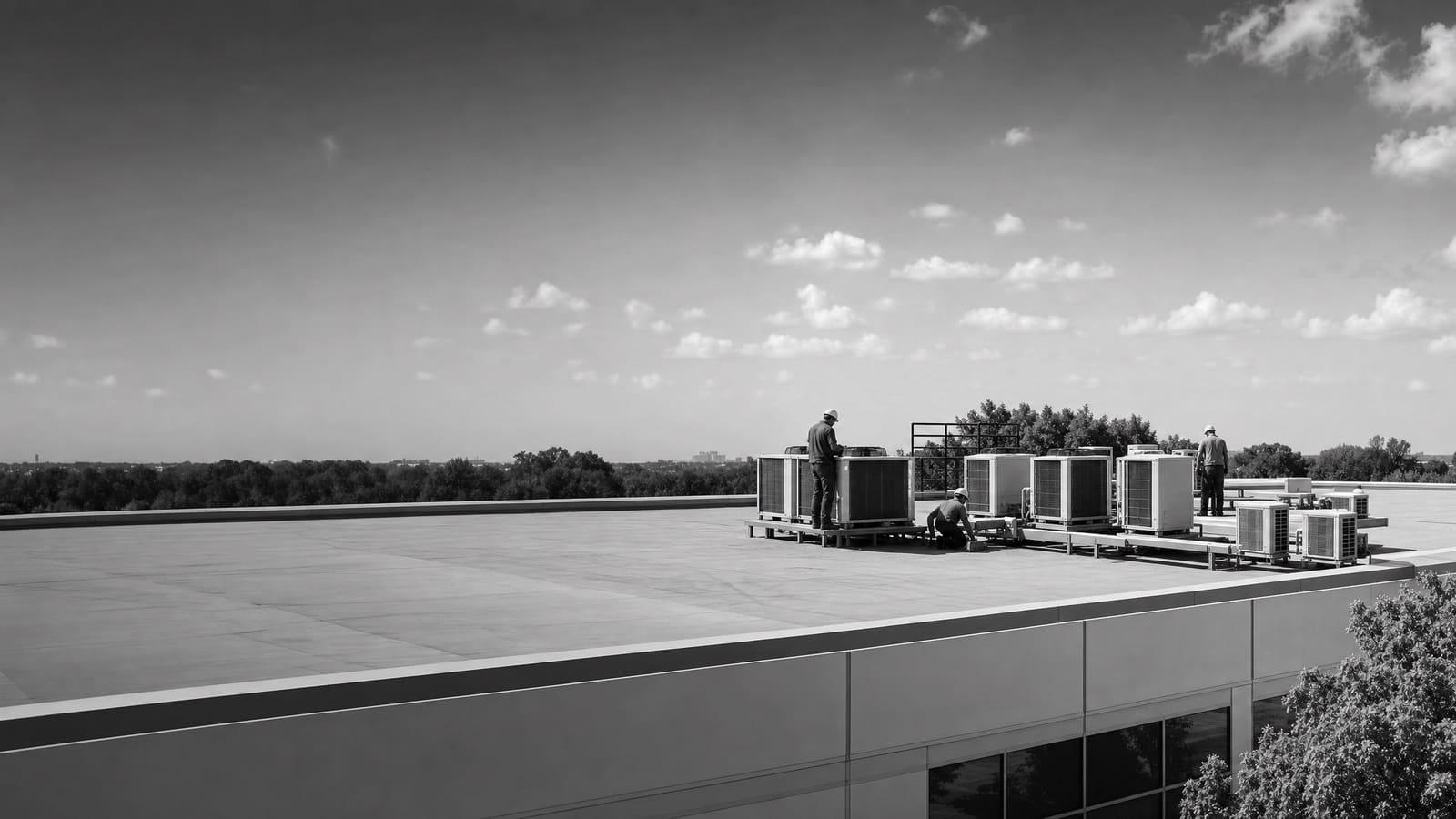
A commercial HVAC replacement is four things: a load check, an equipment decision, a crane set, and a commissioning report that proves the unit performs. Replacement usually beats another repair once the unit is past fifteen years, because an old, inefficient rooftop unit can waste $900 to $3,700 a year in energy by itself. Waiting for total failure removes your options and hands you whatever equipment happens to be on the shelf that week.
A site review has to confirm tonnage against how the space is used now, the curb and roof structure, crane reach across the lot, and whether the electrical service supports the unit you want.
THREE PATHS
The replacement decision, narrowed to three choices
Most replacements come down to three paths, and the right one depends on whether the building still uses its space the way it did when the old unit was picked. A like-for-like swap is the fastest route back to cooling and the cheapest to engineer, but it carries forward any sizing error already sitting on the roof. A right-sized high-efficiency unit costs more up front and requires a real load calculation, and it is where the operating savings live — the performance specification that reshaped this market was built around cutting unit energy use by up to half. An all-electric heat pump rooftop unit adds reverse-cycle heating and is a realistic option here: across most of the West, today's heat pump rooftop units can cover most or all of the winter heating demand. The catch is infrastructure — electrical capacity, physical space, and what happens to the existing gas line.
WHAT MOVES THE NUMBER
The lines that decide your installed price
Nobody can price your roof from a nameplate photo alone. These are the lines that move the installed number most, and the ones a quote should break out instead of burying inside a single lump sum.
BUYING GUIDANCE
Buy on a schedule, not on a failure
The most expensive version of this project is the one nobody planned. Facility managers routinely wait until a unit stops holding the space, needs constant service, or quits outright — and then buy under pressure. Replacing before failure is usually the better business move, and it is the only way you get to compare equipment instead of taking whatever is available.
Start with the load, not the nameplate. A unit picked fifteen or twenty years ago was sized for the occupancy, plug load, and envelope that building had then. Lighting changed. Headcount changed. Sometimes the tenant changed entirely. Sizing the replacement off the old data plate just repeats an old guess with new money.
Then decide what you are actually buying: capacity, or capacity plus performance. High-efficiency rooftop units exist because owners asked for them — the specification that drove them targeted cutting unit energy use by up to half against the old baseline, and more than twenty models now exceed it. On a unit that works through a Southern California cooling season, that gap shows up every month on the bill.
SCOPE CHECK
Which kind of replacement is yours?
Not every replacement carries the same risk. Before you compare bids, work out which side of this line your roof sits on. It explains most of the spread between the numbers you get back.
LOWER COMPLEXITY
Straight swap on a clear roof
Same tonnage, the existing curb fits, an open lot with room for the crane, adequate electrical service, and a space whose use has not changed. Permitting is routine and the on-site work is short and predictable.
HIGHER COMPLEXITY
Resize, convert, or a tight site
Larger tonnage, a new curb footprint, structural review, a switch to electric heating, shared or narrow parking, occupied tenants, or a roof already near end of life. Each of those adds schedule before it adds price.
THE SITE REVIEW
What a real walk of the roof settles
A real site review answers questions a photo cannot. Someone gets on the roof, reads the existing data plate, checks the curb dimensions and condition, and looks at what the deck is carrying. Inside, the review traces where the air actually goes and whether the ductwork matches the tonnage being proposed.
The electrical check matters most on conversions. A heat pump rooftop unit can require more capacity than the gas unit it replaces, and discovering that after the equipment is ordered is an expensive way to learn it. The same visit should settle physical constraints — clearances, roof space, service access — and what happens to the existing gas line.
Then there is access. Crane reach is a function of where the truck can set up, which makes it a parking-lot question. Somebody has to decide which stalls close, for how long, and whether the work happens before tenants open. That answer belongs in the proposal, not in a phone call the morning of the lift.
Ask for these four before you sign
A confirmed load calculation, curb and structural findings, available electrical capacity at the panel, and a written rigging and lot-closure plan. When one bid comes back materially cheaper than the others, one of those four is usually missing from it.
IN NORWALK
Permits, inspections, and the roof underneath
California building departments handle rooftop work as permit work, and their published permit lists run broader than owners expect. Mechanical, electrical, and plumbing upgrades or repairs are listed as permit-required — not only full equipment replacements — and re-roofing is listed separately, whether it is an overlay or a tear-off.
That drives one concrete decision here: if the roof under your unit is near the end of its life, sequence the two projects together. Setting a new unit on a curb you plan to disturb in eighteen months means paying for crane time twice and cutting into a new roof to do it. Confirm the exact permit set and inspection points with the City of Norwalk building division before the crane date is booked, because the inspection calendar, not the equipment, is often what fixes your final date.
Sequence the roof and the unit together
If re-roofing is coming within a few years, put it in the same window as the replacement. One crane mobilization, one set of lot closures, one curb detail done correctly, and one permitting cycle to manage instead of two.
OWNERSHIP AND OPERATIONS
Two things that decide how this looks a year later
Price is the easy part of this decision. What determines whether the project reads as a win twelve months on is quieter: who carries the cost against who collects the savings, and how the new unit fits the rest of the roof. Both are worth settling before anyone writes a specification, because both change what you should buy. A building with a single unit and a single occupant answers them in a sentence. A leased building with four units of different ages does not, and that is where most of the avoidable friction shows up later.
OWNED VS LEASED
Who pays, who benefits
In a leased building, the capital cost and the utility savings often sit with different parties. Settle that first — it decides whether a higher-efficiency unit is worth specifying and who signs the change order when the roof surprises everyone.
MIXED-AGE ROOFS
Refrigerant handling and service
Federal rules govern how refrigerant is handled and recycled when equipment is serviced or retired, so the old charge gets recovered properly rather than vented. A roof carrying units of several different ages needs one service plan that covers all of them.
OVER TIME
Phasing a roof instead of buying one unit at a time
If you have more than one unit up there, this stops being a purchase and becomes a program. Replacing on failure means every unit gets bought at the worst possible moment, alone, at whatever price and lead time the market offers that week. Replacing on a schedule means you set the order, you negotiate once, and you share the crane day.
Rank the roof by age and condition. Anything past fifteen years is a candidate, because those units waste real money every month they run and the waste compounds across a fleet. Decide how many you can fund per year, then work down the list and take the worst performers first.
Procurement follows the same logic. Ordering two or three units together usually improves both pricing and availability, and it lets you standardize on one platform so filters, belts, and controls are common across the roof. Large owners have run this play at scale — hundreds of organizations, tens of thousands of upgraded rooftop units, and tens of millions of dollars a year in combined energy savings. The math is identical on one building, just with fewer zeros.
BEFORE YOU SIGN
Five things a comparable quote has to show
Bids only compare when they show the same things. Ask every contractor to break out these five. Once they do, the cheap number usually explains itself.
01
The equipment, spelled out
Make, model, tonnage, efficiency tier, and heating type — not a line that says "new rooftop unit."
02
How the size was determined
Whether the tonnage came from a load calculation or from copying the old nameplate.
03
Curb, structure, and roof work
Curb adapter, any structural review, and how the roof gets patched and sealed afterward.
04
Rigging and lot plan
Crane size, staging location, which stalls close, and the hours the work happens.
05
Permits, inspections, commissioning
Who pulls permits, who meets the inspector, and what startup documentation you receive.
Get a defensible number
Price the equipment and the building together.
Send the address, operating target, and target opening date. Flux will identify what must be verified before the project can be priced.
Get a free estimateQuestions
Straight answers.
When does replacement beat one more repair?
Once the unit is past fifteen years and the repairs are repeating, replacement usually wins. Old, inefficient rooftop units can waste $900 to $3,700 a year in energy on their own, and that meter runs every month you keep patching. Proactive replacement also lets you compare equipment instead of buying whatever is available the day it fails.
Do I need a permit to replace a rooftop unit in Norwalk?
Plan on it. California building departments treat mechanical, electrical, and plumbing upgrades and repairs as permit work, and a rooftop replacement typically pulls more than one permit. Confirm the exact set and the inspection points with the City of Norwalk building division before the crane date is booked.
Is a heat pump rooftop unit realistic in Southern California?
Usually, yes. Heat pumps are most efficient in mild to moderate winters, and across most of the U.S. West today's heat pump rooftop units can handle most or all of the winter heating demand. The deciding factors are electrical capacity, roof space, and the gas line — not the climate.
What happens to the refrigerant in the old unit?
Federal rules govern how refrigerant is handled and recycled when equipment is serviced or retired, so the old charge is recovered by properly certified technicians rather than vented. Recovery and disposal should appear as a line on the quote instead of being assumed.
Should I replace like-for-like or resize?
Confirm the load either way. If the space and its use have not changed, like-for-like is often the right call and the simplest path. If occupancy, equipment, or the tenant changed, a right-sized unit fixes comfort complaints the old one was never able to solve.
Sources used for this guide
- [1]betterbuildingssolutioncenter.energy.gov — DOE Advanced Rooftop Unit Replacement Guidance
- [2]betterbuildingssolutioncenter.energy.gov — DOE Commercial Heat Pump Rooftop Unit Replacement Guidance
- [3]betterbuildingssolutioncenter.energy.gov — DOE High-Efficiency Commercial Rooftop Unit Toolkit
- [4]energy.gov — DOE Efficient Commercial Rooftop Air Conditioner Program
- [5]epa.gov — EPA Stationary HVAC Refrigerant Management
- [6]californiacity-ca.gov — HVAC Permits