THE DIRECT ANSWER
What a commercial HVAC replacement actually covers
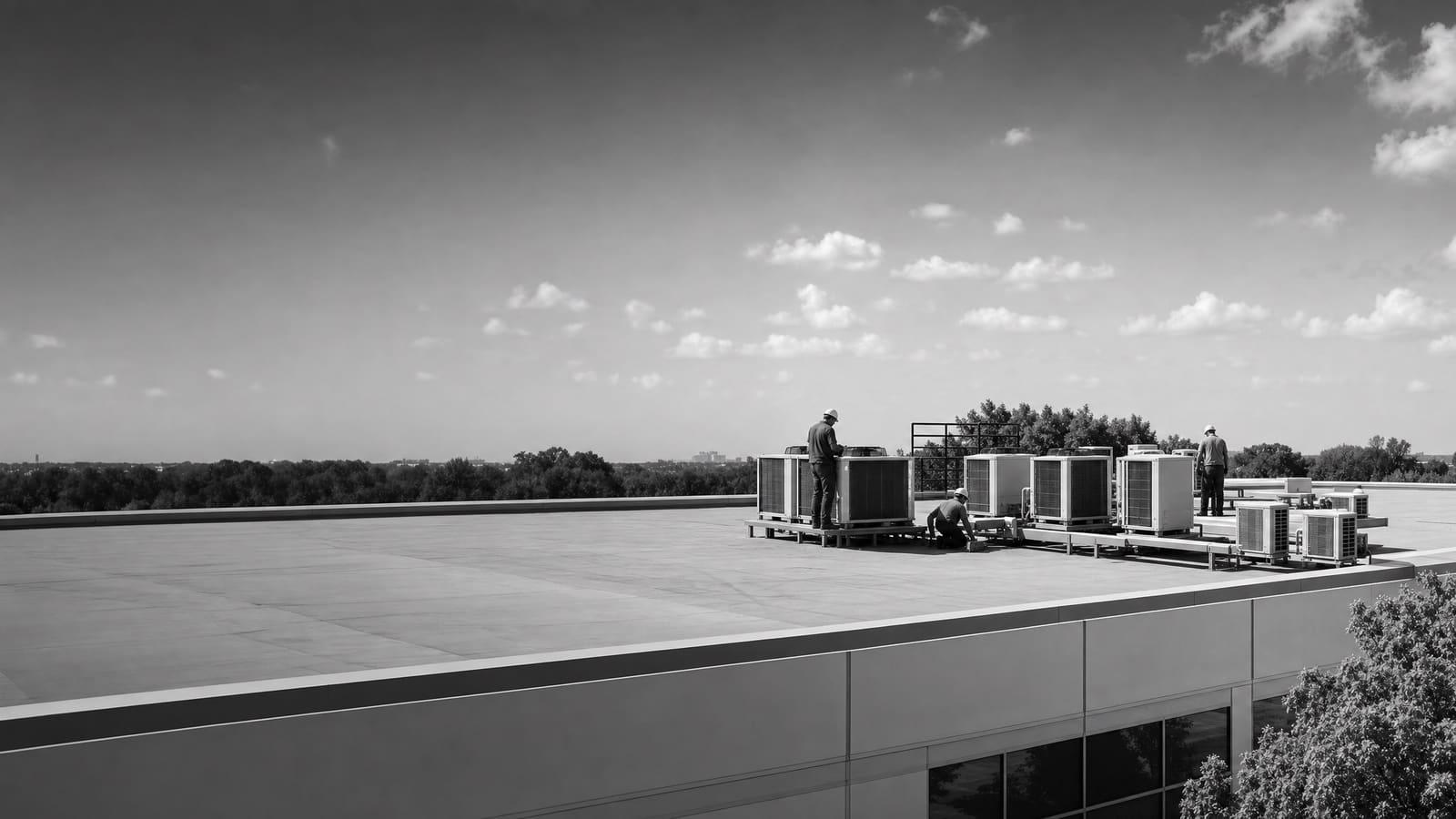
A commercial HVAC replacement covers load verification, equipment selection, rigging and set, connections, permitting, and commissioning — not just the unit itself. Replacement beats another repair once a rooftop unit is past fifteen years and the failures start stacking, because DOE estimates old, inefficient rooftop units waste roughly $900 to $3,700 per unit every year. A repair never recovers that.
A site review has to confirm the real load, the curb and roof structure, available electrical capacity, and crane access before any number on a quote means anything.
THREE PATHS
The three ways this project usually goes
Most commercial replacements come down to three paths, and the right one depends on how long you plan to hold the building.
The first is a like-for-like swap: same fuel, same curb, same connections. It is the fastest way back to conditioned space and the cheapest to engineer, but it carries forward whatever the old unit got wrong.
The second is a high-efficiency replacement in the same fuel type. DOE's rooftop unit challenge asked manufacturers for units that cut energy use by up to half against the old minimum standard, and more than twenty models now exceed that specification. On a building that runs long hours, that difference shows up every month.
The third is a heat pump rooftop unit, either all-electric or dual fuel. DOE's guidance is direct about the South: today's heat pump rooftop units are an appropriate solution and can cover most or all of the winter heating demand in this part of the country.
WHAT MOVES THE NUMBER
The lines that decide your price
No two roofs price the same, so treat these as the lines that actually move your number. Ask which ones the contractor verified on site and which are still assumptions.
HOW TO BUY IT
Decide before the unit decides for you
The most expensive version of this project is the one nobody planned. DOE puts it plainly: facility managers often wait until a rooftop unit no longer conditions the space, needs constant service, or fails outright — and replacing proactively is usually the better business move than replacing on failure, or even than a like-for-like swap at the end of a unit's service life. In a Florida cooling season, replace-on-failure also means paying whatever the market charges for whatever happens to be available.
Verify the load before you buy anything. The nameplate on a twenty-year-old unit records the assumptions of the building it was installed into: that occupancy, that lighting, that envelope, that tenant. If any of those changed, matching the nameplate just reinstalls the old comfort complaint at a new price.
Then take operating cost seriously. DOE estimates old, inefficient rooftop units waste between $900 and $3,700 per unit each year. Multiply that by the units on your roof and the years you plan to hold the building, and the gap between a minimum-efficiency unit and a high-efficiency one usually stops looking like a premium.
SIDE BY SIDE
Simple replacement versus complicated one
Not every replacement carries the same risk. Where your building sits on this line should tell you how much planning time to buy before the crane gets scheduled.
LOWER COMPLEXITY
Same fuel, same footprint
A packaged unit lands on the existing curb or a simple adapter. Fuel and connections stay the same, the load is unchanged, and the electrical service already carries the unit. Permit scope stays narrow and the set is one morning.
HIGHER COMPLEXITY
New fuel, bigger unit, tight roof
Tonnage grows, the footprint changes, or the unit goes all-electric. Now you are checking roof framing, panel capacity, gas lines, and crane reach at once. DOE treats each as its own go/no-go item, and any one can reset the schedule.
SCOPING IT
What a real site review should produce
A useful site review is not a walk-through with a phone camera. It should end with four things written down.
The first is the measured load, calculated from how the space is used today. The second is the physical picture of the roof: curb dimensions, structural condition, clearances, drainage, and where a crane can actually set up. The third is capacity — the electrical panel, the gas service if it stays, and whether what exists can carry what you are specifying. DOE lists electrical capacity, physical constraints, and gas lines as three separate infrastructure checks for exactly this reason, and any one of them can rule an option out before price enters the conversation.
The fourth is schedule: what is available, from whom, and when. Equipment availability is one of DOE's named considerations, not a footnote. A quote built around a unit nobody can ship is not a quote. Ask for what the review found in writing, including the parts that were assumed rather than verified.
Ask for the assumptions, not just the price
Every replacement quote contains assumptions — curb condition, panel capacity, crane placement, roof access. Ask which were verified on the roof and which were carried over from the old nameplate. That list is where change orders come from.
IN NORTH PORT
Florida wants sealed plans for this work
In Florida, a rooftop replacement is permitted as a commercial alteration, and the paperwork is heavier than the word "swap" suggests. Florida commercial alteration permit guidance calls for mechanical plans whenever the scope includes installing or relocating equipment such as HVAC, and those mechanical plans must be signed and sealed by a Florida licensed architect or engineer. Energy calculations are required when the scope includes heating, ventilation, or air conditioning, and the plans have to show the location of the equipment being installed or replaced.
For a North Port building, that means design time and a sealed drawing set belong on the schedule from day one, not after the unit is ordered. Confirm the exact submittal list with the building department that has jurisdiction over your address before you commit to an install date.
Budget the drawing set, not just the unit
A sealed mechanical plan set and energy calculations take real time to produce. On a planned replacement that is a scheduling item. On an emergency replacement it is the thing most likely to stretch a two-day job into a two-week one.
OWNERSHIP
Who pays, and who lives with it
Two questions decide more replacement projects than tonnage does: who pays for the unit, and who has to live with it afterward.
If the building is leased, the split between capital cost and operating savings matters. The owner buys the unit; the tenant usually pays the power bill. A high-efficiency or heat pump unit changes the tenant's monthly cost more than it changes the owner's balance sheet, so the case has to be made in whatever language the lease speaks.
If you hold more than one building, the second question is standardization. DOE's heat pump guidance is written for portfolio owners for a reason: contractor availability, equipment availability, and incentives vary site by site, so some buildings in a portfolio are ready for an electric option and others are not.
OWNED AND OCCUPIED
You keep the savings
When you occupy the building, the efficiency case is simple arithmetic. Utility savings land on your own bill for as long as you hold the property, and a longer hold justifies the higher tier.
LEASED OR MULTI-TENANT
The savings land elsewhere
When tenants pay the power, the operating gain is theirs and the capital cost is yours. Some owners settle that at renewal, some through recovery. Either way, decide it before comparing efficiency tiers.
OVER TIME
Phasing, procurement, and the number that repeats
If you have more than one aging unit on a roof, phasing beats waiting. Replacing them one at a time on a planned schedule keeps each project small, keeps the permit scope predictable, and lets you standardize on one equipment line instead of inheriting whichever unit happened to be available the week something died.
Procurement is where planned projects earn their advantage. When the replacement is scheduled, you can compare units, hold a price, and pick an install window that does not fall in your busiest month. When the replacement is an emergency, availability makes the decision for you.
The lifetime number is the one worth arguing about. Rooftop units condition close to half of all commercial floor space in this country, and DOE's framing is that a unit past fifteen years can waste a substantial amount of energy against a current model. Across DOE's Advanced RTU Campaign, more than 43,000 upgraded units returned a combined $37 million a year in energy savings. That is the scale of the gap between running old equipment and replacing it on purpose. You price the install once. You pay the operating cost every month until the next one.
THE QUOTE
Five things a comparable quote shows
A quote you can actually compare against another quote shows these five things. If any are missing, the difference between two prices is probably scope, not value.
01
The unit, named
Manufacturer, model, tonnage, efficiency tier, and heating type. Not "a comparable unit."
02
Real availability
The lead time for that specific unit, dated, so the install window means something.
03
Everything on the roof
Curb or adapter, structural work, refrigerant recovery, and removal of the old unit.
04
The crane day
Rigging, lot closure, staging, and tenant coordination — included or excluded, stated plainly.
05
Permits and commissioning
Sealed plans, energy calculations, inspections, startup, and documented airflow, charge, and control settings at handoff.
Get a defensible number
Price the equipment and the building together.
Send the address, operating target, and target opening date. Flux will identify what must be verified before the project can be priced.
Get a free estimateQuestions
Straight answers.
When does replacement beat another repair?
DOE's guidance is that waiting until a unit fails is usually the worst option. Once a rooftop unit is past fifteen years and needs frequent service, the annual energy waste alone — DOE estimates $900 to $3,700 per unit — tends to outrun what another repair buys you.
Does a heat pump rooftop unit make sense here?
DOE's heat pump guidance says today's heat pump rooftop units are an appropriate solution across most of the U.S. South and are capable of handling most or all winter heating demand. The gating questions are electrical capacity, physical constraints, and equipment availability at your specific site.
What does the permit process require?
Florida commercial alteration permitting calls for mechanical plans signed and sealed by a Florida licensed architect or engineer when the scope includes installing or relocating HVAC equipment, plus energy calculations and the equipment location shown on the plans. Confirm the full submittal list with your local building department.
Should I match the old unit's tonnage?
Only if the building still matches the assumptions behind that nameplate. Occupancy, lighting, equipment loads, and tenant use all change over twenty years. Confirm the load first, then decide whether like-for-like is the right answer.
What happens to the refrigerant in the old unit?
EPA regulations under Section 608 of the Clean Air Act govern how refrigerant is handled and recycled in stationary air-conditioning and heat pump equipment. Recovery is part of the removal scope, and it should appear on the quote rather than as a surprise line later.
Sources used for this guide
- [1]betterbuildingssolutioncenter.energy.gov — DOE Advanced Rooftop Unit Replacement Guidance
- [2]betterbuildingssolutioncenter.energy.gov — DOE Commercial Heat Pump Rooftop Unit Replacement Guidance
- [3]betterbuildingssolutioncenter.energy.gov — DOE High-Efficiency Commercial Rooftop Unit Toolkit
- [4]energy.gov — DOE Efficient Commercial Rooftop Air Conditioner Program
- [5]epa.gov — EPA Stationary HVAC Refrigerant Management
- [6]tampa.gov — Permit Application Guide Commercial Alteration