THE DIRECT ANSWER
What a commercial HVAC replacement actually covers
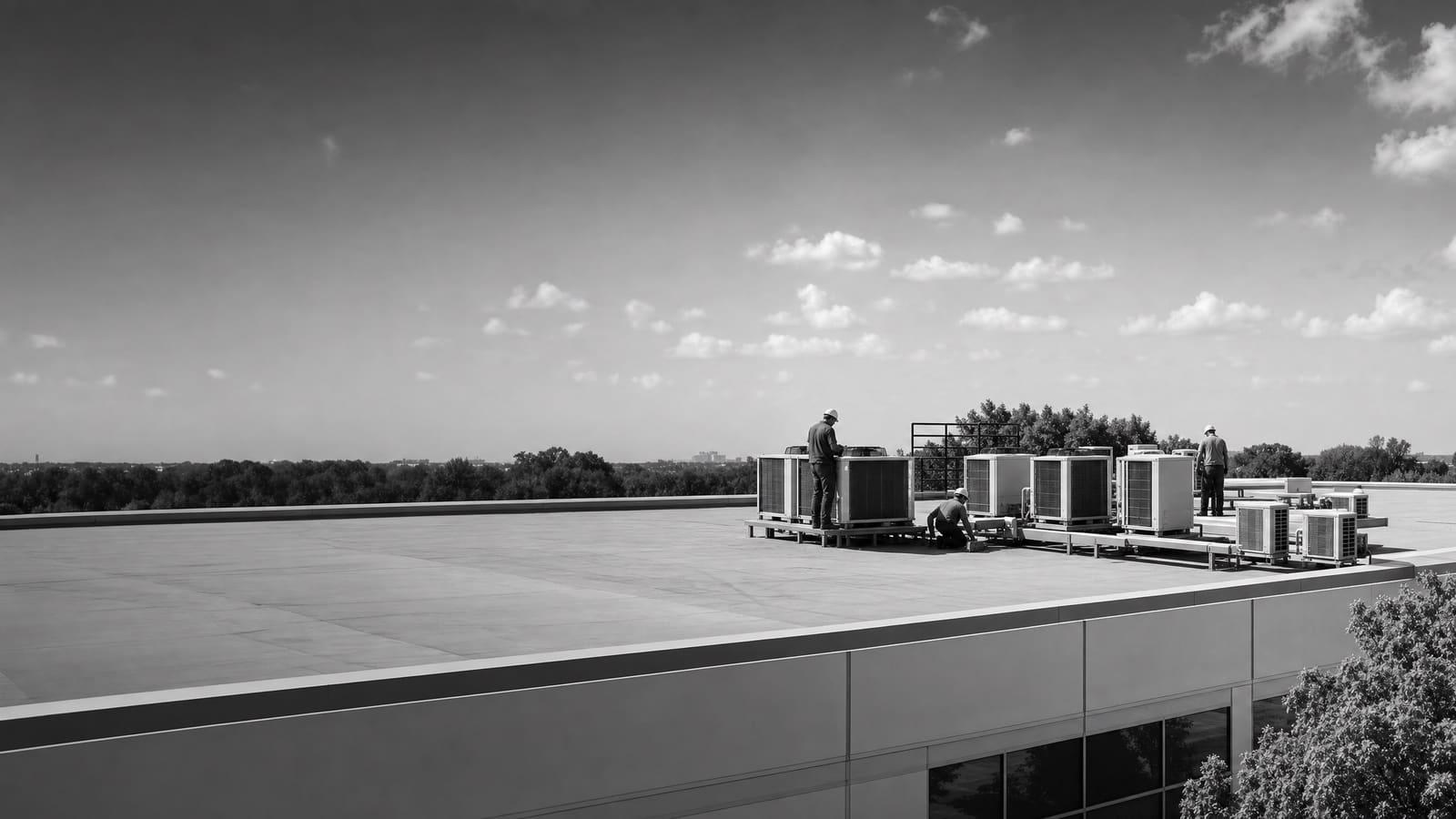
Commercial HVAC replacement means confirming the load the building carries today, selecting equipment you can actually get, setting it, reconnecting power, gas, and controls, then commissioning it before handoff. Replacement beats one more repair when the unit is past fifteen years, when service calls repeat, or when it no longer holds the space. An old, inefficient rooftop unit wastes roughly $900 to $3,700 a year in energy alone, which is often more than the repair invoice that keeps it limping.
A site review still has to confirm the real load, the curb and roof structure, available electrical capacity, and crane access. Those four decide whether a price on paper survives contact with the roof.
THREE PATHS
The replacement decision, narrowed to three choices
Most commercial replacements come down to three paths, and the right one depends on what the building does now rather than what the old nameplate assumed. Rooftop units condition close to half of all commercial floor space in the country, so this decision repeats across most portfolios.
Like-for-like keeps the same fuel and roughly the same capacity. It is the quickest way back to conditioned air and the cheapest to engineer, but it carries forward any sizing mistake the old unit had. A high-efficiency unit costs more up front and pays that back through the meter over its service life. A heat pump rooftop unit adds reverse-cycle heating and moves heating to the electric side, either fully or in a dual-fuel arrangement that keeps gas for the coldest hours.
Across most of the South, current heat pump rooftop units can handle most or all of the winter heating demand. The region still sees sharp cold snaps, which is an argument for dual fuel or a backup heat strategy, not an argument against electric heating.
WHAT MOVES THE NUMBER
The lines that decide the price
These are the items that move a rooftop replacement price. None of them are optional. They are just easy to leave off a thin quote and discover later. Ask for each one broken out so two bids compare on the same scope.
BUYING GUIDANCE
Planned replacement buys back your options
The cheapest commercial HVAC installation is the one you schedule. Facility managers usually wait until a unit stops holding the space, needs constant service calls, or quits entirely. Replacing proactively is frequently the better business decision than either replacing on failure or dropping in a like-for-like unit at the end of the old one's service life. A failure in August removes every option you had. You take what is in stock, at the price it is, on the day it can be craned.
Planning ahead buys back the three things that matter. You compare equipment on efficiency instead of availability. You get the load calculated from how the space is used now, which after a decade or two of tenant changes is rarely what the original design assumed. And you time the work around your operating schedule instead of around the weather.
There is also a middle path worth pricing. Where a unit still has real life left, adding advanced controls can capture part of the savings without a full replacement. Which option wins is a financial question more than a technical one. Run both against the unit's remaining life and its current energy waste before committing.
SIDE BY SIDE
Simple swap or real project
Two roofs carrying the same tonnage can price very differently. Complexity, not capacity, is usually what separates a straightforward swap from a project with a schedule.
LOWER COMPLEXITY
Straightforward swap
Same fuel and capacity, a curb that matches or takes a simple adapter, an open lot for the crane, existing electrical service with room to spare, and controls the new unit can join without a rework.
HIGHER COMPLEXITY
Where the scope grows
A capacity change that triggers structural review, a switch to electric heating that needs service capacity added, tight or shared parking that limits crane reach, occupied space that cannot lose conditioning, or a controls platform needing new integration.
SCOPING THE JOB
What a useful site review answers, in order
A good site review answers questions in a fixed order, because each answer can change the next one. Start with the load: how the space is used today, hours of operation, occupancy, and what equipment throws heat into it. That sets capacity. Capacity sets the physical footprint, which decides whether the existing curb works, needs an adapter, or triggers a structural look at the roof.
Then infrastructure. Electrical capacity is the constraint that most often decides whether an all-electric unit is even on the table, including panel space, service size, and what the rest of the building already draws. Gas lines matter in the other direction. If heating moves to electric, the gas at the unit gets removed or capped, and that is work someone has to price. Physical constraints round it out, including crane access and where equipment can actually land.
Last, availability. Equipment options are only real if they can be delivered inside your window, and the installing contractor needs crews who have set that equipment before. A better unit that arrives two months late is not the better unit.
Ask for the review before the price
Anyone can email a number from a nameplate photo. A number that survives the crane day comes from someone who has stood on the roof, opened the electrical panel, and measured the curb.
OKLAHOMA CONTEXT
The code your Norman replacement is inspected against
Oklahoma sets a statewide minimum for commercial mechanical construction, and it is the 2018 International Mechanical Code as amended by the state building code commission. That is the floor your rooftop replacement is designed and inspected against, whether the job is a like-for-like swap or a change of equipment type.
Two details matter while you scope. The state did not adopt the code's appendices as part of that minimum, but individual jurisdictions are allowed to adopt them on their own, so the local answer is not automatically the state answer. The state also amended the wind resistance provision to allow equipment exposed to wind to be designed and installed to recognized duct construction standards or other approved methods. On a roof in central Oklahoma, how the new unit and its exposed duct are anchored is a real line item, not boilerplate.
Confirm local adoption before design
Have your contractor confirm in writing which code edition and which appendices apply to the permit for your address, and how the wind resistance requirement is being met for both the unit and any exposed ductwork.
OWNERSHIP AND OPERATIONS
Two questions to settle before the unit is ordered
Two questions tend to surface after the unit is already set, and both are much cheaper to answer beforehand.
The first is who benefits. If you own and hold the building, the efficiency tier and the heating fuel decision are yours to make on lifetime cost. If the space is leased and the tenant pays the utility bill, first cost and the remaining lease term shape the decision more than payback math does. That is worth naming out loud during bidding rather than discovering at renewal.
The second is what happens to the rest of the roof. Most commercial buildings carry several units of similar age, and the decision made on the first one quietly sets the pattern for the next four.
OWNERSHIP
Who pays the running cost
The party buying the unit and the party paying to run it are often different. Decide which one the efficiency choice is being made for before equipment gets selected.
FLEET
The rest of the roof
Units of the same vintage fail on a similar timeline. Standardizing equipment and refrigerant as you replace simplifies parts, service contracts, and the next three projects.
PHASING AND LIFETIME COST
Treat a roof full of units as a program
If the roof carries several aging units, plan it as a program instead of a run of emergencies. Group them by age and condition, decide which get replaced, which get controls, and which get one more season, then spread the replacements across budget years. Coordinated upgrade programs have moved tens of thousands of commercial rooftop units this way, and the reason is procurement. Known scope, ordered ahead, set on planned days.
Lifetime cost is the number to compare, not the installed price. A unit that runs for well over a decade spends far more through the meter than it cost to buy, which is why an efficiency tier that looks expensive on the bid sheet can be the cheaper unit within a few years. Incentives can improve that math further, but programs change and vary by utility, so confirm what is actually available and when it closes before you order rather than after.
Refrigerant is the other long horizon. New equipment ships on current refrigerants, so a mixed roof means mixed parts and service planning for years. Standardizing as you replace keeps that manageable.
COMPARING QUOTES
Five things a comparable quote shows
Two bids only compare if they show the same things. Ask for these five in writing before you choose, and make the differences visible instead of assumed.
01
Equipment and capacity
Make, model, tonnage, efficiency tier, and heating type, tied to a current load calculation rather than the old nameplate.
02
Curb, structure, and rigging
Curb adapter, any roof structural work, the crane plan, and how long the parking lot is closed.
03
Utilities and controls
Electrical, gas, and refrigerant work at the unit, plus what it takes to integrate the controls.
04
Permits, code, and inspections
Which permits are pulled and by whom, which code edition applies, and which inspections are included in the price.
05
Lead time and commissioning
A real delivery window, plus startup with charge, airflow, and control settings verified and documented at handoff.
Get a defensible number
Price the equipment and the building together.
Send the address, operating target, and target opening date. Flux will identify what must be verified before the project can be priced.
Get a free estimateQuestions
Straight answers.
When does replacement beat another repair?
When the unit is past fifteen years, the service calls repeat, or it no longer holds the space. An old, inefficient rooftop unit wastes roughly $900 to $3,700 a year in energy alone, so the quiet cost of keeping it often exceeds the visible cost of replacing it.
Should the replacement be a heat pump?
Often worth pricing. Across most of the South, current heat pump rooftop units handle most or all of the winter heating demand. Confirm electrical capacity first, and consider dual fuel if you want gas heat held in reserve for the region's sharp cold snaps.
What code does a Norman replacement follow?
Oklahoma's statewide minimum for commercial mechanical construction is the 2018 International Mechanical Code as amended by the state building code commission. The appendices were not adopted at the state level, but a local jurisdiction may adopt them, so confirm the local answer before design.
What happens to the refrigerant in the old unit?
Federal rules govern how refrigerant in stationary air conditioning equipment is handled and recovered, so removal is certified work performed before the old unit leaves the roof. It should appear as a line on the quote, not as an assumption.
Can controls replace a full unit replacement?
Sometimes. Where a unit still has useful life left, retrofitting advanced controls can capture part of the savings for far less money. Compare both against the unit's remaining life and its current energy waste, and let the financial answer decide.
Sources used for this guide
- [1]betterbuildingssolutioncenter.energy.gov — DOE Advanced Rooftop Unit Replacement Guidance
- [2]betterbuildingssolutioncenter.energy.gov — DOE Commercial Heat Pump Rooftop Unit Replacement Guidance
- [3]betterbuildingssolutioncenter.energy.gov — DOE High-Efficiency Commercial Rooftop Unit Toolkit
- [4]energy.gov — DOE Efficient Commercial Rooftop Air Conditioner Program
- [5]epa.gov — EPA Stationary HVAC Refrigerant Management
- [6]oklahoma.gov — Oklahoma Uniform Building Code Commission - IMC 2018