THE SHORT ANSWER
What a commercial HVAC replacement actually covers
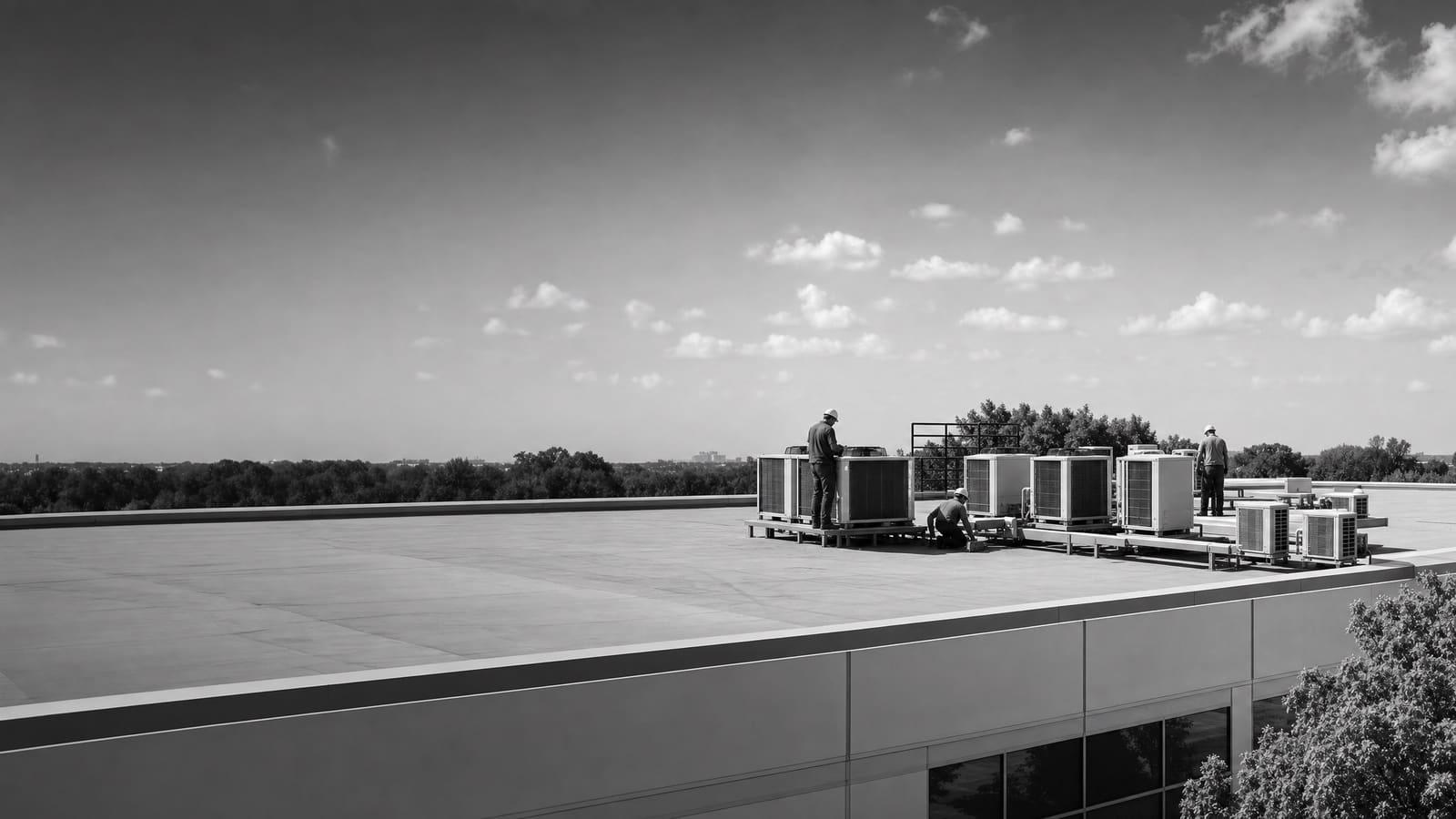
A commercial HVAC replacement covers load verification, equipment selection, rigging and set, gas, electrical and refrigerant connections, controls integration, permits, and commissioning. Replacement usually beats another repair once a unit passes fifteen years, since federal guidance puts the annual energy waste of an old, inefficient rooftop unit between $900 and $3,700 per unit. A tired unit keeps charging you in the months nothing breaks.
A site review still has to confirm curb condition, roof structure below it, electrical capacity, crane access, and how the space is used today. Those five items decide whether the swap is simple or engineered.
THREE WAYS TO GO
Replace on failure, replace like-for-like, or upgrade
Federal guidance is blunt about the default: most facility teams delay buying a new rooftop unit until the old one fails, needs constant service, or stops holding the space. That is usually the most expensive way to buy one. Replacing proactively often beats both replacement-on-failure and a plain like-for-like swap at end of service life, because you keep control of timing, specification, and any incentive paperwork.
The real choice is not between three products. It is between three levels of planning. Running to failure means taking whatever unit is on a truck that week. Like-for-like means you planned the timing but carried the old sizing forward. An upgrade means you spent an extra week confirming load and comparing equipment before anyone placed an order.
Most buildings end up with a mix, and that is fine. A unit over low-stakes storage can reasonably run out its life. The unit over the space that makes you money should not.
WHAT MOVES THE NUMBER
Where commercial HVAC installation budgets move
No two roofs price the same, and the equipment itself is often not the line that surprises people. These are the items that separate two bids on the same building. Ask each contractor to price them explicitly instead of folding them into one number.
IN PRACTICE
Choose the equipment before you choose the price
The equipment decision usually comes down to three paths: the same air-conditioning rooftop unit you already have, a higher-efficiency version of it, or a heat pump unit that also handles heating. Heat pump rooftop units are close mechanical cousins of standard AC units. The difference is that they can run the refrigerant cycle in reverse and make heat without burning gas.
Federal guidance is careful about where that swap makes sense. Heat pump heating efficiency falls as outdoor temperatures drop, and at the cold end it trends toward parity with plain electric resistance heat. That is why the guidance sorts equipment into three families: all-electric units, dual-fuel units that keep a gas backup for the coldest hours, and cold-climate units built to hold capacity further down the thermometer. Which family fits your building depends on your actual winter heating load, your electricity and gas rates, and what your electrical service can carry.
The same guidance flags a constraint that has nothing to do with efficiency: availability. Equipment supply and the number of nearby contractors who install a given technology confidently are real screening criteria. A specification nobody in the region stocks or services costs you time twice — once at order, once at the first service call.
TWO KINDS OF PROJECT
When a swap is simple and when it is engineered
Two buildings can order the same tonnage and end up a month apart on schedule. What separates them is rarely the unit itself. It is what the roof, the electrical room, and the parking lot allow.
LOWER COMPLEXITY
Straight replacement
Same fuel, same tonnage, an existing curb that is still sound, and electrical service that already carries the load. Clear crane reach from the lot. This is the planned one-day set: rig, land, connect, commission.
HIGHER COMPLEXITY
Engineered replacement
A fuel change, a larger footprint, added weight, new feeders, or a curb adapter that needs structural sign-off. Add a tight lot or occupied tenant space below and the work gets phased across nights or a weekend.
BEFORE ANYONE QUOTES
What the site review has to settle
A quote written from a nameplate photo is a starting point, not a price. The site review is where the real scope shows up, and it is short — usually an hour on the roof and a few minutes in the electrical room.
Five things get settled there. First, the load: how the space is used today, not what the original unit was sized for two decades ago. Occupancy, plug loads, lighting, and envelope work all move the number, and copying an old nameplate copies whatever mistake came with it. Second, the curb and the structure underneath it, since a different footprint or a heavier unit can pull structural review into the job. Third, electrical capacity, which decides whether an electric heating option is even on the table. Fourth, fuel and refrigerant routing — where the gas line runs, what gets reused, and what has to be recovered from the old unit. Fifth, access: crane reach, staging room, and how many stalls close for how long.
None of that is exotic. It is the difference between a firm installed number and a range that moves after the crane leaves.
Ask for the scope in writing
A trustworthy quote names the tonnage, the efficiency tier, the curb work, the permits, the crane day, and the commissioning steps as separate lines. When those are folded into a single number, you cannot compare two bids.
OWNING THE OUTCOME
Two things that outlive the install
Two decisions outlast install day. The first is who carries the capital cost and who collects the operating savings, which is a lease question more than an engineering one. The second is what your service coverage looks like once one unit on the roof runs a different refrigerant than the rest of the fleet.
Neither changes what the crane does. Both change what the next five years cost, and both can flip which efficiency tier is genuinely the cheaper choice for your building. Settle them before you sign the equipment order, not after the first invoice arrives.
WHO PAYS
Owner-occupied or leased
In an owner-occupied building, an efficiency upgrade pays you back directly. Under a triple-net lease, the owner writes the capital check while the tenant collects the utility savings. Saying that out loud usually changes the tier decision.
AFTER HANDOFF
Mixed fleets and refrigerant
New commercial equipment ships on newer low-GWP refrigerants, and recovery from the old unit is federally regulated work for certified technicians. Plan for a roof carrying two refrigerant types: parts, training, and service coverage.
PLANNING AHEAD
Phase a fleet instead of buying one emergency at a time
If your roof carries more than one unit, buy them as a fleet. Federal guidance is direct about this: rooftop units past fifteen years old waste substantial energy and money every year they stay in service compared with newer models. Multiply that annual waste by the number of tired units overhead and the case for a written replacement schedule makes itself.
A phased plan is simple. Rank the units by age, service history, and what happens to the business if that specific one quits. Replace the worst one or two this year, on your calendar, with equipment you actually chose. Put the rest on a replacement year and keep them maintained until then. Ordering two or three units together also improves your position on pricing and lead time compared with a single unit ordered under duress.
The opportunity is not theoretical. Through a federal campaign, more than 200 organizations upgraded over 43,000 rooftop units, and those upgrades saved a combined $37 million a year in energy costs. The high-efficiency specification DOE developed with manufacturers targets up to 50 percent less energy use than the prior standard, and more than twenty models now exceed it.
THE QUOTE CHECK
Five things a comparable quote shows
Two bids are only comparable when they show the same things. Ask for these five, itemized, on every quote you collect. If a contractor will not break them out, that is information too.
01
The equipment, named
Manufacturer, model, tonnage, efficiency tier, and heating type. Not "a 10-ton unit."
02
Lead time next to the price
The quoted availability date for that specific model, and what changes if it slips.
03
Curb, structure, and roof work
Adapter, framing, curb repair, and roofing patch priced as their own lines.
04
Rigging, permits, and inspections
Who pulls the mechanical and electrical permits, who books the crane, and who closes the lot for how long.
05
Commissioning and documentation
Startup, charge, airflow, and control settings verified against spec, with the report handed to you.
Get a defensible number
Price the equipment and the building together.
Send the address, operating target, and target opening date. Flux will identify what must be verified before the project can be priced.
Get a free estimateQuestions
Straight answers.
Is it worth replacing a rooftop unit before it fails?
Usually, yes. Federal guidance notes that units over fifteen years old waste substantial energy, and that proactive replacement with a more efficient unit often beats both replacement-on-failure and a plain like-for-like swap at end of life. Waiting for failure means taking whatever equipment is available that week, at whatever price, on whatever schedule.
Should we switch from gas heat to a heat pump rooftop unit?
It depends on your winter heating load, your electricity and gas rates, and your electrical capacity. Heat pump heating efficiency drops as it gets colder, so federal guidance splits the options into all-electric, dual-fuel with a gas backup, and cold-climate units. Have the site review price the electrical work before you decide.
How much does commercial HVAC installation cost?
There is no honest universal number, because tonnage, efficiency tier, curb and structural work, electrical capacity, and crane access all move it independently. Get each of those priced as a separate line on every bid. That is the only way two quotes become comparable.
What happens to the refrigerant in the old unit?
It has to be recovered and handled under federal Clean Air Act rules covering stationary refrigeration and air-conditioning equipment. That means certified technicians and documentation, not a shortcut on removal day. Confirm it is written into the scope.
Should we replace like-for-like or resize?
Confirm the load either way. If occupancy, equipment, lighting, or the envelope have changed since the last unit went in, the old nameplate is the wrong target and resizing fixes comfort complaints the old unit could never solve. If nothing changed, like-for-like is often the right call.
Sources used for this guide
- [1]betterbuildingssolutioncenter.energy.gov — DOE Advanced Rooftop Unit Replacement Guidance
- [2]betterbuildingssolutioncenter.energy.gov — DOE Commercial Heat Pump Rooftop Unit Replacement Guidance
- [3]betterbuildingssolutioncenter.energy.gov — DOE High-Efficiency Commercial Rooftop Unit Toolkit
- [4]energy.gov — DOE Efficient Commercial Rooftop Air Conditioner Program
- [5]epa.gov — EPA Stationary HVAC Refrigerant Management