THE SHORT ANSWER
What a commercial HVAC replacement actually covers
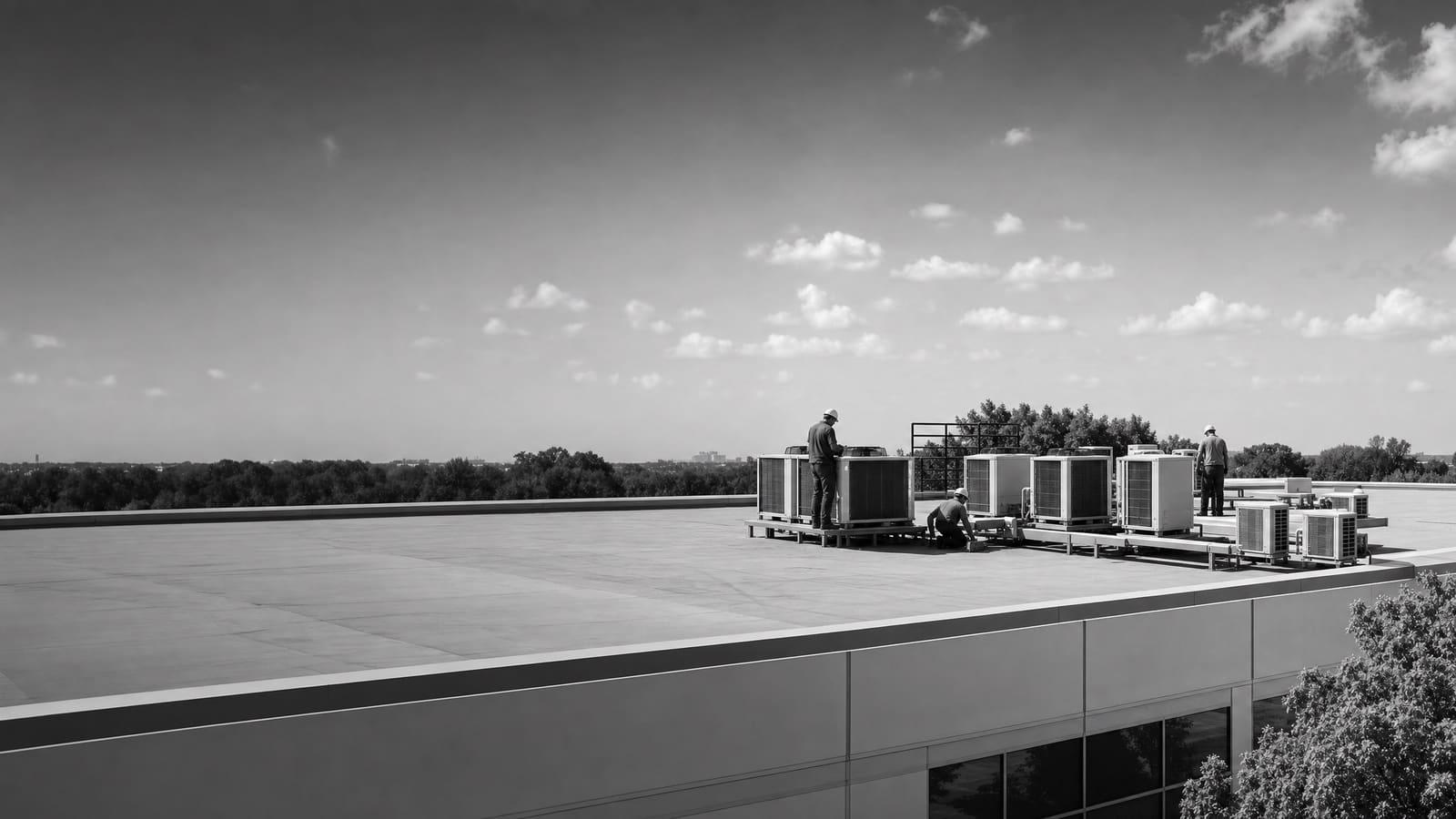
A commercial HVAC replacement covers confirming the load the building carries today, selecting equipment against real availability, recovering the refrigerant from the old unit, setting and connecting the new one, and commissioning it against spec. Replacement usually beats another repair once a unit is old enough to waste energy every hour it runs. DOE puts that line near fifteen years, and estimates old, inefficient rooftop units waste $900 to $3,700 per unit each year.
A site review still has to verify curb and structural condition, electrical capacity at the panel, gas line and refrigerant routing, and roof access for a crane before any of that becomes a price.
THREE WAYS FORWARD
Repair, replace like-for-like, or upgrade the equipment
Every failing rooftop unit gives you the same three options, and the honest answer depends on the unit's age and on what the building does now. DOE's framing for owners is blunt: waiting until a unit fails completely is usually the worst way to buy one. Replacement on failure means no time to compare equipment, no time to right-size, and no leverage on lead time. Whatever is available that week becomes your decision.
The middle path is real, though. DOE's campaign work found owners could either replace old units with efficient ones or retrofit the existing units with advanced controls, depending on which made better financial sense. A unit with a sound cabinet, a working compressor, and years of life left can often be improved without a crane.
The third path is worth studying before the unit dies rather than after. DOE's High-Performance Rooftop Unit Challenge asked manufacturers for equipment cutting energy use up to half against the standard in place at the time, and more than twenty models went on to exceed that specification. A gap that size only pays if you plan for it.
WHAT MOVES THE NUMBER
The lines that decide what your quote says
No one can price a rooftop replacement from a tonnage number alone. These are the lines that separate two quotes on the same building. Ask each bidder to show them separately, because a low total usually means one of them was left out rather than solved.
IN PRACTICE
Choosing between a gas unit and a heat pump
A rooftop heat pump is not exotic equipment. DOE describes heat pump rooftop units as technologically similar to air-conditioning rooftop units, with one addition: they run the cycle backward to heat. That is the whole difference at the equipment level, and it is why the decision is rarely about the box itself.
The decision is about everything around the box. DOE's adoption checklist asks about climate and heating load, electricity and gas prices at that meter, emissions goals, building type, equipment availability, electrical capacity, physical constraints, existing gas lines, and contractor familiarity with the technology. Any one of those can flip the answer for a single building while the rest of a portfolio goes the other way.
On climate, the guidance is favorable but not unconditional. Heat pump efficiency falls as outdoor temperature drops, trending toward parity with electric resistance heat at the bottom of the range. That makes these units best suited to mild-to-moderate winter heating, and DOE says today's models are fully capable of covering most or all winter heating demand across most of the U.S. South and West. The caveat sits in the same guidance: southern climates can still see sharp winter heating demand, and Texas is the example DOE uses. If you go all-electric, how the backup heat behaves and how often it runs is a design question to answer before the order goes in.
SCOPE CHECK
What keeps this simple and what makes it complicated
Two buildings with the same tonnage can produce very different projects. The difference is almost never the unit. It is what the old unit was sitting on, what feeds it, and what has to keep running while the work happens.
LOWER COMPLEXITY
Same use, same curb, same fuel
The space is used the way it was when the original unit went in, the replacement lands on an adapted curb, and the electrical and gas connections stay as they are. Access is open and the lift is a morning.
HIGHER COMPLEXITY
Changed load, changed fuel, tight access
Occupancy or equipment in the space changed, so the old nameplate is wrong. Or the unit moves from gas heat to electric, which pulls in panel capacity. Or the crane has one workable reach angle and the lot cannot close on a weekday.
BEFORE YOU BUY
What a real site review has to settle
The site review is where a rooftop replacement stops being a guess. It has three jobs, and a quote written without them is a placeholder.
The first is load. Sizing should come from how the space is used now, not from the nameplate on a unit specified fifteen or twenty years ago. Occupancy changes, plug loads change, and envelope work changes what the building actually needs. Carrying an old tonnage forward carries any old sizing mistake with it, which is exactly how a brand-new unit inherits the comfort complaints of the one it replaced.
The second is infrastructure. DOE splits this into electrical capacity, physical constraints, and gas lines, and that is the right split. Electrical capacity decides whether an all-electric option is a straightforward order or a service upgrade. Physical constraints decide whether the new footprint sits on the existing curb. Gas lines decide what gets abandoned, capped, or kept.
The third is the day itself. Crane reach, lot closure, tenant hours, and a weather call the day before are what turn the visible part of the project into a morning instead of a week. None of it is complicated. All of it has to be decided before the equipment is ordered, because the answers change what you should order.
Ask for the checklist, not just the price
A serious proposal should show the load basis, the curb and structural finding, the electrical capacity check, and the refrigerant recovery plan. If those four are missing, you are comparing guesses to guesses.
OWNERSHIP AND OPERATIONS
Two things that outlive the install
A rooftop unit is a long-horizon decision usually made in a week, under pressure. Two parts of it keep mattering long after the crane leaves.
The first is who benefits. Rooftop units condition close to half of all commercial floor space in the country, and DOE estimates old, inefficient ones waste $900 to $3,700 per unit each year. Those savings land on whoever pays the utility bill, which is not always whoever pays for the equipment. In a leased building, the lease language decides whether a high-efficiency unit is an investment or a gift.
The second is the fleet. If you run several units, the one you replace this year sets the pattern for the rest. DOE's Advanced RTU Campaign reported more than 200 organizations upgrading over 43,000 units, saving a combined $37 million a year, and results like that come from running a program rather than a series of emergencies.
WHO PAYS, WHO SAVES
Owner-occupied vs. leased
If you occupy the building, efficiency gains come straight back to you. If you lease it out, check whether the lease lets you recover equipment cost against a bill your tenant pays.
ONE UNIT OR A FLEET
Standardize before the next failure
Replacing units one emergency at a time leaves a mixed fleet with mixed parts and mixed refrigerants. Picking a standard now makes every later replacement faster to quote and simpler to service.
PLANNING AHEAD
Buying on your schedule instead of the equipment's
The most expensive version of this project is the one you did not plan. DOE's own framing is that facility managers often delay a new rooftop unit until the current one no longer conditions the space, needs frequent maintenance, or fails completely, and that replacing inefficient units proactively is frequently the better business move, compared both to replacement on failure and to a like-for-like swap at the end of service life.
That is worth reading twice, because it names two different mistakes. One is waiting. The other is replacing without thinking, which is what waiting forces you to do.
Planning changes what you are able to buy. It gives you time to compare efficiency tiers, to run the heat pump question honestly against your electric and gas rates, to check panel capacity before you need the answer, and to hold a lead time instead of taking whatever is on the truck. It also lets you schedule the lift when the lot is empty rather than mid-shift.
If you run more than one unit, the practical move is to rank them by age and condition, replace in that order, and keep the oldest one or two on a short leash so a failure does not become an unplanned purchase. Units past fifteen years are the ones DOE flags as wasting real money every year they run. Those are the ones to price now, while you still have a choice about what replaces them.
QUOTE CHECKLIST
Five things a comparable quote has to show
Two quotes are only comparable when both show the same five things. If one is missing a line the other includes, the cheaper number is usually the less complete one rather than the better deal. Ask for these in writing before you sign.
01
The load basis
Whether the tonnage came from a load calculation on today's use or from the old nameplate. The quote should say which.
02
Equipment, tier, and availability
Make, model, efficiency tier, and a real lead time printed next to the price rather than a promise to check later.
03
Curb, structural, and roof work
The adapter, any deck reinforcement, and who owns the roofing patch and the warranty that goes with it.
04
Rigging, permits, and inspections
Crane, lot closure, mechanical and electrical permits, and which inspections are carried inside the installed price.
05
Startup and commissioning
Charge, airflow, and control settings verified against spec and documented, plus refrigerant recovery from the old unit under EPA rules.
Get a defensible number
Price the equipment and the building together.
Send the address, operating target, and target opening date. Flux will identify what must be verified before the project can be priced.
Get a free estimateQuestions
Straight answers.
When is replacing better than one more repair?
Once a unit is past about fifteen years, DOE flags it as wasting substantial energy, and estimates old, inefficient rooftop units run $900 to $3,700 per unit a year in waste. At that age, another in-season repair mostly buys time on equipment that already costs you money every hour it runs.
Should I match the old unit or resize it?
Confirm the load either way. If the use of the space has not changed, a like-for-like replacement is often right. If occupancy, equipment, or the envelope changed, matching the old nameplate carries the old sizing mistake into a new unit.
Is a rooftop heat pump a reasonable option?
DOE describes heat pump rooftop units as technologically similar to standard units with reverse-cycle heating added, and says today's models can cover most or all winter heating demand across most of the South and West. The checks that decide it are electrical capacity, your gas and electric rates, and how backup heat handles a hard cold snap.
What does the crane day actually look like?
Cones go out, the old unit comes off, the new one lands on the curb, and connections are made. To tenants it reads as a parking inconvenience. Everything that keeps it short — rigging plan, curb adapter, structural check, weather call — happened weeks earlier.
What happens to the refrigerant in the old unit?
EPA Section 608 rules govern how refrigerant is handled and recycled in stationary air-conditioning and heat pump equipment. Recovery from the removed unit is a compliance step handled by certified technicians, and it should appear on your quote rather than after it.
Sources used for this guide
- [1]betterbuildingssolutioncenter.energy.gov — DOE Advanced Rooftop Unit Replacement Guidance
- [2]betterbuildingssolutioncenter.energy.gov — DOE Commercial Heat Pump Rooftop Unit Replacement Guidance
- [3]betterbuildingssolutioncenter.energy.gov — DOE High-Efficiency Commercial Rooftop Unit Toolkit
- [4]energy.gov — DOE Efficient Commercial Rooftop Air Conditioner Program
- [5]epa.gov — EPA Stationary HVAC Refrigerant Management