THE DIRECT ANSWER
What a commercial HVAC replacement actually includes
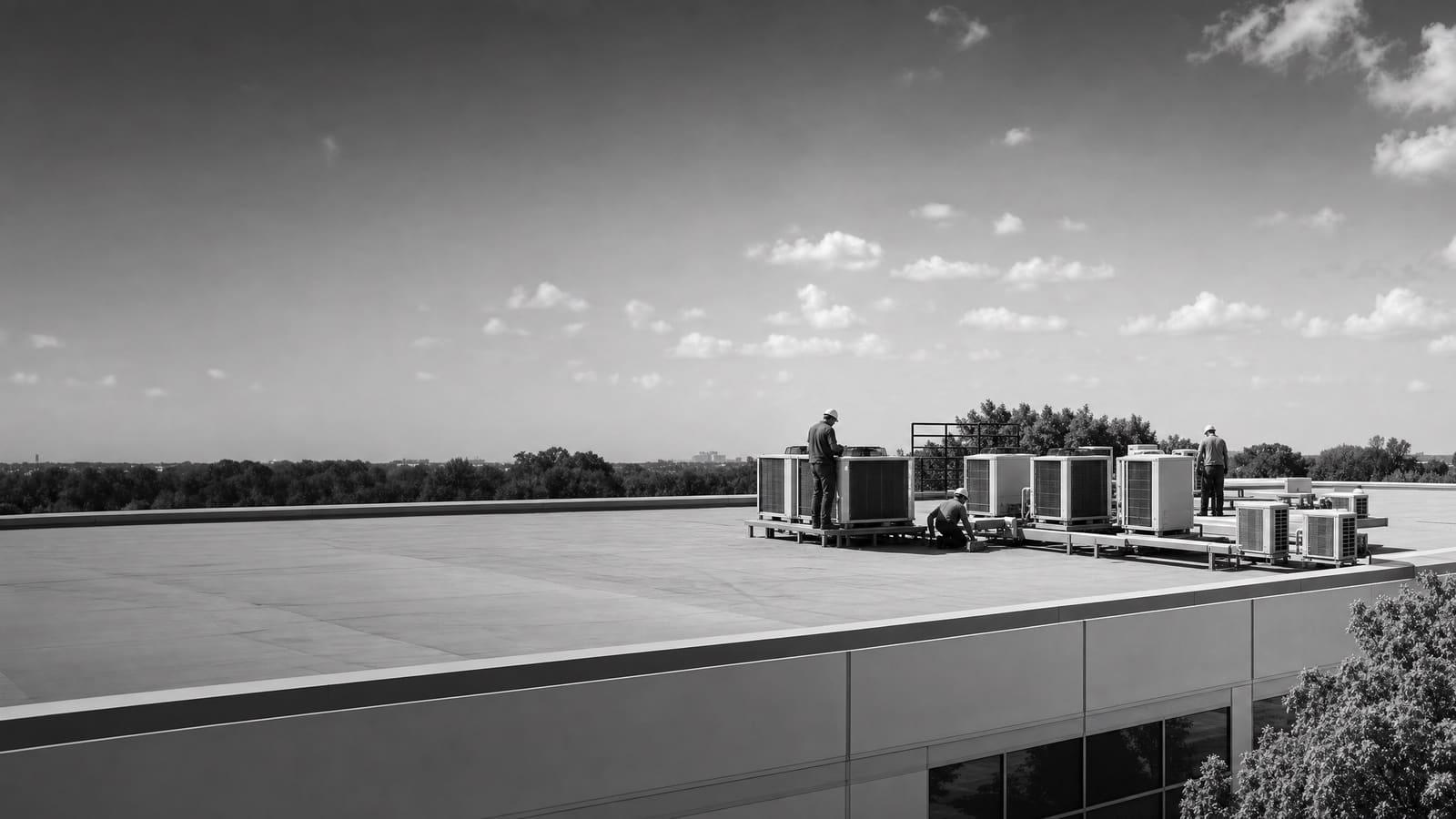
A commercial HVAC replacement covers load verification, equipment selection against real lead times, the curb work under the unit, utility and control connections, permits, rigging, and documented startup. Replacement beats another repair once a unit is past about fifteen years and failing often. DOE puts the annual energy waste of an old, inefficient rooftop unit between $900 and $3,700.
A site review still has to confirm tonnage against how the space is used now, the curb and the structure under it, spare electrical capacity, gas service, and crane access before any number is real.
THE THREE PATHS
Three ways commercial buildings handle a failing unit
Most owners are choosing among three paths, and the right one depends on what the building does now rather than what it did when the old unit landed.
Waiting for failure is the fourth path, and it is the expensive one. A unit that dies in August gets replaced with whatever is available that week, at whatever the freight and overtime cost. Planning the swap while the old unit still runs buys equipment choice, a scheduled crane day, and time to price more than one option.
There is also a middle path worth pricing: retrofitting an existing unit with advanced controls instead of replacing it. That makes sense when the cabinet and compressors are sound and the problem is how the unit runs, not what it is. Once the equipment itself is near end of life, controls alone stop paying, and the money is better spent on the replacement you were going to make anyway.
WHAT MOVES THE NUMBER
The six lines that decide installed price
Installed price on a commercial replacement comes down to about six line items. Ask for each one broken out, because the lines that vary most between bids are exactly the ones a thin proposal leaves out — and a missing line is not a discount.
HOW TO BUY IT
Choose the equipment before you argue about the price
Start with the load, not the nameplate. The tonnage on the old unit reflects the building the day it was installed, and that building has probably changed — different tenants, different hours, more plug load, new lighting, sometimes a new roof. A replacement sized off the old data plate carries forward whatever mistake was already there, and oversized equipment short-cycles, handles humidity poorly, and wears out sooner than it should.
Then price the efficiency tier as an operating decision rather than a spec preference. Rooftop units condition close to half of all commercial floor space in the country, and the annual waste from an old, inefficient one runs from roughly $900 to $3,700. Held across a normal service life, the gap between the base model and a high-efficiency one is usually smaller than the bill difference it prevents. Ask for both prices side by side instead of assuming the cheaper box wins.
Last, decide the fuel. A heat pump rooftop unit does cooling and heating from the same machine and comes in all-electric, dual-fuel, and cold-climate versions. Heat pump efficiency falls as outdoor temperature drops, so the honest test is what your building's winter heating actually demands, what your electrical service can carry, and what gas and electricity cost you today.
SIDE BY SIDE
Why two identical units price differently
Two replacements at the same tonnage can land far apart on price. What separates them is almost never the equipment itself. It is what the curb, the electrical panel, and the operating schedule demand around it once the old unit comes off the roof.
LOWER COMPLEXITY
A straight swap on a sound curb
Same tonnage and heating type, a curb the new footprint fits, open lot access for the crane, existing electrical service adequate as-is, and a space that can lose conditioning for one planned weekday window.
HIGHER COMPLEXITY
Anything that changes the building
Tonnage change, a curb adapter plus structural review, tight or shared parking, a panel with no spare capacity, gas line removal on an electric conversion, or a tenant who cannot go offline during business hours.
BEFORE THE QUOTE
What a site review has to answer
A quote that arrives without anyone looking at the roof is a guess with a number attached. The visit is short, but it has to answer specific things.
Start at the unit: make, model, tonnage, age, heating type, and the refrigerant currently in it. Then the curb, because new units rarely match old footprints — the reviewer is measuring for an adapter and looking at what the structure underneath can carry. Then the connections: the electrical panel and its spare capacity, the gas service if there is one, condensate routing, and how the unit will talk to whatever already controls the building.
Then the part that has nothing to do with mechanical work. Where does the crane set up, how much of the lot closes, and for how long? Which hours can the space go without conditioning? Who has to be notified — tenants, a property manager, anyone with a lease clause about parking?
Those answers are what turn a range into a price. They also set the schedule, which on most commercial replacements is the part that actually hurts when it goes wrong.
Do not skip the refrigerant question
Refrigerant in the old unit has to be recovered and handled under federal Clean Air Act rules, never vented. New equipment ships on newer low-GWP refrigerants, so a roof with mixed vintages needs a deliberate service and spare-parts plan rather than a surprise later.
OWNERSHIP MATH
Two questions that outrank the spec sheet
Two ownership questions change the answer more than any equipment comparison does.
The first is who benefits. If the owner buys the equipment and the tenant pays the utility bill, the cheapest unit tends to win by default, even when the efficient one is clearly better for the building. Look at how the lease handles capital recovery and operating pass-through before you assume the base model is the rational choice. In a building you occupy yourself, that tension disappears and the efficiency tier becomes a straightforward payback calculation.
The second is how many units you actually own. One rooftop unit is a purchase. Six units of similar age are a program, and they deserve to be budgeted, standardized, and sequenced like one — same manufacturer line where it makes sense, so parts, controls, and service knowledge carry across the whole roof instead of restarting with every replacement.
SPLIT INCENTIVE
Who pays for it versus who pays the bill
When capital and operating costs sit with different parties, the efficient unit loses arguments it should win. Read the lease before you price the equipment, not after the bid comes in.
FLEET TIMING
One unit or a roof full of them
Units bought at the same time tend to fail at the same time. Standardizing the replacement model line keeps parts, controls, and technician familiarity consistent instead of fragmenting across four brands.
PLANNING AHEAD
Phasing, lead times, and lifetime cost
Equipment availability is a scheduling input now, not a footnote. Ask for the quoted lead time on the exact model, in writing, and treat a bid that skips it as unfinished. If the building cannot absorb a summer outage, the decision to replace has to happen in the shoulder season, when the unit, the crane, and the electrician can all be booked for the same week.
If you own several units of similar vintage, plan them as a group. Replacing on failure, one at a time, gives up every advantage: you lose pricing leverage, you accumulate four different models and four parts inventories, and you pay whatever an emergency week costs. Rank by runtime and repair history rather than age alone, then move the worst one or two per budget year. DOE's rooftop campaign counted more than two hundred organizations replacing over 43,000 units, together saving about $37 million a year in energy costs — that kind of result comes from staged, planned work, not from emergencies.
Ask about incentives before you order rather than after. Program eligibility can turn on when the application was filed and which efficiency tier ends up on the invoice, so that question belongs in the scoping conversation.
COMPARING BIDS
Five things a comparable quote shows
Two bids are only comparable when both show the same five things. If one is missing a line the other includes, it is not the cheaper bid — it is the incomplete one. Ask for these in writing before you compare totals.
01
The equipment, spelled out
Make, model, tonnage, heating type, efficiency rating, and refrigerant.
02
Availability, not just price
Quoted lead time for that exact model, and what happens if it slips.
03
Curb and roof scope
Adapter or new curb, roof patching, and who signs off on structure.
04
Rigging and site plan
Crane size, lot closure hours, and the date the space loses conditioning.
05
Permits, startup, and warranty
Who pulls them, what startup is documented, and what the labor warranty covers.
Get a defensible number
Price the equipment and the building together.
Send the address, operating target, and target opening date. Flux will identify what must be verified before the project can be priced.
Get a free estimateQuestions
Straight answers.
When is replacement better than one more repair?
Once a unit is past about fifteen years, needs frequent service, and no longer holds the space, another repair is usually buying months. Old, inefficient rooftop units waste roughly $900 to $3,700 a year each, so the repair bill is only part of what you are paying. Replacing before failure also keeps you in control of equipment choice and scheduling.
Should we right-size or match the old unit?
Confirm the load either way. If occupancy, hours, lighting, and equipment loads are close to what they were when the old unit went in, a like-for-like swap is often correct and it is the fastest path back to conditioning. If the space changed use, added tenants, or generates comfort complaints the old unit never solved, right-sizing fixes the underlying problem instead of repeating it.
Is a heat pump rooftop unit the right call for us?
It depends on your winter heating load, your electrical capacity, and what gas and electricity cost your building. Heat pump efficiency drops as outdoor temperatures fall, which is why dual-fuel and cold-climate versions exist. The scoping questions that matter are panel capacity, physical constraints on the roof, existing gas lines, equipment availability, and whether any incentive applies.
What usually causes change orders on these projects?
Three things: a curb that does not match the new unit's footprint, an electrical panel with no spare capacity, and crane access that turns out to be tighter than assumed. All three are visible during a site review. A bid produced without one is where surprises come from, not the equipment itself.
What happens to the refrigerant in the old unit?
It has to be recovered and handled under federal Clean Air Act rules rather than vented, and that work belongs in the installed price. Worth noting for planning: new commercial equipment ships on newer low-GWP refrigerants, so a roof carrying units of different vintages should have a deliberate service and spare-parts plan.
Sources used for this guide
- [1]betterbuildingssolutioncenter.energy.gov — DOE Advanced Rooftop Unit Replacement Guidance
- [2]betterbuildingssolutioncenter.energy.gov — DOE Commercial Heat Pump Rooftop Unit Replacement Guidance
- [3]betterbuildingssolutioncenter.energy.gov — DOE High-Efficiency Commercial Rooftop Unit Toolkit
- [4]energy.gov — DOE Efficient Commercial Rooftop Air Conditioner Program
- [5]epa.gov — EPA Stationary HVAC Refrigerant Management